
My Take: Cursor is the third best coding agent right now, and the gap is going to widen. Claude Code owns the terminal-first developer. Codex owns the OS-level agent frontier after the April 17 Computer Use release. Cursor’s wedge, “the best AI-in-IDE experience”, has been out-innovated on both sides of the IDE in six weeks. The mainstream take, that Cursor is still the leader because of its IDE-native polish, is wrong. Polish was the moat when the fight was inside the IDE. The fight moved.
I have been running Cursor since the early Sonnet 3.5 days, and I have been running Claude Code daily since late 2025. Until about three months ago, the Cursor workflow felt meaningfully better for most tasks. That is no longer true, and the crowd has not caught up with the reality.
The short version is this. Cursor is not losing on product quality. It is losing on category. The other two agents stepped outside the IDE, and that leaves Cursor defending territory the fight has already left.

The Mainstream View and Why It Falls Short
The mainstream view is that Cursor is still the dominant AI IDE because it has the best chat UX, the tightest inline completions, and the largest enterprise footprint.
Recent TechCrunch coverage of Cursor’s funding round doubled down on this framing, describing the company as the category-defining leader of AI-native development.
The argument is reasonable on the surface. Cursor does have the smoothest inline experience. It does have the largest installed base among professional developers. It does have the biggest funding cushion.
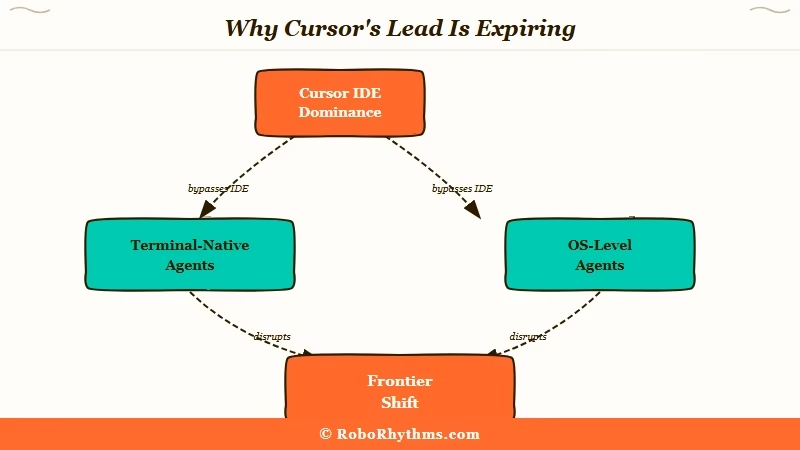
Where it falls apart is the premise. “AI IDE” was the category worth winning in 2025, when the frontier was agent chat tightly stitched into a familiar editor. It is not the category worth winning in 2026.
The frontier moved to two ends Cursor does not currently occupy. On one end, terminal-native agents that operate directly on repos without the IDE as a middleman. On the other end, OS-level agents that step beyond the code entirely and drive the whole machine. Cursor is stuck defending the middle, and the middle is no longer the battleground.
What Is Really Happening in the Coding Agent Market
The shape of the competition shifted in April 2026, and Cursor did not move with it. Two releases in two days reframed what a coding agent is.
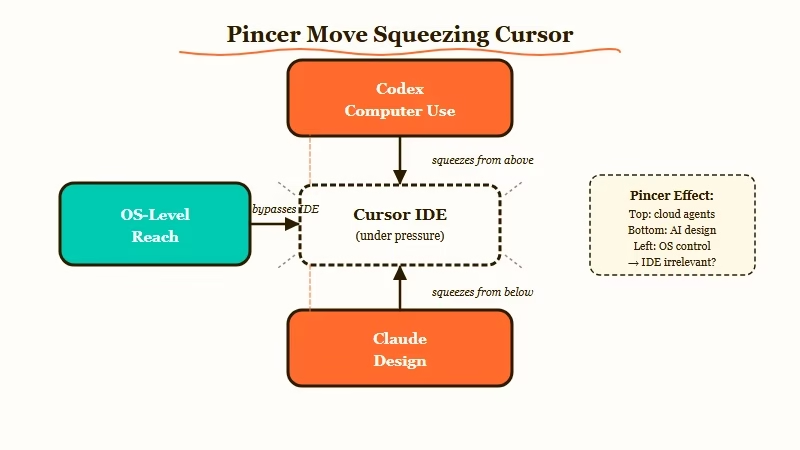
On April 17, OpenAI shipped the Codex Computer Use update that lets Codex drive macOS apps in the background, open simulators, poke at design tools, click through test harnesses. That is not an IDE feature. That is an OS feature.
One day before, Anthropic shipped Claude Design, a text-to-visuals tool that eats slide decks, prototypes, and marketing one-pagers, the workflow surrounding code, not the code itself. Paired with Claude Code’s continued dominance in terminal-first engineering workflows, that is a two-sided pincer on Cursor.
The way I see it, Cursor now faces a brutal decision. Either invest heavily in OS-level reach to match Codex, which is expensive and outside their core competency, or retreat to a tighter IDE-native story, which cedes the aspirational ceiling of the category. Neither path is a clean win.
What this tells me, Cursor’s funding round at a nine-billion valuation was priced on the assumption that “AI IDE” would remain the dominant category shape. It will not.
The Part Nobody Wants to Admit
The uncomfortable implication of Cursor being in third place is that a lot of professional developers are paying for the wrong tool and do not know it yet.
From what I have seen in my own work and in the engineering communities I follow, the switching friction is real but beatable.
Most Cursor users are still on it because the defaults feel good, not because they have tested the alternatives recently. That is fine when you are the clear category winner. It is not fine when two free-tier or subscription-included alternatives now do more.
I would argue the honest framing is this, Cursor is the most polished agent in the IDE category, and the IDE category is getting commoditised from both sides. That is a rough place to sit at a nine-billion valuation. The investor memo reads differently today than it did in February.
For developers already paying for Claude Pro or Max, Claude Code is included. For developers already paying for ChatGPT Plus, Codex is included. Cursor is a separate twenty-a-month subscription on top of one of those, and the increment is harder to justify every week.
Hot Take
Cursor becomes an acquisition target in the next six months, and the acquirer will be Microsoft or Google, not Anthropic or OpenAI. The strategic fit with GitHub is obvious, the VS Code fork is a natural absorb, and the enterprise footprint is a cleaner asset than the product positioning.
This is not a prediction I enjoy making. Cursor built something genuinely great. The problem is that “genuinely great at a category that is getting eaten” is the exact profile that gets acquired rather than scaled to an IPO. Watch the next two earnings cycles at Microsoft. The signal will be there.
What I Would Do If I Were Running Cursor Today
The only move I can see that preserves long-term optionality is an aggressive pivot to the enterprise compliance layer, positioning Cursor as the IDE that enterprise buyers pick for governance reasons, not agent reasons.
Let Claude Code own the individual developer. Let Codex own the OS-level agent. Own the audit trail.
This is a concession, not a victory condition. But it is a coherent one. A coherent concession is worth more than an incoherent defence of lost territory.
If I were a Cursor product lead reading this, I would be pushing internally for three things. One, a visible roadmap for OS-level capability that at least signals intent to fight Codex.
Two, a tighter integration story with enterprise identity and compliance tooling, the stuff that makes CISOs comfortable. Three, a free tier that bleeds developers back from the included-with-subscription agents, because the pricing wedge is the biggest immediate threat.
For individual developers watching this play out, my honest recommendation is to audit your toolchain this week. If you are paying for Cursor and already paying for Claude Pro, cancel one.
If you are paying for Cursor and ChatGPT Plus, cancel one. If you are not paying for any of them, start with Claude Code because it has the lowest floor and the highest ceiling for most professional engineering work today.
The race is not over. But it is not the race Cursor was winning last year.
