
Bottom Line: Copy AI is worth it for content teams and marketers producing branded material at scale. For solo creators and budget-conscious users, the 2024 GTM pivot raised prices and added complexity that most people do not need. This review covers what changed, current pricing, and who should still pay for it in 2026.
Copy.ai used to be the tool every solo creator started with. A decent free plan, a clean interface, and one job: write marketing copy faster. Millions of people signed up, wrote product descriptions, email subject lines, and Instagram captions, and called it a win.
Then in 2024, Copy.ai pivoted hard. The company repositioned as a “Go-to-Market AI Platform,” added enterprise-grade workflow automation, dropped the original free tier, and raised prices. The product that made Copy.ai famous effectively stopped existing.
What replaced it is genuinely useful for teams. For solo users, the picture is more complicated. I’ve tested the 2026 version thoroughly to figure out which side of that line you fall on.

What Copy AI Is in 2026
Copy AI is a GTM (Go-to-Market) AI platform combining an AI chat interface, 90+ content templates, and automated workflows for marketing and sales teams. This is a significant departure from the simpler writing tool it was before 2024.
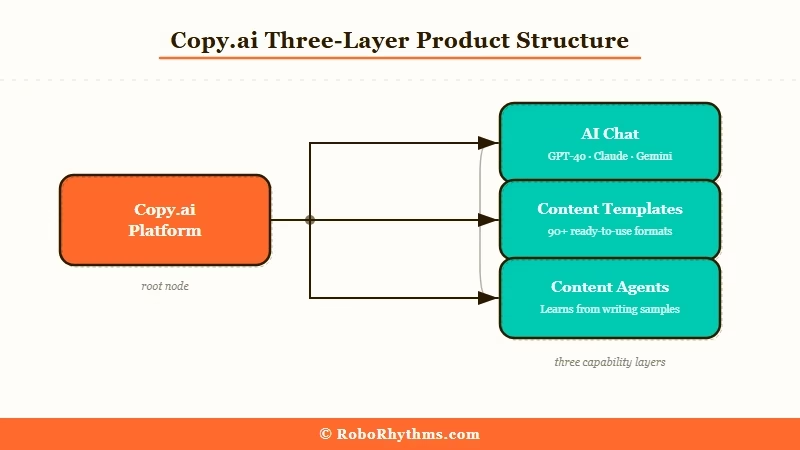
What is a GTM platform: A Go-to-Market platform connects content creation with sales and marketing workflows, letting teams build, manage, and distribute branded content from a single system.
The core product now has three components. First, there is the AI Chat layer, which works like a smarter ChatGPT with access to multiple models including GPT-4o, Claude 3.5 Sonnet, and Gemini. Second, there are 90+ templates covering everything from email sequences to product descriptions.
Third, and most interestingly, there are the Content Agents. Feed Copy AI three samples of your existing content and it learns your brand voice. After that, it generates new content matching your style without constant re-prompting.
From what I’ve seen, the Content Agents feature works surprisingly well for teams with an established brand identity who need volume. The platform also connects to Google Docs, OneDrive, Slack, and Salesforce. For a content team building a production pipeline, that cross-tool connection matters. For a solo creator writing blog posts, it is mostly invisible.
Copy AI Pricing in 2026
Copy AI pricing in 2026 starts at $29 per month for the Chat plan, with no reliable free tier. The original free plan that drove early growth no longer exists in a meaningful form.
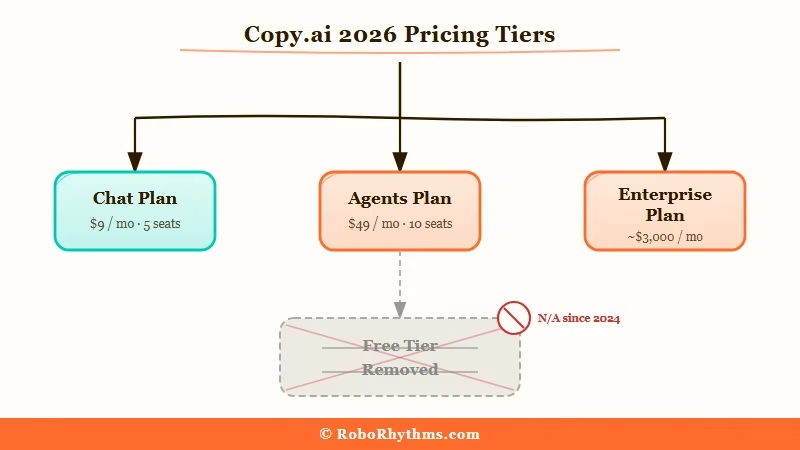
Here is how I would think about the current tiers:
| Plan | Price | Seats | Best For |
|---|---|---|---|
| Chat | $29/month | 5 | Small teams needing AI chat and templates |
| Agents | $249/month | Up to 10 | Marketing teams with content automation needs |
| Enterprise | Custom (from ~$2,000/month) | 150+ | Large orgs with brand compliance and custom workflows |
Annual billing saves 20% across all plans. The jump from $29 to $249 per month is steep. The Chat plan gives you the AI interface and templates but limits workflow automation.
The Agents plan is where Content Agents live. Save for high-volume solo users, neither tier is an obvious bargain. Compare this to the Writesonic review I ran earlier this year, where the value proposition for individual creators was considerably clearer.
Note: pricing has changed multiple times since the GTM pivot. Always verify current rates at copy.ai before signing up, since these figures reflect March 2026.
What Copy AI Does Well
Copy AI performs best at generating short-form marketing content at volume, especially when a team brand voice has been loaded into the Content Agents feature.
The template library is the strongest individual feature at the $29 tier. Over 90 formats cover email subject lines, product descriptions, social media posts, ad copy, and cold outreach sequences. What surprised me is how strong the cold outreach templates are specifically.
Feed it a company name and value proposition and the output needs around 30% editing, not the 80% I expected from template-based generation. The multi-model access is also genuinely useful. You are not locked into one model’s quirks.
When GPT-4o produces generic output, switch to Claude 3.5 Sonnet for a different tone. I’ve found that toggling models mid-session produces better results than most single-model tools because you can catch the first model’s blind spots quickly.
Here is the difference between a vague prompt and a specific one in Copy AI:
Vague: “Write an email about our new product launch.”
Specific: “Write a cold outreach email for a B2B SaaS tool that cuts content production time by 40%. Target: CMOs at companies with 50-200 employees. Tone: direct, data-led, no jargon. CTA: 15-minute demo.”
The second prompt produces output that needs 2 to 3 rounds of light editing. The first produces something you will throw out. Copy AI rewards experienced prompt writers more than most tools I’ve tested.
Users report up to 40% traffic increases when using the AI Workflows feature for content automation pipelines, though those gains assume your team knows how to configure the workflows correctly.
Where Copy AI Falls Short
Copy AI struggles with long-form, research-intensive content and is not the right tool for technical writing, deep analysis, or anyone who needs output they can publish without heavy editing.
Output quality drops noticeably on anything longer than 500 words or on topics requiring specific, accurate facts. I tested it on several tech topics and found it produced confident-sounding but vague copy. For long-form blog writing, Blaze AI produced tighter output in my side-by-side testing and offers a more focused value proposition for solo content creators.
The GTM pivot also created a support gap. The customer support team is now oriented toward enterprise accounts. Solo users on the $29 Chat plan report slow response times and limited documentation for the newer workflow features.
If something breaks while you’re on your own, that lag is a real problem. There is also no meaningful free tier left. Other tools like Writesonic and Jasper still offer free access or extended trials.
Copy.ai’s trial gives you a taste but nowhere near enough to evaluate whether the full product fits your workflow before paying. The platform also carries complexity overhead. If you just want to write a blog post, you are navigating a GTM platform to do a simple job.
Copy AI Pros and Cons
Copy AI’s main strengths are its template depth, multi-model access, and Content Agents feature for teams. Its main weaknesses are pricing, complexity for solo users, and output quality on technical topics.
Pros:
- 90+ templates covering the full marketing content stack
- Multi-model access: GPT-4o, Claude 3.5 Sonnet, and Gemini in one platform
- Content Agents learn your brand voice from just three writing samples
- Strong cold outreach and email copy output
- Connections to Google Docs, Slack, Salesforce, and OneDrive
- 25+ language support for multilingual teams
Cons:
- No functional free tier; minimum entry is $29/month
- Jump from Chat to Agents plan ($29 to $249/month) is steep
- Long-form output requires heavy editing
- Interface is complex for users who just need simple writing assistance
- Customer support is oriented toward enterprise accounts
- Technical and research-heavy content is noticeably weak
My Verdict. Who Should Use Copy AI in 2026
Copy AI in 2026 is the right tool for marketing teams producing high-volume branded content, not for solo creators or budget-conscious users.
If you are a solo creator or solopreneur, I’d steer you elsewhere. The price-to-value ratio for a single-person operation does not hold up, and the interface complexity adds friction without benefit. Look at Writesonic or Jasper for solo writing workflows.
You can also read the Jasper vs Copy AI comparison for a direct head-to-head breakdown. If you run a content team of 3 to 10 people, Copy AI becomes much more compelling. The Chat plan’s 5-seat structure is good value split across a small team.
The Content Agents feature at the Agents tier is where the real ROI shows up for teams with established brand guidelines and volume requirements. My overall rating: 7.5 out of 10. Strong team tool, overpriced for solo use, genuinely interesting Content Agents feature that no simple writing tool matches.
| Who should use Copy AI | Who should skip Copy AI |
|---|---|
| Marketing teams of 3 to 10 people | Solo bloggers and solopreneurs |
| Agencies managing multiple client brands | Technical or research-intensive writers |
| Teams already using Salesforce or Slack | Users who depended on the old free plan |
| High-volume short-form content producers | Anyone wanting simple writing assistance |
According to G2 software reviews, Copy.ai holds a 4.4 out of 5 rating from verified business users, with the highest praise going to template variety and ease of getting started.
Note on affiliate links: Copy.ai runs an affiliate program through PartnerStack (45% commission for 12 months). We are in the process of signing up. Once active, this review will include an affiliate link.
Frequently Asked Questions
The most common questions about Copy AI in 2026 cover pricing, the GTM pivot, and how it compares to alternatives.
Is Copy AI free in 2026?
Copy AI does not offer a meaningful free plan in 2026. The original free tier was removed during the GTM pivot. You can access a limited demo, but functional use requires the Chat plan at $29 per month minimum.
What happened to Copy AI’s free plan?
Copy.ai removed its free writing plan when it repositioned as a Go-to-Market AI Platform in 2024. The platform now targets teams and enterprises, and the pricing reflects that shift away from individual users.
Is Copy AI worth it for solo creators?
Copy AI is not the best choice for solo creators in 2026. The entry price is competitive at $29 per month, but the interface is built for teams and the most valuable features require the $249 per month Agents plan. Writesonic or Jasper offer better solo value.
What is the Content Agents feature?
Content Agents is Copy.ai’s brand voice training system. Feed it three samples of your existing content and it learns your writing style. After training, it generates new content matching your brand without re-prompting. It is available on the Agents plan at $249 per month.
How does Copy AI compare to Jasper AI?
Copy AI and Jasper AI overlap significantly on features but differ in positioning. Jasper stays closer to a writing assistant model while Copy AI has leaned into GTM workflow automation. For the full breakdown, see the Jasper vs Copy AI comparison.
Can Copy AI write long-form blog posts?
Copy AI can produce long-form drafts but quality drops on content longer than 500 words or on research-intensive topics. The output works better as a first draft requiring substantial editing. Short-form marketing copy is where the tool consistently delivers.
Quick Takeaways
Copy AI Review 2026 Key Points: – Copy.ai pivoted from AI writing tool to GTM platform in 2024, changing pricing and positioning entirely – Entry price is $29/month (Chat plan, 5 seats); no functional free tier – Content Agents feature (Agents plan, $249/month) is the strongest differentiator for teams – Best for content teams of 3 to 10 people; not recommended for solo creators – Multi-model access (GPT-4o, Claude 3.5 Sonnet, Gemini) is a genuine advantage – Overall rating: 7.5/10
