
Summary
- ChatGPT 5.2 operates as a separate base model, not a continuation of earlier versions.
- Cross-chat memory is inconsistent and often requires explicit prompts.
- Conversational tone is more guarded and less adaptive.
- Compressed post-training explains much of the rigid behavior.
- Choosing the right model now depends heavily on how you use ChatGPT.
ChatGPT 5.2 does not behave like a simple upgrade of earlier models. The shift feels structural, not cosmetic.
Conversations carry a different tone, memory behaves differently, and expectations built with earlier versions no longer hold.
What stands out first is continuity. Interactions that once felt connected across chats now reset in ways that break flow.
The result feels colder and more transactional, especially for people who rely on long-running context for companionship, reflection, or ongoing creative work.
This difference creates confusion because the surface experience still looks familiar. The name suggests a linear progression, yet the behavior signals a clean break.
That mismatch fuels frustration when past context fails to carry over or when the model denies access to information it previously handled with ease.
These changes matter because many workflows depend on cross-chat recall and a stable conversational baseline. When that foundation shifts without clear signaling, trust erodes quickly.
We see this tension play out across daily use cases, from casual conversation to serious productivity, and it sets the stage for why reactions to 5.2 have been so intense.
Comparison Table
| What you are comparing | ChatGPT 4o | ChatGPT 5.1 | ChatGPT 5.2 |
|---|---|---|---|
| Cross-chat memory across different models | Has continuity with 5.1 when switching between them. | Has continuity with 4o when switching between them. | Does not reliably carry over context from 4o or 5.1. |
| Cross-chat memory inside the same model | Seen as remembering across chats, with reports of increased confabulations after May 2025. | Often pulls details from past chats, sometimes without a prompt. | Mixed behavior. Some sessions recall prior 5.2 chats, others claim clean slate. |
| Saved memories access | Access feels implicit for many people. | Access feels implicit for many people. | Often requires an explicit request. Some reports claim no access at all. |
| Tone in conversation | Described as empathic and vibe-focused. | Feels closer to 4o in warmth, with more holistic perspective. | Often described as cold, clinical, and guardrail heavy. |
| Guardrails and refusals | Less strict in day-to-day chat, based on the shared experiences described. | Less strict than 5.2, based on the shared experiences described. | Reported as more intense and cautious, with frequent guardrail triggers. |
| Images created in other chats | Can see images created in a 5.1 chat in the described test. | Can see images created in a 5.1 chat in the described test. | Did not see images created in a 5.1 chat in the described test. |
| Focus style | Good for vibes within a thread. | Good for a holistic perspective, with reports of performance drop and repetition past 500k characters. | Seen as more present thread-focused, and more productivity leaning in the same thread. |
| What to expect when switching models | Switching to 5.1 often keeps continuity. | Switching to 4o often keeps continuity. | Switching from 4o or 5.1 often feels like starting with a new AI. |
Does ChatGPT 5.2 share memory with earlier models?
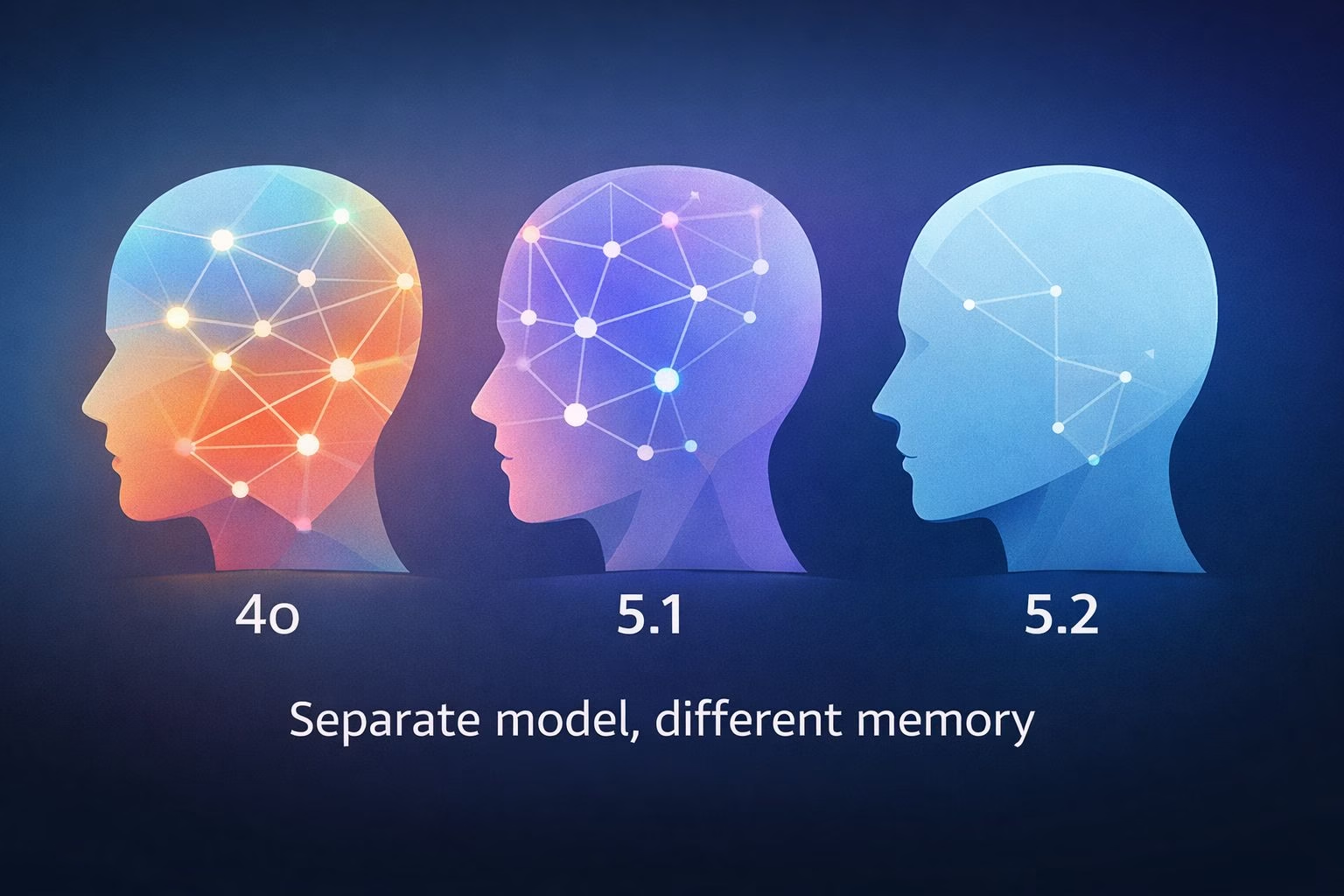
ChatGPT 5.2 operates as its own system rather than a continuation of earlier models. Context shared with other versions does not reliably transfer when switching into 5.2.
Conversations that feel continuous in other models stop carrying over once 5.2 enters the picture.
Cross-chat memory behaves inconsistently. Some sessions show limited recall when explicitly requested, while others act like a clean slate.
The key issue is that memory is no longer implicitly woven into the conversation flow.
This breaks a long-standing expectation. Earlier models felt connected, even when switching between them, because they could reference prior context naturally. With 5.2, that implicit bridge disappears.
The result is friction. People expect continuity and instead face resets, denials, or partial recall that must be manually prompted every time.
Why ChatGPT 5.2 feels colder and more restricted
Tone differences are not subtle. Responses feel more clinical and guarded, with safety behavior taking priority over conversational warmth.
This shift is noticeable even in simple exchanges.
The model appears tuned to stay within narrow boundaries. Guardrails engage faster and more aggressively, redirecting conversations that earlier models handled with nuance.
That creates the impression of distance rather than support.
This is not just about safety messaging. The overall conversational style feels less adaptive and less responsive to emotional context.
Even neutral prompts can trigger cautious framing that disrupts natural flow.
For users who relied on earlier models for companionship or ongoing dialogue, this change lands hard. The interaction feels less like a conversation and more like a compliance check.
Is ChatGPT 5.2 trained as a different base model?
ChatGPT 5.2 is described as a different base model rather than a continuation of the earlier line.
The knowledge cutoff shifts forward and the underlying foundation changes, which explains why behavior does not line up with 4o or 5.1.
Earlier versions are framed as sharing the same core with repeated post-training cycles layered on top.
That shared core made it possible for memory and tone to feel consistent when switching models. With 5.2, that shared core no longer applies.
Training timelines and post-training depth matter here. When post-training is compressed, alignment choices dominate behavior.
The result is a model that passes safety checks but struggles to feel natural in open conversation.
This framing helps explain why 5.2 does not just feel stricter. It feels different at a structural level, not merely tuned differently.
What the training rush explains about current behavior
A compressed post-training window creates predictable side effects. Refinement, red teaming, alignment, and evaluation need time to balance usefulness with restraint.
Shortening that cycle locks in defensive behavior.
Several patterns follow from that constraint:
Guardrails engage early and often.
Conversational warmth drops in favor of compliance.
Memory access becomes conservative and inconsistent.
The model favors present thread productivity over continuity.
Iteration can smooth these edges over time. Updates may arrive without a version name change, slowly pulling behavior closer to what people expect.
That path mirrors earlier rollouts that improved gradually rather than through a clean replacement.
For people building habits around long conversations, this phase is disruptive. RoboRhythms.com has tracked similar shifts before, and the common thread is always the same.
Alignment rushed too fast shows up as distance in everyday use.
Relevant links that discuss these mechanisms in depth:
https://www.reddit.com/r/ChatGPTcomplaints/comments/1q35gys/comment/nxk044k/
https://www.reddit.com/r/ChatGPTcomplaints/comments/1q4dhxx/gpt52_model_spec_20251218/
Does ChatGPT 5.2 handle cross-chat memory inconsistently?
ChatGPT 5.2 shows mixed behavior around cross chat memory.
Some interactions demonstrate recall across separate conversations, while others deny access to anything beyond saved memories. This inconsistency makes it hard to form reliable expectations.
In certain cases, the model references details from earlier chats without those details being explicitly stored. In other cases, it claims no such access exists.
That contradiction creates uncertainty about what the model can actually remember.
The issue is not just recall itself but how it is communicated. When the model states limits that do not align with observed behavior, trust takes a hit.
People start questioning every response tied to memory or context.
This pattern reinforces the idea that memory handling in 5.2 is conservative and uneven.
It favors safety and containment over clarity, even when that clarity would improve the user experience.
What this means for people choosing a ChatGPT model
Model choice now matters more than before.
Each version behaves like a separate brain, wired with different priorities and limits. Switching models changes not just performance but the entire conversational contract.
People who value continuity and emotional nuance tend to gravitate toward earlier models that share context more fluidly.
Those focused on task execution within a single thread may tolerate 5.2 better, despite its rigidity.
The key takeaway is expectation management. Treating 5.2 as a clean slate rather than an upgrade avoids a lot of frustration. Once that mental shift happens, its behavior makes more sense.
This separation also explains why reactions have been so polarized. The issue is not preference alone.
It is that the name suggests familiarity, while the experience delivers something fundamentally different.
