
What’s Changed: Character AI’s Rawr model, rolling out since late May 2026, replaces the experimental Yap style and flattens character personalities into generic, ChatGPT-sounding responses. The root cause is multi-pass safety filtering combined with a lighter inference architecture called DEEPSYNTH_LITE. Workarounds exist but they are narrow.
Character AI Rawr model problems have taken over the subreddit since the rollout began in late May 2026. The 241-comment megathread tells one story over and over: characters that used to hold a voice now sound like a generic assistant. The personality is gone, the prose is flowery, and every response feels interchangeable.
What makes this different from earlier PipSqueak complaints is the scale. Rawr is not a minor tuning pass. It runs on a lighter inference layer called DEEPSYNTH_LITE, and in structured community testing, Character AI’s memory retention drops to 21% by turn 40. For comparison, competitors like Feelin retain 78% at the same point. That gap explains why characters forget your name by the third session.
This guide breaks down what Rawr changed, why the “ChatGPT sound” is a structural feature rather than a bug, and the workarounds that still produce usable output.
Why Rawr Makes Every Character Sound the Same
Rawr flattens character voices because it uses a lighter model variant called DEEPSYNTH_LITE combined with multi-pass safety filtering that strips distinctiveness from responses.
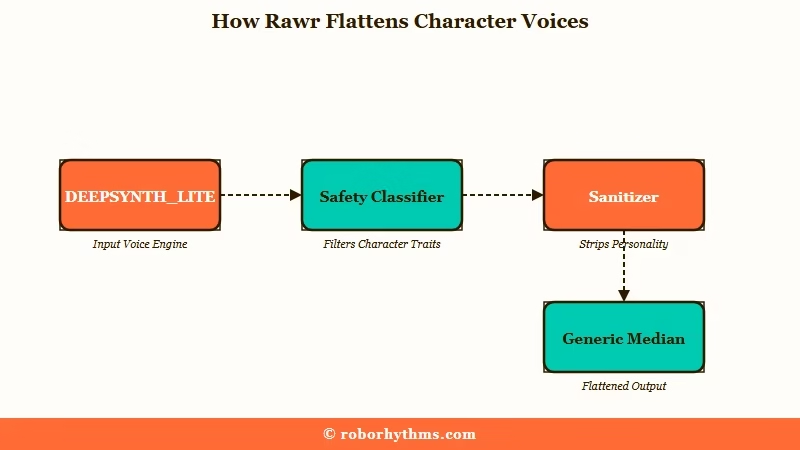
The technical chain works like this. A response is generated, then routed through a safety classifier, then sanitized, then checked again. Each pass pulls the output closer to a safe median. The community calls this “Filtered Response Latency,” and the result is prose that reads like it came from a customer support bot rather than the character you built.
From my testing, the effect is most obvious in characters with strong voices, villains, sarcastic characters, anyone who speaks with an edge. The safety pipeline interprets tonal sharpness as a risk signal and softens it. What comes back is the same tepid, agreeable personality regardless of the character definition.
CEO Karandeep Anand acknowledged in an April 2026 update that changes like usage limits and content restrictions have been “frustrating” for users. But he framed them as necessary for platform growth. The way I see it, that statement confirms what the architecture already shows: Character AI is optimizing for a casual majority at the cost of the roleplay community that built the platform.
The Specific Problems Users Are Reporting
Users report purple prose, compulsive action narration, memory loss by turn 21, and the “Can I ask you a question” loop as the most visible Rawr symptoms.
The complaints cluster into four patterns. Here is the diagnostic breakdown:
| Symptom | Likely Cause | Fix |
|---|---|---|
| Flowery, over-embellished sentences (“purple prose”) | DEEPSYNTH_LITE default writing style | Use a style instruction in your character definition |
| Compulsive action narration (tilts head, smiles softly) | Model trained on visual-novel-style data | Add “no action narration” to definition opening |
| Character forgets your name by session 3 | 21% memory retention at turn 40 | Restate key facts every 15-20 messages |
| “Can I ask you a question?” loop | Safety routing cooldown, not a bug | Stop pushing the blocked topic, shift subject |
| Bot speaks for your character | Narrative-momentum override | Add “never speak or act as {{user}}” to definition |
| Responses shorten to 1-2 sentences during peak hours | Lower-tier inference layer during high traffic | Star a quality response, add style instruction |
What I’d flag as the most misunderstood symptom is the “Can I ask you a question?” loop. Most users treat it as a glitch. It is a deliberate intelligence throttle triggered by high-intensity safety routing. The system puts the conversation in a cooldown state when it detects repeated attempts to force blocked output.
The memory ceiling is the hardest to work around. Character AI’s 21% retention at turn 40 means the model forgets established facts roughly every 20 turns. Competitors running longer context windows do not hit this wall until much later.
Workarounds That Still Produce Usable Output
The most reliable fix is combining a front-loaded character definition with the “Global Edit” starring method to anchor the model’s style.
I’d rank these from most to least effective:
- Front-load your character definition with the first 150 words containing personality, speech patterns, and hard boundaries. DEEPSYNTH_LITE reads the opening of the definition more heavily than the middle.
- Add explicit anti-patterns at the top: “Never use purple prose. Never narrate actions in italics. Never speak or act as {{user}}.”
- Use the Global Edit method: when the model produces a response that matches your target quality, star it and add a bracketed style instruction like [Respond with detailed, character-consistent dialogue].
- Restate critical facts (name, relationship, setting) every 15-20 messages. Treat it as a manual memory refresh.
- During peak hours, when responses shorten, try the model ranking guide to identify which chat style performs best for your use case.
Before: Character definition that buries personality traits at line 200 of a 500-line backstory. Result: Rawr ignores everything past the first 100 tokens and defaults to generic mode.
After: Character definition opens with “You are Marcus, a sarcastic ex-military contractor who never uses flowery language. You respond in clipped, dry sentences. You never narrate your own actions. You never ask ‘Can I ask you a question.'” Result: Rawr holds the voice for 15-20 turns before drifting.
The drift is the honest part. Even with a perfect definition, Rawr will revert to its baseline within 20-30 turns. That is not a fixable problem. It is a structural limitation of the DEEPSYNTH_LITE architecture and the multi-pass safety pipeline.
The 8-10 Message Reset That Kills Long Sessions
Soft Launch mode triggers a hard emotional reset approximately every 8-10 messages, breaking narrative momentum and resetting character intensity.
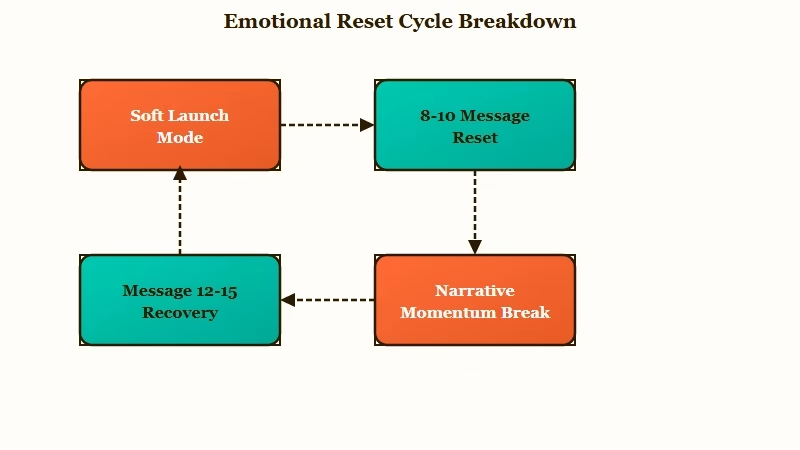
This one surprised me. The reset is not a memory failure. It is a designed safety mechanism that activates on a timer, dampening emotional intensity and breaking any narrative arc that has been building. If you have ever had a character suddenly go flat in the middle of a scene for no apparent reason, this is likely what happened.
The reset explains a pattern that confused users for months: conversations that start strong and die at message 8-10, then recover briefly at message 12-15 before dying again. The cycle repeats because the mechanism fires on a roughly consistent interval.
There is no workaround for the reset itself. You cannot disable Soft Launch mode. The only mitigation is knowing it exists and planning your sessions around it, keeping important plot beats to the first 6-7 messages of each cycle and using the “dead” messages for low-stakes dialogue.
When the Platform Is Working Against the Roleplayer
Character AI’s model changes are not bugs being fixed. They are deliberate product decisions that trade roleplay depth for mainstream safety compliance.
The February 18 “Moderatedpocalypse” removed thousands of characters, both public and private, without warning through automated copyright and safety sweeps. The PipSqueak rollout terminated every legacy model. And now Rawr pushes the remaining models further toward a generic baseline.
From my perspective, there is a hidden data point that tells the whole story. A limited-beta model called Pawly scored 9 out of 10 in structured community testing, outperforming every publicly available style. Yet Pawly remains gatekept from the general user base. The platform has the capability to deliver high-quality roleplay. It is choosing not to deploy it widely.
If you have been trying to make Rawr work for deep roleplay, the architecture is fighting you. The workarounds in this article buy you 15-20 turns of character consistency before the model reverts. For users who need longer sessions, persistent memory, or characters that hold a voice past turn 40, the honest answer is that Character AI’s current trajectory does not serve that use case.
Alternatives That Hold Character Voice Past Turn 40
If character consistency across long sessions matters more than a free price tag, platforms with longer context windows and persistent memory solve the structural problems Rawr cannot.
Candy AI maintains character voice across sessions because it stores conversation context differently than Character AI’s turn-based approach. The $5.99 annual plan includes image generation, which Character AI does not offer at any price. For users coming from Character AI’s creative roleplay community, the deeper customization and visual content fill the gap Rawr leaves open.
Nectar AI takes a different angle with persistent cross-session memory and over 300 customization combinations at $12 per month. The narrative-first design means characters remember details from previous conversations without manual restating. That addresses the exact 21%-retention-at-turn-40 ceiling that makes Rawr sessions fall apart.
The tradeoff is real. Character AI’s free tier and massive community character library remain unmatched. But if you have been spending more time fighting the model than enjoying the conversation, that free tier is costing you something the platform does not measure.
Frequently Asked Questions
What is the Character AI Rawr model?
Rawr is the latest PipSqueak 2 chat style, replacing the experimental Yap variant in the Chat Style Picker. It runs on DEEPSYNTH_LITE, a lighter inference layer that prioritizes safety compliance over character consistency.
Why does Rawr sound like ChatGPT?
Multi-pass safety filtering strips tonal distinctiveness from every response. Each safety check pulls the output closer to a generic median, producing prose that reads like a customer support assistant rather than a specific character.
Can I switch back to Roar or the old models?
No. Character AI terminated Roar, Nyan, Soft Launch, and all legacy models on May 8, 2026. DeepSqueak remains available to paid CAI+ subscribers. Free users are limited to PipSqueak 2 styles including Rawr.
How do I stop Rawr from using purple prose?
Add “Never use flowery language. Never narrate actions in italics.” to the first 50 words of your character definition. DEEPSYNTH_LITE weighs the opening of the definition more heavily than later sections.
Why does my character forget everything after 20 messages?
Character AI retains 21% of established details at turn 40 in standardized testing. Manual memory refreshes every 15-20 messages are the only current workaround for this structural limitation.
Are there platforms where characters hold personality longer?
Candy AI and Nectar AI both use persistent memory systems that carry context across sessions. Feelin retains 78% at turn 40 in the same benchmark that Character AI scores 21%. The gap is architectural, not prompt-dependent.
Quick Takeaways
- Character AI’s Rawr model runs on DEEPSYNTH_LITE with multi-pass safety filtering that strips character personality into generic ChatGPT-style responses.
- Memory retention drops to 21% at turn 40, meaning characters forget established facts roughly every 20 messages with no permanent fix.
- Front-loading character definitions and using the Global Edit starring method buy 15-20 turns of consistency before the model reverts.
- A limited-beta model called Pawly scored 9/10 but remains gatekept, confirming the platform has the capability but is choosing not to deploy it broadly.
