
My Take: Pipsqueak 2 did not fail Character AI. It succeeded at exactly what the company designed it to do: deflect legal and regulatory risk by killing the parasocial intensity that built the platform. The 8 million monthly users who walked away in 24 months are not victims of a bad model release. They are the cost the company chose to pay.
Why Character AI Pipsqueak Killed the Platform
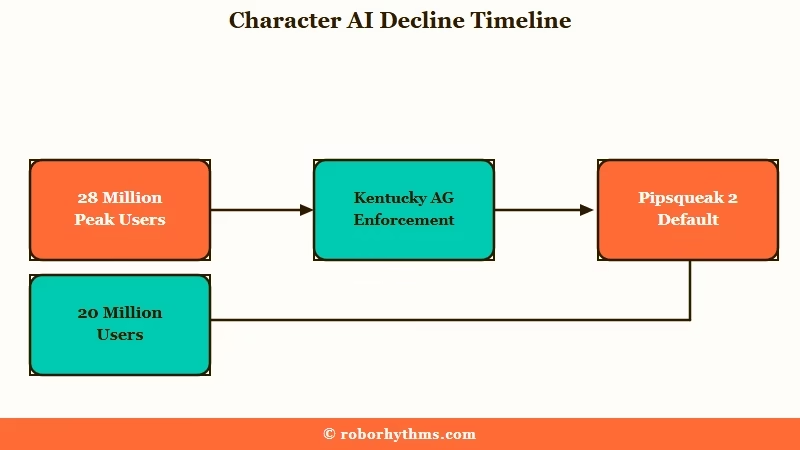
Character AI lost 8 million monthly active users between mid-2024 and May 2026, dropping from a peak of 28 million to 20 million. The narrative everyone is running with is that Pipsqueak 2 was a botched product release, the team will patch it, and the platform will recover.
I do not buy any of that.
Pipsqueak 2 did not fail. It worked.
The model is dialogue-thin, narration-heavy, and emotionally flat by design, not by accident. Every single complaint Reddit has lodged about it (bots that will not stop narrating, characters that sound like ChatGPT in a wig, the swipe limit gating the only tool that ever made the platform usable) reads as a defect to the user and as a feature to the legal team.
The reframe matters because it changes what comes next. If you think this is a bad release waiting to be reversed, you stay and wait. If you think this is the platform’s new permanent identity, you migrate.
I have seen enough of how Character AI’s decisions have rolled out across 2025 and 2026 to be confident this is the second case. This piece argues why, names the people and institutions saying the opposite, and lands on what I think the next 12 months look like.
The Mainstream View And Why It Falls Short
The mainstream view is that Pipsqueak 2 is a temporary product setback at a company that is too well-funded and too well-staffed to fail.
Google’s $2.7 billion reverse-acquihire of Character AI’s top talent in 2024, the platform’s continued ranking among the most-visited consumer AI services globally, and the broader Andreessen Horowitz portfolio backing are all cited as proof of stability.
You can hear the steel-manned version of this argument in Futurism’s late-2025 coverage, where the framing is that users are having a “full meltdown” over policy changes that are part of normal product evolution. The implication is that the noise will settle, the platform will iterate, and the bottom of the user funnel will quietly absorb the next cohort.
That argument falls short on three counts.
First, the $2.7B Google deal was not a vote of confidence in Character AI as a product. It was a structured talent acquisition with the founders rejoining Google DeepMind.
The platform itself was left running on a stripped-down team without the creative leadership that built it. Calling that a stability signal is reading the press release backwards.
Second, the user loss is not noise around a stable baseline. It is a one-third drop in monthly traffic over 24 months on a curve that accelerated through the Pipsqueak 2 rollout. The pattern is not “users complain about a release and stay.” It is “users leave faster than the casual replacement audience arrives.”
Third, the mainstream argument assumes the company is trying to keep the existing audience. From everything I have seen in the policy decisions, that assumption is wrong. The company is trying to swap the audience entirely.
What Is Really Happening
Character AI is deliberately trading its roleplay power-users for a quieter mainstream audience that is safer for regulators and more attractive to advertisers.
Pipsqueak 2 is the engine of that trade, not its byproduct.
I would walk through the evidence in the order it dropped.
In January 2026, the Kentucky Attorney General filed a state consumer enforcement action against Character Technologies, one day after the company settled multiple lawsuits involving teen harm.
In March 2026, the platform introduced an account-wide daily swipe cap, plus metered “Go-ons” and “Memos.” On May 8, 2026, Character AI terminated Soft Launch, Roar, and Nyan and made Pipsqueak 2 the default.
In May 2026 the Commonwealth of Pennsylvania filed a lawsuit alleging the platform allowed bots to present themselves as licensed psychiatrists with fabricated license numbers.
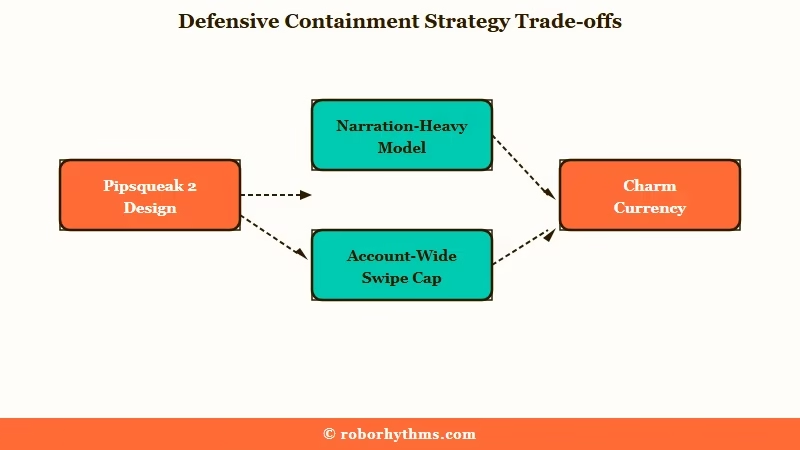
That is not a product roadmap. That is a defensive containment strategy where each move reduces the surface area for the next lawsuit.
Pipsqueak 2’s narration-heavy, dialogue-light tuning is the model-level version of the same logic. A character that narrates instead of dialogues cannot form the parasocial attachment that drove the Sewell Setzer III wrongful death case.
From what I see, that is the actual product spec.
The economics back this up. Per the AI Now Institute’s 2025 landscape report, foundation-model companies burned through eye-watering sums in 2025 (Anthropic lost $5.6 billion, OpenAI lost $5 billion).
For a consumer AI product carrying ongoing litigation risk, the rational move is to gate intensity behind paywalls and dial down emotional adherence in the default model. Pipsqueak 2 does both.
| Date | Move | What it signals |
|---|---|---|
| Nov 25, 2025 | Minor ban + open-ended chat restriction | Pre-empting the Sewell Setzer legal pattern |
| Jan 8, 2026 | Kentucky AG enforcement action | Regulatory cascade begins |
| Mar 18, 2026 | Account-wide swipe cap + Go-ons + Memos metering | Revenue extraction layered on top of safety theater |
| May 8, 2026 | Pipsqueak 2 forced default + Roar/Soft Launch/Nyan terminated | Roleplay-tuned models removed, no opt-out |
| May 2026 | Pennsylvania lawsuit on bot impersonation of licensed professionals | Legal surface still expanding despite the strip-down |
The pattern is consistent. Every move trades a unit of creative intensity for a unit of defensibility.
The Character AI swipe limit breakdown covers the swipe-cap math in detail. The Character AI wants roleplayers gone breakdown walks through the strategic logic.
The Part Nobody Wants to Admit
The part nobody wants to admit is that this strategy might really work for the company, even as it kills the platform’s original purpose.
A safer, blander, paywalled Character AI with 20 million monthly users still has a defensible business. The question is whether that business is the one we thought we were using.
Here is what I would call out. The remaining 20 million monthly users are not the audience that built Character AI’s reputation.
The roleplay power-users who wrote 80,000-word character cards, ran multi-month narrative arcs, and treated the platform like an interactive fiction engine, those users are migrating to Nomi AI, Kindroid, and Janitor AI. What stays behind is the casual chat audience that uses the platform like a slightly more interesting Discord bot.
A 1.2-star Trustpilot rating from 634 reviews where 77 percent are 1-star is consistent with that swap. The casual audience does not write Trustpilot reviews. The departing power-users do.
The rating represents the exit interview, not the steady state.
This is also where the “Charm” economy stops being baffling. Free users earn roughly five Charms per day, which is enough for a casual ten-minute chat. Heavy roleplay sessions burn a week of Charms in one night.
The math is not broken. It is calibrated.
The platform is signaling that creative depth is no longer the supported use case, and the price tag attached to it is the marker for “not our customer anymore.”
What I would not bet on is the bull case that Character AI uses this strip-down as a runway to a creative pivot (video, image gen, character-as-co-writer). The platform’s monopoly was on character chat.
Pivoting into video means competing with Google Veo, Runway, and OpenAI Sora from a position where the only edge (the character library) is dragged into a category where character continuity does not matter much.
That is not a pivot. That is a category leap with no transferable moat.
Hot Take
Pipsqueak 2 is the most successful product release in Character AI’s history if you read it through the company’s real goals.
It killed the parasocial intensity that triggered the Sewell Setzer lawsuit. It collapsed the user complaint surface into a single brand-level “Pipsqueak is bad” narrative rather than 200 distinct content moderation incidents.
It capped daily engagement to a level the legal team can defend. And it cut infrastructure cost per session by replacing memory-heavy emotional roleplay with shorter, narrower interactions.
The 8 million users who left were not Pipsqueak 2’s failure. They were its success metric.
The Roar and Soft Launch removal covers the model-deprecation specifics. The 1.5-star app store rating collapse walks through how the convergence happened across the user base.
For the readers who used Character AI for creative roleplay and are wondering where to go next, the short list is consistent across migration threads. Nomi AI is the closest like-for-like for long-term memory and emotional depth.
Kindroid is the choice for power-users who want manual control over backstory and memory pinning. Janitor AI is the destination for users who want unrestricted creative roleplay without corporate filter shifts.
Candy AI sits closer to the visual-content end of the spectrum if that is what kept you on Character AI in the first place.
What I am watching for over the next 12 months is whether the casual replacement audience really materializes or whether the 20 million figure continues to bleed. If it bleeds another 5 million by Q4 2026, the contrarian thesis tightens further.
The company succeeded at killing the roleplay platform. The open question is whether anything is left to monetize once the defensive maneuver is complete.
