
Something changed on Character AI this week that is pushing thousands of users toward a decision they didn’t expect to face. You open the app, try to start a chat, and get stopped by an age verification screen.
The platform is now rolling out character AI ID verification through a third-party service called Persona, and the explanation they’re giving for it doesn’t hold up when you check the source material.
Character AI says California law requires this. I’ve looked at the actual legislation, and that’s not what it says.
If you’re staring at that screen, wondering whether to hand over your passport or driver’s license to an AI chatbot company, read this first.
I’ll walk through exactly what the verification process involves, what the California law requires, what Persona does with your data, and what to do if you’d rather not comply.
Quick note: if you’re already done with Character AI over this and just want a place to go, Candy AI is the alternative I’d point most people toward.
No government ID required.
What Is Character AI ID Verification and How Does It Work
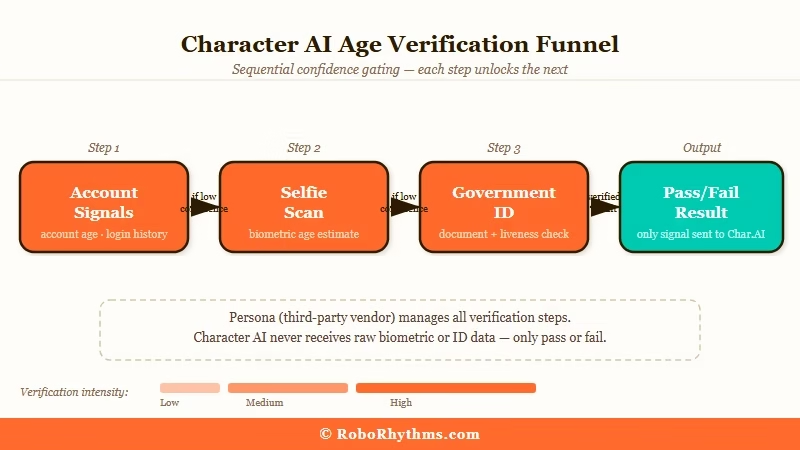
Character AI ID verification is a three-step age assurance process using a third-party service called Persona: an algorithm screens your account signals first, then a selfie scan, and only requests a government document as a last resort if the selfie result is inconclusive.
The rollout is happening in waves, which is why you might have seen the complaints before hitting the screen yourself.
The update also includes daily message limits on the free tier and ads shown between conversations, but the ID verification is the element generating the most friction.
What is Persona: An identity verification service that processes selfies and government IDs biometrically on behalf of companies, returning only a pass/fail result to the requesting platform.
Here is how the actual process works:
- Algorithmic age assurance: Character AI looks at your account data (age on file, usage patterns, third-party signals) to estimate whether you’re 18 or older. Most users pass here without seeing any verification prompt.
- Selfie scan: If the algorithm result is borderline, Persona asks you to take a selfie. It estimates your age biometrically from your face.
- ID upload: Only if the selfie result is still inconclusive does the system request a government document. Acceptable documents include driver’s licenses, passports, and national IDs. Student IDs and expired documents are rejected.
Character AI’s official position is that they receive only a pass/fail result from Persona. They state they never see your actual ID image. Persona claims to delete biometric data within 30 days.
Whether that’s reassuring depends on your level of trust in third-party data processors, which I’ll get to in a moment.
If you want more context on how the broader platform changes have played out, I’ve been tracking the declining user experience on Character AI across several recent updates.
This one is the biggest reaction yet.
Does California Law Require Character AI to Collect Your ID
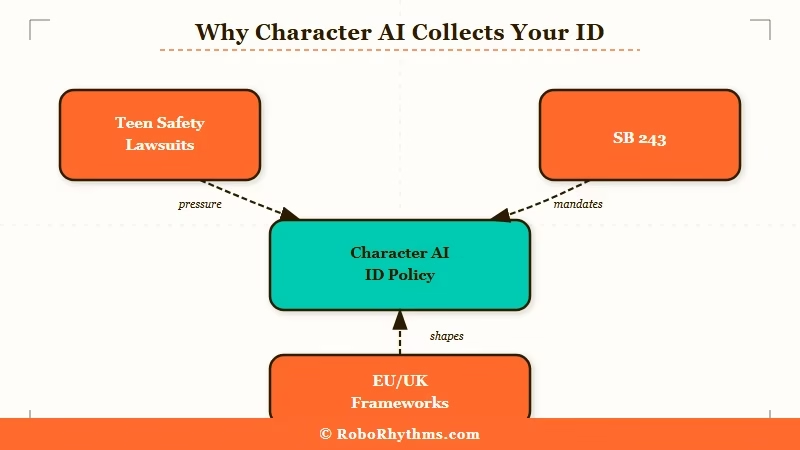
California law does not require chatbot users to upload government ID. The relevant laws require companies to estimate user age and protect minors. How companies fulfill that obligation is their own policy choice, not a direct legal mandate.
This is the part that’s earned Character AI the most distrust this week, and the anger is legitimate. Let me break down what the actual laws say.
SB 243 (AI Chatbot Safety Act, effective January 1, 2026): This law requires operators of AI chatbots that provide “adaptive, human-like responses” to implement protections for users under 18. Specifically, they must:
- Display clear notices that the chatbot is not a human
- Block engagement unless protocols exist to prevent self-harm content
- Prohibit content that is sexually suggestive for minors
- Document and report on safety metrics
What SB 243 does not say: collect government ID. It doesn’t even specify what mechanism companies must use to determine whether a user is a minor.
Self-reported age with behavioral guardrails would satisfy this law.
AB 1043 (Digital Age Assurance Act, effective January 1, 2027): This law requires app stores and operating system providers to build age verification APIs.
It isn’t even in effect yet, and it targets app stores and OS providers, not chatbot platforms directly.
| California Law | What It Requires | Government ID Upload Required? |
|---|---|---|
| SB 243 (AI Chatbot Safety, 2026) | Age-appropriate protections for users under 18 | No |
| AB 1043 (Age Assurance, 2027) | App stores to build age verification APIs | Not yet in effect |
| Character AI’s current policy | ID verification via Persona | Company choice, not legal obligation |
Legal analysis of the California Age-Appropriate Design Code Act (AB 2273) confirms this reading: companies are required to consider user age and put protections in place, but are explicitly allowed to use self-reported age or estimation methods in most cases.
Requiring a government document goes beyond the minimum the law demands.
As reported by FKKS Technology Law, companies can choose to exceed the minimum requirements, and some do for liability reasons. But that’s a business decision, not a mandate.
Why would Character AI make that choice? A few credible explanations:
- Litigation risk management following the 2024 teen safety lawsuits
- Getting ahead of stricter EU and UK age verification frameworks
- Positioning for AB 1043 compliance before it takes effect in 2027
None of those are necessarily bad reasons. The issue is presenting a business decision as a legal requirement when it isn’t one.
Is It Safe to Give Character AI Your ID Through Persona
Submitting your ID through Character AI’s Persona integration carries real privacy risk, primarily from the possibility of a data breach at Persona rather than direct misuse by Character AI. Your ID is processed biometrically, and Persona retains it for up to 30 days before deletion.
Here is where I’d push back on the “it’s totally safe” framing.
Character AI’s claim that they never see your ID is plausible and consistent with how Persona is designed to work. The concern isn’t primarily what Character AI does with it. The concern is Persona itself.
Persona processes identity documents for many companies. Like any processor handling sensitive government credentials at scale, it represents a concentrated breach target.
If Persona is ever compromised, the biometric data and ID scans processed within that 30-day retention window become part of the incident scope. The deletion policy reduces but does not eliminate that exposure.
A few things worth knowing before you decide:
- Persona’s 30-day biometric data retention is their stated policy, not a figure independently audited by a regulator
- No third-party security audit of Persona’s systems has been published specifically for this Character AI integration
- Adults aged 19 and older are reporting hitting the verification screen too, not just users who look young or have a new account
- Character AI’s support has reportedly resolved some cases for long-standing paid subscribers without requiring ID
That third point matters more than it might seem. If the verification were purely about protecting minors, verified adults with years of account history wouldn’t be hitting the same screen at this rate.
The broader-than-expected rollout is what has people questioning whether the data collection serves additional purposes.
I’m not claiming it does. The honest answer is that you can’t know from the outside. What you can know is that “the law made us do it” isn’t the full story.
| Platform | ID Required? | Verification Method | Age Gate |
|---|---|---|---|
| Character AI | Potentially yes (via Persona) | Algorithmic + selfie + ID document | 18+ required to chat |
| Candy AI | No | Self-reported age at signup | 18+ self-declared |
| Nomi AI | No | Email signup only | Standard ToS agreement |
| ChatGPT | No | Email + phone verification | 13+ with parental consent |
What to Do If You Don’t Want to Submit Your ID
If you don’t want to submit your ID for Character AI verification, your practical options are to try the selfie step alone, contact support as a paying subscriber, or move to an alternative platform that uses self-reported age instead.
Here’s how I’d think about the decision:
Option 1: Try the selfie step first
The ID upload only triggers if the selfie scan is inconclusive. If you’re clearly over 18 in appearance, you may pass on the selfie alone without reaching the document step.
Before assuming you need to hand over a passport, test whether the selfie alone gets you through.
Option 2: Contact Character AI support
If you’re a paid c.ai+ subscriber or have a long-established account, support has reportedly resolved some cases without requiring ID. It’s not a guaranteed path, but it’s worth trying before walking away from a paid subscription.
Option 3: Switch platforms
This is the route a significant number of users are taking. Two options I’d point people toward:
- Candy AI: Customizable characters, no government ID required, self-declared 18+ at signup. Works differently from Character AI in that it’s more companion-focused and less roleplay-library-focused, but covers a lot of the same conversational use cases.
- Nomi AI: Persistent memory, companion-oriented design, email signup only. No ID verification requirement for standard access.
I’ve written a more detailed breakdown of Character AI alternatives if you want the full comparison. The short version: these platforms have improved significantly, and the gap with Character AI has narrowed.
Before scenario: You open Character AI to continue a conversation you’ve had for months. You’re 23, have a paid subscription, and the app presents a screen asking you to upload a government ID to a third-party company via your phone camera.
After scenario (switching to Candy AI): You create an account with an email address, declare your age, set up the kind of character you want to talk to, and are chatting within a few minutes. No Persona. No ID scan. No daily message cap interrupting mid-conversation.
The Character AI community has also been seeing frustration with the new swipe and message limits added alongside this update. If the ID wall wasn’t enough, the message cap has added another layer of friction for users on the free tier.
And the age verification false-positive problem that was already annoying people before this update has not gone away.
