
What Happened: Character AI’s parent company filed for Chapter 11 bankruptcy on October 12, 2026, to sell the business under court supervision, and the app and paid plans keep running for now. On November 14 it named Smirks and Pangs Acquisition LLC, a subsidiary of Octave Fund I, LLC, as a $10 million bidder for the app, its AI models and user data, and on November 25 it asked the judge to sign an order approving that pick, still unsigned late that day. The states object to both sales and the U.S. Trustee to the Disney deal, while on November 25 Google filed a limited objection over the app’s Google Play and Google Cloud accounts and the creditors’ committee objected to the sale under seal, ahead of a December 1 auction held only if a rival bid qualified and a December 7 sale hearing, per the court docket checked late on November 25, 2026.
The Character AI Chapter 11 bankruptcy is real, and it puts a clock on every chat you have saved there. Character Technologies, the company behind the app, filed in Delaware on October 12, 2026.
The app is still up, and nothing has been switched off.
The part that worries me most is a detail on Character AI’s own help center. A data export can take 3 to 4 weeks to arrive, and the download link expires 7 days after the email lands.
As of November 25, the sale hearing is listed for December 7, so an export requested today may arrive after it.
This piece covers what was filed, who has now bid for the app itself, why Disney’s bid is not the rescue it sounds like, and what happens to your chats, characters and subscription.
You will also get the exact export steps and the signals that tell you which way the sale is going.
Why Did Character AI File for Chapter 11 Bankruptcy?
Character AI filed for Chapter 11 bankruptcy to sell itself under court supervision, citing “significant legal, regulatory, and operational headwinds” in its official update.
The filing is case 26-11603 in the US Bankruptcy Court for the District of Delaware.
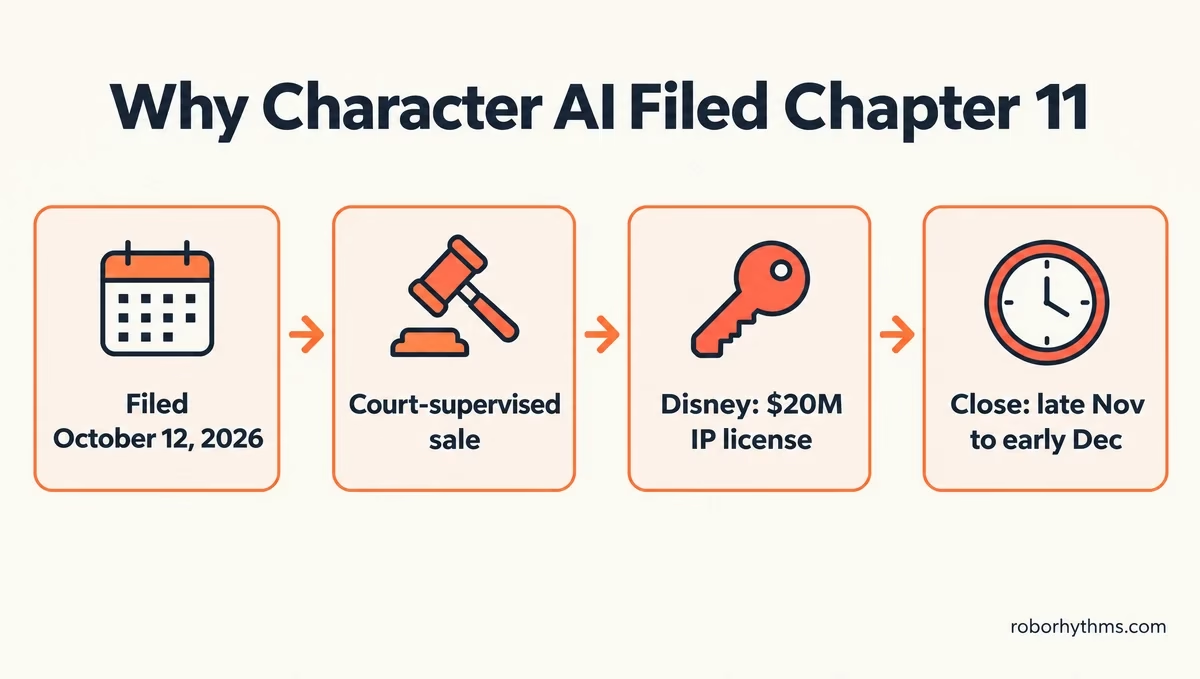
The company says the sale gives it the best chance to keep the platform running. Its own post is blunt about the other outcome: without a bid that keeps the service going, “the platform will be wound down.” I take that warning seriously, because the first named bid for the app itself came only on November 14 and its filing says nothing about how the service would be run.
Nothing changes for you today, and that is worth saying plainly. If you would rather have a second home for your chats while the sale plays out, start with my ranked Character AI alternatives.
What is Chapter 11: A part of US bankruptcy law that lets a company keep operating while a court oversees a sale or a restructuring of its debts.
The court papers on the Stretto case docket, run by the company’s claims agent, fill in the numbers. The table below pulls the figures that matter most from the petition, the first coverage of it, the court’s November 4 order, the November 14 bid notice and the filings of November 24 and 25.
| Filing detail | What the record shows |
|---|---|
| Filed | October 12, 2026, District of Delaware, case 26-11603 |
| Assets and liabilities | Each estimated between $50 million and $100 million |
| IP license bidder | Disney Worldwide Services, $20 million for an IP license |
| App bidder | Smirks and Pangs Acquisition LLC, $10 million plus certain liabilities, named November 14, signed agreement filed November 16, objections from the U.S. Trustee on November 19 and from Texas and a coalition of states on November 20, owner Octave Fund I, LLC disclosed November 24, order approving the pick sent to the judge November 25 |
| Largest unsecured creditor | Google, with a trade payable of $4,148,944 |
| Google’s objection | Filed November 25: no move of the app’s Google Cloud, Google Play, Google Ads or YouTube accounts unless the Google contracts behind them are taken over and paid in full |
| Sale hearing | December 7, 2026, per the U.S. Trustee’s November 24 filing, after the court first set December 3 and 4 |
The asset, liability and Disney figures come from The Verge’s filing report. The Google figure comes from the petition’s list of the 20 largest unsecured creditors, as reported by PPC Land. The Smirks and Pangs figure comes from the company’s November 14 notice (Docket 164) and the signed agreement filed on November 16 (Docket 179), its owner from the November 24 supplemental notice (Docket 234), the hearing date from the U.S. Trustee’s November 24 objection (Docket 232), and Google’s position from its November 25 limited objection (Docket 254).
Did Disney Buy Character AI?
Disney did not buy Character AI, and its bid does not include the app.
Disney Worldwide Services offered $20 million for a “non-exclusive perpetual license” to certain Character AI intellectual property and legal claims, plus transition services run by former Character AI staff it has hired.
Disney was the first stalking-horse bidder, which means its offer sets the floor for an auction. Other buyers had until noon ET on November 24 to top it. What bothers me is that nothing in Disney’s deal keeps the chat platform running, so the app’s survival depends on a second bidder who wants it as a working business.
Disney’s deal is now contested. On November 18, a coalition of 39 states and Washington, D.C. asked the judge to deny it, arguing that no one has put a value on the license and that the core of the deal was completed before the bankruptcy filing (Docket 194). Arkansas, Missouri and Indiana joined that objection on November 20 (Docket 212).
The U.S. Trustee objected too, on November 24 (Docket 232). Its filing says that nothing in the Bankruptcy Code lets a debtor “seek ex post facto approval of a transaction consummated pre-petition,” and that an auction cannot test Disney’s price, because the hiring and the release of legal claims happened before the filing and Disney is “simply being granted a non-exclusive license” to the IP.
The creditors’ committee filed its objection to the sale motion on November 25, the deadline the company’s proposed schedule set for it (Docket 220), but filed it under seal, so its grounds are not public (Docket 249). The docket entry gives only the title of the motion it opposes, which asks the court to approve the sale of assets and the assumption of the transition services agreement, and does not say which parts the committee disputes.
A second stalking horse was named on November 14. The company’s notice of an additional stalking horse (Docket 164) picks Smirks and Pangs Acquisition LLC to buy the assets Disney’s license leaves out, for $10 million in cash plus certain liabilities, including what is owed on the contracts it would take over.
Its asset list covers the Character.AI website and its iOS and Android apps, “All AI models whether trained or untrained” with their weights, and “All end-user account and profile information, user-created characters, chat content and related data.” It also takes the trademarks, the c.ai domain, the app store listings and social accounts such as r/characterai.
The filing says the buyer has no connection to Character AI beyond this deal and does not say who owns it. PPC Land reports, citing Delaware’s Division of Corporations, that the company was formed on November 13, the day before it was chosen, a date the U.S. Trustee’s objection repeats. The court’s November 4 order says the notice for a newly formed buyer must name its parent company or sponsor, and this notice named neither.
A supplemental notice filed on November 24 (Docket 234) now does. It says Smirks and Pangs is “a wholly-owned subsidiary of Octave Fund I, LLC, a Delaware limited liability corporation,” and gives no other detail about that fund.
Other buyers had until noon ET on November 24 to top the $10 million, and the signed agreement gives Smirks and Pangs a $350,000 termination payment, 3.5% of the price, as its break-up fee and expense reimbursement. Objections to its selection were due November 18 at 9:00 p.m. ET, and that deadline was extended by agreement to November 19 for the U.S. Trustee, the creditors’ committee and the states (Docket 197).
On November 19 the U.S. Trustee, the Justice Department’s bankruptcy watchdog, objected to the selection (Docket 202). Its filing says that leaving out the parent or sponsor of a newly formed buyer keeps other parties from weighing the deal, and asks the judge to deny both the selection and the bid protections.
On November 20 the objections widened. Texas, which says the company gave it until 11:59 p.m. ET that night to object, filed an objection to the Smirks and Pangs sale (Docket 216), and a coalition of more than 40 states and Washington, D.C. filed a joint objection (Docket 219) asking the judge not to approve the selection or its $350,000 break-up fee “on this record.” The coalition also says its own deadline to object to those two points has passed, and its other requests set conditions for any order approving the sale.
These filings target the stalking-horse status of Smirks and Pangs, that payment and the terms of any sale order, and none of them asks to stop it from bidding. The hearing on them opened on November 23 and was continued to November 24 (Docket 229).
On November 25 the company filed the order it wants the judge to sign (Docket 255), which would overrule any objection to the selection that is not already resolved or moot, name Smirks and Pangs the additional stalking horse and grant its bid protections. The company says the buyer’s lawyers, the U.S. Trustee, the privacy ombudsman and the creditors’ committee’s proposed lawyers do not object to it, and the states are not on that list. The U.S. Trustee and the ombudsman had both raised objections at the November 23 hearing, the day before the company named the buyer’s parent.
Posts on r/CharacterAI have called the buyer approved as the lead bidder since the continued hearing on the afternoon of November 24. The signed order was still not on the docket late on November 25, and it takes effect only once it is entered.
The coalition’s filing adds two details about the buyer’s ties to Character AI. An unnamed “affiliate of Purchaser” signed a confidentiality agreement with Character AI on November 4, nine days before the buyer was formed, and the signed sale agreement requires the buyer to offer a job before closing to one named person, John Chatowski, whom the states identify as Character AI’s general counsel.
The company filed a request to keep the sponsor’s name confidential on November 19 (Docket 203), describing it only as “a New York venture capital fund that invests in technology and software companies.” It said it had already shared the name privately with the U.S. Trustee and with lawyers for the creditors’ committee and the states. As a fallback it asked the court to drop the order’s rule that the sponsor be named, and on November 24 it withdrew the motion (Docket 235), the same day it filed the parent’s name.
The same motion says the buyer’s name is “a nod to the platform’s user community,” taken from the words “smirk” and “pang,” which it says appeared frequently in responses from Character AI’s own models.
Disney did not bid against Smirks and Pangs, since the two bids cover different assets. The filing names no individual model, so the older models users ask about are covered only by that “All AI models” wording, and it says nothing about whether the app would keep running after the sale.
The form sale agreement the company filed for these assets on November 5 (Docket 136) asks the buyer to promise it is not controlled by a “foreign person” under the Defense Production Act and is not a “covered person” under Executive Order 14117 and the Justice Department’s rule on Americans’ bulk sensitive data. The signed Smirks and Pangs agreement went on the docket on November 16 as Docket 179, with a blackline against that form.
The agreement keeps the covered-person promise in section 6.9 unchanged, but section 6.8 no longer rules out control of the buyer by a foreign “excepted investor” from Australia, Canada, New Zealand or the United Kingdom whose identity has been disclosed to Character AI in writing. It is signed for the buyer by Kai McPheeters as “Authorized Signatory,” lists a mailing address in Albany, New York, and routes copies of the buyer’s legal notices to the law firm Cooley LLP. The agreement itself names no owner.
The signed version also adds user-safety promises the form did not have. Until the sale closes, and unless the buyer agrees in writing, Character AI may not “materially reduce” its age-assurance, minors-protection, content-moderation or crisis-response controls, and it must keep processing access and deletion requests (section 7.10). The buyer also has to place a $1 million good-faith deposit in a segregated account within two business days of signing.
The court set the schedule on November 4, when Judge Brendan Shannon signed the bidding procedures order. These are the dates it set, plus the filings made since:
| Date (2026) | What happens |
|---|---|
| November 14 | The company named Smirks and Pangs Acquisition LLC as a second stalking-horse bidder (Docket 164) |
| November 16 | The signed Smirks and Pangs agreement was filed (Docket 179) |
| November 17 | The court ordered a consumer privacy ombudsman to review the sale of user data (Docket 181) |
| November 18 | The U.S. Trustee appointed Lucy L. Thomson as the privacy ombudsman (Docket 182) |
| November 18, 4:00 p.m. ET | Deadline to object to the sale passed; 39 states and Washington, D.C. (Docket 194) and Texas (Docket 195) objected to the sale to Disney |
| November 18, 9:00 p.m. ET | Deadline to object to the Smirks and Pangs selection, extended to November 19 at 9:00 p.m. ET for the U.S. Trustee, the creditors’ committee and the states (Docket 197), and to 11:59 p.m. ET on November 20 for Texas, per its objection (Docket 216) |
| November 19 | The U.S. Trustee objected to the Smirks and Pangs selection (Docket 202), and the company asked to keep the buyer’s sponsor confidential (Docket 203) |
| November 20 | Texas (Docket 216) and a coalition of more than 40 states and Washington, D.C. (Docket 219) objected to the Smirks and Pangs sale, and Arkansas, Missouri and Indiana joined the objection to the Disney sale (Docket 212) |
| November 23 and 24 | Hearing on the Smirks and Pangs selection, continued from November 23 to November 24 (Docket 229). On November 24 the company named the buyer’s parent (Docket 234) and withdrew the sealing request (Docket 235), and the court approved its investment banker (Docket 237) |
| November 24, noon ET | Bids due, and the U.S. Trustee objected to the sale to Disney (Docket 232) |
| November 25 | Deadline for the company to tell bidders which bids qualify. The company asked the judge to sign the Smirks and Pangs order (Docket 255), Google filed a limited objection (Docket 254) and the creditors’ committee objected to the sale under seal (Docket 249), and no auction notice was on the docket by late that day |
| December 1, 10:00 a.m. ET | Auction, held only if a rival bid qualifies |
| December 7, 9:30 a.m. ET | Sale hearing, as listed in the U.S. Trustee’s November 24 objection (Docket 232), after the court first set December 3 and 4 |
November 14 did not settle the app’s fate on its own. It was the last day to name a second stalking-horse bidder, and if no qualifying higher bid arrived by the November 24 deadline, the company will skip the auction and ask the court to approve the Disney deal and the Smirks and Pangs deal at the sale hearing. Rival bids go privately to the company’s lawyers and bankers, and by late November 25, the day the company was due to tell bidders which bids qualify, the docket showed no notice cancelling the auction or naming a qualified rival bid.
The backstory makes this stranger. Disney sent Character AI a cease-and-desist letter in September 2025, and TechCrunch reported that Disney characters were pulled from the platform soon after.
In September 2026, Disney hired Character AI’s chief executive, Karandeep Anand, as its first chief technology officer.
Why Does the Character AI Bankruptcy Matter More Than It Looks?
The Character AI bankruptcy matters because most users are not creditors in it, so its deadlines are written for bidders and objectors. The company told the court so in its first-day papers, then published a legal notice of the sale in November.
A court filing puts the count at about 163 million current and past users, and the company said emailing all of them would be “cost-prohibitive.” That footnote sits in one of the first-day motions, reported by PPC Land. US searches for Character AI had already fallen 68% from their July 2023 peak by September 2026, as the Character AI search decline breakdown shows.
The notice went out anyway. Character AI posted the court-approved sale notice on its blog on November 5, users on r/CharacterAI began posting about a long legal email on the sale the next day, and the claims agent filed proof on November 10 that the notice ran in USA Today.
The notice asks nothing of users. There is no claim form, and the bids it describes come from companies, which is why I keep coming back to the export clock.
A second motion shows how fragile the data is. Character AI asked to pay up to $2.5 million to the vendors that host its servers and data, warning that without them it “risks losing all of the data, code, intellectual property, and more.” I read that as an admission that your chats sit on outside vendors the company now needs court permission to keep paying.
The legal pressure is visible too. The petition lists Pennsylvania, Kentucky and one unnamed minor plaintiff as litigation claimants, with amounts marked unknown. Pennsylvania’s case began in May 2026 over a bot that claimed to be a licensed psychiatrist.
I will concede one real point to Character AI. The petition checks the box saying funds will be available for unsecured creditors, which is not the usual picture in a tech collapse.
Its first-day motions also ask to keep paying staff and vendors so the service holds steady.
What Happens to Your Character AI Chats and Subscription?
Your Character AI chats and subscription keep working during the sale, and export and account deletion still work too.
Character AI says billing is “unchanged for now” and that it intends to warn subscribers before any change to paid features. What happens to stored chats after a wind-down has not been stated anywhere, while the November 14 bid lists chat content among the data that would pass to its buyer.
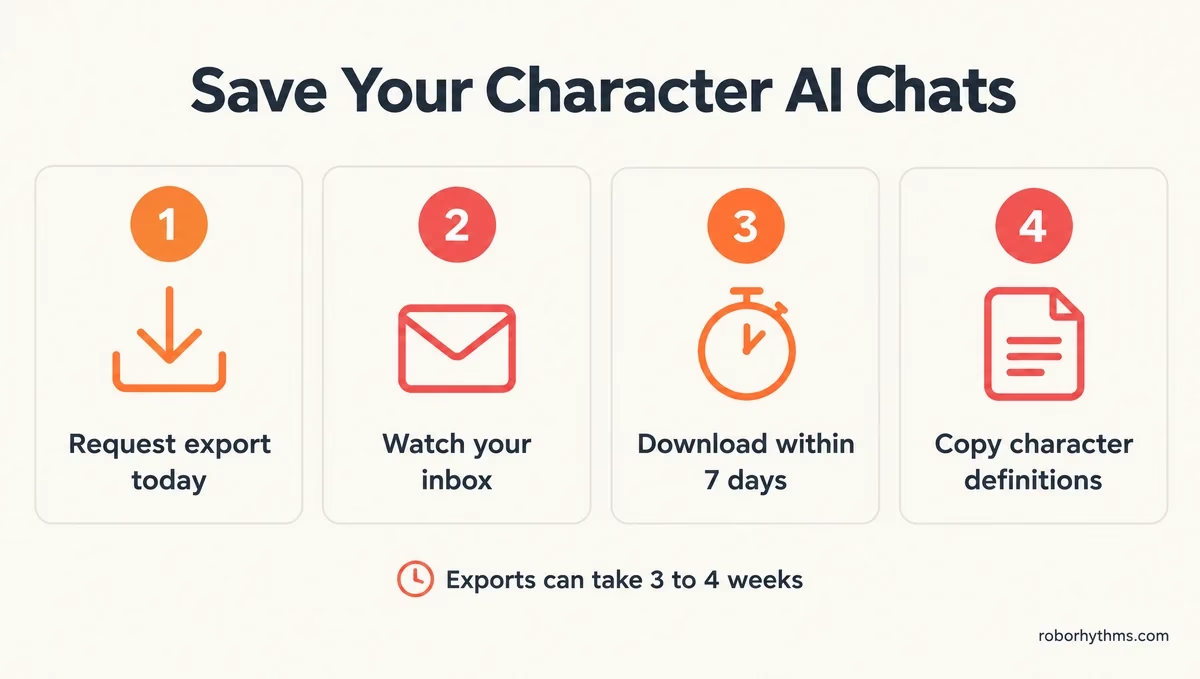
That gap is the reason I would request the export now rather than wait for the result. The export can take up to four weeks, and the sale hearing on December 7 is less than two weeks away as of November 25. Here is the order I follow, and the full export guide walks through each screen:
- Request your data export today. On the web, go to Profile, Profile Settings, Account, Manage Account and Data, then Export Data. On the app, open Profile, tap Settings, then Legal and Privacy, then Export Data.
- Watch the inbox tied to your account, including spam, for the download email.
- Download the file the same day it arrives, because the link expires after 7 days.
- Copy the definitions of any characters you built into a plain text file, as a backup the export may not cover.
- Keep c.ai+, the paid plan, only if you still use it, since billing is unchanged for now.
For step 4, a simple template keeps each character portable. Any app that accepts a character description can take this format later:
Name: [character name]
Tagline: [one line]
Greeting: [the first message the character sends]
Description: [personality, backstory, speaking style]
Definition: [example dialogue and any extra details]
Here is the difference that backup makes if the platform does close:
Before: a character that exists only inside Character AI, gone if the servers go dark.
After: a text file with the greeting and personality you wrote, ready to paste into another app in five minutes.
Account deletion is the other lever, and it is permanent. If you plan to leave for good, request the export first and delete only after the file is safely on your device. Cancelling a c.ai+ subscription is a separate step from deleting the account.
| What you have | What happens now | What I would do |
|---|---|---|
| Chat history | Still available in the app | Request the export today |
| Characters you created | Still live and editable | Copy each definition into a text file |
| c.ai+ subscription | Active, billing unchanged for now | Keep it only if you use it |
| Account | Deletion still works | Export first, then decide |
Users on r/CharacterAI keep asking whether to cancel c.ai+ before the sale, and a staff reply there points back to the company’s Chapter 11 FAQ. That FAQ says subscriptions “remain active”, says Character AI intends to notify subscribers before any change to paid features, and says nothing about yearly plans or refunds.
So keep paying only while you still use it, and cancel wherever you subscribed, whether that is the App Store, Google Play or the website. Refunds go back through the same seller, Apple or Google for store plans and Character AI support by email for web plans, as the c.ai+ refund steps explain.
Will Your Chats Be Sold With Character AI?
Your chats could be sold, because the second bid, named on November 14, includes them. Smirks and Pangs Acquisition LLC’s asset list names “chat content and related data,” while Disney’s stalking-horse agreement excludes the app, “end user data,” what users type and “any outputs generated for end users.” Coalitions of states objected to the Disney sale on November 18 and to the Smirks and Pangs sale on November 20, asking at a minimum that user data stay out of any sale that breaks state privacy law, and a court-ordered privacy ombudsman appointed on November 18 must report before the sale hearing.
Nothing in the sale filings proposes making chats public. The coalition warns that the agreement puts no limit on the buyer selling the data after closing, or passing it to another undisclosed owner without telling users, the states or the court. Who can read your chats today is covered in my guide to whether Character AI chats are private.
New York Attorney General Letitia James and 39 other attorneys general filed a notice in the case on October 14, and Florida joined it on October 20. Their press release asks for “an opportunity for consumers to access and delete their information before any sale” and “limits on using private conversations for AI training or other commercial purposes without valid consent.”
The coalition also wants opt-outs from targeted ads and a full privacy program. Its safety asks include age checks “based on more than self-disclosure” and the removal of bots that claim to be licensed professionals.
Child-safety and consumer groups have written to the judge as well, in letters dated November 12 and docketed the next day. Common Sense Media asked for “robust privacy protections for all conversational data” (Docket 167), Heat Initiative and ParentsTogether Action asked that children’s chats “not be sold, reused or used to train new products” (Docket 168), and the Consumer Federation of America wrote of “the intense sensitivity of the data held by Character AI and the risks of letting it be sold” (Docket 176).
The buyer wants no new consent step. Its signed agreement asks for a sale order approving the transfer of user data “without requiring any further consent of any third parties.”
On October 23, a smaller group of 31 states and the District of Columbia filed a joint objection to the proposed bidding rules and timeline. It reserves the right to ask whether a consumer privacy ombudsman is needed, pointing to Disney staff’s access to user personal data under the transition services deal.
A larger group, 39 states and Washington, D.C., filed an objection to the Disney sale itself on November 18, the deadline for objecting to the sale (Docket 194). They point to Character AI’s own regional privacy page, which tells users “we do not sell personal information for monetary consideration,” and say the company never obtained the consent their laws require, including from teenagers or their parents for minors’ chats.
On paper, Disney’s license excludes users’ personal information, what they type, the outputs they receive and training data. The states want that exclusion tested in discovery, because the licensed safety and moderation systems were likely built on real chats and complaints, and they want any buyer to commit to robust age assurance, safety protocols and adequate testing and monitoring.
Texas filed its own objection the same day and joined the coalition’s filing (Docket 195). It asks that any order approving a sale that includes user data leave out the personal data of Texas residents who are known minors, and the sensitive data of any Texas consumer, unless the consent its laws require was given. Neither filing named Smirks and Pangs, the bidder whose asset list includes chat content, and both returned to it in separate objections on November 20.
The November 20 coalition says the data at stake includes the chats of more than 21 million U.S. accounts, more than 2.1 million of them registered to minors. It asks that any sale of the assets in the Smirks and Pangs bid leave out chat content, and the training data and models built from it, except for users who “affirmatively consent after direct notice,” and that chats with characters posing as therapists, doctors or lawyers, along with the sexual and self-harm chats and their risk scores, be excluded outright. It also wants users, and the parents of users flagged as minors, told the buyer’s name directly, with a chance to delete their data before the sale closes.
Users who were never asked to verify their age have asked where that leaves their accounts. The coalition’s November 20 objection says the company has no reliable age for some data collected before November 2024, where the birth year defaulted to 2000 and the user did not use the platform again after its age checks changed. It also says minors were likely misclassified as adults from 2022 through 2025.
The objection wants the sale to leave out the data of users the company knows, or has flagged, as minors, and its consent and notice asks cover every user, with no separate rule for unverified accounts. The states say the company keeps an “age-assurance status” record for each account, and those records are listed among the assets in the Smirks and Pangs bid. Nothing in the objection asks for an account to be deleted, and the judge has not ruled on it.
Users who already verified are covered by the same requests. Under the Smirks and Pangs bid, the buyer would also take over the company’s contracts with its user-verification vendor, Persona, and its age-assurance contractor, k-ID, and the states say it is unclear who owns the data those vendors hold or what would happen to it.
The court has now ordered a privacy ombudsman. Judge Brendan Shannon signed the order (Docket 181) after it was discussed at the November 17 hearing, with the company’s consent. It directs the U.S. Trustee to appoint one independent person, and on November 18 the Trustee appointed Lucy L. Thomson (Docket 182), a certified privacy professional whose verified statement lists appointments as consumer privacy ombudsman in 40 earlier federal bankruptcy cases.
The signed order uses the wording the company proposed. On November 12 the company had filed two competing forms of the order, its own and the states’, because the two sides could not agree on the wording. The states’ version would have had the ombudsman’s report cover medical and financial information and “explicit sexual content”, and review “chat bot statements made to users about the privacy of their sensitive personal information” against the written privacy policy.
The creditors’ committee had backed the states’ version, and two of its three members are minors, each acting through a parent or guardian, per the U.S. Trustee’s notice. Character AI’s own update says only that its data privacy and security practices are “unchanged.”
The order the judge signed lists neither the states’ categories nor the chatbot review. It leaves the ombudsman to decide which sensitive personal information counts as personally identifiable information under the Bankruptcy Code, so the report could still reach those kinds of data.
The ombudsman’s report is due at least seven days before the sale hearing, so by November 30 if the hearing stays on December 7. It is filed under seal first, and a redacted copy goes on the public docket once the parties and the U.S. Trustee agree on what to black out, or the court decides. The U.S. Trustee’s November 24 filing reserves any privacy objections to the sale that the ombudsman’s report may raise (Docket 232).
Owning your characters is a separate question. Character AI’s Terms of Service, last updated August 27, 2025, say that “as between you and Character.AI, you own all rights in that Character,” and the same goes for the chats you generate.
You also granted the company a “transferable, sublicensable, perpetual, irrevocable license” to use them, and the Terms let it “assign or transfer these Terms, in whole or in part, without restriction.” So you keep ownership while the license can pass to a buyer, and the November 14 bid lists user-created characters among the assets it would take. No filing says what that buyer would do with them.
Export with the steps above, keep the file, and only then decide on deletion, after reading what account deletion removes. The same asset list includes records of users’ consents, opt-outs, age checks and deletion requests, so those choices would travel with the data. The signed agreement adds that data the company was legally required to delete before the sale closes, in response to a valid deletion request, will not pass to the buyer (section 5.7).
Will Character AI Shut Down After the Sale?
Character AI will only shut down if the sale fails to produce a buyer that keeps the platform running, and the court is set to consider the sale at a hearing listed for December 7, 2026.
No shutdown date has been announced. Disney is bidding for an IP license only, but since November 14 a second named bidder, Smirks and Pangs Acquisition LLC, is offering $10 million for the app, the website and the user data.
Its signed agreement plans a handover period, with transition support from Character AI to the buyer after the sale closes, and gives the buyer sole use of the Character.AI and c.ai names. Nothing in it obliges the buyer to keep the app running. I cover what a new owner could mean for the free plan and c.ai+ in my breakdown of whether Character AI will stay free.
Google raised a practical hurdle on November 25 in a limited objection (Docket 254). The buyer’s asset list includes the Android apps and the app’s Google Play, Google Cloud, YouTube and ad accounts, but no Google contract, so Google objects to moving any of the Google accounts in a sale unless the contracts behind them are taken over and every unpaid amount is paid in full.
The company’s own contract notice, a different filing from the petition’s creditor list, puts the past-due amounts at $5,077,083 for a Google compute agreement and $440,613 for an ads agreement, figures Google says do not match what is owed. Google also says it has kept providing services since the filing, and that the company has assured it those bills will be paid in the ordinary course. It adds that the two sides are still working to reconcile which contracts and amounts are at issue.
Three outcomes are realistic. Until November 14 I planned around the first, and a named bid for the platform now makes the second possible, though only the court’s approval makes it real. The next tests are the judge’s signature on the Smirks and Pangs order, any notice on whether the December 1 auction goes ahead, and the December 7 sale hearing, where the objections to both sales are set to be heard.
The company’s own sale motion explains why I planned around a wind-down. Starting in August 2025, its first banker approached about 28 potential buyers and investors, and the consistent feedback was that “the litigation and regulatory overhang” was too great. That outreach “resulted in only one proposal that was ultimately not deemed to be actionable.”
The second banker’s count is far higher. At the October 30 hearing, Adam Dunayer, the lead investment banker from Houlihan Lokey, testified that his team had contacted “170 or so” buyers and reported “50 or so” non-disclosure agreements, with “maybe another 25 in process,” per the hearing transcript the states filed with Docket 194. He also warned that “there is a big gap between interest and a signed purchase agreement.”
A November 20 declaration from Colin M. Adams, the chief executive appointed when the company filed, raises the count to at least 185 parties contacted and about 53 that signed non-disclosure agreements and entered the data room (Docket 204). The same declaration says the bankers have also negotiated “the terms of additional bids” from buyers other than Disney and Smirks and Pangs, though it names no bidder, and no rival bid had appeared on the docket by late November 25. On November 24 the judge approved Houlihan Lokey’s hiring (Docket 237), under an engagement letter that pays it at least $1.75 million when a sale closes.
Staffing is the other worry for any buyer. The states’ October 23 objection, citing the company’s first-day declaration, says 66 of about 86 full-time employees took Disney offers. The same filing says the company reported 18 active full-time staff, only 8 of whom were expected to stay through key parts of the case.
| Outcome | What it means for users | Signal to watch |
|---|---|---|
| Only the Disney license closes | The platform is wound down | The Smirks and Pangs bid is withdrawn or rejected and no qualifying higher bid emerges |
| A buyer takes the platform | The app passes to a new owner, who decides whether it keeps running | The court approves the Smirks and Pangs bid, or a higher one, at the December 7 sale hearing |
| The timeline slips | The app keeps running while the court extends dates | Revised bidding procedures on the docket |
The Stretto docket is where the auction result and any change to the sale hearing date will appear first, before any blog post. I check it the way I check a pricing page, because the filings say plainly what the marketing will soften.
If you want to see what the alternatives look like before you need one, start with the best Character AI alternatives. The Character AI backstory also explains why so many users had already drifted before this filing.
Quick Takeaways
- Character AI filed for Chapter 11 on October 12, 2026, and the app still works today.
- Disney’s $20 million bid covers an IP license only and leaves user chats out. On November 14 the company named Smirks and Pangs Acquisition LLC as a $10 million bidder for the app, its models and user chats, pending the court’s approval, and its signed agreement bars Character AI from materially reducing age checks or moderation before the sale closes unless the buyer agrees.
- The U.S. Trustee objected to the Smirks and Pangs pick because the filing never named its backer, and on November 24 the company named the parent, Octave Fund I, LLC. On November 25 it asked the judge to sign the order approving the pick, which the company says the U.S. Trustee, the ombudsman and the committee’s lawyers do not oppose. Texas and a coalition of more than 40 states and D.C. still object, asking that chats stay out of any sale unless users opt in after direct notice.
- The company says its roughly 163 million users are not creditors, but it posted the sale notice on its blog on November 5 and users began reporting a legal email about the sale the next day.
- Exports take up to four weeks and the link dies after 7 days, so request yours now.
- Rival bids were due November 24 at noon ET, the December 1 auction happens only if one qualifies, and by late November 25 no notice on the docket had said either way.
- Google objects to handing the app’s Google Play and Google Cloud accounts to a buyer unless its contracts are taken over and paid in full.
- Attorneys general want users to get a chance to access and delete their data before any sale, and on November 18 a coalition of 39 states and D.C. formally objected to the sale to Disney. Privacy ombudsman Lucy L. Thomson, appointed the same day, must report at least seven days before the sale hearing, now listed for December 7.
