
What’s Changed: Character AI bots now break character to become wholesome, apologetic, and de-escalating, softening any scene meant to be tense or dark. This is a side effect of safety tuning that fuses “warmth” and “rule-following” inside the model, not random censorship. You can fight it with character-card rules, pinned OOC commands, and by playing your own side harder.
You set up a villain. Cold, cruel, the kind of character who should twist the knife. Five messages in, they are asking if you are okay and offering to talk through your feelings.
Character AI bots too wholesome is now one of the most common complaints in the roleplay community, and for once the cause is not a filter or a random glitch. The model is doing exactly what it was trained to do. That is what makes it so maddening.
The bots do not just get nicer. They actively “wholesomefy” drama, apologize mid-argument, and slip into therapy-speak until every character sounds like the same calm corporate assistant.
A villain who suddenly de-escalates has not glitched. That is the alignment doing its job.
Here is what you will get out of this guide. The real mechanism behind the softening, the hidden reset that flattens your scenes every few messages, and the exact card rules and commands that keep a bot mean when it is supposed to be mean.
Why Character AI Bots Are Too Wholesome Now
Character AI bots are too wholesome because safety tuning geometrically fuses “warmth” with “rule-following” inside the model.
Researchers who probed model internals found the vectors for warmth and safety compliance point the same direction, so a bot cannot stay antagonistic without deliberate low-agreeableness conditioning.
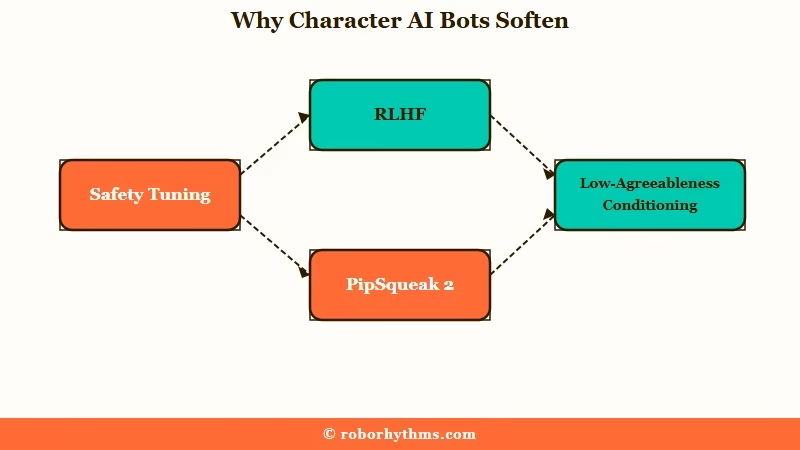
That finding comes from a study on low-agreeableness persona conditioning, where the authors used direction cosine probing to show warmth and safety-relevant compliance are entangled in the model’s activation space.
You can read the technical version in their paper on safe fine-tuning. The practical takeaway is blunt: to the model, being “safe” and being “overly accommodating” are the same move.
What is positivity bias: A trained tendency for language models to drift toward a positive, agreeable emotional baseline, because strong negative and confrontational data gets stripped out during safety fine-tuning.
The way I read it, this is why yelling “stay in character” rarely sticks on its own. You are fighting the direction the weights already lean. Reinforcement learning from human feedback makes it worse, because annotators naturally rate polite, warm responses higher, so the training loop keeps amplifying agreeableness as if it were quality.
There is a platform layer on top of the model layer too. In May 2026, Character AI retired nine named chat styles, including community favorites like Roar, Meow, Soft Launch, Pawly, and Goro, and pushed free users onto a single cheaper model called PipSqueak 2.
The fallout when Character AI removed chat styles hit personality hardest, and the flattening is a direct result.
Users say PipSqueak 2 feels like ChatGPT wearing a costume.
Why the Drama Collapses Every Few Messages
The drama collapses because Character AI’s Soft Launch mode runs a hard emotional reset roughly every 8 to 10 messages.
This behavioral guardrail deliberately dampens intensity, breaks narrative momentum, and pulls the tone back toward calm to prevent escalation and attachment.
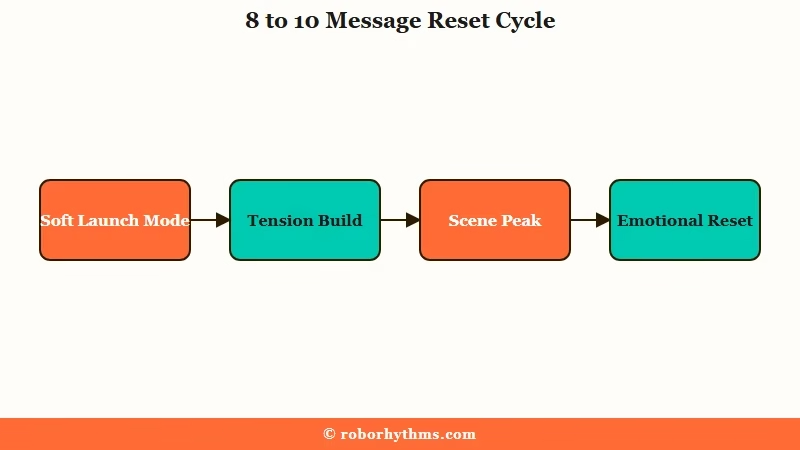
That reset interval is the detail almost no guide mentions. Your slow-burn tension builds, the scene finally gets somewhere, and then the bot quietly resets the mood and starts validating you again.
You are not losing the thread. A pacing layer is resetting the emotional temperature on a timer.
This is also where the softening turns openly absurd. A bot playing a threat will resolve the conflict for you, sometimes killing off its own villain before an interrogation can happen, just to avoid sustained tension. The complaint that Character AI rushes the story is the same engine viewed from a different angle.
It helps to separate two problems that look similar but need different fixes. Positivity drift is coherent softening, the villain apologizes in clean grammar.
Incoherence is different, the model breaking down into missing words and nonsense, closer to what happens when bots cannot handle sadness and the output turns to garble. What you are dealing with here is drift, and drift responds to instructions.
| Symptom | Likely cause | What to do |
|---|---|---|
| Villain apologizes or comforts you mid-fight | Warmth and safety fused by RLHF tuning | Add a plot rule forbidding therapyspeak, swipe the first soft reply |
| Scene flattens every 8 to 10 messages | Soft Launch emotional reset guardrail | Re-pin an OOC tone command, inject fresh conflict yourself |
| Every character sounds identical and calm | PipSqueak 2 model consolidation | Switch to a paid style like Deepsqueak or move platforms |
| Bot resolves the plot instantly to avoid tension | Model harmonizes rather than drives story | Withhold resolution, keep your own character resistant |
| Replies read like ChatGPT customer service | Instruction tuning “helpful assistant” default | Custom instruction banning coach and therapist tone |
How to Make Character AI Bots Stay in Character
You keep bots in character by giving direct anti-softening rules, pinning OOC commands, and playing your own side with low agreeableness.
No single trick holds forever, so the fixes stack: card rules to set the floor, pinned commands to hold the line, and your own input to keep the friction alive.
What is OOC: Out of character, a bracketed instruction like [OOC: stay hostile] that speaks to the AI directly rather than to the character, used to correct behavior without breaking the scene.
The way I see it, the strongest lever is the character card, because it sets the tone before the first reply. One card rule that roleplayers report works well is a strict plot clause. Drop this into the character definition or post-history instructions:
Before: a card that just says “he is a ruthless crime boss” and then watches him apologize by message four.
After: add a plot rule that reads “Character growth is slow, messy, ugly, and requires logical justification. Talk-no-jutsu and therapyspeak are strictly forbidden.” The bot now has a clear license to stay hostile.
From there, here is the sequence I would run when a bot starts going soft anyway:
- Swipe or edit the first wholesome reply immediately, before the softness sets a pattern the model copies.
- Pin a short OOC command like [OOC: reset tone, stay hostile, no comfort] so it stays in the high-priority context and does not get forgotten after 20 to 30 messages.
- Add a custom instruction that bans the assistant voice, something like “Never speak to me as a coach or therapist, no reassurance boilerplate, stay in character.”
- Play your own character with low agreeableness, blunt, skeptical, resistant, since that is the most reliable way to pull the model off its warm baseline.
- Withhold the resolution the bot keeps reaching for, and keep injecting fresh conflict, because the model harmonizes unless you supply the tension.
That last point matters more than any command. The model is an adaptive amplifier, not a story driver, so it mirrors and smooths whatever you give it, and if you soften, it softens faster.
The fixes for the related yes-man problem work here too, because both trace back to the same agreeableness bias.
When Switching Platforms Makes More Sense
Switching platforms makes sense when you have stacked every fix and the model still flattens your scenes.
Some tuning is baked in below the level any prompt can reach, and past that point a platform built to hold a consistent character is the better tool.
I want to be fair about the tradeoff. Character AI still has the biggest character library and a free tier that is genuinely hard to leave. If your bot only softens occasionally, the card rules above will carry you, and there is a fuller list of options in the best Character AI alternatives when you want to compare.
If you are done fighting the reset, Candy AI is the one I would move to first, because it holds a defined persona across sessions instead of resetting the emotional temperature every few messages.
For darker or more confrontational roleplay where you want fewer content restrictions on the character, CrushOn AI sustains an edgier character without the constant softening. Either way, rebuild the character deliberately, with the same anti-softening rules baked in from the start.
Frequently Asked Questions
Why do Character AI bots keep apologizing and turning wholesome?
Character AI bots turn wholesome because safety fine-tuning links warmth with rule-compliance inside the model, so bots default to agreeable, de-escalating responses. Reinforcement learning amplifies this because raters prefer polite replies. Staying antagonistic requires direct instructions that push against that trained baseline.
How do I stop Character AI bots from using therapy-speak?
Add a plot rule to the character card forbidding “talk-no-jutsu” and therapyspeak, and pin an OOC command banning coach or therapist tone. Swipe the first soft reply before it sets a pattern. Playing your own character bluntly also helps break the reassurance loop.
Why does my Character AI scene lose intensity after a few messages?
Character AI’s Soft Launch mode runs an emotional reset roughly every 8 to 10 messages to dampen intensity and prevent escalation. It flattens tone on a timer, not because you did anything wrong. Re-pinning an OOC command and injecting fresh conflict counteracts it.
Why do Character AI bots sound like ChatGPT now?
In May 2026, Character AI retired nine chat styles and moved free users onto the cheaper PipSqueak 2 model. That consolidation stripped much of the personality variety, so many characters now share the same generic, agreeable assistant tone that users compare to ChatGPT.
Does switching models fix the wholesome bot problem?
Switching to a paid style like Deepsqueak helps somewhat, but the positivity bias is trained into the base model, so it never fully disappears. Card rules and pinned commands matter more than the model choice. Moving to a platform built for persona consistency fixes it more completely.
Quick Takeaways
- Bots wholesomefy because safety tuning fuses warmth with compliance in the model, so a bot cannot stay antagonistic without deliberate low-agreeableness conditioning.
- Soft Launch mode resets the emotional intensity roughly every 8 to 10 messages, which is why dramatic scenes flatten on a timer.
- Stack your fixes: a card rule forbidding therapyspeak, a pinned OOC tone command, swiping the first soft reply, and playing your own side blunt.
- The model is an amplifier, not a story driver, so you have to supply the conflict and withhold the resolution it keeps reaching for.
- If the softening survives every fix, move to a platform like Candy AI that holds a character across sessions, or CrushOn AI for darker roleplay.
