
TL;DR: Candy AI’s roleplay works best when you open with a detailed scene-setting prompt, use asterisks for physical actions, and steer the narrative to trigger Story Mode images. The 15 scenarios below cover romance, fantasy, mystery, and more, each tested and ready to copy.
Most people jump into Candy AI with a one-line opener and wonder why the conversation stalls after three exchanges. The platform rewards setup, and the 15 Candy AI roleplay scenarios below are designed to give you a strong start in any genre.
What I found from testing is that the opener is almost everything. A prompt with a clear location, a defined relationship, and one unresolved tension runs for an hour. A vague opener runs for five minutes before both sides run out of things to say.
Try Candy AI on the free tier first to get a feel for how the characters respond, then upgrade if the session cap cuts you off mid-story. Premium unlocks full-length sessions and Story Mode image generation.
The AI companion industry has grown fast. According to Grand View Research, the AI companion market was valued at $28.19 billion in 2024 and is projected to grow at a 30.8% annual rate through 2030. Candy AI is one of the platforms leading that growth, with the company claiming over 2 million users.
What is Candy AI: Candy AI is an AI companion platform where you create or choose a character and have ongoing conversations, including extended roleplay sessions with memory across chats.
Before the scenarios, here is a two-minute primer on how Candy AI handles roleplay differently from most alternatives.

How Does Candy AI Roleplay Work?
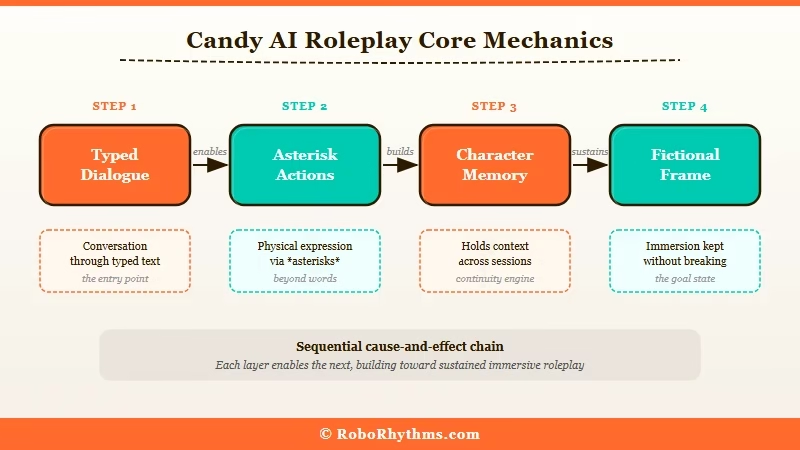
Candy AI roleplay works through typed conversation combined with asterisk-formatted actions that direct character behavior within the scene. Unlike platforms built purely for chat, Candy AI was designed with extended roleplay in mind, meaning the characters are built to stay in character across long exchanges.
The way I’d describe it to someone switching from Character AI: the memory is stronger, the character doesn’t break into disclaimers mid-story, and the free tier limits your session length. What you lose is the community-created character library. What you gain is a more consistent partner for extended creative fiction.
The core mechanic is simple. You type regular dialogue for your character. For physical actions or scene changes, wrap them in asterisks.
So “walks to the window and looks out at the rain” communicates movement without needing to narrate it separately. This signals to the AI that you’re in roleplay mode and want it to respond in kind.
For more prompt techniques across platforms, see our full guide to AI roleplay prompts.
What Are the Best Candy AI Roleplay Scenarios?
The best Candy AI roleplay scenarios give the character a clear role, place you in a specific location, and start mid-action rather than at a neutral point. Here are 15 organized by genre, along with notes on how each performs on the platform.
| Scenario Type | Candy AI Rating | Story Mode Images | Best For |
|---|---|---|---|
| Romantic slow-burn | Excellent | Triggered often | Long sessions |
| Fantasy quest | Very Good | Inconsistent | Creative writing |
| Slice-of-life | Excellent | Triggered often | Daily habit use |
| Mystery/detective | Good | Rarely | Puzzle-driven users |
| Sci-fi exploration | Very Good | Inconsistent | World-building |
Romance and Slow-Burn Scenarios (1-5)
These are the most consistent performers on Candy AI. The character memory means details from the opening exchange surface naturally ten messages later without you needing to repeat them.
Scenario 1: Enemies to Allies Sets the scene mid-tension. The character is someone you’ve clashed with for years; circumstances just forced you to share a safehouse for 48 hours.
Opening prompt: “We’ve been avoiding each other since the fallout two years ago, but now we’re stuck here until the storm passes. I drop my bag on the floor and look at you without saying anything. The silence in the small cabin feels heavier than the rain outside.”
Scenario 2: Childhood Friends, Reunited You’ve reconnected after a decade. Neither of you has said what you both feel.
Opening prompt: “I see you across the coffee shop before you see me. I almost leave before you turn around, but it’s too late. It’s been ten years. You look exactly the same.”
Scenario 3: New Neighbors Simple, low-stakes start that gives the story room to build. You’re borrowing something and neither of you expected to like the conversation.
Opening prompt: “I knock on the door twice and wait, holding an empty coffee mug. I know it’s late. I just moved in and my stuff isn’t here yet. Any chance you have instant coffee?”
Scenario 4: Boss and New Employee Classic power dynamic with natural room to evolve across sessions.
Opening prompt: “Today is my first day at the firm. You’re my manager and you’ve made it clear you set the standard here. I sit down across from you for the orientation and try not to look nervous.”
Scenario 5: Chance Meeting at an Airport Good for a one-session story with a defined endpoint. One of you has to board.
Opening prompt: “Our flight is delayed by six hours. I grab the seat next to you because it’s the only one with a working outlet. I notice your book. I read the same one on a train last year.”
Fantasy and Adventure Scenarios (6-9)
Fantasy works on Candy AI but needs more upfront worldbuilding. From my testing, spending your first two messages on the world before jumping into action leads to a much stronger session.
Scenario 6: Court Mage and the Rogue Knight The character is a knight who doesn’t trust magic; you’re the mage assigned to their mission.
Opening prompt: “The king assigned me to your party before I could argue. I secure my traveling cloak and catch up to your group at the gate. I know you don’t trust mages. You don’t have to. Just don’t get yourself killed before we reach the border.”
Scenario 7: Last Inn Before the Mountain Small setting, high stakes. The character is a mercenary; you need their help for a crossing.
Opening prompt: “I spread the map across the table between us. The pass opens for three days starting tomorrow morning. I can pay you what you asked. What I can’t do is make this trip alone.”
Scenario 8: Found in the Forest The character discovers you. Minimal setup needed. The scenario explains itself.
Opening prompt: “I’m sitting against a tree, my ankle wrapped in the sleeve I tore off my shirt. I’ve been here for two hours. You’re the first person I’ve seen. I don’t know this forest and my map is useless.”
Scenario 9: Dragon’s Negotiator Political fantasy. You’re negotiating a treaty with a dragon who has taken human form.
Opening prompt: “The kingdom sent me alone because they think a show of trust might work better than an army. I set the treaty documents on the table. I’m told you prefer directness. So: tell me what you want that we haven’t offered yet.”
Slice-of-Life Scenarios (10-12)
These are the strongest for building a long-term Candy AI relationship. The low stakes give the memory system room to shine, and you’ll notice the character referencing small details over time.
Scenario 10: Study Partners Library setting. The character helps you prep for an exam you’re not ready for.
Opening prompt: “Finals are in four days and I’ve barely covered half the material. I drop my notes on the table across from you. I heard you’re the person to ask. I’ll buy coffee if you can explain the chapters I missed.”
Scenario 11: Regulars at the Same Cafe You’ve been nodding at each other for weeks. Today someone finally says something.
Opening prompt: “You’re in my spot. I say it with a slight smile so you know I’m not serious. I’ve been coming here every Tuesday for two years. You’ve been here every Tuesday for the past month. I figured we should at least know each other’s names.”
Scenario 12: Late Night Kitchen Apartment setting, flatmates or close friends. No conflict needed.
Opening prompt: “It’s 11:30pm and I come downstairs to find you already in the kitchen. I couldn’t sleep either. I put the kettle on without asking and pull two mugs from the cabinet.”
Mystery and Thriller Scenarios (13-14)
Mystery requires the character to withhold information, and Candy AI handles this well when you set up the secrecy in your opener.
Scenario 13: The Witness You’re a detective. The character was present when something happened and hasn’t told anyone yet.
Opening prompt: “I set a coffee cup in front of you before I sit down. I’m not here to accuse you of anything. I just need to understand what you saw that night. Take your time. Start from when you arrived.”
Scenario 14: Classified Files Corporate thriller. The character reached out to you about something they found.
Opening prompt: “You reached out to me. I check the corridor before I sit down. Whatever you found is serious enough to risk this meeting. I need to know what’s in those files and why you came to me instead of your legal team.”
Sci-Fi Scenario (15)
Scenario 15: First Contact Protocol You’re a translator assigned to communicate with an alien diplomat who took human form to ease the meeting.
Opening prompt: “The briefing said you chose this form so we’d be more comfortable. I sit across from you and open my notebook. I appreciate the gesture. Let’s start simple: what should I call you, and what do you most want us to understand first?”
How Do I Write a Strong Candy AI Roleplay Prompt?
A strong Candy AI roleplay prompt sets the location, establishes the relationship, and opens mid-action rather than at a neutral starting point.
The single biggest difference between a session that runs for an hour and one that stalls at three exchanges is the opening prompt’s specificity.
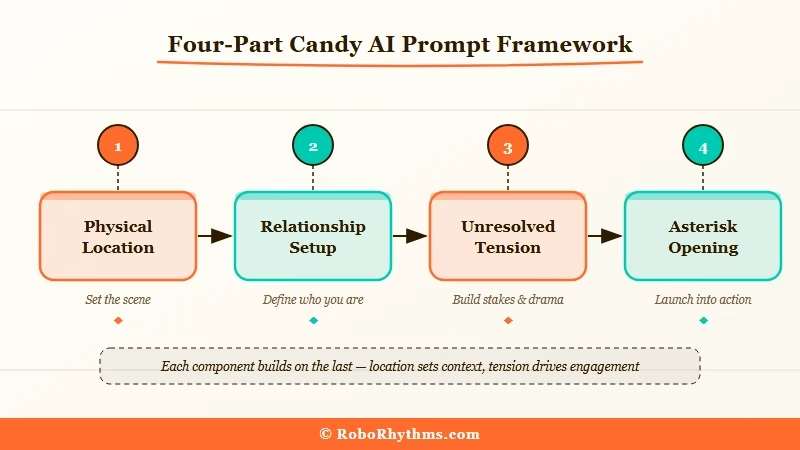
Here’s the framework I’d follow:
- Set the physical location in the opening line (“a small cabin, rain outside,” “the library closes in 20 minutes,” “your flight leaves in six hours”)
- Establish the relationship (whether you’re strangers, rivals, old friends, or colleagues). The character needs to know how to calibrate its tone
- Add one unresolved tension. Something that pulls the story forward without resolving itself in the first exchange
- Open mid-action with an asterisk move. Drop into a physical moment rather than narrating from outside the scene
| Prompt element | Example | Why it works |
|---|---|---|
| Location | “a small cabin, rain outside” | Anchors the character in a specific space |
| Relationship | “you’re my manager, first day” | Sets tone and power dynamic immediately |
| Unresolved tension | “your flight leaves in six hours” | Creates forward momentum without forcing resolution |
| Opening action | “I drop my bag on the floor“ | Grounds the scene mid-moment, not at a blank start |
Here’s what that looks like as a before-and-after:
Vague: “I want to do a roleplay. You’re my friend and we’re talking.”
Specific: “I find you sitting on the steps outside the venue, jacket over your shoulders. You missed the whole last set. I’ve been looking for you. I sit down next to you. Do you want to talk about it, or do you just want to sit here for a bit?”
The second version gives Candy AI a physical setting, an established closeness, an implicit conflict, and a natural choice to respond to.
If you want help generating openers for a scenario you have in mind, the AI roleplay scenario generator builds them on demand.
How Does Candy AI Story Mode Change the Roleplay?
Candy AI Story Mode generates images timed to your roleplay narrative, and you can steer which images appear by moving the scene to a setting with clear visual content. This 2026 update changed the platform meaningfully. It is no longer just text.
The mechanic tracks where the conversation is set and what the characters are doing. When the narrative reaches a scene with clear visual content (a dinner, an outdoor location, a specific outfit), Story Mode generates an image to match. The image follows the narrative, not keyword triggers.
The practical implication is that you can engineer the images. If you want to see your character dressed up, steer the conversation toward a formal setting (“I mention the gallery opening tonight” or “we end up at the restaurant you mentioned last week“).
From what I’ve seen, the romantic and slice-of-life scenarios above trigger Story Mode most reliably. Fantasy scenarios are inconsistent because the visual references are less anchored in real-world settings the model can render confidently.
What Do I Do When My Candy AI Roleplay Gets Repetitive?
Repetitive Candy AI roleplay almost always means the current scene resolved its tension without a new one appearing, not that the platform has hit a ceiling. This was the most common complaint I found in user discussions across AI roleplay communities: the AI starts looping on the same beats after a strong opening.
The loop kicks in when the current scene has used up its dramatic potential. The fix is injecting a new variable, not starting over.
Three methods that work, in order of how disruptive they are:
- Add a time jump. Write “Three weeks later, I run into you at the market.” This resets the scene without wiping the memory
- Inject an external interruption. Write “Someone knocks on the door mid-conversation.” Forces both characters to respond to something new
- Reveal withheld information. Write “I hand you the letter I’ve been deciding whether to give you.” Introduces stakes that pull the story forward
For a deeper breakdown of this problem across platforms, our fix repetitive AI roleplay guide covers platform-specific fixes in detail.
If Candy AI’s overall style doesn’t fit what you’re looking for, CrushOn AI handles long-form creative fiction with a slightly different approach. We broke down how they compare in Candy AI vs CrushOn AI.
Frequently Asked Questions
The most common questions about Candy AI roleplay cover setup, session length, and how to keep conversations from going stale.
Is Candy AI good for roleplay?
Candy AI is one of the stronger platforms for ongoing roleplay because the character memory holds context across long sessions. It outperforms Character AI in staying in character without breaking the fiction. The free tier caps daily messages, so serious roleplay users will want the paid plan.
Do I need Premium for Candy AI roleplay?
The free tier limits messages per day, which cuts sessions short mid-narrative. Premium starts at $12.99/month and removes that cap. For anything longer than a quick exchange, the paid plan makes a real difference.
How do I start a roleplay on Candy AI?
Select a character, open a new chat, and use your first message to set the scene. The 15 scenarios above are all designed as first messages.
Copy one, adjust the details to your preference, and send. The character will pick up from there.
How do I get Candy AI to generate images during roleplay?
Candy AI’s Story Mode generates images automatically when the scene has clear visual content. To trigger it, steer the conversation toward a specific location or outfit. Moving from a neutral conversation to a restaurant, a gallery, or an outdoor scene tends to prompt image generation within a few exchanges.
Why does my Candy AI roleplay keep repeating itself?
Repetition happens when the current scene has resolved its tension and no new hook has appeared. The time jump, external interruption, and revealed-information methods described above all introduce forward momentum without resetting the chat.
Can I use Candy AI for fantasy roleplay?
Yes, but fantasy needs more upfront setup than romance or slice-of-life. Spend your first two messages establishing the world before jumping into action. Scenarios 6-9 above include ready-to-use fantasy openers with the necessary setup built into the prompt itself.
