
TL;DR: Build a lead qualification agent with five questions, a two-dimension fit score, and a confidence threshold that gates Slack handoff. Practitioners on r/AI_Agents have flagged five failure modes that bite within the first month. A Novolytics benchmark puts AI cost per qualified lead at $3 to $8 versus $40 to $80 for manual SDR work.
The economics of an AI lead qualification agent are not subtle. A Novolytics benchmark for 2026 puts the cost per qualified lead at $3 to $8 with AI scoring versus $40 to $80 with a human SDR doing the same work, an 80 percent reduction. Prospeo’s mid-market data widens the gap further, $39 per qualified lead for AI versus $262 for a human SDR, with manual qualification eating 40 to 60 percent of an SDR’s time.
The gap exists. The reason most teams do not capture it is that the AI part is the easy part.
The hard part starts about a week after the agent ships. A recent r/AI_Agents thread on a five-question Slack-routed lead qualifier listed five things that broke first, and not one of them was the language model. Scoring logic, routing thresholds, CRM field structure, ignore-state handling, and Slack-noise discipline are what decide whether the agent earns its place in the sales stack or gets quietly archived after month two.
This walkthrough shows the architecture I would build today for a solo operator or small team, the framework choice that gets you to MVP fastest, the structured output schema that survives contact with sales, and the routing rules that keep your Slack channel from turning into a graveyard.
How a Lead Qualification Agent Works in Production
A production lead qualification agent is a six-layer system, not a single LLM call.
Solutelabs breaks the stack into gateway, guardrails and policy, agent runtime, tools and knowledge, validation, and logs and traces. The model is one layer of six; the other five are where every production failure I have seen tends to land.
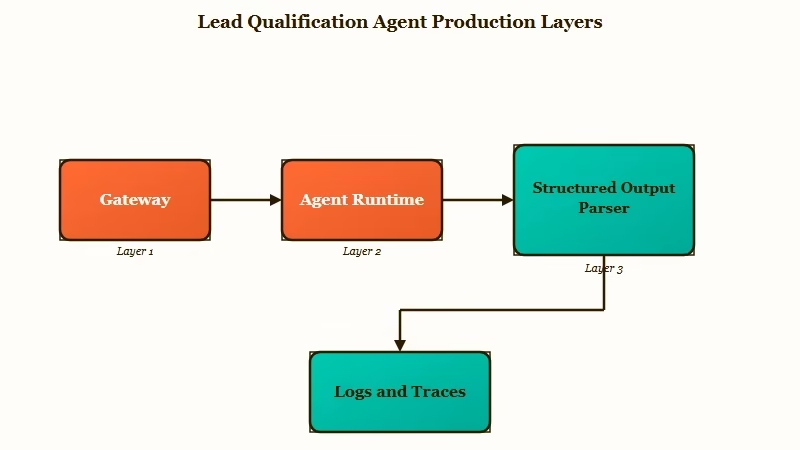
For a solo build, the easiest entry point is the n8n GPT-4o-mini workflow template, which collapses those six layers into a five-stage no-code flow you can ship in an afternoon. The stages, in order:
- Manual trigger (replace with form/webhook in production)
- Code node to ingest the lead transcript or form response
- AI Agent node calling GPT-4o-mini with the qualification prompt
- Structured Output Parser to enforce JSON shape
- Set node to clean the parsed fields before they hit downstream tools
Pick the framework based on your starting point, not on what is fashionable on Twitter. F3 Fund It benchmarked the four most common stacks for one-person teams in 2026 and the speed-to-first-workflow numbers are striking.
| Framework | First workflow time | Best for | Watch out for |
|---|---|---|---|
| n8n | 20 minutes | Non-developers, fastest MVP, ready templates | Self-host complexity, cloud op count pricing |
| Make.com | 30 minutes | Visual builders, broadest native connectors | Operation pricing scales with lead volume |
| CrewAI | 1 hour | Multi-agent (Researcher, Scorer, Router) | Python only, smaller connector library |
| LangChain | 2 to 4 hours | Maximum flexibility, custom toolchains | Documentation gaps, often need to read source |
| AutoGPT | 1 hour | Experimental autonomy, research builds | Can burn OpenAI credits in hours without step caps |
For a sales pipeline you want to keep running past the first quarter, my pick is n8n for the speed-to-first-lead, with Make.com as the second-best if you want stronger native CRM connectors out of the box.
If you need a code-level custom agent for an unusual scoring rule or a regulated industry, Dynamiq’s custom AI agent builder is the production-grade path. A longer Make.com walkthrough covers the platform choice in more depth.
One more layer to think about up front: the Slack handoff itself. The official Slack agent design tenets at docs.slack.dev are explicit on two things that matter for lead qualifiers.
Name the agent after its function (“Deal Desk” or “Lead Triage”) rather than a human name like “Sarah”, because the human-first naming blurs the line between team member and bot. And stream long-form responses but ship short structured ones as a single complete message, because sales reps scan, they do not read.
The Five Failure Modes That Kill Lead Qualification Agents
Every failure mode lives in the rules and routing, not in the model.
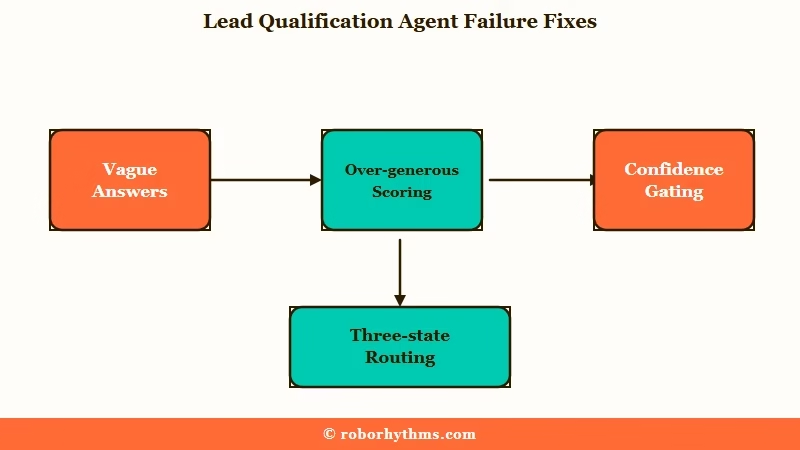
Practitioners on r/AI_Agents have documented five concrete ones, each with a specific fix that survived contact with a working sales team. From what I have seen, all five hit you in the same order on every new build.
| Symptom | Likely cause | Fix |
|---|---|---|
| Leads answer vaguely, scoring becomes inconsistent | Free-text inputs going straight into the scorer | Inference layer that rewrites vague answers into structured fields BEFORE the scorer sees them |
| Too many leads flagged hot, sales stops trusting alerts | Scoring weights enthusiasm equally with firmographic fit | Weight ICP fit (industry, company size, role) higher than urgency signals; cap intent_score contribution at 40 percent |
| Slack channel becomes a graveyard nobody reads | No confidence threshold, no short-format handoff | Set confidence threshold ≥ 0.7 to fire; trim handoff to company, use case, fit score, recommended next step |
| CRM fills with unstructured summary notes | Agent dumps free-text into a “notes” field | Replace notes with named structured columns: industry, companysize, leadsource, painpoint, fitscore, confidence |
| “Ignore” treated as a single state | Binary qualify/ignore logic | Three ignore reasons (not a fit, not enough info, not ready yet) each routed to a different downstream workflow |
The inference-layer pattern in row one is the single highest-leverage fix. A practitioner described it as “an inference layer that takes the user’s answers and rebuilds them before sending to the agent to score and route.”
This is the architectural move that turns a noisy free-text input into a clean scoring input, and it is the difference between a model that scores consistently across hundreds of leads and one that drifts depending on lead vocabulary.
Two failure modes worth flagging show up across the production literature even though the original five did not include them. A Solutions4sf analysis of broken Pardot scoring architectures found that roughly 70 percent of B2B scoring models stop correlating with conversion outcomes within 12 to 18 months.
The diagnostic signature is a bimodal score distribution where deals close at score 25 just as often as at score 250, and 10 to 30 percent of “MQLs” turn out to be existing customers reading upgrade content. Retune the scoring twice a year minimum.
The other one is the Pricing Page Paradox, surfaced in r/hubspot discussions of lead scoring failure modes. A lead visiting the pricing page four times in one week often scores lower than a cold lead because the model weighs firmographic fit too heavily and ignores behavioral intent.
The fix is a two-dimension score (fit on one axis, intent on the other) rather than a single composite, which Prospeo’s lead qualification process guide flags as the 2026 default for any team scoring more than 50 leads per week. Tool hallucinations from underspecified prompts compound all of the above when the agent is making the scoring call.
The Structured Output Schema That Sales Teams Trust
The schema is the contract between the agent and everything downstream. Get the field set right at the start and you can swap models, swap frameworks, even swap CRMs without rewriting the rest of the pipeline. What I would ship today is this shape, which holds up across the production builds in the source material:
{
  "company": "string",
  "industry": "string",
  "company_size": "1-10 | 11-50 | 51-200 | 201-1000 | 1000+",
  "lead_source": "string",
  "pain_point": "string (under 120 chars)",
  "fit_score": "integer 0-100",
  "intent_score": "integer 0-100",
  "confidence": "float 0.0-1.0",
  "route": "slack_hot | crm_warm | nurture_not_ready | dead"
}
The two-dimension scoring (fit and intent as separate integers, not collapsed into one composite) is what gives the routing logic something to act on. Slack-hot fires when fit ≥ 70 AND intent ≥ 60 AND confidence ≥ 0.7. The other routes fire on different combinations.
The prompt that produces this schema is where most builds slip, because asking the model to score in plain English produces inconsistent outputs across runs. The fix is to be brutal about format.
Vague: “Score this lead as hot, warm, or cold based on the answers below.”
Specific: “You are a lead qualification agent. Score this lead across two independent dimensions on a 0 to 100 integer scale. fitscore = firmographic match to ICP (industry, company size, role). intentscore = urgency signals in language (timeline mentioned, problem framing, existing tool dissatisfaction). Output JSON only matching the schema. If you cannot extract a field, set fitscore and intentscore to null and confidence to 0.3. Do not output any text outside the JSON object.”
That second prompt produces 90+ percent valid JSON across runs, where the first one produces a paragraph that the parser cannot use. Pair the prompt with the 4-section agent prompt structure (role, tools, decision rules, output format) and you cut hallucinated tool calls down to near zero.
The output the agent ships to your CRM and Slack should look like this after the parser cleans it up.
Before: “Summary: Lead from webinar seems interested in our product. Reasonably engaged. Sent to sales for follow-up.”
After: “Company: Acme Corp. Industry: B2B SaaS. Company size: 51 to 200. Lead source: Tuesday webinar. Pain point: manual onboarding eats 8 hours per week. fitscore: 78. intentscore: 62. confidence: 0.81. Route: slack_hot.”
The second version is what a sales rep can act on in five seconds. The first is what gets archived. The same principle that makes agent memory architecture work in long-running builds applies here: structured beats prose every time.
Three Ignore States and the Real Cost Per Qualified Lead
The single biggest mistake on first builds is treating “ignore” as one outcome. It is three, each pointing to a different downstream workflow.
- Not a fit. The lead’s firmographics rule them out (wrong industry, wrong company size, wrong role). Route to a “do not contact” tag in the CRM and drop. Re-checking quarterly is fine, weekly is wasted compute.
- Not enough info. The agent could not score with confidence (confidence < 0.5). Route to an enrichment workflow (Clearbit, Apollo, ZoomInfo, or a follow-up question sequence). Re-score after enrichment completes.
- Not ready yet. Good fit, low intent (fit ≥ 70, intent < 40). Route to a nurture sequence (drip email, retargeting list, monthly newsletter). Re-evaluate when intent triggers fire (pricing page visit, ROI calculator use, sales page revisit).
Each of those three calls a different system. Lumping them all into one “ignore” bucket means good leads either get ghosted or pestered out of the funnel.
Once the routing is right, the math becomes worth measuring. The Real Cost Per Qualified Lead formula from a r/VoiceAI Automation discussion is the only one I have seen that captures the full picture:
Real CPQL = (AI Cost + Telephony + Data + CRM + Infra) / Number of Qualified LeadsA sample voice agent campaign cited in that discussion ran 400 raw conversations through the formula and landed at 80 qualified leads at $25 per qualified lead total cost. That number is the one to benchmark your build against, and to compare to the 2026 industry conversion rates from the same Cufinder Lead-to-MQL data you can use as a sanity check on your own funnel.
| Stage conversion (2026 average) | Global avg | High performer | Watch out |
|---|---|---|---|
| Lead-to-MQL | 31% | Professional Services 35% | SaaS only 12-20% |
| MQL-to-SQL | 13% | B2B SaaS Enterprise 40% | Construction 12% |
| Cost per qualified lead (manual) | $40-$80 | n/a | Mid-market SDR $262 |
| Cost per qualified lead (AI) | $3-$8 | n/a | Voice agent $25 all-in |
The way I would think about this is: if your Lead-to-MQL is sitting under 20 percent six weeks in, the issue is almost always the inference layer (row 1 of the failure-mode table) rather than the model itself. The GitHub PR auto-fix agent patterns translate cleanly here, schema-first design with a strict validation layer at the boundary.
Frequently Asked Questions
What is the cheapest way to start building a lead qualification agent?
The n8n GPT-4o-mini lead qualification template is the lowest-cost path. Free self-hosted n8n runs locally, GPT-4o-mini costs roughly $0.15 per 1M input tokens, and you can ship a first version in 20 minutes. Total monthly cost for a 500-lead pipeline is typically under $5 in API calls.
How many qualifying questions should the agent ask?
Five is the sweet spot. Practitioners on r/AI_Agents have landed on five after testing more, because conversion drops sharply after question six and below three the agent has nothing to score. Map the five to: budget, timeline, use case, team size, existing tools.
How do I stop my Slack hot-leads channel from becoming noise?
Three rules. Set a confidence threshold of 0.7 minimum before firing. Send only the four-field handoff (company, use case, fit score, recommended next step) not the full transcript. And route low-confidence leads to enrichment or nurture, never to the hot channel.
What is a realistic cost per qualified lead with AI?
A Novolytics 2026 benchmark puts AI cost at $3 to $8 per qualified lead versus $40 to $80 manual. Prospeo’s mid-market data lands at $39 AI versus $262 SDR. Use the Real CPQL formula (AI + telephony + data + CRM + infra divided by qualified leads) to get your actual number, not the vendor’s marketing one.
Which framework should a solo founder pick?
n8n if you want first workflow in 20 minutes and have no Python preference. CrewAI if you want a Researcher plus Scorer plus Router multi-agent setup and you are already in Python. Make.com if you want the broadest native CRM connectors. LangChain only if you have a custom scoring rule the no-code platforms cannot express.
How often should I retune the scoring weights?
Every 6 to 12 months at minimum, before they decay. A Solutions4sf analysis of B2B Pardot scoring architectures found that 70 percent of models stop correlating with conversion outcomes within 12 to 18 months. The diagnostic signal is a bimodal won-deal distribution where the same close rate shows up at low and high scores.
