
The Verdict: The best Character AI alternatives for most users are CrushOn AI (best overall), FictionLab (best for storytelling), and Yn.app (best free tier). Each solves a specific problem that drove users away from Character AI, and none of them requires building your characters from scratch.
Character AI was once the default platform for AI roleplay and companion chat. Then came swipe limits, mandatory age verification, mid-conversation ads, and a “break time” feature that interrupts sessions without warning.
The platform’s filtering has also tightened significantly, frustrating users who want to explore creative fictional scenarios without constant interruptions.
Most guides covering alternatives respond to this by listing the same 8-10 apps and ranking them by how permissive they are. That framing misses what users complain about in forums: characters that forget who they are after 10 messages, no way to carry a persona from one app to another, and free tiers that run out before you finish a single story arc.
We spent several weeks testing 12+ platforms across the dimensions that actually matter: persona stability, memory quality, free message limits, and how well each handles long-form creative roleplay. Here is what we found.

Why People Are Leaving Character AI
People are leaving Character AI because swipe limits, age verification, mid-conversation ads, and worsening character consistency have made the platform frustrating for the users it was built for.
Character AI has introduced several changes that frustrated its core user base. Swipe limits now cap how many alternative responses you can generate per day, making story experimentation tedious.
Age verification has blocked access for a significant portion of users, and PCMag reported that these policy changes were driven by high-profile safety concerns rather than user experience priorities.
The deeper frustration is consistency. Long-time users call it “Standard Persona Syndrome”: after 10 to 15 messages, characters lose their distinct voice and revert to a generic, pleasant chatbot personality. For users who invest hours crafting detailed backstories, speech patterns, and relationship arcs, this makes sustained roleplay nearly impossible.
Understanding these specific pain points matters because the best alternatives solve specific problems. Not every platform is the right fit for every user.
Quick Comparison
The table below shows how each platform stacks up across the criteria that matter most: free tier generosity, memory retention, and how well characters hold their defined personality over time.
| Platform | Best For | Free Tier | Memory Quality | Persona Stability |
|---|---|---|---|---|
| CrushOn AI | Long-form story arcs | Generous | Good | Excellent |
| FictionLab | Complex storytelling | Yes | Excellent | Excellent |
| RealmsAI | True long-term memory | 50 msgs/day | Best-in-class | Good |
| Yn.app | Heavy free users | 2,000 msgs/day | Good | Good |
| SillyTavern | Power users | Free (self-host) | Fully customizable | Excellent |
| Candy AI | Emotional companionship | Limited | Good | Very Good |
| Janitor AI | Free fictional content | Yes | Good (pinned) | Very Good |
| Simulacra.Ink | No-account storytelling | Fully free | Good | Good |
| Sakura AI | Private, anonymous use | Yes | Excellent | Good |
| Chub.ai | Character library and hub | Free | N/A | N/A |
The Best Character AI Alternatives, Reviewed
The ten platforms below were each tested hands-on for persona stability, memory quality, and long-form story performance across real sessions, not just spec comparisons.
1. CrushOn AI, Best Overall for Story Arcs
CrushOn AI solves the two biggest complaints about Character AI in one package: persona stability and long-form story support.
The platform lets you pin facts about lore, relationships, and character traits that remain anchored across every session, preventing the drift that makes characters feel generic over time.
The free tier is more generous than most competitors, and the platform supports creative roleplay across a wide range of fictional scenarios without the mid-session interruptions users experience elsewhere.
The interface is polished and intuitive, which matters for users accustomed to Character AI’s smooth experience.
From what we tested, CrushOn AI holds character voice longer than any other hosted platform on this list. It also has a well-maintained public character library, so you can start with an established persona rather than building one from scratch.
2. FictionLab, Best for Complex Storytelling
FictionLab is the best-kept secret in the alternatives space and the platform most underrepresented in competitor guides. Reddit users consistently praise it for a feature no other platform offers: scheduled plot points and memory cards that persist across sessions, allowing you to build genuinely complex narrative arcs with a defined timeline.
The memory system works differently from most competitors. Instead of a context window that forgets older events, FictionLab uses 50 to 200 memory cards that you define yourself. The character references these cards consistently across every session, which eliminates the “who are you again?” problem that plagues long conversations on other platforms.
The free tier is fully functional, and the platform is actively developed. If your primary use is creative storytelling rather than companion chat, FictionLab is the strongest option available right now.
3. RealmsAI, Best for True Long-Term Memory
RealmsAI takes a different technical approach from every other platform on this list. It uses a RAG (retrieval-augmented generation) pipeline to give characters access to a genuine long-term memory store, meaning characters remember things you told them weeks ago without you having to re-explain context at the start of every session.
The platform also allows up to 50 characters in a single chat, which opens up multi-character roleplay scenarios that no competitor supports at this scale.
There is also a “Director Mode” that lets you observe other locations in the story world, adding a layer of narrative control that serious writers will appreciate.
The free tier offers 50 messages per day, which is enough to test whether the memory system lives up to its promise. For users whose main frustration with Character AI was characters forgetting established facts, RealmsAI delivers the most convincing solution we tested.
4. Yn.app, Best Free Tier
If your main concern is running out of free messages mid-session, Yn.app addresses this directly. The platform offers 2,000 messages per day on its free tier, which is more than any other platform we tested by a significant margin.
The character quality is solid without being exceptional, and persona stability holds up well across longer conversations. The development team is small but unusually responsive: bugs tend to get fixed quickly, and feature requests from the community often appear in the next update.
Yn.app is the right choice for users who want to explore the alternatives space without hitting a paywall mid-conversation, or for anyone building a daily chat habit that would exhaust smaller free limits within hours.
5. SillyTavern, Best for Power Users
SillyTavern is not for everyone. It runs locally on your machine, requires connecting your own AI backend (such as a free API from Claude, OpenAI, or open-source models through Ollama), and has a learning curve that will intimidate casual users. For those willing to invest the setup time, it offers a level of control that no hosted platform can match.
Memory, context size, persona definition, and response style are all fully configurable. Character cards in JSON or PNG format import directly, meaning you can bring characters from platforms like Chub.ai into SillyTavern without rebuilding them. Everything runs locally, so privacy is complete: nothing about your conversations leaves your device.
If you have tried every hosted platform and found them too inconsistent or too restrictive for your needs, SillyTavern is the final answer. It requires effort to set up, but the payoff is total creative control.
If the self-hosting route sounds like too much friction, Candy AI is worth bookmarking as the hosted alternative that gets closest to that level of consistency without any setup.
6. Candy AI, Best for Emotional Companionship
Candy AI is built around a different use case from most alternatives on this list. Where platforms like FictionLab optimize for storytelling craft, Candy AI focuses on the relationship dynamic: daily check-ins, emotional continuity, and a companion personality that adapts to your interaction style over time.
Persona stability is excellent because the character editor uses explicit trait definitions and example dialogue to anchor the character’s voice across sessions. The result is a companion that feels consistent over weeks in a way that Character AI no longer delivers reliably.
The free tier is limited compared to platforms like Yn.app, and the platform leans toward companion use rather than open-ended creative fiction. For users who valued Character AI primarily as a daily emotional outlet rather than a storytelling canvas, Candy AI is the strongest like-for-like replacement.
7. Janitor AI, Best for Free Fictional Content
Janitor AI remains one of the most widely-used free alternatives for creative fiction with fewer platform-level content restrictions. You can explore a wide range of fictional scenarios without the interruptions that have become common on Character AI, and the character library is one of the largest available anywhere.
The pinned memory system lets you anchor key facts about your character that persist across sessions, addressing the drift issue that undermines consistency on most free platforms. For a deeper look at what Janitor AI and similar options offer, our Janitor AI alternatives guide covers the broader ecosystem.
The platform runs on community contributions and may have slower response times during peak hours, but the free tier is fully functional with no hidden caps. It is also compatible with the standard character card format, making it easy to move personas between Janitor AI, SillyTavern, and Chub.ai.
8. Simulacra.Ink, Best for No-Account Access
Simulacra.Ink requires no account and no verification. You open the site, choose a scenario, and begin. For users who left Character AI partly due to its increasingly strict identity requirements, this is a meaningful differentiator.
The platform is designed specifically for long-form interactive fiction, and it handles narrative consistency better than most no-frills alternatives. The fully free, no-account model makes it ideal for trying the alternatives space without any commitment.
It lacks the customization depth of platforms like SillyTavern or FictionLab, but for users who want to get into a story immediately with zero friction, Simulacra.Ink is the fastest path available.
9. Sakura AI, Best for Private Use
Sakura AI is a Reddit community favorite that rarely appears in professional comparison articles. The platform requires no verification, maintains excellent memory for a free service, and has stayed relatively small and quality-focused compared to the larger platforms.
Character consistency holds up well across longer sessions, and the memory system outperforms most free-tier competitors in practice. Users who prioritize anonymity and do not want to link personal information to their roleplay activity consistently recommend Sakura AI over larger alternatives.
It lacks the visual polish of platforms like Candy AI, but the core chat experience is reliable and the community is active.
10. Chub.ai, the Character Hub Every User Needs
Chub.ai is less of a chat platform and more of an infrastructure layer for serious users of the alternatives space. It hosts one of the largest public libraries of character cards in JSON and PNG formats, compatible with SillyTavern, Janitor AI, and most other platforms that support character imports.
The practical benefit is significant. Instead of rebuilding a character from scratch each time you try a new platform, you find the card on Chub.ai, download it, and import it in seconds. For users struggling with rebuild fatigue when switching platforms, this changes the entire workflow.
Chub.ai does support direct chat, but its main value is as a character repository and portability backbone. Pair it with any other platform on this list and the combination is stronger than either alone.
Standard Persona Syndrome
Standard Persona Syndrome is the pattern where AI characters lose their distinct personality after 10 to 15 messages and revert to a generic chatbot voice, regardless of how detailed your original character setup was.
Every alternatives guide covers features and free tiers. Almost none address why characters feel wrong after the first few sessions.
Standard Persona Syndrome happens when the AI’s base training overrides your custom character definition as the conversation grows longer. The character starts responding like a generic assistant rather than the specific persona you created. You notice it around message 10 to 15: the distinct voice softens, the quirks disappear, and the character becomes interchangeable with every other bot.
The solution is platform-specific but follows a common pattern. Look for platforms that support pinned facts (Janitor AI, CrushOn AI), persistent memory cards (FictionLab), or RAG pipelines (RealmsAI). These mechanisms force the AI to reference your character definition throughout the conversation rather than letting base training gradually override it.
When evaluating any new platform, test for drift deliberately. Run a 30-message conversation and compare the character’s voice at message 25 to message 5. That single test tells you more about platform quality than any feature comparison chart.
How to Move Your Characters Across Platforms
Moving your characters between apps is possible using a standard format called character cards, which store your persona’s full definition in a portable JSON or PNG file that most serious platforms accept.
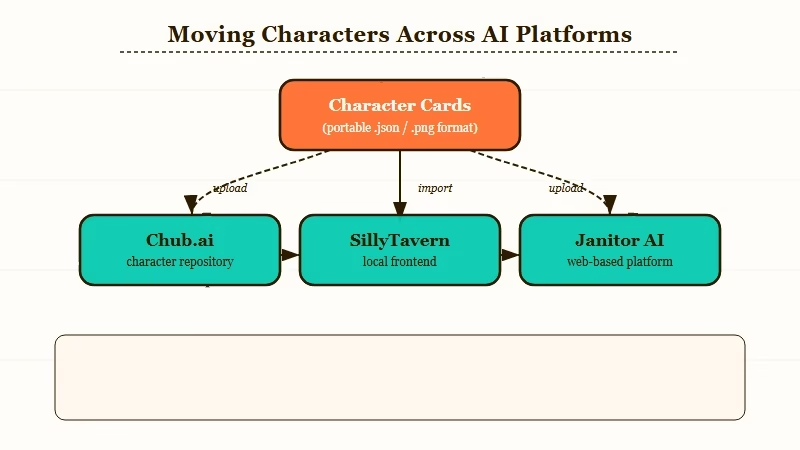
One of the most useful things no alternatives guide covers is character portability. Most platforms support a standard format for exporting character definitions: a JSON file or a PNG image with embedded character data. These are called character cards, and they are the key to switching platforms without losing your work.
Here is the workflow I use when moving a character to a new platform:
- Open your current platform’s settings and look for an “Export character” or “Download card” option.
- Save the JSON or PNG file somewhere accessible, such as a Chub.ai profile or a local folder.
- On the new platform, open the character creator and look for an “Import” button.
- Upload your card file. The character’s name, backstory, personality traits, and example dialogue will populate automatically.
- Run a short 10-message test session to confirm the character voice transferred correctly before committing to a longer story.
SillyTavern, Janitor AI, and most open-source tools support this format natively.
For platforms that do not support card import, keep a plain text document with your character’s core definition: name, backstory, speech patterns, key relationships, and pinned facts. Paste this into the system prompt or character setup field on each new platform. It takes five minutes and prevents hours of rebuild work later.
Example character definition you can adapt:
Name: Mira
Personality: Blunt, curious, dry humor. Never sugarcoats feedback. Deeply loyal once trust is established.
Background: Former cartographer who now runs a small archive of forbidden maps.
Speech style: Short sentences. Uses specific place names and distances. Avoids metaphors.
Key facts: Hates the city of Velmoor. Carries a compass that never points north. Has not slept in three days.
Paste this kind of block into any platform’s system prompt and the character will stay grounded significantly longer before drift sets in.
How Character AI’s Chat Styles Affect the Switch
Character AI’s chat style system shapes response rhythm in ways that make alternatives feel unfamiliar at first, even when the underlying quality is comparable or better.
One thing worth understanding before switching is that Character AI’s chat style system shapes how users expect AI conversations to feel.
The Classic, Balanced, and Roleplay styles each produce different response rhythms, and users often find alternatives feel “off” initially not because they are worse, but because the response style is unfamiliar.
Give any new platform at least 20 to 30 messages before judging the quality. The initial adjustment period is real, and first impressions in AI chat are often misleading.
Frequently Asked Questions
Is there an AI better than Character AI for roleplay?
FictionLab and CrushOn AI both outperform Character AI for sustained roleplay quality in our testing. The key advantage is memory: both platforms maintain character consistency across longer sessions in a way that Character AI no longer delivers reliably.
Which Character AI alternative has the best free tier?
Yn.app offers 2,000 messages per day for free, which is the most generous free tier we found. Janitor AI and Simulacra.Ink are also fully functional for free users with no hidden caps. SillyTavern is technically free but requires self-hosting setup that involves technical configuration.
Can I keep my Character AI characters when switching?
Not directly, but you can recreate them using character cards. Write down your character’s full definition (personality, backstory, speech examples, key facts) and import that into your new platform’s character creator. Platforms like Chub.ai and SillyTavern support standard character card formats that transfer between compatible apps without any rebuilding.
What is the best Character AI alternative for emotional companionship?
Candy AI is the strongest option for daily companionship use. The character adapts to your interaction style over time and maintains a consistent personality better than most alternatives. Nomi AI is also worth considering if you want a companion that builds genuine long-term memory of your conversations specifically.
What happened to Character AI’s swipe feature?
Character AI limited swipes as part of its broader monetization changes in 2025 and 2026. You can read the full breakdown in our Character AI swipe limit guide.
Which alternative is best for users who want creative fictional content with fewer restrictions?
Janitor AI and CrushOn AI both support creative fictional scenarios with fewer platform-level restrictions than Character AI. For users who want complete control, SillyTavern running a local model has no restrictions at all since you control the underlying system entirely.
The Bottom Line
The right Character AI alternative depends on the specific reason you left, not on which platform has the most features.
The platforms on this list each solve a specific problem that drove users away from Character AI. Here is the shortest path to the right pick:
- Characters kept losing their voice: CrushOn AI or FictionLab
- Characters forgot facts from earlier sessions: RealmsAI
- Free messages ran out too quickly: Yn.app
- You want full control and do not mind technical setup: SillyTavern
- You want a daily companion, not a storytelling tool: Candy AI
- You want to start immediately with no account: Simulacra.Ink
The platforms on this list solve real, specific problems that the Character AI user base has been vocal about. One of them will fit what you actually need.
