
The Verdict: For long-form story and narrative video, LongStories.ai is the top pick, holding one face, one style, and one identity across scenes for videos up to 15 minutes long. For talking-head long-form, avatar tools lead. HeyGen wins on per-video duration ceiling (30 minutes). Synthesia wins on language coverage and corporate workflows. Pictory wins for repurposing existing long-form content. Generative models like Veo 3 and Runway Gen-4 are still capped under 30 seconds and belong as B-roll, not as the primary tool for long videos.
The “best AI video generator” question splits into two completely different categories the moment you ask “for what.” For 8-second cinematic clips and short-form social cuts, Sora 2, Veo 3, and Runway Gen-4 dominate. For anything that needs to run longer than 30 seconds, those tools become the wrong answer almost immediately, and most “top AI video generator” lists fail to make this distinction.
This piece is for the second use case. If you’re producing a 5-minute product tour, a 10-minute training module, a YouTube essay, or a long-form marketing explainer, the right answer is almost certainly an avatar-based or repurposing tool, not a generative model.
The duration ceilings, the monthly minute allocations, and the practical workflow integration matter far more than which model produced the prettiest 8-second cinematic clip on Twitter last week.
I’ve been watching the long-form AI video category since the Sora shutdown in March 2026, and the lineup has stabilised around one story-video specialist (LongStories.ai), three avatar tools (HeyGen, Synthesia, Pictory), and one editor that handles long videos via transcript-first workflow (Descript). Generative tools play a supporting role.
Cisco’s Annual Internet Report projected that video would account for more than 80 percent of global internet traffic by 2025, with long-form formats taking a growing share of that mix. Generative video models do well on short clips and lose coherence past 60 seconds, which is why the right tool for long video work is almost never the first one a benchmark league table will recommend.
Why Generative Models Are the Wrong Tool for Long Videos
The longest a leading generative model can produce in a single shot is roughly 60 seconds, and most cap at 8 to 20 seconds.
For long videos, you’d need to stitch dozens of clips together, and character continuity falls apart across cuts.
Veo 3 currently holds the longest single-shot duration at 60 seconds for the most generous setup, with most outputs sitting in the 6 to 8 second range. Runway Gen-4 produces 10 to 12 seconds. Kling generates 15 seconds. Sora is gone, the API will follow later in 2026.
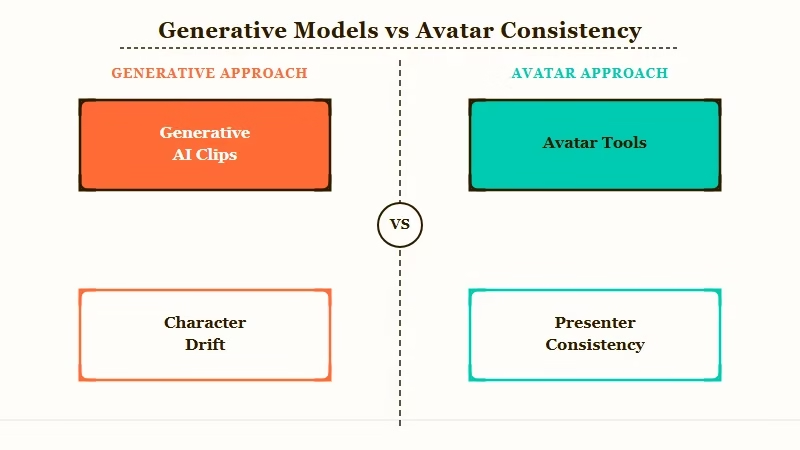
The structural problem is character consistency. To produce a 5-minute video with Veo 3, you’d need roughly 75 separate clips. The current generation of generative models cannot keep a character looking like the same person across that many cuts. Hair changes. Clothing shifts. Backgrounds drift. The result feels like a series of separate shots rather than a continuous video.
Avatar-based tools solve the consistency problem at a different layer. The avatar is rendered, not generated, so the same person appears in shot 1 and shot 75 with identical hair, identical clothing, and identical lighting. The trade-off is creative range. You get a presenter in a fixed environment, not a cinematic short film.
For long videos, the trade is worth it. Most multi-minute content people need to ship is presenter-style, not cinematic. Product tours, training modules, marketing explainers, social media talking-head content, and corporate communications all live in the avatar territory.
How the Long-Form AI Video Tools Compare in 2026
The five meaningful long-video tools in 2026 are LongStories.ai, HeyGen, Synthesia, Pictory, and Descript. Each wins a different scenario. The right pick depends on whether you’re starting from a script, an existing long-form asset, or raw footage.
The data table:
| Tool | Max video duration | Monthly allocation | Entry price |
|---|---|---|---|
| LongStories.ai | 15 minutes per video | Credit-based (Pro: ~16 min/mo) | Free; $59/mo (Pro) |
| HeyGen | 30 minutes per video | 30 minutes/month (Creator) | $29/mo |
| Synthesia | Multi-minute (script-based) | 120 minutes/year (Starter) | $29/mo |
| Pictory | Source-document length | 30-60 videos/month | $23/mo |
| Descript | Unlimited (full editor) | 10-30 hrs transcription | $24/mo |
| Veo 3 / Runway / Kling | 8-60 seconds per clip | Credit-based | $15-$20/mo |
I’d think about the picks like this:
LongStories.ai Wins for Long-Form Story and Narrative Video
LongStories.ai is the pick I reach for first when the long video is a story rather than a talking head. It is built for long-form narrative video, holding one face, one style, and one identity across scenes for videos up to 15 minutes, which is the exact point where generative clip models lose coherence.
That character consistency is the whole game for faceless YouTube channels, animated explainers, and music videos, the long-form formats growing fastest right now. More than 10,000 creators have made 20,000+ videos on it, and going from one episode a week to one a day is the kind of throughput the avatar tools below cannot match for story content.
Use LongStories.ai for: narrative marketing videos, animated explainers, multi-scene brand stories, music videos, and any long-form piece where the throughline is a story, not a presenter. Paid plans start at $59/month, with a free tier to test it first.
HeyGen Wins on Per-Video Ceiling and Live Avatars
HeyGen lets you produce a single video up to 30 minutes long on the entry plan. That’s the longest single-shot avatar production in the consumer tier of any tool I’ve evaluated. For training videos, long product walk-throughs, and onboarding content, the per-video ceiling matters more than the monthly minute total.
The newer feature worth knowing is HeyGen’s Live Avatar, which turns a long-form video into an interactive knowledge base where the avatar can respond to viewer questions in real-time using a custom knowledge base. For internal training or sales enablement, this is a genuinely new capability that doesn’t exist on competitors. The HeyGen review covers the broader product in detail.
The trade-off is voice cloning quality at the entry tier. The voice clones get noticeably more natural at the higher tiers, and the entry tier voices can sound mechanical for emotional content.
Synthesia Wins on Languages and Corporate Polish
Synthesia’s positioning is corporate polish. The avatar quality at the entry tier is higher than HeyGen’s, and the language coverage (140+ languages with automated lip-syncing) is the broadest in the category. For a marketing team needing to translate a 5-minute product tour into 30+ languages, Synthesia is the only tool that does it without manual reshoots.
The catch is the monthly minute allocation. The Starter plan is 120 minutes per year, which works out to 10 minutes per month. For high-volume teams, you’re either paying for higher tiers ($89/mo Creator, $1,000+/mo Enterprise) or hitting the cap inside week three. The HeyGen vs Synthesia comparison breaks down the per-tier math.
Use Synthesia for: corporate communications, multi-language marketing, training content where polish matters more than volume.
Pictory Wins for Repurposing Existing Content
Pictory takes a different approach. Instead of generating from a script, it ingests existing long-form content (blog posts, webinars, podcast transcripts) and converts it into branded short videos with captions and voiceovers. For content marketers sitting on a back catalogue of long blog posts or podcast transcripts, Pictory turns that asset library into video without writing new scripts.
The 30-60 videos per month allocation is generous. The trade-off is that Pictory is repurposing-first, not creation-first. You can’t easily start from a blank script. The Pictory AI review covers the workflow and limits in detail.
Use Pictory for: blog-to-video pipelines, webinar recap videos, podcast-to-video conversion.
Descript Wins When You Already Have Footage
Descript is a different beast. It’s a full video editor that lets you edit by editing the transcript. Delete a sentence in the document and the corresponding video clip is removed. Reorder sentences and the video reorders. For long-form video editing, this transcript-first workflow is a 10x time saver compared to traditional non-linear editors.
Descript’s catch is that it’s a video editor first, not a generator. If you need to produce a long video from scratch with no existing footage, Descript won’t generate the source material. It excels when you already have raw footage (recorded webinars, talking-head footage, interviews) and need to cut it into a polished long-form video fast.
Use Descript for: editing existing long-form video, podcast video production, talking-head content where you’ve already recorded the footage.
The Concrete Comparison Scenario for a 10-Minute Marketing Video
Example scenario: You’re producing a 10-minute product tour for a SaaS launch. On HeyGen, you script the tour, pick an avatar, generate the 10-minute single video, and export. On Synthesia, you do the same but spend 10 of your 10 monthly minutes in one shot, leaving nothing for revisions. On Veo 3, you’d need 75 separate generated clips and the character would change appearance multiple times. On Descript, you’d need to record the 10 minutes yourself first.
The HeyGen path is what almost every solo marketer or small-team creator I’ve watched evaluate this pick ends up choosing. The single-video ceiling is the practical decision factor.
How to Pick the Right Long-Video AI Tool
Pick by where your raw material is starting from, not by which tool produces the prettiest 8-second clip.
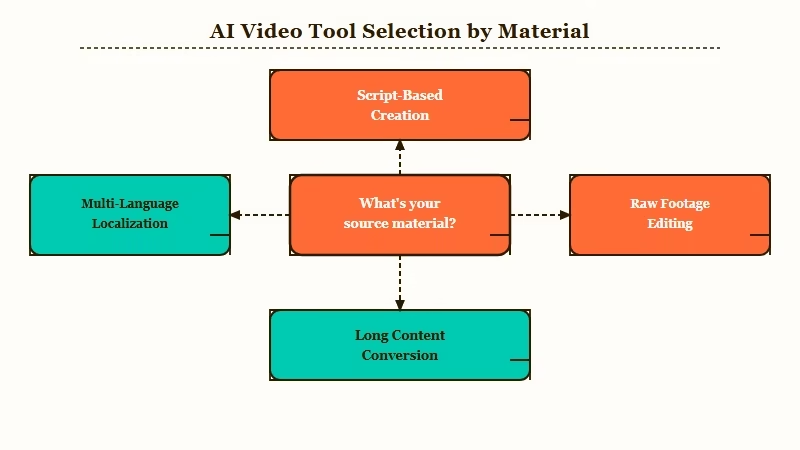
Use this decision flow:
- You’re making a long-form story, animated explainer, or music video → LongStories.ai. Character consistency across scenes for videos up to 15 minutes is what wins this scenario, the format generative clips cannot hold.
- You’re starting from a script and need a single long talking-head video → HeyGen Creator. The 30-minute single-video ceiling and live avatar option win this scenario.
- You need multi-language localization at corporate polish → Synthesia Creator or higher. Nothing else handles 30+ language outputs without manual reshoots.
- You have long-form content (blogs, podcasts, webinars) to convert → Pictory Standard. The repurposing workflow is the time saver.
- You already have raw footage and need to edit it down → Descript Creator. The transcript-first editing is the multiplier.
- You need short cinematic B-roll, not a long video → Veo 3, Runway Gen-4, or Kling. These are not long-video tools. Use them for accents inside a long video produced elsewhere.
- You want animated narrative, not talking heads → the AI story maker category guide covers the integrated narrative tools (LongStories AI, LTX Studio, Kaiber) built for multi-minute story videos with character consistency, a different architecture entirely from the avatar tools above.
Frequently Asked Questions
What is the longest single video an AI tool can generate in 2026?
HeyGen at 30 minutes per video on the Creator plan. Synthesia handles multi-minute videos with no fixed per-video ceiling within your monthly allocation. Generative models like Veo 3 cap at 60 seconds in their most generous configuration, and most clips run 6 to 12 seconds.
Can Sora generate long videos in 2026?
No. OpenAI announced the Sora web and app experiences are being discontinued, with the API following later in 2026. Sora is no longer a viable choice for any video duration in 2026.
How does HeyGen compare to Synthesia for marketing teams?
HeyGen wins on per-video ceiling and live avatars. Synthesia wins on language coverage and corporate-grade polish. For solo creators or small teams producing English-only content, HeyGen is usually the better pick. For multi-language enterprise marketing, Synthesia is structured for that use case.
Is Pictory good for YouTube long-form videos?
Pictory is better for short-form repurposing than original long-form. It takes existing long content and produces shorter clips, captions, and B-roll style assemblies. For original 10+ minute YouTube essays, HeyGen or Descript are stronger fits depending on whether you’re starting from a script or from raw footage.
What’s the cheapest way to make a 10-minute AI video?
Pictory at $23/month if you’re repurposing existing long-form content. HeyGen at $29/month if you’re starting from a script. Descript at $24/month if you already have the raw footage. The monthly minute allocations matter as much as the entry price.
Should I use a generative model like Veo 3 for any part of a long video?
Yes, for cinematic B-roll inserts. Veo 3, Runway Gen-4, and Kling produce 8-15 second cinematic clips that are better than stock footage for accenting key moments inside an avatar-led long video. They are not the primary tool for long-form content, they are the seasoning.
