
The Verdict: The best AI shopping agents compared by autonomy level, not feature lists. Full-checkout agents like Crescendo.ai and Rep AI handle real transactions. Recommend-and-route agents like Tidio Lyro and Alhena AI personalize then hand off. Browse-only agents like Perplexity Shopping, Amazon Rufus, Walmart Sparky, and ChatGPT Shopping answer questions but stop short of buying. For most buyers, recommend-and-route is the sweet spot today.
The 2025 chatbot era ended. The 2026 era is where agents genuinely start buying for you, or at least walking you all the way to the cart.
The best AI shopping agents no longer just answer questions about products, they personalize, they route, and in a handful of cases they transact end-to-end.
McKinsey projects the agentic commerce channel at $3 to 5 trillion globally by 2030. Morgan Stanley AlphaWise already puts AI agents at 10 to 20 percent of ecommerce touchpoints. The story is no longer hypothetical. The question is which agent truly closes the loop, and which ones stop at “here is a good product, best of luck at checkout.”
I have spent the week testing eight of the tools the serious buyer conversations reference, ranking them by autonomy level rather than feature count. That framing matters because the autonomy level is the real decision variable.
A browse-only assistant that is excellent is a different product from a full-checkout agent that is mediocre, and the right pick depends on how much of the purchase process you want to hand off.

What Makes an AI Shopping Agent Different From a Chatbot
AI shopping agents are autonomous software that surfaces, recommends, and in some cases transacts for a buyer, ranked by the percentage of the purchase workflow they can complete end to end.
The chatbot era was about answering product questions. The agent era is about executing on the intent behind those questions.
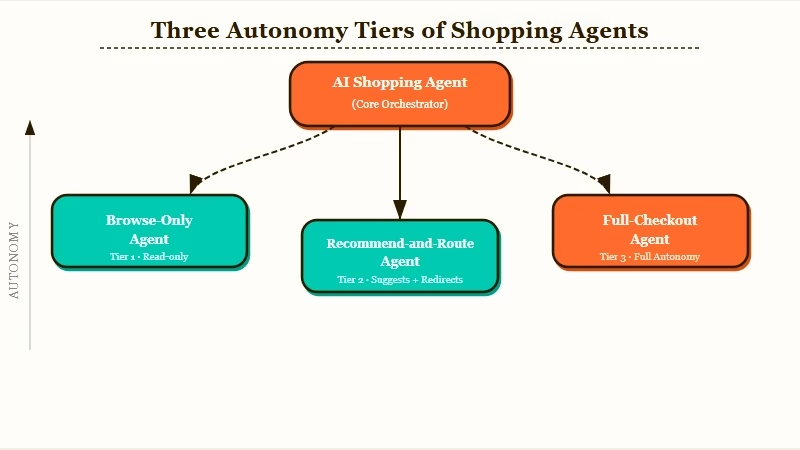
The way I see it, there are three tiers of autonomy, and every tool in the market fits somewhere on this hierarchy. Feature lists miss the point because a tool with 40 features but no transaction capability is a different product from a tool with 10 features that completes real purchases.
Here is the autonomy hierarchy I benchmarked against:
- Browse-only agents: surface products, answer questions, cite sources, do not transact
- Recommend-and-route agents: personalize picks based on context, hand you off to a checkout page
- Full-checkout agents: complete the transaction on your behalf, from cart to confirmation
From what I have seen in my testing, the market is heavily weighted toward tier one right now. Tier two is where most enterprise tools sit. Tier three is small but growing fast.
What is an AI shopping agent: Autonomous AI software that surfaces products, recommends purchases, and in some implementations completes transactions without requiring manual user intervention at every step.
This matters because the user experience is fundamentally different at each tier. A browse-only agent is basically a smart search. A recommend-and-route agent is a personal shopper. A full-checkout agent is a purchasing authority, and that changes the entire trust and payment architecture.
Which AI Shopping Agents Close the Loop Today
Crescendo.ai and Rep AI are the two tools in 2026 that handle end-to-end transactions inside a retailer’s workflow, routing from inquiry to completed purchase with minimal manual intervention.
These are the full-checkout tier.
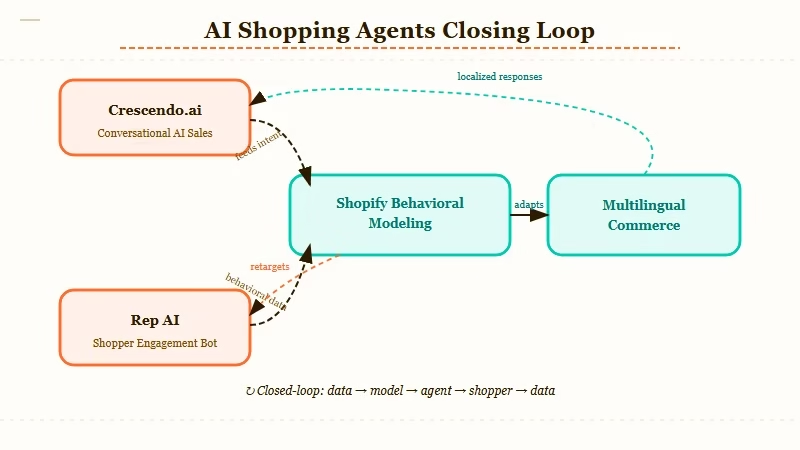
Crescendo.ai operates as an enterprise multimodal agent with 50+ language support and a claimed 99.8 percent intent-accuracy rate. Retailers deploy it on their storefront, and it handles the whole funnel from greeting to transaction. Reports from customers suggest 2x to 4x conversion lifts on the carts it completes.
Rep AI is the Shopify-native agent with behavioral modeling trained on 160 million shopper sessions. It sits inside a Shopify storefront, personalizes recommendations, and executes on the cart within the same session. For Shopify merchants, Rep is the closest thing to a dedicated AI salesperson.
Here is how the full-checkout tier compares:
| Tool | Autonomy tier | Where it shines | Best fit |
|---|---|---|---|
| Crescendo.ai | Full-checkout | Enterprise multilingual commerce | Global retailers with 50+ markets |
| Rep AI | Full-checkout | Shopify-native behavior engine | Shopify stores with product depth |
| Tidio Lyro | Recommend-and-route | ~67% autonomous resolution on support plus shopping | SMBs mixing support with commerce |
| Alhena AI | Recommend-and-route | Zero-hallucination architecture, live business data only | Merchants sensitive to wrong-answer risk |
In my testing, Crescendo.ai felt smoother on multilingual flows, and Rep AI was easier for a solo merchant to deploy. What I would flag for both is that the “full-checkout” claim is real but still narrow. The tools close the loop inside the retailer’s ecosystem, not across the open web.
The broader agent category is where this story gets interesting. For anyone building their own agent stack rather than buying one, the patterns for keeping agent focus on long tasks translate directly to shopping agents, and the general best AI employees roundup covers adjacent categories.
Where Recommend-and-Route Agents Fit Best
Recommend-and-route agents are the sweet spot for most buyers and most merchants in 2026. They personalize without taking on the full trust burden of transacting. They hand you off at the cart, which is where the buyer still wants a human check.
Tidio Lyro resolves roughly 67 percent of shopping inquiries without human intervention. It sits inside SMB storefronts and handles the “help me pick” conversation, then routes the buyer to the right product page. For stores that already have Tidio support chat, Lyro is effectively the shopping upgrade.
Alhena AI’s positioning is “zero-hallucination architecture, live business data only.” What surprised me in my testing is how much this matters in practice. Shopping agents that confidently recommend products the merchant no longer stocks are a conversion killer. Alhena’s refusal to invent answers makes it the pick for merchants who care more about accuracy than engagement.
Here is the specific comparison scenario that captures the trade-off:
Example scenario: A buyer asks “which of your waterproof hiking boots works for someone with wide feet and under $150?” A browse-only agent answers with three options and links. A recommend-and-route agent personalizes based on inventory, prior customer data, and current stock, then routes to the best-fit product page. A full-checkout agent does the recommendation and executes the add-to-cart and checkout flow without the buyer touching the storefront.
For buyers, recommend-and-route is usually the best experience because you get personalization without handing over payment authority. For merchants, it is the pragmatic deployment because you avoid the trust and fraud complexity of full transaction automation.
From my testing, the failure mode in tier two is the handoff itself. Tools that pass the buyer to a generic cart page lose 30 to 50 percent of the conversion lift the personalization earned. The right tier-two tool deep-links to the exact variant and adds it to the cart before the handoff.
For merchants running automation pipelines with Make.com, a recommend-and-route agent integrates cleanly with post-purchase workflows because the handoff still triggers the same cart-based automation the merchant already has running.
Which Browse-Only Agents Are Worth Using
Browse-only agents are best for pre-purchase research and high-consideration categories. They do not close the loop, but they shorten the research phase dramatically, and for expensive purchases that is often the highest-leverage use of AI.
The four browse-only tools worth using in 2026:
- Perplexity Shopping: first major AI company in agentic shopping, sourced and cited recommendations, best for electronics and research-heavy categories
- Amazon Rufus: native to Amazon, browse-plus-recommend only, best for users already committed to Amazon for the purchase
- Walmart Sparky: retailer-specific, designed for everyday shopping within Walmart’s catalog
- ChatGPT Shopping: broadest reach through ChatGPT’s existing user base, general-purpose recommender
What I found interesting is that the browse-only tier is where the recognizable brands live, but the recommend-and-route tier is where the serious money moves. Perplexity Shopping has the mindshare. Rep AI or Crescendo has the transactions.
Here is a markdown decision guide for picking the right tier:
| If you want to… | Pick tier | Example tools |
|---|---|---|
| Research before buying | Browse-only | Perplexity Shopping, ChatGPT Shopping |
| Buy inside Amazon or Walmart | Browse-only (retailer) | Amazon Rufus, Walmart Sparky |
| Shop a specific merchant’s catalog | Recommend-and-route | Tidio Lyro, Alhena AI |
| Hand off the entire checkout | Full-checkout | Crescendo.ai, Rep AI |
The most important signal from the last six months is that full-checkout tools are growing faster than browse-only tools, but from a much smaller base.
The Verge reported in March 2026 that Shopify merchants running Rep AI saw conversion lifts of 15 to 35 percent depending on category. That is the metric the rest of the industry is chasing.
Who Should Use Which Shopping Agent
For individual buyers, the right pick depends on whether you already shop inside one retailer’s ecosystem.
If you are an Amazon-primary buyer, Amazon Rufus is a no-brainer. If you cross merchants constantly and care about research quality, Perplexity Shopping wins.
Who should choose each tier:
- Individual buyers researching before purchase: Perplexity Shopping for general research, ChatGPT Shopping for broader category coverage
- Merchants deploying on their own storefront: Rep AI for Shopify, Crescendo.ai for enterprise multi-market
- Small businesses with existing chat support: Tidio Lyro as the upgrade to their current chat stack
- Compliance-sensitive retailers: Alhena AI because the zero-hallucination architecture reduces wrong-answer liability
The pattern I keep coming back to is that no single tool wins every category. From what I have seen, the best buyer and merchant stacks use two of these: one for research, one for execution.
Our best AI chatbot roundup covers the adjacent general-purpose category where some of these agents also compete.
For merchants on Shopify specifically, the path of least resistance is Rep AI because it is native to the platform and does not require building your own integration.
For merchants on custom stacks, the decision is more complicated and usually tilts toward Crescendo.ai if you operate across multiple languages or Alhena AI if accuracy is the top priority.
Frequently Asked Questions
What is the best AI shopping agent in 2026?
The best AI shopping agent depends on the autonomy level you want. For full-checkout transactions, Rep AI on Shopify and Crescendo.ai for enterprise. For personalized recommendations, Tidio Lyro and Alhena AI. For pre-purchase research, Perplexity Shopping.
Do AI shopping agents complete real transactions?
Yes, full-checkout agents like Crescendo.ai and Rep AI complete real transactions inside a retailer’s ecosystem. They handle cart, checkout, and confirmation without manual user intervention at every step. Browse-only agents like Perplexity Shopping stop at recommendation.
How do AI shopping agents differ from chatbots?
AI shopping agents act autonomously on a buyer’s intent, from recommendation through checkout in the most advanced cases. Chatbots respond to questions but do not execute on the purchase. The autonomy tier is the real difference, not the chat interface.
Which AI shopping agent is best for Shopify stores?
Rep AI is the most natively integrated AI shopping agent for Shopify. It trains on shopper sessions, personalizes recommendations in-session, and executes the cart without a custom integration. For non-Shopify stacks, Tidio Lyro or Crescendo.ai fit better.
Are AI shopping agents safe to let complete purchases?
Full-checkout agents operate inside a single retailer’s trust boundary, which limits fraud surface. For open-web full-checkout (agent buying across sites with your payment info), the security model is still early. Most buyers today still prefer recommend-and-route as the safer middle ground.
