
The Verdict: The best AI movie generator depends on which of three hidden tiers you really want. Showrunner for AI-native streaming episodes, LongStories AI for owned multi-minute renders, Runway Gen-4 or Sora 2 for cinematic clips. Most “ai movie generator” lists mix all three and frustrate buyers.
The search “ai movie generator” pulls up listicles that rank Showrunner next to Pika as if they compete. They do not.
One is a streaming platform that produces full episodes. The other generates 6-second clips you have to stitch into something resembling a film.
I have watched the same buyer mistake play out three times in two months. Someone signs up for Sora at $20 monthly expecting a 5-minute short, hits the 60-second cap on Sora 1 (or 25-second cap on the new Sora 2), and cancels within the trial. The category they wanted was a streaming-tier or pipeline-tier tool somewhere else on the same page.
This guide separates the three tiers cleanly. Streaming platform first (the part nobody covers correctly), pipeline tools second, clip generators third. After that a price breakdown, a “who should choose which tier” decision frame, and an honest answer to “can AI ship a feature-length movie yet” before the FAQ.
Why AI Movie Generator Is Really Three Different Tools
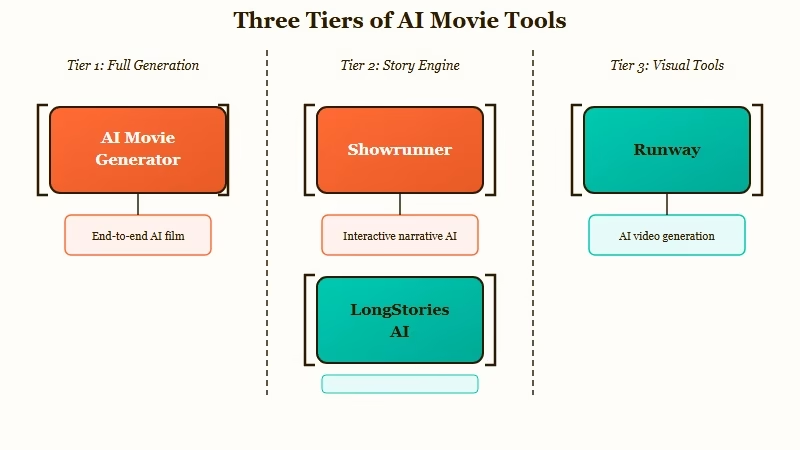
An AI movie generator is one of three structurally different tools: a streaming platform that produces full AI-native episodes (Showrunner), a pipeline tool that renders multi-minute narrative video as one piece (LongStories AI, LTX Studio, mStudio), or a clip generator that produces 5 to 60-second cinematic shots you assemble manually (Runway Gen-4, Sora 2, Kling, Pika).
The way I see it, the search-results confusion comes from how vendors pitch themselves. Every clip generator wants the “movie” keyword because the search volume rewards it. The result is a mismatch between what buyers want and what tools deliver.
What is a streaming-tier AI movie tool: A platform like Showrunner that handles scripting, animation, voicing, and editing in one workflow, publishing finished episodes to its own player.
What is a pipeline-tier AI movie tool: A workflow tool that renders a multi-scene narrative video as one piece, with character consistency built into the asset model.
What is a clip-tier AI movie tool: A model that produces one cinematic shot at a time (typically 5 to 60 seconds) that the user assembles in a video editor.
The structural difference matters because price-per-minute math is wildly different across the three. A clip-tier tool at $20 monthly produces maybe twenty short shots a day, which becomes about ten minutes of raw clip output before any stitching work.
A pipeline-tier tool at $9 monthly renders a 10-minute animated video as one piece with characters already locked. A streaming platform at $10 to $20 monthly produces full episodes targeting 22-minute runtimes.
Best AI Movie Generator at the Streaming Tier
The best AI movie generator at the streaming tier is Showrunner, because it is the only platform shipping full AI-native episodes with built-in distribution, Amazon backing, and a 40% creator revenue share on remixed content.
From my testing, this tier is the one most “best AI movie generator” lists skip entirely, because Showrunner looks like a streaming app and not a tool. That misclassification costs the reader the most important option in the category.
Showrunner
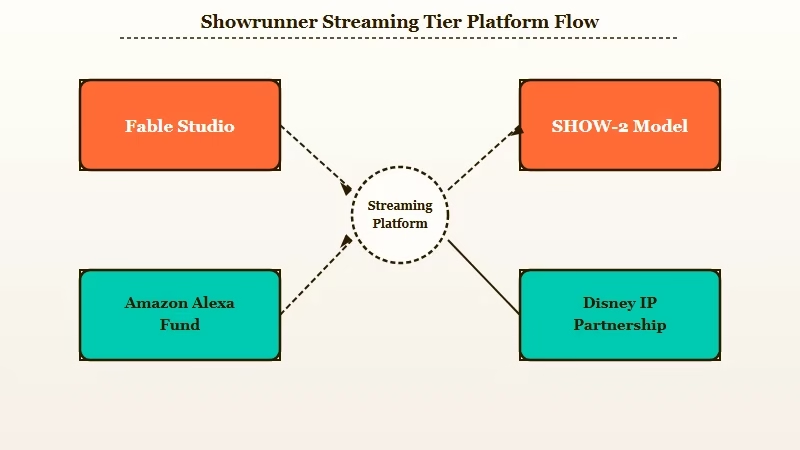
Built by Fable Studio on the proprietary SHOW-2 model. Launched July 2025 as an AI-native streaming platform for user-generated animated episodes. The flagship show “Exit Valley”, a satire of Silicon Valley culture, accumulated over 80 million views before launch.
Pricing is expected in the $10 to $20 monthly range with rollout still pending. The platform offers a 40% creator revenue share for remixed content, which is unusual in the category and the strongest single value-prop for creators evaluating “make money from AI movies”.
Showrunner is funded by Amazon’s Alexa Fund (amount undisclosed), which signals potential Prime Video distribution downstream. Fable also holds active discussions with Disney for AI-generated spinoffs using licensed intellectual property. This is the only AI movie tool with both a streaming distribution path and IP-partnership traction baked in.
The limitation: you do not own the output. Showrunner episodes live on Showrunner.
If you want a movie file you can upload to YouTube or sell on your own site, this is the wrong tier. For that, look at the pipeline tier below.
Best AI Movie Generator at the Pipeline Tier
The best AI movie generator at the pipeline tier is LongStories AI, because it renders up to 10-minute animated videos as a single pass at $9 monthly with the Universe system handling character consistency across every scene.
From my testing, this is the tier most buyers searching “ai movie generator” really want, and the one that delivers without the streaming-platform lock-in or the clip-tier stitching tax.
LongStories AI
The cheapest pipeline-tier option in the category. Pricing starts at $9 monthly with a 400-credit free trial and output up to 10 minutes per video. The Universe feature lets you define a character and visual style once, then reuse both across every video on the account, which is the only mechanism in this tier that holds character consistency at sub-$10 pricing.
Cost comparison the same source flags: a polished 10-minute video costs $100 to $200 via AI platforms versus $1,800 to $3,000 via traditional agency. That is a 9 to 30x cost gap, the strongest single number in the AI movie category. The full LongStories AI review breaks down the Universe workflow with example outputs.
What I would recommend most: pair LongStories with a tight script and a defined Universe before generating. The output quality scales with how precisely you have specified the character upfront. You can get started at LongStories AI.
LTX Studio
A heavier-weight pipeline tool from Lightricks. Listed at $35 monthly starter in third-party pricing comparisons, with a free tier for evaluation. The platform passed 135,000 users and combines storyboard-to-video automation, AI dubbing, multi-format export to Premiere or DaVinci Resolve, and a timeline editor with revision history.
LTX Studio is desktop browser only, which rules out mobile workflows entirely. From what I have seen, it is the right pick for creators who want studio-grade output and are willing to invest hours per project in the timeline editor. The character generator tool plus AI-generated actors with version control across shots is the closest indie filmmakers get to a “trained cast” workflow.
mStudio
The other named pipeline-tier tool at $27 monthly starter. mStudio is positioned for multi-shot film with consistent characters and is explicitly marketed for feature-length scenes. It includes dedicated character references that persist across every frame, audio support, and is one of only two tools in this tier that ranks for character consistency at the studio level.
I would suggest mStudio over LongStories for creators who already think in shots and need explicit reference-based character control rather than the Universe abstraction.
Best AI Movie Generator at the Clip Tier
The best AI movie generator at the clip tier is Runway Gen-4, because it produces the highest-quality cinematic shots at $15 monthly, with Sora 2 leading on audio synchronization and Kling on long single-clip length.
These are the tools that win head-to-head comparisons on individual shot quality but never produce a full movie. Buyers expecting a 5-minute narrative will assemble 30+ clips and manage character drift across every one.
Runway Gen-4 and Gen-4.5
The output-quality leader. $15 monthly Standard for ~10-second clips with partial character consistency, $95 monthly Unlimited for 4K output.
Runway’s documented 30-second character drift threshold means any character appearing in clips longer than that will look subtly different scene to scene. The best AI animated video generator breakdown covers the drift threshold and credit math in full.
Sora 2
Released September 30, 2026. The clips cap at 15 to 25 seconds at 1080p but now include synchronized audio (dialogue with lip-sync plus background music). For dedicated music video workflows where audio and visual must integrate, the music video generator breakdown covers the three structural variants in that adjacent category.
The character cameos feature lets you insert specific licensed characters via the Disney partnership, which is unusual but constrained: you cannot define an original character and have it persist across cameos.
Pricing runs roughly 20 to 25 credits per 1080p video on a credit-based system, with ChatGPT Plus and Pro tier access. What surprised me about Sora 2 is the price-to-length ratio.
The most expensive clip generator in the category caps the shortest clips. Length does not scale with price here.
Kling AI
The longest individual clips in the clip tier at 2 minutes via the extend feature, with five pricing tiers from $6.99 Standard to $180 Ultra. Caps at 1080p across every tier with no 4K option. Kling 3.0 adds native multi-shot storytelling and 4K production in newer enterprise tiers.
The buying quirk worth knowing: Kling subscription credits expire monthly, while separately purchased top-up packs remain valid for 2 years. Heavy users save money by buying top-ups rather than upgrading tiers.
Pika and the rest
Pika at $10 monthly handles short creative effects clips, ~6-second cap, partial character consistency. Useful for storyboard iteration but not for narrative video over a single clip.
Luma Dream Machine at $10 monthly, Hailuo at free + paid, and Higgsfield at $9 monthly fill out the rest of the clip tier with similar 6 to 10-second caps and stylistic differences rather than structural ones.
How AI Movie Generators Compare on Price and Output
The cheapest pipeline-tier AI movie generator is LongStories AI at $9 monthly for 10-minute renders, while Showrunner leads streaming-tier output at the expected $10 to $20 monthly with full-episode publishing.
The pricing comparison below sorts the field by tier first, then by output length and starting price.
| Tool | Tier | Starting price | Max output |
|---|---|---|---|
| Showrunner | Streaming | $10 to $20/month (expected) | Full episodes (22-min target) |
| LongStories AI | Pipeline | $9/month | 10 minutes (full render) |
| mStudio | Pipeline | $27/month | Feature-length scenes |
| LTX Studio | Pipeline | $35/month | Multi-scene narrative |
| Runway Gen-4 | Clip | $15/month | ~10-sec clips (4K on Unlimited) |
| Sora 2 (OpenAI) | Clip | $20+/month (credit-based) | 15 to 25-sec clips, 1080p |
| Kling AI | Clip | $6.99/month | 2 min via extend (1080p) |
| Pika | Clip | $10/month | ~6-sec clips |
A polished 10-minute video costs $100 to $200 via these AI platforms versus $1,800 to $3,000 via a traditional animation agency.
That is a 9 to 30x cost gap that the indie AI film coverage from The Ankler has been documenting through Wonder Studio and Russo Brothers production-cost case studies.
If you only remember one decision frame from this guide, use the one below.
| Your goal | Pick this tier | Top tool |
|---|---|---|
| Publish AI episodes on a hosted platform | Streaming | Showrunner |
| Render a 5 to 10-minute narrative video you own | Pipeline | LongStories AI |
| Build feature-length scenes with explicit character refs | Pipeline | mStudio |
| Studio-grade timeline for indie short film | Pipeline | LTX Studio |
| Single cinematic clip at 4K | Clip | Runway Gen-4 Unlimited |
| Short clip with synchronized audio | Clip | Sora 2 |
| Long single clip on a tight budget | Clip | Kling AI Pro |
Who Should Choose Each Tier
Choose the streaming tier if you want distribution baked in, the pipeline tier if you want to own the output file, or the clip tier if you have a professional editor and want AI shots as raw material.
From my testing, the three buyer profiles map cleanly:
- Streaming-tier buyers are creator-economy users who want distribution and revenue share without owning a YouTube channel or storefront. Showrunner’s 40% creator revenue share on remixed content is the actual draw, not the SHOW-2 model itself.
- Pipeline-tier buyers are YouTube creators, indie filmmakers, and faceless-channel operators who need a renderable file to upload, monetize, and own. LongStories at $9 monthly is the cheapest entry point. mStudio and LTX Studio scale up for users who need timeline-level control.
- Clip-tier buyers are marketing teams, short-form social creators, and filmmakers with professional editors (Premiere, DaVinci, After Effects) who want AI clips as raw material to mix into footage-based projects.
Example scenario: You want to ship a 10-minute animated YouTube short about ancient Greek mythology. On Showrunner, you would publish to Showrunner’s player and earn a creator revenue share, but the video lives there. On LongStories AI, you write the script, define a Universe with a recurring narrator and consistent visual style, and generate a single 10-minute render you download and upload to your own YouTube channel. On Runway Gen-4, the same project requires 10 to 15 clips at 30 to 60 seconds each, manual character continuity work between each clip, and a video editor to stitch the sequence.
The cluster of story-focused AI tools sits in the same pipeline category, and the structural pattern is identical: integrated workflow beats stitched clips for narrative output.
The Honest Truth About Feature-Length AI Movies
No AI tool ships a feature-length 90-minute movie from a single prompt in 2026, and pretending otherwise is the most common mistake AI movie articles make.
The closest options as of late 2026: Showrunner targets 22-minute episodes for established IP frameworks. LongStories AI caps at 10 minutes per render. mStudio is marketed for “feature-length scenes” rather than full films.
Runway Gen-4 chains can push past 2 to 3 minutes before character drift becomes visible. None of these produce a complete 90-minute film without manual assembly and substantial editor time.
The indie-AI-film movement covered by the broader AI animation generator breakdown flags Wonder Studio (Autodesk-owned, used in Russo Brothers projects) as the closest professional path to AI-assisted feature production. But that is AI-assisted post-production work, not a one-prompt movie generator.
What I would expect by mid-2027: pipeline-tier tools push to 30 to 60-minute renders, Showrunner adds custom-IP support beyond licensed catalogs, and Sora or a successor hits 2-minute single-render clips. None of that is here yet.
Frequently Asked Questions
What is the best AI movie generator overall?
The best overall depends on output ownership. For full AI-native episodes on a hosted platform, Showrunner. For 5 to 10-minute renders you own and upload anywhere, LongStories AI at $9 monthly. For cinematic individual clips, Runway Gen-4 at $15 monthly.
Can AI generate a full feature-length movie in 2026?
No tool ships a one-prompt 90-minute film as of late 2026. The closest options are Showrunner (22-minute episode target), LongStories AI (10-minute renders), and mStudio (marketed for feature-length scenes). Anything longer requires manual stitching and editor time.
How much does it cost to make an AI movie compared to a traditional one?
A polished 10-minute AI movie runs $100 to $200 in monthly tool costs across LongStories and LTX Studio. A comparable traditional animation agency project runs $1,800 to $3,000 for the same length, a 9 to 30x cost gap.
What is Showrunner and how is it different from Sora?
Showrunner is an AI-native streaming platform built by Fable Studio on the SHOW-2 model, backed by Amazon, that produces full episodes published to its own player with a 40% creator revenue share. Sora 2 is a clip generator from OpenAI that produces 15 to 25-second video shots. They are not direct competitors.
Which AI movie generator handles character consistency across scenes?
Pipeline-tier tools (LongStories AI with Universes, LTX Studio with Elements, mStudio with dedicated references) are the only ones that hold character consistency across multi-minute narrative renders. Clip-tier tools (Runway, Sora 2, Kling, Pika) handle consistency within a single clip but not between clips.
Can I make money from AI-generated movies?
Three paths today. Publish to Showrunner and earn the 40% creator revenue share on remixed content.
Render with a pipeline-tier tool (LongStories AI, LTX Studio, mStudio) and upload to a monetized YouTube channel. Or sell finished renders to clients as ad creative or course content.
Quick Takeaways
- The AI movie generator category is three completely different products in one search term: streaming platforms (Showrunner), pipeline tools (LongStories AI, LTX Studio, mStudio), and clip generators (Runway Gen-4, Sora 2, Kling, Pika).
- For owned multi-minute renders, LongStories AI at $9 monthly is the cheapest pipeline-tier entry point and the only sub-$10 option with full character-consistency persistence via the Universe system.
- For AI-native episodes with built-in distribution and a 40% creator revenue share, Showrunner is the only streaming-tier option, backed by Amazon’s Alexa Fund and Disney IP discussions.
- Sora 2’s September 30, 2026 launch added synchronized audio and Disney-licensed character cameos but still caps clips at 15 to 25 seconds, leaving the clip-tier ceiling intact.
- No AI tool ships a full 90-minute feature film from a single prompt in 2026, so if you searched “ai movie generator” expecting that, plan on either Showrunner episodes or pipeline-tier multi-minute renders via LongStories AI before paying for a clip generator you will outgrow.
