
What Happened: Anthropic’s annualized revenue hit $30 billion in April 2026, surpassing OpenAI’s $25 billion ARR for the first time. The company grew from $9 billion ARR at end-2025 in roughly four months. It also locked in a 3.5-gigawatt compute deal with Google and Broadcom.
When I first saw the headline, I assumed it was a typo. Anthropic, the company that was essentially pre-revenue two years ago, now earns more annually than OpenAI? The company that built ChatGPT?
And yet here we are. Anthropic’s run-rate revenue crossed $30 billion in April 2026, according to TechCrunch and Bloomberg. That places it above OpenAI’s $25 billion ARR, marking the first time Anthropic has led this race on revenue.
Not just capability benchmarks. Actual money.
The Anthropic revenue 2026 story is one of the fastest corporate growth arcs in tech history. For Claude users and anyone paying attention to where enterprise AI is heading, this announcement carries more signal than most.

What Did Anthropic Announce in April 2026?
Anthropic’s April 2026 announcement covered three things: a $30 billion ARR milestone, a doubling of its largest enterprise clients, and a 3.5-gigawatt compute deal with Google and Broadcom.
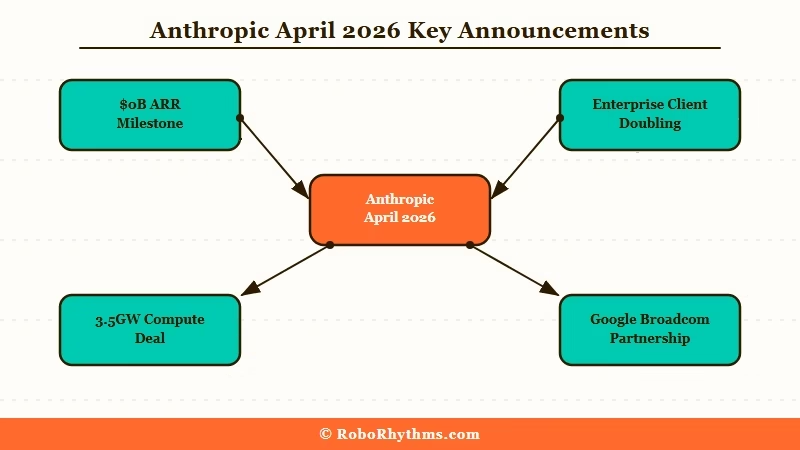
Anthropic closed February 2026 with $9 billion in annualized revenue. The Register confirmed the $30 billion figure in early April, meaning the company more than tripled its revenue run rate in roughly four months. At $1 billion ARR in January 2025, the same metric took another 15 months to 30x.
Those are venture-stage growth rates at enterprise scale.
The enterprise customer count tells a sharper story. Business clients spending over $1 million per year with Anthropic doubled from 500 to 1,000 in less than two months following the Series G raise. That is not organic growth. That is signed-contract, multi-year-commitment enterprise demand expanding at an unusual rate.
The compute deal with Google and Broadcom adds a forward-looking dimension. Anthropic secured access to 3.5 gigawatts of computing capacity, extending an existing October 2025 agreement. The new capacity comes online in 2027.
That means Anthropic is not just celebrating past revenue. It is locking in the infrastructure to sustain and grow it.
How Does Anthropic’s Revenue Compare to OpenAI?
OpenAI sits at approximately $25 billion ARR as of April 2026, meaning Anthropic leads in revenue for the first time in both companies’ histories.
From my read of the situation, this matters well beyond bragging rights. OpenAI’s revenue composition is more consumer-heavy, with ChatGPT Plus and Pro subscriptions making up a large share.
Anthropic’s composition runs roughly 80% enterprise, according to reporting on the announcement.
Enterprise revenue carries fundamentally different economics: higher retention, lower churn, and contracts that expand over time rather than cancelling when novelty fades.
| Metric | Anthropic (April 2026) | OpenAI (April 2026) |
|---|---|---|
| ARR | $30 billion | $25 billion |
| Revenue mix | ~80% enterprise | More consumer-heavy |
| $1M+ annual clients | 1,000+ | Not disclosed |
| Key infrastructure deal | 3.5GW Google and Broadcom | Microsoft Azure |
| Growth from $9B ARR | 4 months (3x) | Slower recent pace |
Why Is This Bigger Than a Revenue Milestone?
This revenue crossover signals that the enterprise AI market has already chosen its top vendors, and Anthropic is now one of them.
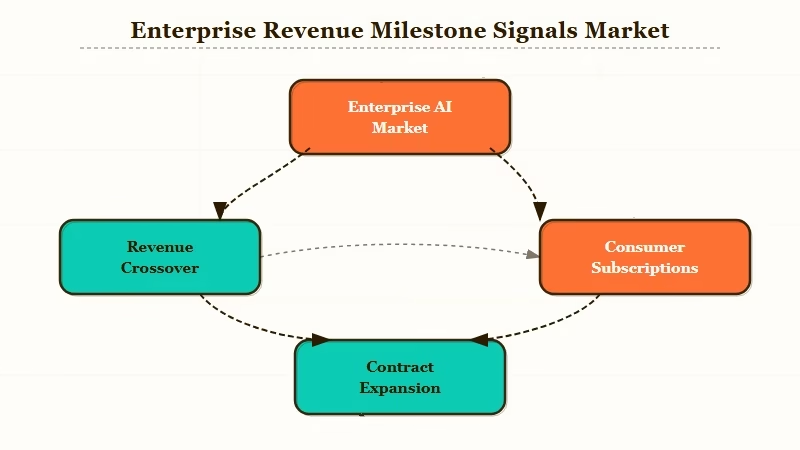
The way I see it, the real story is not the number itself. It is what the number represents about enterprise buyer behavior. When a company has 1,000 customers each spending over $1 million annually, it has revenue that renews, expands, and compounds.
I’d argue that 1,000 enterprise accounts at $1M+ is a more defensible business than 100 million ChatGPT subscribers at $20 per month. The unit economics are completely different.
Anthropic built its reputation on safety and reliability, which enterprise procurement teams rank near the top of their vendor criteria. Companies deploying Claude into customer service workflows, legal document review, or internal knowledge management do not switch models for a flashier demo. The switching cost is too high once it is embedded.
Claude’s coding and agent-building capabilities have also become major revenue drivers in ways that were less visible six months ago.
With developer teams standardizing on Claude for production agent workflows, Anthropic is not just selling API access. It is embedded in the infrastructure that companies now depend on.
What Drove the Speed of Growth?
Anthropic grew from $1 billion ARR in January 2025 to $30 billion in April 2026 because enterprise buyers made multi-year commitments early and those contracts expanded.
From what I’ve seen in the coverage, the February 2026 Series G raise was a catalyst. Enterprise buyers treat a large funding round as a signal of platform stability.
Companies that had been hesitant to commit multi-year API contracts moved forward after the raise because Anthropic looked like it was in the race to stay.
The doubling of $1M+ clients in under two months right after the Series G confirms that signal-driven buying happened at scale.
The AI safety track record also played in Anthropic’s favor in ways that are counterintuitive. Enterprise legal and compliance teams prefer working with a vendor that has documented safety practices.
Anthropic’s Constitutional AI approach gives procurement departments something to cite in internal risk assessments. OpenAI’s more permissive approach can create compliance friction in regulated industries.
What Does Anthropic’s $30 Billion Revenue Mean for Claude Users?
For Claude users, this milestone means more compute capacity, faster model development, and reduced uncertainty about the platform’s long-term viability.
Here is what I’d watch over the next six months as a direct Claude user:
- Rate limit changes. The 3.5-gigawatt compute deal coming online in 2027 signals Anthropic is building capacity ahead of demand. More infrastructure typically means fewer API throttle events and shorter queue times during peak hours.
- Faster model release cadence. Enterprise revenue at this scale funds R&D at a meaningfully faster rate. Expect more frequent Claude model updates, not fewer.
- Pricing adjustments for enterprise tiers. Companies with 1,000+ large clients tend to restructure their pricing tiers to capture more value from their heaviest users. Watch for premium tier changes that affect power users.
- More enterprise-specific features. Team workspaces, compliance audit tools, and SOC 2 certification expansions become higher-priority when your client base is 80% enterprise. Some of those features eventually reach individual users.
The concern worth flagging: as Anthropic’s enterprise mix deepens, consumer-facing features may move slower on the roadmap. Anthropic’s recent decisions around third-party tool access already showed that enterprise contract protection takes priority when there is a conflict. That pattern will likely continue.
Will Anthropic Stay Ahead of OpenAI in Revenue?
Anthropic is positioned to maintain or extend its revenue lead through 2026, given its enterprise composition and locked-in compute expansion.
I’d hesitate to call this permanent. OpenAI still has more consumer mindshare, stronger name recognition with non-technical buyers, and Microsoft’s distribution behind it. One or two transformative OpenAI enterprise deals could close the gap quickly.
But the trajectory favors Anthropic right now.
What I’m watching is whether OpenAI’s GPT-5 timeline accelerates in response. Competitive pressure from a revenue lead is exactly the kind of catalyst that shifts internal prioritization. If GPT-5 ships with a clear capability advantage, enterprise buyers will reconsider. If it does not ship soon, Anthropic’s lead grows.
The Anthropic acquisition of Coefficient Bio earlier in April also points to vertical expansion beyond pure model provision. If the drug discovery bet pays off, revenue diversification could make the gap more durable.
| What to watch | Why it matters |
|---|---|
| GPT-5 release timing | Could reverse enterprise momentum for OpenAI |
| Anthropic compute capacity timeline | 3.5GW online in 2027 sets ceiling for scaling |
| $1M+ client count next quarter | Measures whether enterprise expansion sustains |
| Claude pricing tier changes | Signals how Anthropic monetizes growth |
| Vertical market expansions | Drug discovery, legal, finance all being pursued |
