
What Happened: Details about Anthropic’s internal “Conway” project leaked in early April 2026, revealing an always-on agent platform built directly into Claude. Conway can run Claude Code, control Chrome, respond to external webhooks, and support a custom extension format. It’s not announced, not released, and Anthropic hasn’t officially confirmed it exists.
Anthropic didn’t say a word about it. Developers found it anyway.
Code and interface analysis published by TestingCatalog on April 1, 2026 surfaced details of a project called Conway, an internal Anthropic agent platform that runs continuously, responds to external triggers, and supports a custom extension format.
The Anthropic Conway agent is not a chatbot upgrade. It’s a different product category.
What Is Anthropic’s Conway Agent?
Conway is Anthropic’s internal name for an always-on agent platform that keeps Claude running continuously, responding to external triggers rather than waiting for user input.
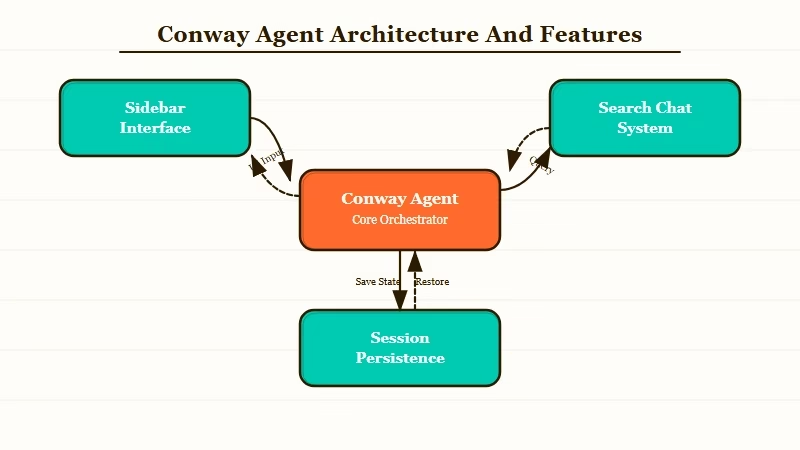
The details came from code and interface analysis surfaced by TestingCatalog in early April 2026. Conway shows up as a sidebar option inside Claude’s interface, launching what the code calls a “Conway instance.”
That instance has three areas: Search, Chat, and System, each with its own functionality separate from the standard Claude conversation view.
From what I’ve seen of agentic platforms, what makes Conway stand out is not the chat interface. It’s the persistence layer underneath it.
What Can Conway Do?
Conway can run Claude Code, handle Chrome browser control, receive external webhooks, and send notifications, making it a full background agent platform rather than a chat upgrade.
From what I’ve seen of the documentation, the webhook system is the capability that separates Conway from everything Anthropic has shipped before. The key capabilities documented in the leak include:
- Claude Code integration: the instance can run Claude Code directly, meaning it can write, edit, and execute code without a separate interface
- Chrome browser control: Conway can operate a browser autonomously, not just generate instructions for a human to follow
- Webhook triggers: public URLs that external services can call to wake the Conway instance, enabling event-driven automation
- Notification system: Conway can send notifications when tasks complete or conditions are met
- Extension support: a dedicated Extensions area accepts
.cnw.zipfiles, Anthropic’s proposed format for custom tools, UI tabs, and context handlers
The webhook system is what makes this genuinely different from Claude’s existing agentic features. An agent that wakes up when a GitHub push happens, or when a calendar event fires, or when a monitoring alert triggers, is a fundamentally different product category from an agent you talk to.
| Feature | Standard Claude | Conway |
|---|---|---|
| Always running | No | Yes |
| Browser control | Limited | Full Chrome control |
| External triggers | No | Webhook wake-up |
| Custom extensions | No | .cnw.zip format |
| Code execution | Via Claude Code | Native |
| Notifications | No | Yes |
Why Is Conway a Bigger Deal Than Other Agent Announcements?
Conway is a bigger deal than typical agent announcements because it shifts Anthropic from building a better chatbot to building an agent platform with an extension ecosystem.
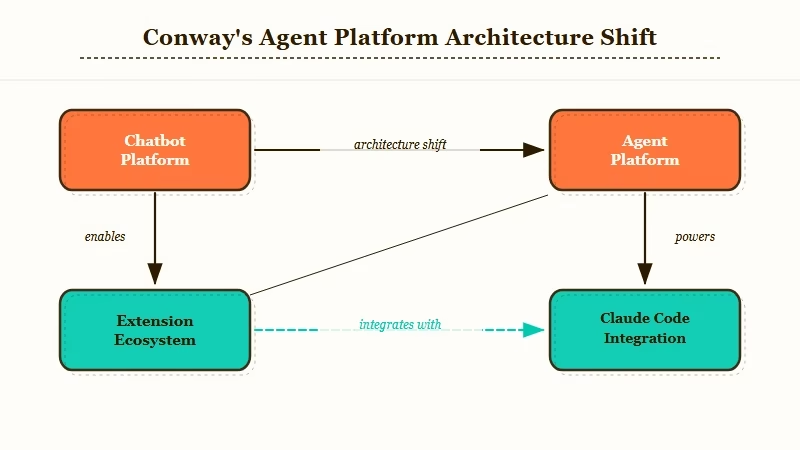
The way I see it, the extension format is the most significant part of this leak. If third-party developers can build .cnw.zip extensions that plug into Conway, Anthropic acquires a platform moat.
It stops competing purely on model quality and starts competing on workflow ecosystem depth, similar to how Salesforce built lock-in through AppExchange, or how Chrome became the dominant browser partly through its extension library.
This is not Anthropic’s first step in this direction. The Anthropic Managed Agents API launched earlier in 2026, and Claude Code has been expanding its agentic capabilities.
Conway looks like the consumer-facing layer on top of that infrastructure: the product someone who isn’t a developer would open and use to set up persistent automated work.
From my perspective, the detail that stands out is the webhook wake-up model. A Conway instance that sleeps until a specific external signal fires, then completes a task and returns to sleep, is a very different cost structure from an agent running inference continuously.
That design choice suggests Anthropic has thought carefully about how to make this economically viable at scale.
What Does This Mean If You Use Claude Right Now?
For current Claude users, Conway isn’t available yet, but it signals what the paid tiers of Claude are likely to evolve into within the next 12 months.
What I’d watch is whether Conway becomes a feature of Claude Pro or a separate product tier. The always-on angle, combined with custom extensions and webhook support, points toward a business or power-user product rather than a consumer upgrade.
If you’re currently using Claude for agentic workflows and automation, Conway would be the native, productized version of what you’re likely building manually today.
The extension system is also worth tracking if you build or use AI tools professionally. A standard package format for Claude-native extensions is the kind of thing that either becomes a small niche or becomes the AppStore equivalent for AI agents. The early version of that story is starting to be written now.
When Will Conway Be Released?
There is no announced release date for Conway, and Anthropic has not publicly confirmed the project exists.
From what I’ve seen in how Anthropic ships, the time between internal testing surfacing in a code leak and a public announcement is typically measured in months, not quarters. The Claude Code roadmap followed a similar pattern.
Conway’s infrastructure is detailed enough that this doesn’t read like early experimentation.
It reads like something that has already survived internal review and is moving toward a release timeline. Conway’s extension format being this specific is the tell.
Anthropic released managed agents for business use in early 2026, and Conway looks like the next logical layer: the persistent, user-facing platform that sits on top of the same underlying infrastructure. Expect an announcement before the end of 2026, most likely framed as a Claude Pro feature or a standalone product for teams.
