
What Happened: Anthropic ended Claude Pro and Max subscription coverage for OpenClaw and all third-party agentic tools on April 4, 2026, at 12pm PT. Users must switch to pay-as-you-go extra usage billing or direct API access. Anthropic is offering a one-time credit to soften the blow.
If you woke up today and found your OpenClaw setup broken, you are not alone. At 12pm PT on April 4, 2026, Anthropic cut off subscription-based access for Claude Pro and Max users running third-party tools like OpenClaw.
This is the second time Anthropic has made a move like this, having pulled the same lever with Claude Code and external coding harnesses like OpenCode last month.
This was not a bug. It was a deliberate policy change. Anthropic stated that third-party harnesses put an “outsized strain” on its infrastructure and that capacity needs to be protected for its own products.
For a lot of builders and power users, this is a direct hit to their cost structure. The subscription-based path to running OpenClaw was widely used because it bypassed API costs entirely. That path is closed now.
What Did Anthropic Do to OpenClaw Subscriptions?
Anthropic blocked all Claude Pro and Max subscription usage inside third-party agentic tools, effective April 4, 2026. OpenClaw users must now use API billing or Anthropic’s new pay-as-you-go extra usage add-on.
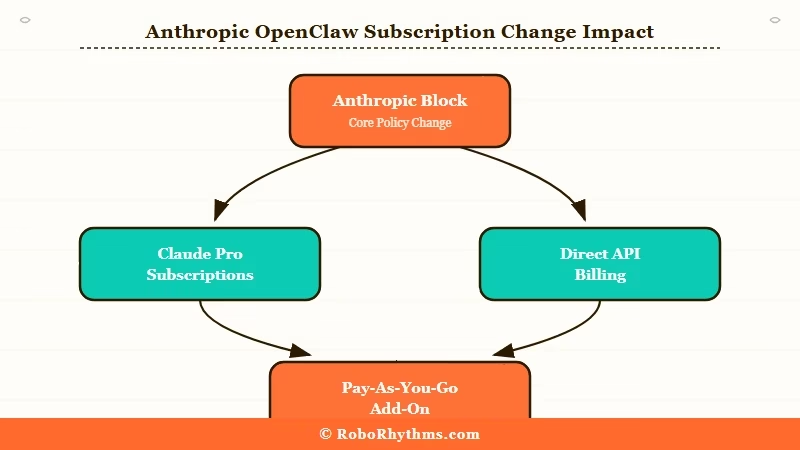
The way I read Anthropic’s statement, the technical reasoning is sound even if the outcome stings. The company’s own tools, particularly Claude Code, are optimized for high prompt cache hit rates. They process tokens efficiently by reusing cached context.
Third-party harnesses like OpenClaw largely bypass that caching layer. One heavy OpenClaw session can consume dramatically more infrastructure than an equivalent Claude Code session at the same output volume.
From Anthropic’s perspective, a flat-fee subscriber running serious automation through OpenClaw was getting effectively unlimited compute at a fixed price. That does not scale, and they closed it.
Your four access paths going forward, and what each one actually costs:
| Access method | Best for | Cost model | OpenClaw compatible |
|---|---|---|---|
| Claude Pro/Max (base) | Casual Claude.ai users | Flat monthly fee | No, as of April 4 2026 |
| Extra usage add-on | Existing subscribers with moderate OpenClaw use | Pay-as-you-go per session | Yes |
| Anthropic API (direct) | Heavy builders and production workloads | Token-based pricing | Yes |
| Nanoclaw (Agent SDK) | Developers who want SDK-compliant access | API pricing | Yes, SDK-compliant |
Anthropic is also offering a one-time credit equal to one month of the user’s subscription cost, redeemable through April 17, and up to 30% off on pre-purchased extra usage bundles.
Why Is This a Bigger Deal Than It Looks?
This signals that Anthropic is drawing a hard line between its consumer products and the developer API ecosystem. Builders who were living in the gap are now on the wrong side of that line.
The subscription loophole was never officially sanctioned, but it had become widespread. Community estimates in the r/AI_Agents thread today suggest that roughly 60% of active OpenClaw sessions were running on subscription credits. That is a meaningful chunk of the platform’s active user base.
This move rhymes with what Anthropic did a month ago when it blocked Claude Code subscriptions from working with external coding harnesses like OpenCode. The pattern is consistent. Anthropic is protecting its own products’ infrastructure capacity while pushing heavy API users toward the API.
From a business standpoint, that is rational. From the builder’s standpoint, it is a cost shock.
The community reaction I found most telling came from the Reddit thread: “feels like Claude is slowly shifting towards builders more than regular users.” From what I’ve seen, that is partly right and partly wrong. Anthropic is shifting toward builders who pay for infrastructure, not builders who found a way around paying for it.
One comment worth flagging for context: “It was always against TOS. Now it’s just more explicit.” That framing is accurate. The subscription access was being quietly tolerated, not officially permitted.
This formalizes a rule that already existed on paper.
What Does This Mean for OpenClaw Users Right Now?
If you were running OpenClaw on a Claude Pro or Max subscription, your sessions will fail until you switch to API billing or the extra usage add-on through your Anthropic account.
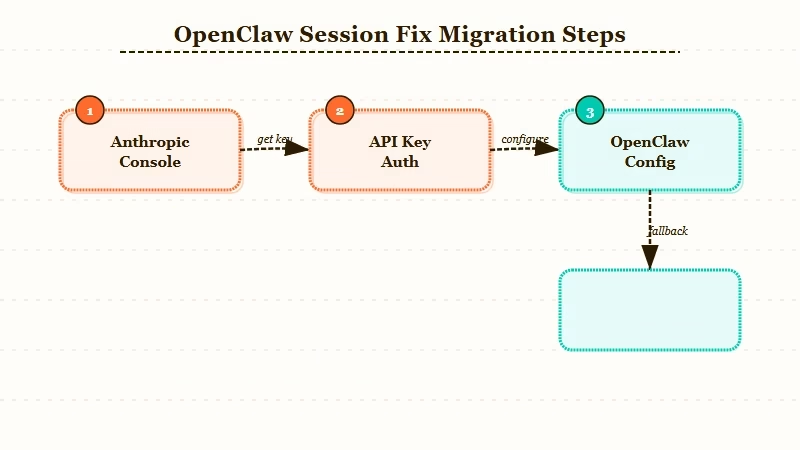
Here is the sequence I’d work through, in priority order:
- Claim your one-time credit before April 17. Anthropic is giving you back one month of subscription cost as a credit. That is real money and you should not let it expire.
- Decide between the extra usage add-on vs. direct API access. If your usage is light to moderate, the extra usage add-on is the path of least friction. If you are running heavy production automation, check API pricing at volume since it gets competitive with batching.
- Explore Nanoclaw as an SDK-compliant option. A commenter on Reddit flagged Nanoclaw as a harness built on the official Anthropic Agent SDK, which is still fully permitted. If cost is your main concern, this is worth testing.
- If OpenClaw’s cost structure no longer works for you, check what OpenClaw alternatives have matured in the last few months. The market has moved considerably.
- If you are staying on API billing, cache aggressively. The community consensus is that API pricing is fine at volume if you design your sessions properly. Reducing redundant context in long-running sessions is where the real savings come from.
Making the switch: what the config change looks like
Open OpenClaw Settings and navigate to Model Provider. You will see an auth field currently set to subscription. Change it to api_key and paste in your key from console.anthropic.com/settings/keys. If you are using OpenClaw via a managed host like ClawTrust, they will provide a field in your dashboard for the API key directly. No local config edit needed.
For users running OpenClaw headlessly via config file, the relevant change looks like this:
// Before
{
  "provider": "anthropic",
  "auth_mode": "subscription"
}

// After
{
  "provider": "anthropic",
  "auth_mode": "api_key",
  "api_key": "sk-ant-..."
}
Restart OpenClaw after saving. If your first session fails with an auth error, double-check that the key has the claude-3-7-sonnet model tier enabled in your Anthropic console, new keys default to Claude Haiku only.
The users most exposed are the ones using OpenClaw for lightweight, low-frequency automation where the API cost per session could exceed what they were paying on subscription. For heavy production builders, the API was always the better infrastructure choice anyway.
What Comes Next for OpenClaw After This?
OpenClaw will need to rebuild its value proposition around API-native cost structures, and Anthropic’s own tools like Claude Code stand to benefit from the shift.
According to VentureBeat’s coverage of the announcement, Anthropic framed this specifically as a capacity protection measure, not a monetization play. I find that framing mostly credible. The infrastructure asymmetry between native tools and third-party harnesses is real.
But the outcome is the same regardless of the framing. Users pay more.
In the near term, expect OpenClaw to update its documentation and onboarding. The OpenClaw setup guide will need a revision. Third-party managed hosting providers may also reprice their plans to reflect the new underlying cost.
The harder question is what this does to OpenClaw’s casual user base. A tool that had zero marginal cost for light users is now a tool with real per-session costs. That changes who stays and who leaves.
The platform that survives this is the one that builds a community comfortable with API-first costs, which is a very different audience from “people who wanted cheap Claude access.”
Anthropic’s own products stand to gain from the confusion. If you are going to pay API rates regardless, the case for staying inside Claude Code’s native environment gets stronger by default.
