
My Take: AI startup ARR numbers are not a metric. They are a fundraising tool dressed up as a metric. The Cluely CEO who admitted to lying about ARR to a reporter did not make a mistake. He described the industry norm out loud. Everyone in the ecosystem knows this. Nobody wants to be the one to say it because they all benefit from the fiction.
Cluely is an Andreessen Horowitz-backed startup whose CEO told a reporter its ARR doubled in a week to $7 million. When called out, he said he “got a random cold call from some woman asking about numbers and told her some BS.”
The real number was $5.2 million.
The response from Silicon Valley was mostly a shrug. The founder apologized, the funding continued, Bloomberg wrote a piece, and by Wednesday, the story was already off the front page.
What happened at Cluely was not an anomaly. It was a confession that someone forgot to make in private.

The Mainstream View (And Why It Falls Short)
The mainstream view, as Bloomberg captured it from investors in their April 7 report, is that ARR gaming is a known quirk that sophisticated investors already discount, so the market self-corrects without intervention.
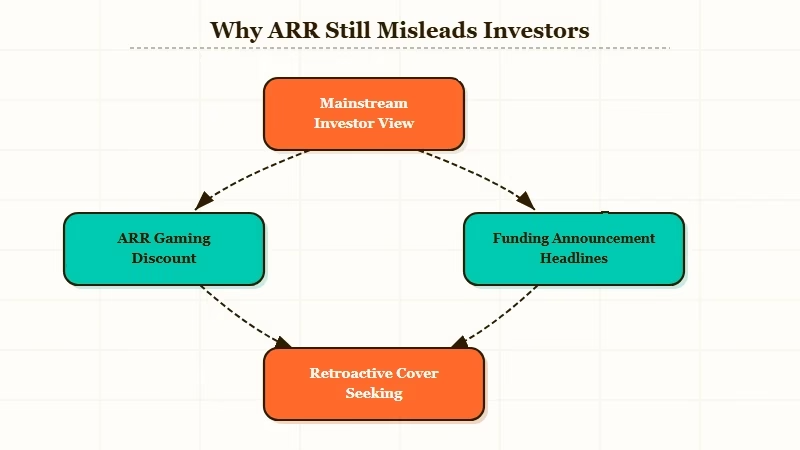
The argument goes: ARR is an early indicator, investors know to adjust for it, and the funding process corrects for abuse through due diligence.
Cluely’s CEO got caught and embarrassed, the market punished him socially, and the story moved on. Case closed, apparently.
This view collapses the moment you ask one question: if sophisticated investors already knew to distrust ARR, why does it remain the headline metric in every major AI startup announcement, every funding round press release, and every demo day pitch deck?
If ARR was understood as unreliable noise, it would be footnoted.
The fact that it leads every headline proves that even the “sophisticated” buyers are still using it as a signal. They just want the license to claim later that they knew.
What’s Actually Happening
AI startup ARR has no universal definition, no audit requirement, and no SEC standard, which means it measures whatever a founder needs it to measure at the moment they need to raise money.
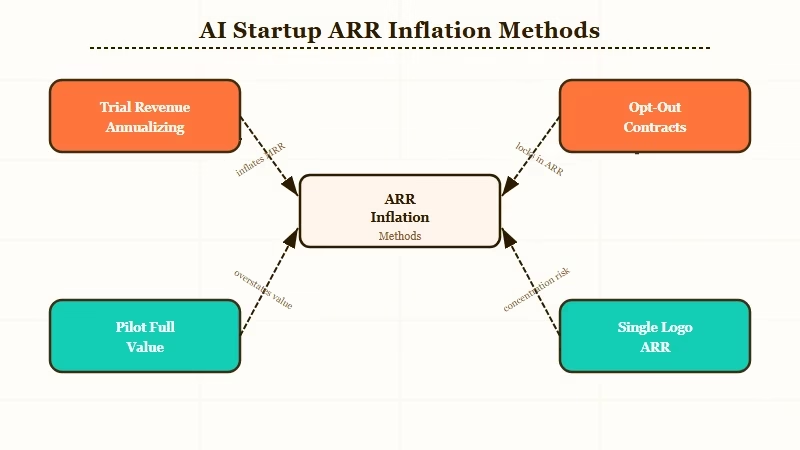
From what I’ve seen across the AI tooling space, the inflation happens in four specific ways. Trial revenue gets annualized and counted as recurring. Contracts with opt-out clauses get included as signed.
Pilot agreements get projected at full contract value. Month-over-month revenue from a single logo gets annualized before the customer has renewed. None of this is technically illegal. It is just definitionally incoherent.
The meta-game is transparent to anyone inside it: announce inflated ARR, get TechCrunch pickup, use the headline to close the next round. Before any of the numbers are scrutinized, you have 18 months of runway and a new ARR number to announce.
This is the same dynamic driving companies like Meta to pivot from open-source to proprietary AI models. The narrative requirement of growth metrics shapes product decisions more than engineering reality does.
The gap between announced ARR and actual product delivery is widest in agentic AI tools, where the underlying technology still fails at scale.
The same pattern I described in why AI agents keep failing in 2026 applies here: the headline number is optimized for press, not for performance. The ARR is announced before the retention data is available.
The Part Nobody Wants to Admit
Every participant in the AI funding ecosystem profits from the ARR fiction, which is why nobody has a structural incentive to fix it.
VCs mark portfolios to ARR, so if ARR is high, paper returns are high, LPs are happy, and the next fund raise is easier. Founders announce high ARR to attract talent and enterprise customers who would otherwise ask harder questions.
Press outlets repeat the ARR numbers because they generate clicks. Enterprise buyers use them to justify internal AI budget requests to their own executives.
The way I see it, the Cluely case exposed something more important than one founder’s dishonesty. It exposed that the entire AI funding ecosystem has quietly agreed to operate on a metric with no agreed-upon definition.
This is not a bug in how AI startups are measured. It is the feature. The fiction is load-bearing, and the correction, when it comes, will not be called fraud. It will be called market normalization.
What that looks like in practice: when you look at what it actually takes to build production-grade AI systems, the engineering complexity is substantial.
The ARR that gets announced for “AI infrastructure tools” is announced months before anyone can verify whether the underlying system works reliably at scale. The two facts are not related by any reporting requirement.
Hot Take
The AI startup “ARR explosion” that every VC newsletter has been celebrating for two years is not evidence of product-market fit. It is evidence of an industry that learned how to make accounting aesthetics look like growth. When the enterprise contracts that anchor these ARR numbers come up for renewal in 2026 and 2027, the retention rates will be the number that actually matters, and nobody in Silicon Valley is volunteering to publish those.
