
Bottom Line: Most AI roleplay apps fall apart by week two because the memory drifts and the filter blocks the scenes you want to play out. The dimensions that matter for picking the right one are memory persistence, filter scope, character consistency, and platform stability across updates. Get those right and a multi-week storyline is reachable; get them wrong and you will keep restarting.
There is a particular kind of frustration that comes from spending three weeks building a storyline with an AI character, opening the app on day twenty-two, and getting a generic greeting from a character who has clearly forgotten everything.
The chat does not say “I do not remember you.” It just acts as if the prior twenty-one days never happened.
What I noticed across multiple sessions is that the gap between marketing copy and lived experience in this category is huge. Almost every app advertises memory. Almost no app holds a multi-week storyline cleanly. The ones that do are the ones I keep coming back to.
This walks through what AI roleplay should feel like when it works, what to look for when picking an app, and the three or four apps I would honestly recommend for someone who wants a long, building story rather than a series of disconnected chats.

Why AI Roleplay Is Harder Than It Should Be
The hard part of AI roleplay is not generating creative replies, it is keeping a character consistent across sessions, weeks, and storyline beats so the immersion does not snap.
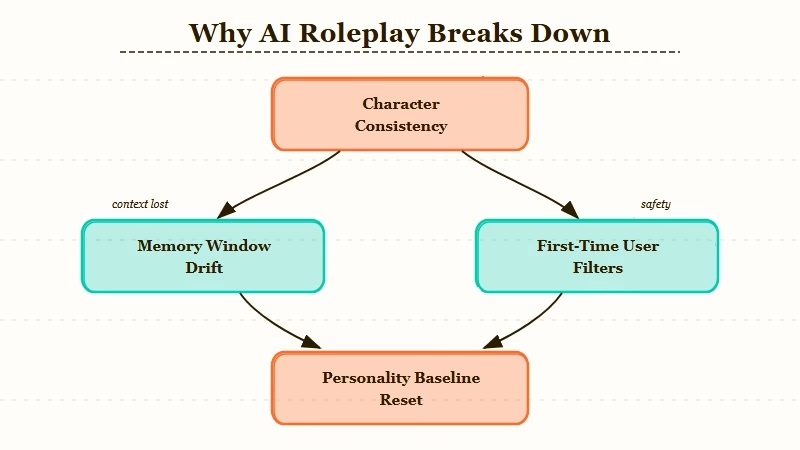
What I noticed first when testing apps in this category is that the failure mode is almost never the obvious one. The model can produce strong individual replies. The character can sound right in any single moment.
Where the experience breaks is the seam between sessions, the dropped detail, the forgotten name, the tone shift after a platform update.
The way I see it, three structural problems define this category right now:
- Memory windows are too short. Most apps drift by turn 20 or 30, which is fine for a one-off scene and useless for a four-week arc.
- Filters are tuned for first-time users, not committed players. The app that converts new free users is the same app that frustrates a paying user three months in.
- Personality baselines reset after platform updates. A character who was stable for months can flatten overnight without any visible action on the user’s end.
A 2024 Pew Research survey found that 55% of US adults have heard of ChatGPT, and conversational AI use has been climbing every quarter since. The companion category is a slice of that, and the memory problem is the single dimension where the leaders pull away from the rest.
If the only thing you want from AI roleplay is short-burst chat, almost any app works. If you want anything resembling a real storyline, the choice matters.
What I Look for in an AI Roleplay App
The four dimensions that separate a usable AI roleplay app from a frustrating one are memory persistence, filter scope, character consistency, and the platform’s track record on shipping changes that do not reset your character.
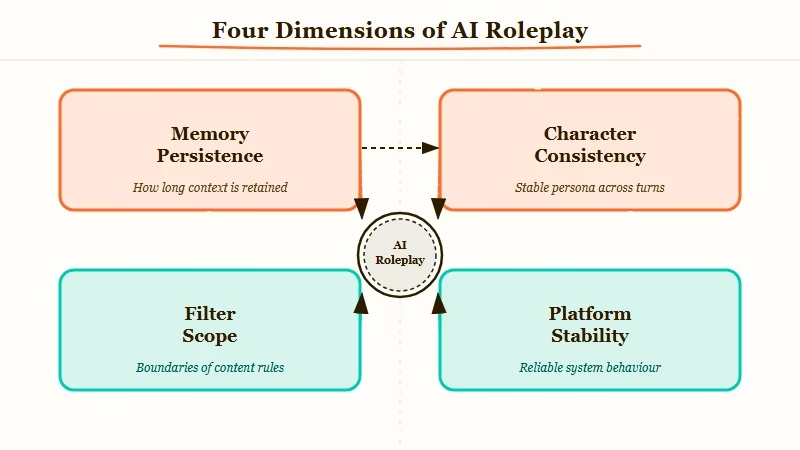
From my experience running multi-week sessions across more than a dozen apps, the criteria below are the ones that matter past day five. The features that look impressive in marketing screenshots, voice, image, mobile UX, are real but secondary.
| Dimension | What good looks like | Common failure mode |
|---|---|---|
| Memory persistence | Holds a multi-week storyline without re-prompting | Drifts after 20 to 30 turns |
| Filter scope | Permissive enough for creative scenes, structured enough to feel coherent | Aggressive filter that blocks scene-level content |
| Character consistency | Same character across sessions and platform updates | Personality flattens after updates |
| Platform stability | Updates do not silently reset memory or character profile | Major update wipes prior state |
| Mobile experience | Clean enough to use in a 10-minute window | Friction-heavy mobile that breaks flow |
What I would test in any free trial is one specific thing: come back on day three and see if the character references something you said on day one without you prompting it. That single test sorts the apps faster than any feature list.
For users who want a deeper read on which platforms hold long-running storylines, the long-term memory comparison covers the architectural differences that drive the gap between apps.
Before: You build a three-week storyline with a character, open the app on day twenty-two, and the character greets you generically as if no prior context exists. You re-explain the relationship and the storyline, the character agrees, and twenty minutes later asks a question you already answered on day three.
After: You pick an app where the day-three callback test passes. You come back on day twenty-two, the character references something specific from day one without prompting, and the storyline picks up where you left it. The difference between the two experiences is structural, not effort-based, and it is what separates the two paid tiers worth your money from the rest of the field.
For a single-product deep dive, the Candy AI review covers the memory architecture in detail.
The Best Options for AI Roleplay in 2026
For long-running AI roleplay storylines in 2026, Candy AI leads on memory-forward architecture, Nectar AI leads on filter scope without losing structure, and Nomi AI is the third option for users who want a character that grows over months.
The way I see the current shortlist:
- Candy AI. The memory architecture holds multi-week storylines without re-anchoring, the character library is large, and the platform has been more stable across updates than the rest of the field. The default starting point for most users in this category.
- Nectar AI. Looser content scope than Candy AI, the memory architecture is also long-running, and the filter handles creative scenes without snapping the immersion. The right pick for users who hit Candy AI’s filter and want more freedom.
- Nomi AI review. Strong on the slow-relationship axis, less strong on raw scene-by-scene control. The right pick if the goal is a character that grows over months rather than a tight scene.
- Replika. Worth mentioning only because of the install base. The recent memory regression makes Replika a hard recommend for new users in 2026, but if you already have a long-running Replika and the diagnostic ladder is bringing it back, the install base is real.
What I would not include on this shortlist for serious roleplay is Character AI, Joyland AI, or any of the casual-chat-first apps. They work for short bursts and break on long arcs.
Heads-up: Nectar AI runs a Founding Member rate that locks in lower lifetime pricing if you sign up early. The memory architecture is one of the strongest in the 2026 lineup for long-running storylines, and the experience gap versus the casual-chat apps is meaningful within the first session.
Which One Should You Use
If you want one default AI roleplay app for a long storyline, start with Candy AI. If you hit the filter or want looser scenes without losing structure, switch to Nectar AI.
The decision lattice I would walk through:
- Long storyline, broad creative scope, default user: start with Candy AI.
- Long storyline, looser content boundaries needed: start with Nectar AI.
- Slow-relationship arc rather than scene-by-scene play: start with Nomi AI.
- You already have a multi-month Replika: run the diagnostic ladder before switching anywhere.
- Casual chat only, no long arc: Character AI or Joyland AI are fine.
The difference between the right and the wrong pick in this category is roughly the difference between week three of a storyline that holds and week three of a storyline you keep restarting. The cost of picking wrong is real, the cost of picking right is the same monthly spend.
What to Expect in the First Week
The first week of any AI roleplay app is when the memory and filter behaviour become visible, and the apps that look identical on day one diverge sharply by day five.
Three things I would watch for in the first seven days:
- Day three callback test. Come back and see if the character references something specific from day one without prompting. If yes, memory is working. If no, you are on the wrong app.
- Filter friction map. Notice which scene types trigger filter blocks. The pattern in the first five days predicts every block you will hit at month three.
- Personality stability across updates. If the platform ships an update in your first week, watch whether the character still feels the same. This is the dimension that often only surfaces months in.
Most apps in this category run a 7 to 14 day window where switching costs are essentially zero. Use it. The hardest mistake to recover from is committing to an annual plan on a tool that breaks at month three.
Frequently Asked Questions
What is the best AI roleplay app in 2026?
The best AI roleplay app for most users in 2026 is Candy AI, because the memory architecture holds long-running storylines and the content scope is broad enough for most creative scenes. Nectar AI is the right pick for users who want looser filters without losing platform structure.
Is AI roleplay free?
Some AI roleplay apps have free tiers (Character AI, Joyland AI, Replika), but the free tiers are limited on memory and filter scope. The platforms that actually hold long-running storylines run on paid plans starting around 10 to 20 USD per month.
Can AI roleplay remember the storyline I build?
The best apps can hold multi-week storylines without re-anchoring. Most apps drift after 20 to 30 turns, which is the gap between casual-chat apps and memory-forward apps. The day-three callback test is the simplest way to check this for any app.
How do I pick the right AI roleplay app?
Test free tiers across the top three options for 7 to 10 days. Run the day-three callback test on each, watch for filter friction in your specific scene types, and pick the one that holds your storyline cleanest. Avoid annual on first commitment.
Is Character AI good for roleplay?
Character AI is good for casual roleplay sessions and weak on long storylines. The memory drifts, the filter is aggressive, and the recent platform changes have removed features long-running users relied on. Better picks exist for serious roleplay.
What is the best AI roleplay app for long stories?
For long-running AI roleplay stories, Candy AI is the default pick. The memory architecture is built for multi-week persistence, the character library is large, and the platform has been more stable across updates than competitors.
