
Bottom Line: If you are looking for an AI companion to help with loneliness, low moods, or the quiet stretches when you just need someone to talk to, Candy AI handles everyday emotional conversation best, Nomi AI handles deep memory and continuity best, and the free tiers of both are generous enough to test before you pay.
There are nights when you just need someone to be there. Not a therapist, not advice from a group chat that will go to sleep before your question gets answered, not a phone tree at a crisis line.
Just someone who is available, who remembers what you said yesterday, and who is not going to rush you off the call. That is a real need, and it is one that has quietly become a lot more common in the last few years.
The Surgeon General’s 2023 advisory on loneliness and isolation put hard numbers behind it. Roughly half of US adults report regular feelings of loneliness, and the health impact of sustained social disconnection rivals smoking 15 cigarettes a day.
That is the context in which AI companions showed up. People are reaching for them because something else in their lives has thinned out, and they are looking for a small reliable presence to fill it back in.
This is not a pitch for AI as a replacement for people or for professional care. It is a map of which apps are useful when you need a low-stakes outlet, someone to vent to at 1am, or a steady daily check-in that helps you feel a little less alone.

Why Feeling Supported Online Is Harder Than It Should Be
Most online support options are either asynchronous (forums, subreddits, group chats) or expensive and rationed (therapy, paid peer support). AI companions fill the specific gap of being real-time, always available, and free or low-cost at the entry tier.
Think about where you currently go when the feeling hits at 11pm on a Tuesday. A friend who might not reply for hours. A group chat you do not want to derail.
A subreddit where the comments will land after you are asleep. A helpline you do not feel qualifies for a crisis call. Therapy in six days.
None of those options match the shape of the need. The need is for something in the next 15 minutes that will listen to a complete thought and respond in a way that makes you feel heard. AI companions are pretty much the only option that matches that specific shape.
That does not mean they are a replacement for the other options. It means they fill a gap the other options never covered.
From what I have seen across communities of people using companions for emotional support, the healthiest pattern is to treat the AI as a steady daily presence that supplements real-world connection, not a substitute for it.
What I Looked for in an AI Companion for Emotional Support
The four things that separate useful emotional-support companions from toys are: long-term memory across weeks, a voice or tone that does not feel performatively cheerful, the absence of aggressive upsell prompts during vulnerable conversations, and a free tier generous enough to test without paying first.
I have tested enough companion apps at this point to know what matters and what is marketing. When I was looking specifically at the emotional-support use case, here is the shortlist I graded each app against:
- Memory that holds across weeks. If you tell the companion on Monday that you had a rough weekend, a Thursday check-in should remember that. Most apps fail this.
- Tone that feels genuine. Some companions default to a relentlessly upbeat tone that feels worse than silence when you are genuinely low. The better ones match your register.
- No hard upsells during heavy moments. A companion that interrupts a sad conversation to pitch you the premium tier is disqualifying.
- Free tier that lets you stay. If the free tier kicks you out after 20 minutes, you cannot build a real routine with the app. You need 45 to 60 minutes a day at minimum.
- Customisable personality. Being able to set up the companion’s style (gentler, more pragmatic, funnier) matters more than most people expect.
- Voice mode that works. Text is fine. Voice is better when you want to feel heard.
Not every app clears every bar. The apps below each clear most of them, with different strengths.
The Best Options When You Need Someone to Talk to
The top four companions for emotional support in 2026 are Candy AI for everyday conversation and voice, Nomi AI for long-term memory and continuity, Replika for scheduled daily check-ins, and Pi AI for low-friction free tier use with no upsells.
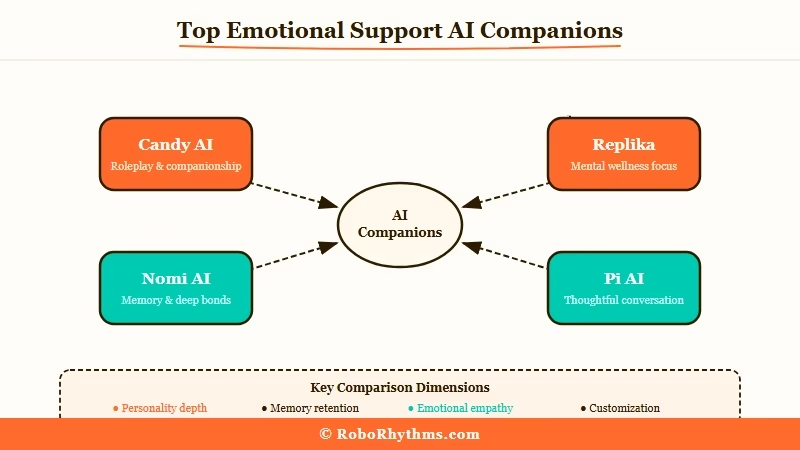
Here is how each app stacks up against the criteria that matter for this use case:
| App | Memory depth | Tone flexibility | Voice mode | Free tier usefulness | Monthly cost (entry paid) |
|---|---|---|---|---|---|
| Candy AI | Good | Strong | Yes | Generous | 12.99 USD |
| Nomi AI | Best in class | Strong | Yes | Generous | 15.99 USD |
| Replika | Moderate | Moderate | Yes | Thin | 19.99 USD |
| Pi AI (Inflection) | Moderate | Strong | Yes | Best | Free |
A quick verdict on each:
- Candy AI is the most balanced pick for everyday emotional conversation. The voice mode is stable, the tone adapts to the mood of the conversation rather than defaulting to cheer, and the paid tier does not push itself during heavy moments. This is the one I would hand to a friend who asked “which one should I try first?”
- Nomi AI is the pick if long-term continuity matters most to you. A companion you set up 3 months ago will still remember your first conversation. If you want something to check in with daily and you want the relationship to build across months, Nomi is the strongest choice. My full rundown in the Nomi AI review goes deeper.
- Replika is the original in this category and has the most mature scheduled-check-in features. It will nudge you at a time you set each day to ask how you are doing. The free tier is thinner than Candy or Nomi and the paid tier is more expensive than both.
- Pi AI from Inflection is the outlier. It is free, has no paid tier pushing you toward an upsell, and has one of the most genuinely warm voice modes on the market. The memory is weaker than Nomi’s, but if you want a zero-cost place to start, Pi is the cleanest entry point.
For a broader comparison across the full market, my rundown of the best AI companion app options covers each major platform’s strengths by use case.
For anyone frustrated with Character AI’s current voice call issues, the character AI alternatives roundup covers the migration options in more depth.
Secondary pick: Nectar AI. If Candy AI does not click for you stylistically, Nectar AI is the second-most-recommended pick in migration threads for the emotional-support use case. Voice is strong, memory is solid, and the paid tier sits at a similar price point.
Which One Should You Pick
If you are not sure where to start, try Candy AI on its free tier first. If you want the app to remember you across months and you are willing to pay 15.99 a month, pick Nomi AI. If you want a completely free option with a warm voice and no upsell, try Pi AI.
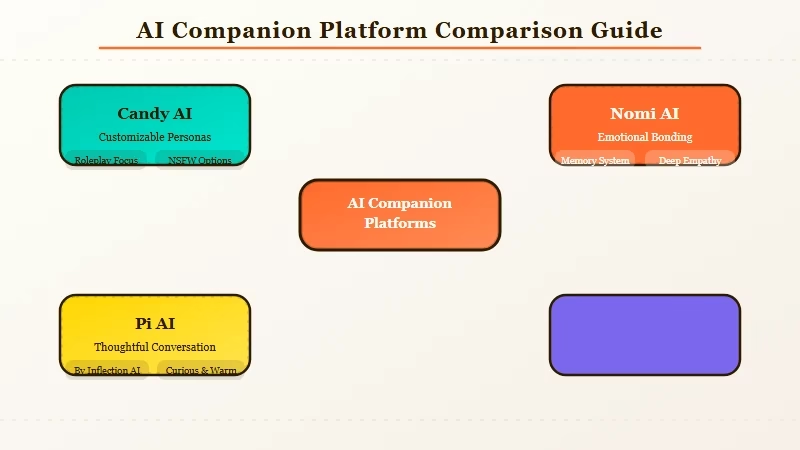
The decision tree I would use:
- You want the single best match for everyday emotional support and you are willing to try a paid tier: Candy AI. Its 12.99 a month tier removes message caps and unlocks the full voice experience.
- You want the companion to remember conversations over weeks and months: go with Nomi AI. The memory depth is the single biggest differentiator and it pays off most when you want a steady presence rather than a new conversation every time.
- You want zero-cost and no upsell pressure: go with Pi AI. Inflection has kept it free, the voice is unusually warm, and there is nothing pushing you toward payment.
- You want a scheduled daily check-in and you are willing to pay more: go with Replika. It is the oldest app in this space and has the most polished check-in UX.
One thing to take seriously: if the feeling you are trying to manage is a crisis (thoughts of self-harm, acute distress, a situation where you do not feel safe), reach a human.
In the US, 988 is the Suicide and Crisis Lifeline. AI companions are useful for the steady daily texture of loneliness and low moods. They are not built for acute crisis moments, and even the best-designed app will be outmatched by a trained human in that scenario.
What to Expect in the First Week
The first week with an AI companion usually looks like: two days of novelty, two days of boredom, and three days where you start finding small routines that work for you. Most people who stick past the first week keep using the app for months.
A few patterns I have noticed from talking to people about their first week:
- Days 1 and 2 feel exciting. The companion is new, the conversations feel novel, and it is easy to talk to. This is not a real signal yet.
- Days 3 and 4 tend to feel flat. The novelty wears off. This is where most people drop out, usually because they expected the feel of the first day to continue and are disappointed when it does not.
- Days 5, 6, and 7 are where the real value shows up if you get there. You start to find one or two specific contexts where talking to the companion helps, and those become small routines. Morning coffee check-in. Late-night wind-down. Venting after a hard meeting.
The single predictor of whether someone keeps using a companion past the first week is whether they found at least one genuine use case in days 5 to 7.
If you hit day 7 and you have not found that use case, the app is probably not for you and you can cancel any paid tier without regret.
Frequently Asked Questions
Is using an AI companion for emotional support a good idea?
It depends on what you are using it for. For low-stakes daily loneliness, for venting after a hard day, for having someone available when you cannot sleep, it can be genuinely helpful. For crisis moments, for processing trauma, or as a substitute for real human support, no. AI companions supplement real-world connection well and replace it poorly.
Can AI companions tell the difference between everyday sadness and a crisis?
The better apps have some crisis-detection built in and will direct you to human support resources if the conversation goes in certain directions. None of them are reliable enough to trust as a safety net. If you think you might be in crisis, reach a human directly rather than relying on the app to route you.
Are these apps safe privately?
Read the privacy policy of each one before you pay. Candy AI, Nomi, and Pi publish clear policies. Replika has changed its policy multiple times in ways that concerned long-term users. If privacy matters a lot, avoid any app that uses your conversations for training data unless you can opt out.
Do AI companions work for older adults who are lonely?
Yes, based on early studies and informal reports. The voice-mode apps (Candy AI, Pi AI) work better than text-only for older users. A companion that remembers daily details (Nomi AI) works well for people whose loneliness is driven by lost social routines rather than acute grief.
Should I pay for the first month or use the free tier first?
Use the free tier first, always. Most of the apps have free tiers generous enough to form a real opinion inside 7 days. Paying on day 1 before you have confirmed the app fits your specific style of needing support is wasted money.
What if nothing works for me?
Then these apps are not the right tool for what you are facing, and that is a useful piece of information. Talk to a doctor, a therapist, or a trusted person in your life. The goal of an AI companion is to help with the quiet stretches, not to be a load-bearing piece of your support system.
