
Bottom Line: AI Dungeon is still the best free sandbox for freeform text adventures, and its free tier is ad-free. The $14.99 Journey plan pays off on the smaller models, but its bigger models run at only 4K of context until you reach Legend at $29.99. New accounts made since September 28, 2026 also share story text for training by default, so open Data Privacy Settings first.
This AI Dungeon review covers the two things that decide whether you should pay: what each tier really buys, and what Latitude now does with your stories.
I care more about where a paywall sits than about a feature list, and AI Dungeon’s sits in an odd place.
AI Dungeon is Latitude’s text adventure game, where you type what your character does and an AI model writes what happens next. Latitude launched it in 2019.
The Android app holds 4.0 stars from 106K reviews on Google Play, which is a solid score for an app this old.
You will know which plan earns its money by the end, and which data setting to pick before your first story.
What Do AI Dungeon Reviews Miss About Your Data?
AI Dungeon reviews mostly miss the September 28, 2026 change: new accounts now share prompts and story text with Latitude for training by default, and some new models and extra context may require providers that keep data.
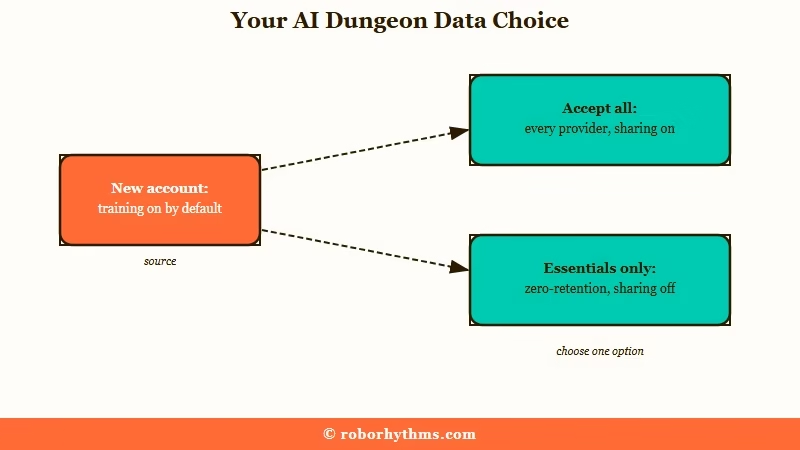
Latitude announced the change in a staff post on r/AIDungeon. Improve the AI used to be opt-in on AI Dungeon, and it is now on by default for new users, which lets Latitude use shared prompts, story text and AI responses for evaluations and training.
What is zero-day retention: A provider policy where the AI company keeps no copy of your prompts or replies after generating a response.
The same post opens AI Dungeon to providers without zero-day retention. The first is an OpenAI embedding model for the memory system, and Latitude says it is exploring providers that could double the context on DeepSeek and GLM models.
Existing players get a pop-up to set their preferences. “Accept all” turns on every provider and the optional sharing, while “Essentials only” keeps you on zero-retention providers and switches training off, which may cost you “some models, features, and cost optimizations,” per the announcement.
History is the reason I read that pop-up slowly. Latitude’s own Taskup incident page says that in May 2021 about 100 clippings from AI Dungeon stories were posted to 4chan by a contractor at Taskup, a company OpenAI’s data-labeling vendor was using, with AI Dungeon data shared without Latitude’s knowledge.
None of that makes the new setup sinister, and Latitude says stories stay encrypted in storage. For anyone writing personal stories, Essentials only is my pick, and you can change it anytime under Data Privacy Settings in your account.
If you came for one-on-one character chat, Candy AI is built for that and needs no model setup. You give up AI Dungeon’s story tools in exchange for a single companion who talks back.
What Is AI Dungeon and How Does a Turn Work?
AI Dungeon is a text adventure game where you type an action, a line of dialogue or a piece of narration, and an AI model writes the next part of the story.
Each turn starts with an input mode. Do writes an action for your character, Say writes speech, and Story adds narration directly, while See asks for an image of the scene.
What is context: The amount of recent story and lore, measured in tokens of roughly three-quarters of a word each, that the AI reads before writing a reply.
Before the model writes, AI Dungeon assembles its context. The membership page lists what goes in: your recent adventure text plus the AI Instructions, Story Summary, Plot Essentials, Author’s Notes and any Story Cards that match.
Story Cards are the feature I rate highest, because they feed lore to the AI only when a keyword shows up in the story. A tavern card with the barkeep’s name and secrets stays out of the prompt until someone walks into the tavern, which saves context for what is happening now.
The mobile layout changed this year. The Do, Say and See buttons were rearranged to make room for video generation, and players in one thread dislike the new vertical menu.
Is AI Dungeon Free?
AI Dungeon is free to play, and the free Wanderer tier is ad-free, but it runs smaller 12B to 24B models at 2K to 4K of context with room for 25 memories.
The ad-free part dates from the Unchained update, which Latitude describes as bringing “ad-free play.” Free players can pick models such as Muse and Wayfarer Small 2, which run at 4K, while Hearthfire and Harbinger run at 2K on the free tier.
Latitude’s rotating free model is the one I would leave on as a new player. It rotates between several models behind the scenes to cut repetition, so you never have to choose one.
Small context is less of a wall than it sounds. In one thread, a player describes a 29k-turn story kept on track at just 4K of context on a larger paid model, using careful prompting and a handful of good Story Cards.
The free tier is enough to learn whether you like the format, and that is the test I care about before anyone pays. Journey and Legend each include a one-week trial with purchase if you want to test the bigger models.
How Much Does AI Dungeon Cost?
AI Dungeon costs $14.99 a month for Journey, $29.99 for Legend, $49.99 for Mythic and $99.99 for Ultimate, and each step adds credits, memories and context.
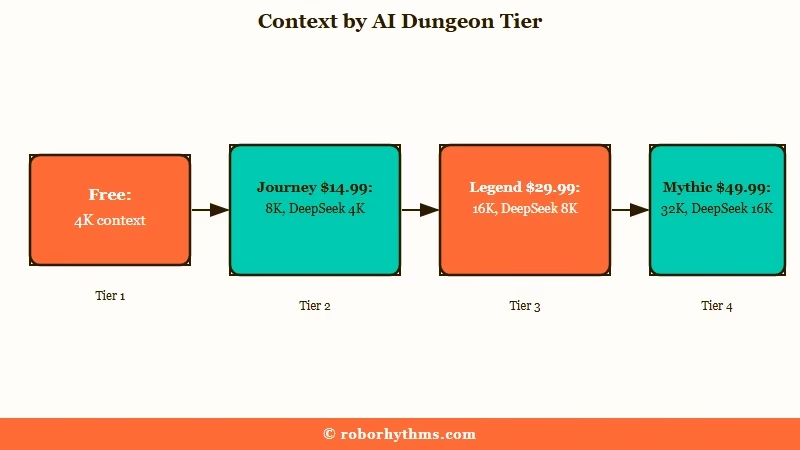
The 4K catch is the line in this table that bothers me most. On Journey, the bigger models you upgrade for, such as DeepSeek V3.2, run at half the context the small models get on the same plan.
| Tier and monthly price | Monthly credits | Context on most small models | Context on DeepSeek V3.2 |
|---|---|---|---|
| Wanderer, free | 0 | 4K | Not available |
| Journey, $14.99 | 760 | 8K | 4K |
| Legend, $29.99 | 1,650 | 16K | 8K |
| Mythic, $49.99 | 2,750 | 32K | 16K |
| Ultimate, $99.99 | 5,200 | 32K | 32K |
Prices and credits come from the membership page, and the per-model context comes from the model guide. Memories rise from 25 on the free tier to 100, 200, 400 and 800 on the paid plans.
Example scenario: On Journey, a long adventure on one of the small models gets 8K of context, so the AI reads roughly the last several thousand words each turn. Move the same adventure to DeepSeek V3.2 and the AI reads only 4K, so older details drop out twice as fast unless you spend credits on extra context.
There is one bright spot on Journey. Muse, Latitude’s 12B storytelling model, gets 16K there, double the tier’s headline figure.
Above Ultimate sit the Shadow Tiers, called Banshee, Reaper and Apocalypse. They are web only and monthly only, they push DeepSeek V3.2 as far as 128K, and Latitude itself warns that “the prices of Shadow Tiers can be uncomfortable.”
Which AI Models Does AI Dungeon Use?
AI Dungeon uses a mix of Latitude’s own fine-tuned models and hosted open models, with DeepSeek, GLM and 70B models starting at the $14.99 tier.
The free tier gets Latitude’s smaller fine-tunes, while Journey adds Nova 70B, Wayfarer Large, DeepSeek V3.2 and a larger rotating model. In a staff beta post, Latitude also put experimental Gemini 3.8 Flash in its beta environment for Legend and above, and GLM 5.3 Flash for Journey and above.
The rotating models switch between several underlying models, which keeps prose fresh and occasionally drags in a pickier one. A recent thread complains that refusals are back on the larger rotation, and the player asks Latitude to drop the model doing it.
The written rules are narrow. Latitude says the only intended trigger for its AI filter is content involving the sexual exploitation of children, so refusals on mature themes look like a model’s own training at work, and I see that split as fair to Latitude.
Is AI Dungeon Good for Long Stories?
AI Dungeon is good for long stories only if you manage context, because everything outside the model’s context window drops out of what the AI can see.
Latitude admits memory has been its weak spot. In the September post, it says fixing key bugs in AI Dungeon’s memory system took 8 months and another AI engineer, and the first new provider, the OpenAI embedding model, is aimed at memory.
Repetition and memory loss are common complaints in its low-star reviews on the Google Play listing, behind only bugs, crashes and login problems. The fixes for repetitive AI roleplay carry over well to AI Dungeon.
I keep long stories alive with three habits:
- Put the facts that must never change, such as names and relationships, in Plot Essentials.
- Move lore into Story Cards with tight keywords, so it loads only when it matters.
- Refresh the Story Summary every few hundred turns, before old events fall out of context.
What Is AI Dungeon Voyage?
Voyage is Latitude’s newer AI RPG platform built on a persistent World Engine, open to everyone since August 26, 2026, and one Latitude membership covers premium play on both Voyage and AI Dungeon.
TechCrunch reported that Voyage’s World Engine took Latitude five years to develop. It tracks characters, objects and relationships so the world holds together over many sessions.
Latitude’s launch announcement says anyone can play for free without limits on public multiplayer servers, in parties of up to eight. Subscribers get unlimited play on private servers, and that same membership covers premium AI Dungeon.
Voyage suits players who want rules, stakes and multiplayer, and AI Dungeon suits pure freeform writing. I count the shared membership as the best value point in Latitude’s lineup.
What Are AI Dungeon’s Pros and Cons?
AI Dungeon’s biggest strengths are a generous ad-free free tier and transparent documentation, and its biggest weaknesses are the 4K catch on bigger models and the new data defaults.
Pros:
- The free tier is ad-free and runs real story models with Story Cards included.
- The help center publishes context limits model by model, so you know what you are buying.
- The written content rules are narrow, aimed at child sexual exploitation.
- One membership also covers Voyage.
- Data export is self-service now, so you can back up every adventure.
Cons:
- On Journey, the bigger models get 4K of context, half of what the small models get.
- New accounts share story text for training by default.
- The image generator blocks harmless scenes, such as two people holding hands over coffee, according to the mobile layout thread.
- Bugs, crashes and login problems lead its recent low-star reviews.
- Shadow Tier pricing puts long context out of reach for most players.
The con that weighs most for me is the data default, because it is the one a new player never sees unless they go looking.
Who Should Use AI Dungeon and Who Should Skip It?
AI Dungeon suits players who want freeform text adventures and will manage context, and it is a poor fit for anyone who wants one companion character or strict data privacy by default.
Pick AI Dungeon if you like steering a story turn by turn, building lore in Story Cards and playing community scenarios. It is the easiest place I know to start that kind of play, because the free tier works on day one.
Skip it if you want full control of models and data. SillyTavern runs on your machine and lets you choose every provider, and writers after prose rather than games have NovelAI alternatives for stories to compare.
If you would rather chat with ready-made characters than run a story game, Nectar AI is the alternative I point people to first, with anime and realistic characters you can talk to straight away, though you lose Story Cards and the turn-by-turn story tools.
For a wider shortlist, the best AI for roleplay roundup compares the main options side by side.
Is AI Dungeon Worth Paying For?
AI Dungeon is worth paying for at Legend ($29.99) if you want the bigger models at 8K or more, and Journey ($14.99) is worth it only if you mostly stay on the smaller models.
My verdict comes down to which models you plan to use. On Journey you get Muse at 16K and the small models at 8K, which is a real upgrade from the free tier.
| If you want | Pick | Why |
|---|---|---|
| To try the format | Wanderer, free | Ad-free, Story Cards, 4K on the small models |
| Longer stories on small models | Journey, $14.99 | 8K on most small models, 16K on Muse |
| DeepSeek and the 70B models | Legend, $29.99 | 8K on the bigger models, 16K on the small ones |
| Very long context | Mythic or Ultimate | 16K to 32K on DeepSeek V3.2 |
Whatever tier you pick, set your data choice before your first story. New accounts start with sharing on, and the switch takes a minute in your account settings.
Quick Takeaways
- AI Dungeon’s free tier is ad-free and good enough to learn the format before paying.
- On the $14.99 Journey plan, DeepSeek V3.2 and the 70B models run at 4K, half the 8K the small models get.
- Since September 28, 2026, new accounts share story text for training by default, and Essentials only switches that off.
- Legend at $29.99 is the first plan where the bigger models get a usable 8K.
- My advice is to start free, pick a data setting first, and upgrade only once you know which models you want.
