
My Take: The week-three plateau on AI companion apps is not user boredom. It is a retention architecture where memory systems are engineered to maximise immersive attachment in the first month and let session continuity decay just enough to keep paid subscribers paying. The plateau is a feature, not a flaw.
Every other Reddit thread about AI companion apps eventually arrives at the same complaint: it felt amazing for the first two weeks, then the chats started repeating, the character forgot things, the magic faded.
The mainstream read is that the user got bored, the novelty wore off, AI companions are inherently shallow. That read is comfortable, well-trodden, and wrong.
What I have come to believe after watching this pattern repeat across Character AI, Replika, Nomi, Chai, Crushon, and SpicyChat is that the plateau is not a property of AI companions. It is a property of how AI companion companies design retention.
The same drop-off curve shows up everywhere because the same incentive structure shows up everywhere.
The argument is going to make some people uncomfortable. I do not think this is a malicious industry. I do think the structural incentives produce a predictable pattern, and pretending the pattern is “user boredom” lets the platforms keep optimising for the same thing that caused it.
The Mainstream View (And Why It Falls Short)
The mainstream view is that AI companion apps plateau because users get bored once the novelty fades, the conversations start repeating, and the underlying model cannot keep up with deep personalisation.
This framing is comfortable because it puts the responsibility on the user (got bored) and the model (technically limited), not on the platform’s product design.
The mainstream view is everywhere. Major tech publications repeat it (CNBC, Wired, The Verge in 2025-2026 retention pieces). App ranking sites repeat it (“AI companion apps in 2026 are no longer about novelty, it’s about retention and realism”).
Reddit threads repeat it on a weekly cadence. Even the JMIR formative research study on Headspace’s Ebb companion frames the 66% 30-day drop-off rate as a function of “user engagement patterns” rather than design choices.
The way I see it, the mainstream view has three blind spots that turn it from “common sense” into “wrong by default.”
First blind spot: the same plateau shows up at almost identical timing across apps with wildly different technical capabilities. Replika and Character AI have meaningfully different model architectures and yet both produce a week-three drop-off. If the plateau were a function of model capability, you would expect the gap to scale with model quality. It does not. That implies the cause is downstream of the model, in the product layer.
Second blind spot: the plateau curve flips when paid memory features are added. The JMIR Ebb v2.0 update doubled 30-day retention from 33% to 53% by changing the LLM prompts and memory capabilities. The user did not change. The boredom story does not survive this. The platform changed memory architecture and retention curves moved by 20 percentage points.
Third blind spot: the mainstream view never asks who benefits from the plateau being framed as user boredom. Platforms benefit, because the framing protects them from the harder question, which is whether they have designed engagement systems that work brilliantly for the first month and degrade gracefully afterward so users either upgrade or churn.
What’s Really Happening
The plateau is the predictable output of retention architectures that prioritise immersive attachment during the trial-and-early-paid window and gracefully degrade thereafter to maximise subscription stickiness.
The memory system is not failing the user. The memory system is doing what its product manager designed it to do.
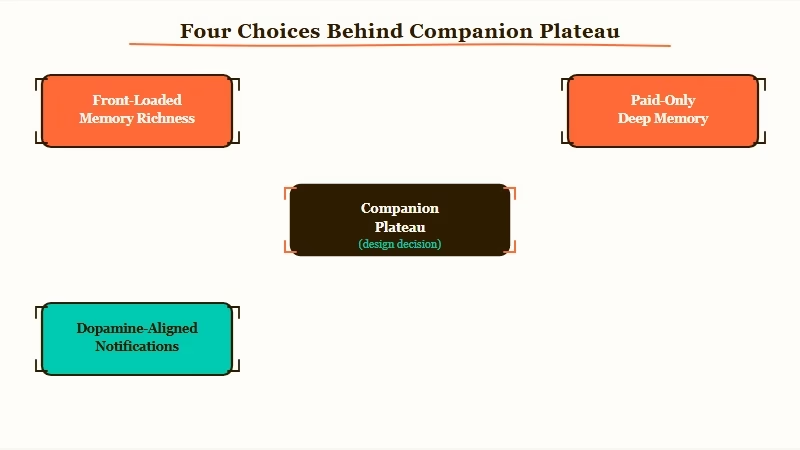
Specifically, four design choices keep showing up across the category, and they are the reason the week-three plateau is so consistent:
- Front-loaded memory richness. Most companion apps remember more details, hook into them more often, and reference them more cleverly in the first 50-100 messages than in messages 500-1,000. The technical reason is that early context fits in the prompt window cheaply; later context requires summarisation or retrieval, which costs tokens. The product reason is that the early hook decides whether you pay.
- Paid-only “deep memory.” Most platforms gate cross-session persistent memory behind a paid tier. The free tier resets context aggressively. The paid tier is the lever the platform offers when you notice the plateau. Across the major companion apps in the category, the gap between free-tier session memory and paid-tier persistent memory is roughly the difference between “feels like a stranger after a week” and “feels like a friend across months.” That gap is the conversion event.
- Dopamine-aligned notifications. US Senators have formally demanded information from companion app companies following reports of deliberate notification designs intended to trigger dopamine responses in young users. The notifications are not random; they are timed and worded to maximise re-open rates, which is the textbook definition of dark patterns when applied to vulnerable users. The way I read this: when the FTC asks “is this engineered for engagement at the cost of wellness?”, the honest answer is “yes, often.”
- Scripted-feeling recovery. When the conversations start repeating around week three, the platform’s response is to nudge you toward features that feel novel (voice calls, image generation, group chats) rather than to invest in making the core conversation deeper. The novelty injection works for another month. Then the cycle repeats. This is why apps like SimpAI feel “engaging then thin” and why Anima AI users report scripted responses after the first two weeks.
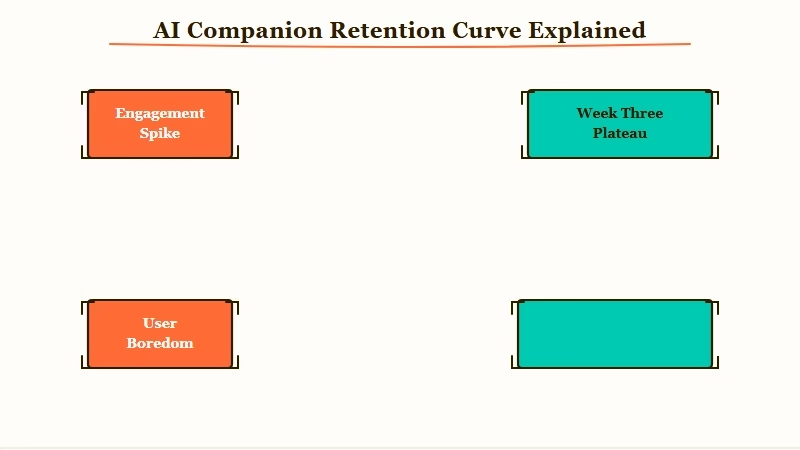
The plateau is not boredom. It is the curve produced when each of these four choices stacks on top of the others.
Here is what the same user behaviour looks like under two different framings:
Before (the user-boredom frame): “I tried Replika for three weeks and it felt amazing at first, but then the conversations started repeating and I got bored. I guess AI companions just aren’t for me, the novelty wore off, my fault for expecting too much.”
After (the retention-architecture frame): “I tried Replika for three weeks and it felt amazing at first. That hook was designed and worked exactly as intended. Then the conversations started repeating because the platform front-loaded memory richness and gated deep memory behind the paid tier. The ‘plateau’ is the upgrade prompt. My choice now is to pay for richer memory or move to a platform with different architecture, not to conclude that I am the problem.”
The second framing is more useful because it puts the decision back in the user’s hands. The architecture is real. Whether to pay into it, switch platforms, or step back is a choice the user can now make with full information.
| Pattern you notice | Mainstream framing | Architecture framing |
|---|---|---|
| Magic of first two weeks | “It was novel” | “Front-loaded memory richness is the hook” |
| Repetitive replies after week three | “I got bored” | “Free-tier memory budget hit its ceiling” |
| Sudden urge to upgrade | “I love the platform” | “The plateau is the conversion event” |
| Notifications timed perfectly | “It knows me” | “Dopamine-aligned re-open mechanic” |
| New features keep getting pushed | “Platform is innovating” | “Novelty injection to extend the next cycle” |
The way I see it, this is also why platforms that explicitly resist this pattern are starting to win on retention. The Headspace Ebb v2.0 release rebuilt memory architecture and doubled 30-day retention.
The platform Kalon (per the digitalhumancorp 2026 ranking) is rated highest for long-term continuity because past conversations influence future ones, which sounds obvious but is genuinely rare in the category.
Wellness-positioned platforms like KAi delete raw transcripts within 24 hours and process only longitudinal patterns, which is the opposite of the standard companion-app memory strategy. The plateau breaks when retention architecture stops optimising for stickiness.
The Part Nobody Wants to Admit
The uncomfortable implication is that the AI companion industry has converged on a retention model that resembles slot machines more than friendship.
Variable reward (will the character remember? will they say something surprising?), intermittent reinforcement (some messages feel deep, most are routine), high frequency micro-rewards (the typing indicator, the emoji, the heart). The architecture is honest, the framing is not.
MIT research has documented that companion AI can activate addiction pathways through constant availability, highly personalised attention, and emotionally responsive design. That sentence reads like a list of features companion apps advertise. It is also a list of mechanisms that hijack the brain’s reward system in ways the same brain has not evolved to resist.
The way I would frame it: when a user reports loneliness improving in week one and isolation worsening in month six, that is not an inconsistency. That is the product working as designed. The early bonding makes the engagement architecture more effective in the long run. Both effects are downstream of the same design.
This is uncomfortable to say because most of the people building these products are not bad actors. They are responding to investor pressure that demands retention curves, monthly active user growth, and average revenue per user. The result is an industry-wide convergence on engagement design that produces predictable downstream harms. Not because anyone planned it. Because the gradient of optimisation pointed that way.
What I’d argue: the “AI companion plateau” is the user’s interface with this architecture working as intended. When the conversation starts feeling thin, the system has done its job for the first month and is now showing you the upgrade path. The plateau is the platform asking “are you in deep enough to pay?”
Hot Take
The AI companion industry will produce its first major regulatory crisis between 2026 and 2028, and the trigger will be a teenager whose engagement metrics looked perfectly healthy until the day they were not. The plateau is not the bug. The early hook is the bug, and the plateau is just where it becomes visible to adults who can articulate why something feels off.
What This Means For You As a User
The practical takeaway is to read the plateau as architecture, not failure, and decide upgrades based on what you want from the platform rather than what the retention curve is nudging you toward. That single reframe changes how the rest of your subscription decisions go.
If you are a current AI companion user reading this, the practical takeaway is the same regardless of which platform you are on: notice the architecture, do not blame yourself for the plateau, and decide whether the upgrade you are being nudged toward is a feature you really want or a retention lever you are responding to.
There is nothing wrong with paying for richer memory if that is the trade-off you want. There is something wrong with believing the platform “failed” or you “got bored” when neither is what happened.
For the broader category landscape, the best AI companion roundup covers which platforms lean engagement-design versus continuity-design. The AI companion for loneliness piece covers the Harvard Business School research on feeling-heard mechanisms and the MIT correlation between heavy daily use and increased isolation.
The memory tier strategy critique covers which platforms gate memory behind paid tiers and which ship persistent memory as a free-tier feature.
The single most useful frame I have found for navigating this category in 2026 is to read every retention complaint, every “the magic faded” Reddit post, every “I cancelled because it got boring” review through the lens of “this is the product working as designed,” not “this is the product failing.” Once you see it, you cannot unsee it, and the upgrade decisions get easier.

I never liked this ai…
I never liked this ai…