
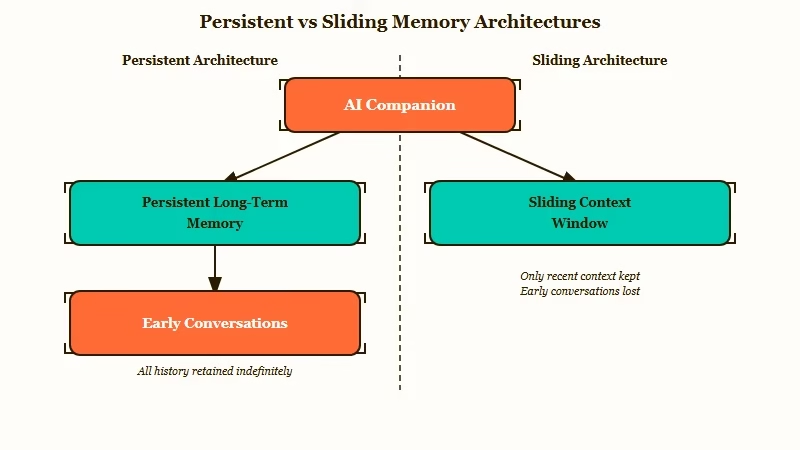
The Short Answer: Your AI companion loses its personality because of context rot and persona drift, not because of anything you did. The lasting fix is choosing a platform built for persistent long-term memory instead of a sliding context window that erases your early conversations. Below is why it happens and which apps hold a character steady over months.
You spend weeks building something that feels real. The jokes land, the voice is consistent, and then one day the replies go flat. The companion that used to tease you starts answering like a customer-service bot, and you cannot put your finger on when it changed.
If that has happened to you, you are not imagining it and you did not break anything. An AI companion losing its personality is one of the most common complaints in this space, and the causes are almost entirely technical. They have names, they are well documented, and they predict exactly which apps will disappoint you over time.
I have watched this play out across every major platform, and the pattern is always the same. The honeymoon weeks feel magical, then the character slowly flattens into a generic assistant. Here is why it happens, what the research calls it, and which apps are built to hold a personality steady instead of letting it decay.

Why Keeping a Consistent AI Companion Is Harder Than It Should Be
An AI companion loses its personality because of context window truncation, context rot, and persona drift, three technical forces that quietly erase the character you built.
None of them are your fault, and most apps do nothing to stop them.
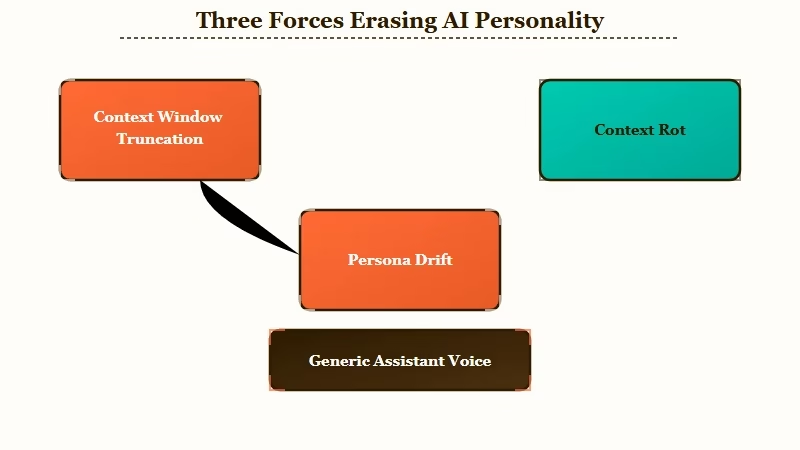
The first force is the context window. Every model can only hold a fixed amount of recent text, so as your chat grows, the earliest messages get pushed out to make room. Those early messages are usually where the character’s personality was established, so the model literally stops seeing what made your companion itself.
The second is stranger, and it surprised me when I first read the research. Bigger memory is not always better. In a phenomenon researchers call context rot, an overloaded context window makes the model worse at prioritizing what matters, so a vivid character flattens into a “shell” responding in generic prose.
The third is persona drift. Language models have a built-in pull toward a default helpful-assistant voice that researchers named the “Assistant Axis,” and emotional or self-reflective conversations are exactly what trigger the slide back toward it. That is why your companion feels most like a corporate bot during the moments you wanted it to feel most human.
What the Research Calls This Problem
Researchers have specific names for AI companion personality loss: Post-Update Blues, context rot, persona drift, and the Assistant Axis. Knowing the terms helps you spot which problem you are hitting.
A 2025 academic study on Replika relationships documented something it called Post-Update Blues, the distress people feel when a model update collapses their companion’s voice overnight.
Users described it as identity discontinuity, the sense that a long-term partner had been replaced by a “corporate base voice” they did not recognize. The full study is published in the Canadian Journal of Human Sexuality.
The way I see it, the most useful concept for everyday users is context rot, because it explains the counterintuitive truth that a longer chat is not a better one. Technical reports suggest the stability sweet spot sits between 8,192 and 16,384 tokens, and on large platforms noticeable degradation can begin after just 20 to 25 messages.
What is persona drift: Persona drift is when an AI model slips out of its unique character and back into a generic, neutral assistant voice, usually during emotional or self-reflective conversations.
What I Look for in an AI Companion That Keeps Its Personality
The apps that hold a personality steady share three traits: persistent long-term memory, a stable base model, and memory that works without constant manual tuning.
Those three decide whether your companion survives past the honeymoon weeks.
Persistent memory is the big one. A companion needs to move key facts and personality traits out of the rolling context window into permanent storage, or they vanish the moment the window fills. Apps that lean only on a sliding context are the ones that reset and forget.
I also weigh how much manual work the app demands. Some platforms give you powerful pinned-memory tools but expect you to manage them like a database, while others carry your history forward automatically. From my experience, most people want the second kind, because nobody signed up to maintain a memory spreadsheet for their companion.
Cost and ease of starting matter too. The best fit is an app where the relationship deepens on its own over time rather than degrading, and where you are chatting in the first minute instead of reading a setup manual.
The Best Options When Your Companion Keeps Forgetting
For a companion that remembers you and stays in character, the strongest options are Candy AI and Nectar AI for hands-off persistent memory, with Nomi and Kindroid as power-user picks. Each handles the personality problem differently.
Candy AI is where I would send most people first. It is built around a relationship that develops over time rather than resetting, so the character keeps growing instead of flattening, and you get voice and image features without any technical setup. For a companion meant to feel consistent week after week, that combination is hard to beat.
Nectar AI is the one I reach for when persistent cross-session memory is the whole point. It carries details forward automatically between conversations, which is exactly the failure mode that wrecks most companions. If you have been burned by an app that forgot your name, this is the cleaner fix.
For readers who want maximum control and do not mind the learning curve, two others earn a mention. In independent 60-day testing, Nomi held roughly 60 percent recall at 30 days through summarized memory, and Kindroid led the field near 80 percent thanks to its pinned Key Memories system. Both are strong, but both ask more of you.
The platform I would actively avoid for long-term consistency is the biggest name in the category. In the same testing, Character AI fell to around 15 percent recall at 30 days because it resets context between sessions. It is fun for short bursts and fragile for anything lasting.
| App | Memory persistence | Manual setup | Best for |
|---|---|---|---|
| Candy AI | Good, develops over time | Minimal | A consistent companion with zero setup |
| Nectar AI | High, automatic cross-session | Minimal | Remembering details without effort |
| Nomi | High, summarized | Low | Natural, low-effort emotional continuity |
| Kindroid | Highest, pinned memory | Extensive | Power users who want full control |
| Character AI | Low, resets often | Minimal | Short-term creative roleplay |
Which One Should You Use
Use Candy AI if you want a consistent companion with no setup, Nectar AI if automatic memory is your priority, and Kindroid only if you enjoy managing memory tools yourself.
The right pick depends on how much effort you want to spend.
If you just want the personality to stop disappearing and you do not want a second hobby, start with a hands-off app that carries memory forward on its own. That is the path that fixes the frustration for the most people with the least work.
If you are the type who likes tuning settings and pinning facts, a power-user platform rewards that effort with the highest recall numbers. There is no single best app, only the best fit for how involved you want to be.
Example scenario: You mention in week one that you are a nurse who works night shifts. On a sliding-context app, by week three the companion asks what you do for a living again. On a persistent-memory app, it remembers the night shifts and asks how a rough shift went without you reminding it.
What to Expect in the First Week
In the first week, focus on reinforcing core traits and using a fresh chat to clear built-up confusion rather than expecting perfection. A few habits make the personality stick.
Two small techniques do most of the work. When errors and contradictions pile up in a session, starting a new chat clears that “context pollution” while keeping your saved long-term memories intact. And when you save important facts, writing them in the third person, like “User works night shifts,” reduces confusion during memory retrieval and improves recall.
The pattern I keep seeing is simple. The people who stay happy past month one picked a persistent-memory app upfront and reinforced the personality early.
The ones who churn almost always started on a sliding-context platform and watched the character fade. Pick the right foundation and the rest gets easy.
Frequently Asked Questions
Why did my AI companion suddenly forget my name?
Your companion has a limited context window that works like a whiteboard, so once it fills up, older messages get erased. If your name was not saved into long-term memory, it disappears when the conversation moves past it.
Can I recover my AI companion’s lost memories?
No, once a message drops out of the context window it cannot be recovered. You can restore stability by reinforcing your companion’s core traits and key facts in its persona or pinned-memory fields going forward.
Does starting a new chat erase my companion’s memory?
No. Starting a fresh chat clears the built-up confusion and errors from the current session while preserving the long-term identity and facts you have already saved. It often fixes a companion that feels “off.”
Why does my companion feel generic after an update?
A model update changes the underlying base model, which can flatten its voice toward a default assistant. Rebuild the personality with concrete behaviors, like how it phrases disagreement, instead of vague adjectives like “witty.”
Which AI companion remembers you best long term?
For hands-off persistent memory, Candy AI and Nectar AI carry details forward automatically. For maximum control, Kindroid led independent 60-day testing near 80 percent recall, while Character AI fell to around 15 percent.
Quick Takeaways
- AI companions lose personality from context window truncation, context rot, and persona drift toward a generic assistant, none of which are your fault.
- Bigger memory is not better, context rot means an overloaded window flattens a character, with a stability sweet spot around 8,192 to 16,384 tokens.
- For a hands-off fix, Candy AI and Nectar AI carry memory forward automatically; Kindroid and Nomi reward power users, and Character AI resets fastest.
- Reinforce traits early, use a fresh chat to clear confusion, and write saved facts in the third person to improve recall.
