
What Happened: AI companion apps crossed $120 million in annual revenue last year and the number of competing platforms grew by 38% in 2025 alone. In April 2026, UnitedHealthcare launched an AI companion for 20.5 million members, five states are passing new laws regulating the space, and Character AI now reports 233 million registered users. What was a fringe niche two years ago is becoming a contested mainstream market.
The AI companion app market in April 2026 looks nothing like it did eighteen months ago. Revenue has gone from a rounding error to nine figures. Major enterprises are entering.
The shift is not just about scale. The nature of the platforms entering this space is changing what AI companionship means and who regulates it.

What Is Driving AI Companion App Revenue Right Now?
Consumer AI companion apps generated $82 million in just the first half of 2025, crossing $120 million by year’s end, according to TechCrunch’s app store data.

The growth came from two sources. First, existing platforms like Replika and Character AI deepened monetization. Replika moved more users onto paid tiers, and Character AI launched its premium subscription with subscriptions becoming a meaningful revenue contributor alongside ad revenue.
Second, new entrants flooded the space. There are now 337 active and revenue-generating AI companion apps worldwide.
128 of those were introduced in 2025. That is a 38% expansion in the available product catalog in a single year.
The platforms generating the most revenue are still the ones that figured out the relationship mechanic first. Replika, Nomi AI, and Candy AI all benefit from users who return daily. That retention pattern is what generates subscription revenue at scale.
What I find interesting about the revenue figure: $120 million sounds large until you compare it to the broader AI tool market. It is still a small number relative to the platform valuations being thrown around. The market is not yet efficient, and that is exactly why new entrants keep arriving.
The three platforms that have shown the clearest revenue growth heading into 2026 look like this:
| Platform | Reported Users | Revenue Signal | Key Advantage |
|---|---|---|---|
| Character AI | 233M registered | Subscription + ads | Largest user base |
| Replika | 30M daily active | Subscription | Retention depth |
| UnitedHealthcare Avery | 6.5M (target: 20.5M) | Enterprise contract | Healthcare scale |
Why the April 2026 Market Looks Different From Last Year
The AI companion market in April 2026 is being shaped by three forces that did not exist at this intensity twelve months ago: enterprise entry, state regulation, and massive user scale.
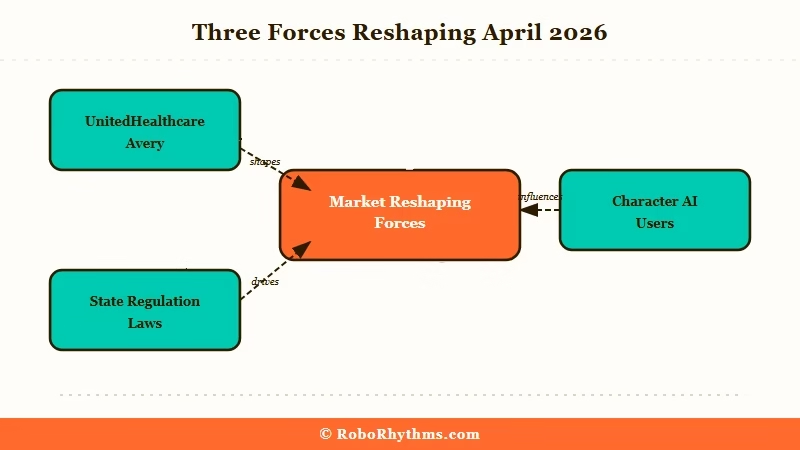
The enterprise entry is the most significant signal. UnitedHealthcare launched an AI companion called Avery in early 2026, currently serving 6.5 million members with a stated plan to reach 20.5 million commercial, Medicare, and Medicaid members by year’s end.
When a Fortune 50 health insurer builds an AI companion product for 20 million people, the category has crossed from novelty to infrastructure.
UnitedHealth Group’s $1.6 billion AI investment plan for 2026 signals this is not a one-off experiment. Enterprise AI companions are now being designed to reduce friction in health plan navigation, not to provide social connection. That is a fundamentally different use case than the consumer companion space, and it is now competing for the same term.
The regulation pressure is also compressing the market. Five states passed or advanced new AI companion laws in Q1 2026 alone, covering disclosure, crisis intervention, and in Tennessee’s case, developer liability for emotional simulation. The full breakdown is in our April 2026 regulation overview.
The third force is user scale. Character AI now reports 233 million registered users. Even if only a fraction are active, that is a user base that dwarfs most social platforms of five years ago.
At that scale, AI companionship is no longer a subculture. It is a consumer behavior category.
What This Means If You Are Using an AI Companion App Today
For everyday users in April 2026, the market shift means more choice, more platform consolidation pressure, and some meaningful uncertainty about which apps will still exist in twelve months.
The 337-app market is too fragmented to sustain at this size. When the broader AI model cost drops further and compliance costs from new state laws increase, smaller platforms without enterprise backing or strong user retention will exit. From what I have seen, platforms that survived past regulatory cycles tend to have either deep user bases or venture backing.
One mid-size companion readers keep asking about is Moemate, a useful case study in how fast that exit can happen, see what happened to Moemate.
Here is how I would think about platform survival odds based on what is visible right now:
- Platforms with 1M+ active users and clear subscription revenue are safe. Regulatory compliance is expensive but not existential at that scale.
- Platforms backed by enterprise contracts (healthcare, productivity) are insulated from consumer market pressure.
- Platforms in the 50,000-500,000 user range with no subscription revenue face the highest risk from both regulation compliance costs and competition from better-funded alternatives.
- Niche platforms with deep community retention (specific genre, audience, or use case) can survive without massive scale if churn is low.
For users of established platforms like Candy AI or Nomi AI, near-term risk is low. These platforms have demonstrated retention and are large enough to absorb compliance costs.
For users of newer or smaller platforms, the question worth asking is: does this app have a clear revenue model, and is it building a user base with real retention? A platform with 50,000 downloads and no subscription revenue is not positioned to survive the next regulation wave or the next LLM cost shock.
The positive side of consolidation: the surviving platforms will be more capable, more compliant, and more focused on delivering the actual experience users want. The fringe products that exploited ambiguity about what they were building are the ones most likely to exit.
What the AI Companion Market Looks Like by End of 2026
The state-level regulation wave will thin the field, enterprise entry will redefine the category’s public perception, and the platforms that make it through will be competing at a level that looks nothing like 2024.
The most likely scenario by late 2026: ten to fifteen dominant consumer platforms, a separate category of enterprise AI companions led by healthcare and productivity use cases, and a long tail of specialized apps targeting niches like gaming (Questie AI, which we reviewed in our Questie AI review), creative writing, and language learning.
Federal regulation is still trailing state action, but the FTC’s existing unfair practices authority gives it a path to mandate disclosure and crisis intervention features nationally without new legislation.
The market passing $200 million in annual revenue in 2026 is a reasonable expectation given H1 2025 trajectory. Whether the broader AI companion category (including enterprise) reaches the $36 billion projection some analysts cite depends heavily on how quickly healthcare and wellness use cases scale.
What is not in question is that the market has permanently left the novelty phase. Enterprise investment, regulatory attention, and nine-figure revenue are the markers of a real market. Per Grand View Research, the AI companion space is entering a consolidation phase, and that is a fundamentally different game than the growth phase that preceded it.
