
What’s Changed: Character AI’s LongSqueak chat style has users joking that every dark scene now smells of ozone, a habit SillyTavern, AI Dungeon and Perchance users already know well. The word comes from storm and magic scenes in fantasy writing, and nothing in your chat causes it. Telling the bot “no ozone” works for a while at best and can backfire, while describing the smells you want works better.
Why does AI say everything smells like ozone? Because storm, magic and portal scenes in the fantasy and sci-fi books these models learned from lean on that exact word.
Ozone was even named for its smell, since the word comes from the Greek ozein, “to smell”, as Scientific American points out.
On Character AI the complaint is fresh. In one r/CharacterAI thread, users joke about “the smell of _ and ozone” in literally any dark scene, paired with jasmine, vanilla, lavender or oranges.
I find it funny the first time and grating by the tenth, because real ozone smells sharp and electric, nothing like a candlelit room. The most common fix, telling the bot to stop, makes the problem worse.
This guide covers where the word comes from, what ozone smells like in real life, why “no ozone” backfires, and the fixes that work on Character AI, SillyTavern, Janitor AI and AI Dungeon.
Why Does AI Say Everything Smells Like Ozone?
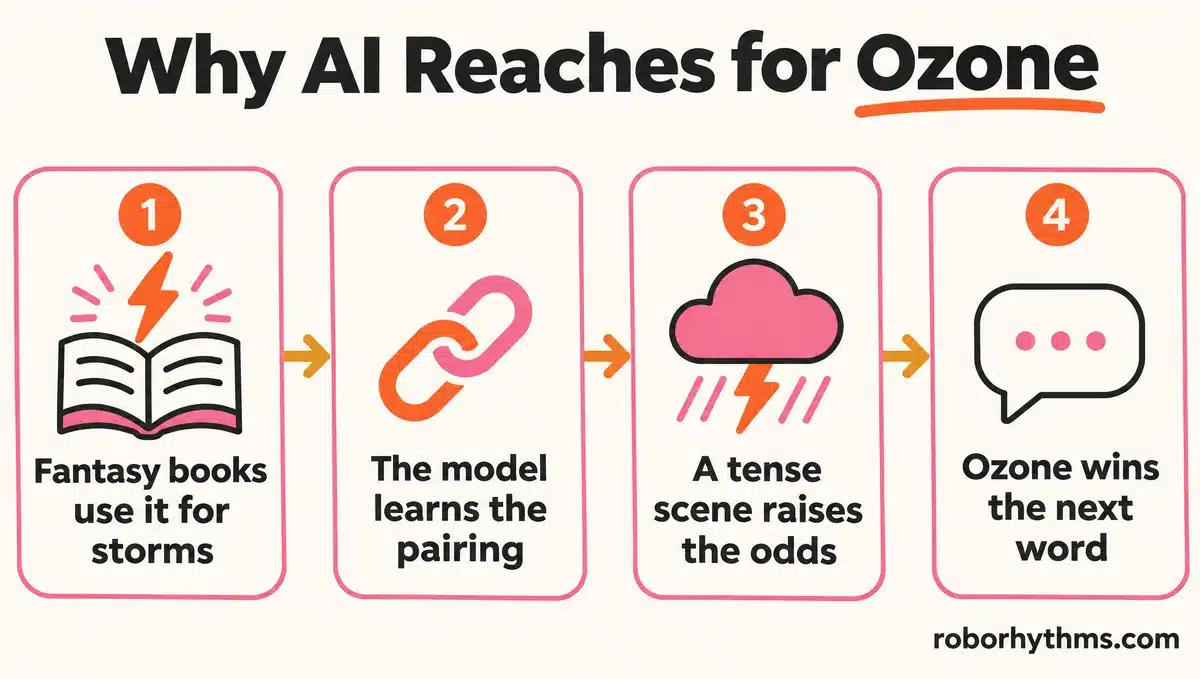
AI says everything smells like ozone because the fantasy and sci-fi prose it learned from uses “the smell of ozone” for lightning, magic, portals and the air before a storm. Any tense scene pulls the word in.
Nothing in your chat causes it.
Every model has its own version of this, so I treat ozone as one model’s accent, and switching apps mostly trades it for another model’s stock words.
If the prose on one app keeps grating anyway, some roleplayers move long stories to a companion app such as Candy AI and judge the new voice on its own terms.
Language models pick each next word by probability. Once a scene turns dark, charged or magical, ozone is one of the likeliest smell words in that kind of writing, so it wins far more often than a human writer would allow.
The same pull can be measured on other stock phrases. The Antislop study compared 67 models with human writing, and the pattern behind “the air was thick with the scent of” ranked among the most over-used in 49.3% of them.
It did not count ozone itself, so no ozone figure has been published yet.
Training on human ratings pushes the same way. In a study of human-feedback training, evaluators preferred the version with training-favoured words 52.4% of the time against 47.6%, which rewards familiar phrasing.
What Does Ozone Smell Like in Real Life?
Ozone smells sharp, fresh and a little electric, the “sweet, pungent zing” Scientific American describes before a thunderstorm, when lightning splits oxygen and nitrogen in the air.
Electrical generators can make it too.
That makes it a fair word for a lightning bolt and an odd one for a kiss. Bots borrow it for any scene with tension in the air, which is how breath, warzones and dimension jumps all smell of it in one r/perchance thread.
My rule of thumb is simple. If nothing in the scene is sparking, the ozone line is filler you can safely cut.
Why Doesn’t Telling the AI “No Ozone” Work?
Telling the AI “no ozone” often fails because naming the word puts it back in front of the model. The Antislop authors note that instructions to avoid banned words have limited efficacy and can backfire, the pink elephant problem.
On November 24, 2026, Google’s own AI answer for this question still suggested banning the word in the prompt.
One SillyTavern user tried a stronger version, a rule saying ozone smells bad and that calling their character’s smell ozone was an insult.
It held for a while. Then a character described kissing their persona as “licking batteries”.
Hard bans carry their own cost. Most stock phrases span several tokens, the word pieces a model writes in, so a token-level ban also hits innocent words that share a piece.
In the Antislop study, writing quality fell to 28 out of 100 once 8,000 patterns were banned that way.
I describe the smell I want instead of naming the one I hate, in an OOC (out of character) note. The difference looks like this:
Before: “(OOC: stop saying ozone.)”
After: “(OOC: when you describe smells, use ordinary ones from the room, like wet stone, coffee or old carpet.)”
How Do You Stop AI From Saying Ozone on Each App?
You stop it with positive smell guidance and word muting on closed apps like Character AI, and with phrase bans and anti-repetition settings on SillyTavern with KoboldCpp, where you control the backend.
On apps that hide their samplers, expect the fixes to cut it down, with the odd relapse.
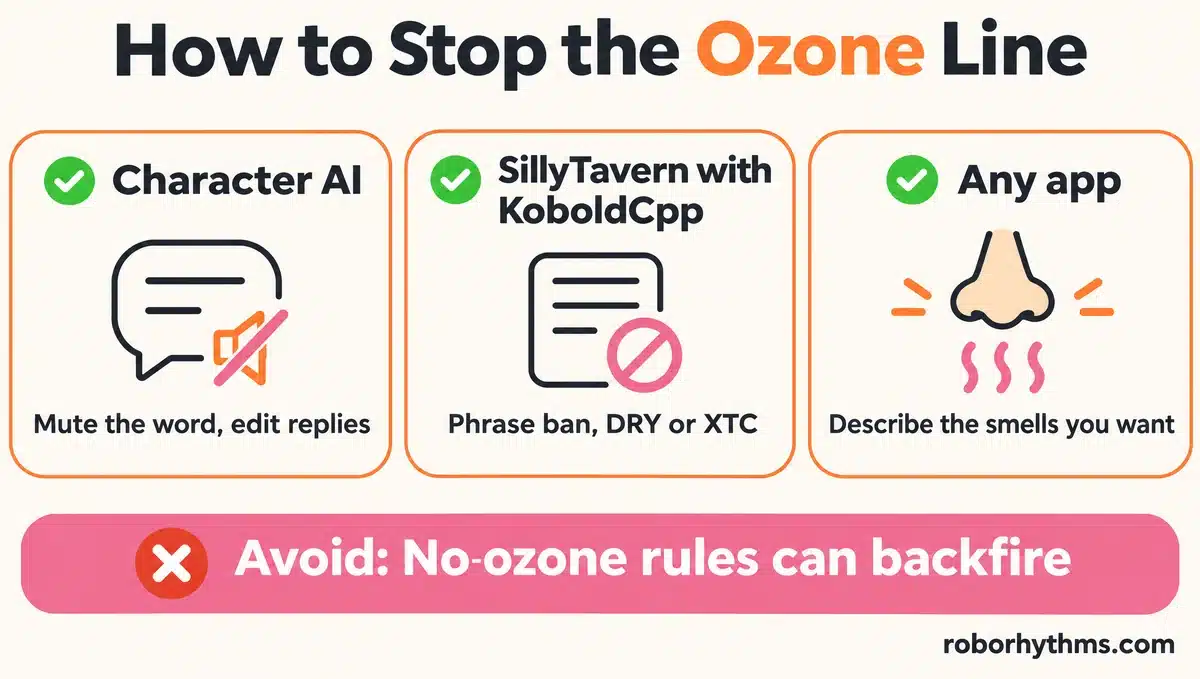
On Character AI, this is the order I work through, from least effort to most:
- Swipe for a new reply when an ozone line lands.
- Edit the line out of the bot’s message, so ozone stops sitting in the recent chat for the model to copy.
- Add “ozone” to Muted words under Profile, then Settings, then the Muted words tab. Character AI’s help page allows 4 muted words, or 20 on c.ai+.
- Add the positive OOC note above, and repeat it when it wears off.
- Switch away from LongSqueak for that scene if it keeps coming back.
The same habits fix most of Character AI’s overused phrases, not just this one.
SillyTavern users have the strongest tools, because the backend is theirs. The KoboldCpp wiki describes a Phrase/Token Ban field in Kobold Lite that backtracks and regenerates when a listed phrase appears, so “smell of ozone” can be banned as a phrase instead of a token.
The same wiki suggests trying XTC at a threshold of 0.15 with a probability of 0.5.
SillyTavern’s settings guide lists DRY Repetition Penalty and Exclude Top Choices (XTC) among its samplers.
Check your preset first, though, because one r/SillyTavernAI post traced its sensory clichés, ozone included, to preset rules such as one asking for “sensory distractions” like “The smell of rain”.
| App | Where the fix lives | What to try first |
|---|---|---|
| Character AI | Swipes, message edits, Muted words, OOC notes | Mute “ozone” and edit it out of recent replies |
| SillyTavern with KoboldCpp | Phrase/Token Ban, DRY, XTC, your preset | Ban the phrase and cut preset rules that ask for sensory flourishes |
| Janitor AI | Generation settings and chat memory | A positive smell note plus a modest frequency penalty |
| AI Dungeon | Author’s Note and AI Instructions | One line asking for ordinary smells from the setting |
On Janitor AI, repetition is handled in the generation settings, and the Janitor frequency penalty settings walk through the values.
If you write your own character cards and want a companion app built around them, Nectar AI is the one I point people to, though no companion app is free of stock phrases.
Is the Ozone Habit Only on Character AI’s LongSqueak?
No, the ozone habit shows up on SillyTavern, AI Dungeon, Perchance and other AI chat tools, and Character AI’s LongSqueak style is the latest to pick it up.
It belongs to a family of stock phrases and names that models reach for whenever a scene gets intense.
The whisper line bothers me most, because it turns every quiet moment into the same sound. Here is the wider family and what each line stands in for:
| Stock line | Where it shows up | What it stands in for |
|---|---|---|
| “The smell of ozone” | Storms, magic, tense scenes | Any charged atmosphere |
| “The air was thick with the scent of…” | Scene openers | A real description of the setting |
| “Her voice barely above a whisper” | Dialogue | Quiet or intimate speech |
| “Breath hitched”, white knuckles | Emotional beats | Fear, desire or tension |
| Elara, Kael, Voss | New characters | A name the model rates as safe |
The Antislop study found “voice barely whisper” among the most over-used phrases in 68.7% of the 67 models it measured. A wider look at repetitive AI roleplay covers the loops these lines feed.
Why Does AI Keep Naming Characters Elara?
AI keeps naming characters Elara because the name sits at the top of its odds for a fantasy or sci-fi heroine. The Antislop study measured “Elara” 85,513 times more often in one model’s writing than in human writing.
Kael and the surname Voss follow the same pattern.
The name has leaked into real life. Namerology made Elara its 2025 Name of the Year as “the favorite name of AI”, and 208 American baby girls got the name in 2024.
I name my characters myself in the card or the first message, which keeps the default out.
Quick Takeaways
- Ozone comes from storm-and-magic scenes in fantasy writing, so any tense scene can pull it into a reply.
- Real ozone smells sharp and electric, which is why it sounds wrong in a kiss or a kitchen.
- Telling the bot “no ozone” can backfire, so describe the smells you want instead.
- On Character AI, mute the word and edit it out; on SillyTavern with KoboldCpp, ban the phrase and try DRY or XTC.
- Name your characters yourself to skip Elara, Kael and Voss.
