
TL;DR: Fanfiction is a story written by fans using characters, settings or plots from a book, show, film or game they love, shared for free with other fans. Most of it lives on Archive of Our Own, FanFiction.net and Wattpad. In the United States it generally rests on fair use, because it adds something new and nobody sells it.
What is fanfiction, and why do so many people read it?
It is fiction fans write about someone else’s characters, and its biggest home, Archive of Our Own, listed 18.63 million works across 83,110 fandoms in early October 2026. Every one of them is free to read.
What surprised me most is who writes it. In a 2022 survey of 5,000 Archive of Our Own users by University of Central Florida researchers, 78.97% were aged 18 to 34, so the teenagers-only picture is out of date.
This guide gives you the plain definition, the words you meet in your first hour of reading, where to find stories, and whether any of it is legal.
If you want to watch a fanfic take shape first, our AI fanfic generator drafts a short one from any fandom you type in.
What Is Fanfiction?
Fanfiction is a story a fan writes using characters, settings or events from someone else’s work, then shares for free with other fans.
The source can be a novel, a TV series, a film, a game or a band, and fans call that original material the canon.
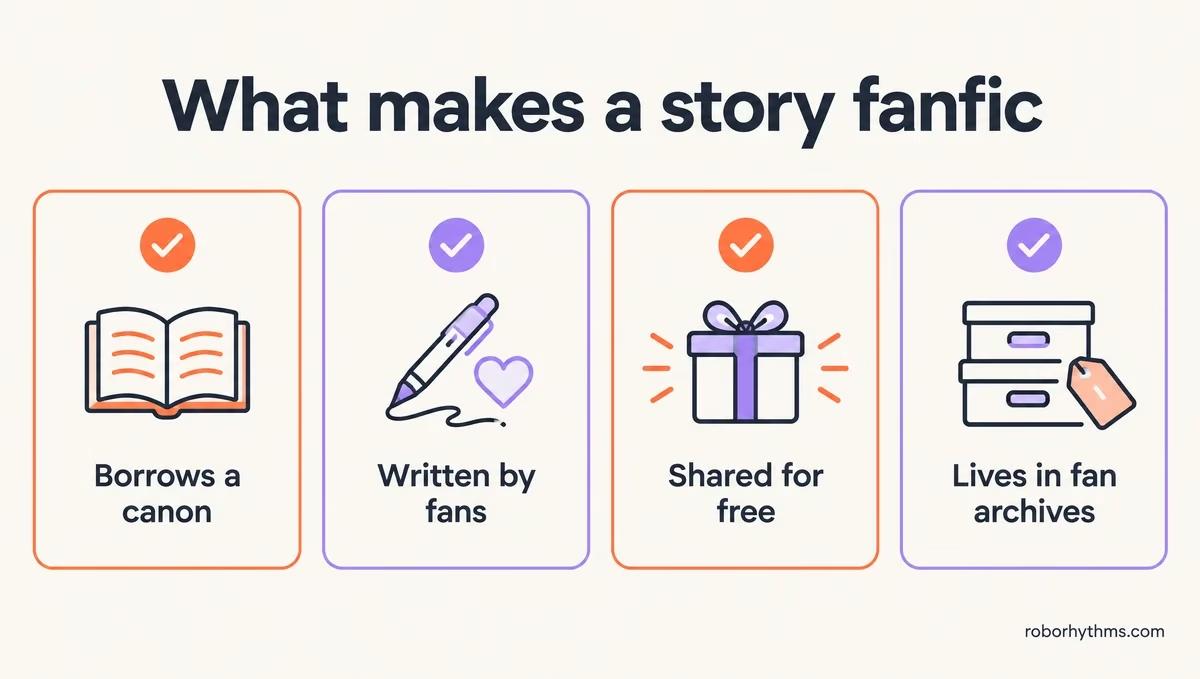
Four traits mark a story as fanfic:
- It borrows a canon. The characters or the world come from an existing work, even when the plot is brand new.
- Fans write it. Most writers are hobbyists working without any deal from the original author or a publisher.
- It is shared free. Writers post for other fans and expect comments and kudos in return, not money.
- It lives in a community. Stories sit in fan archives, tagged so readers can find the exact pairing or trope they want.
The free part matters most to me. Sarah Schnitzler’s entry in the University of Bergen’s Living Glossary of Digital Narrative describes fanfiction as running on a “gift economy,” where stories are “created, shared, gifted and exchanged” inside a community.
A licensed Star Wars novel borrows the same characters and still falls outside that, because it is sold.
Who Writes Fanfiction?
Mostly adults in their twenties and early thirties, according to the largest recent survey of Archive of Our Own users.
Researchers Lauren Rouse and Mel Stanfill of the University of Central Florida collected 5,000 responses in early 2022 and published the results in Flow.
Of those respondents, 35.51% were 18 to 24, 43.46% were 25 to 34 and 15.74% were 35 to 44. Cisgender women made up 53.77%, the largest single group.
That data kills the teen-hobby stereotype for me. Plenty of readers start young, as one r/FanFiction thread shows, but the archive’s core is people in their twenties and thirties.
What Do Fanfic Terms Like Canon, AU and OC Mean?
Canon is the official story, fanon is what fans widely believe about it, an AU moves the characters into a different world, and an OC is a character the fan invented.
Those four words, plus a few about romance and story length, cover most of what a new reader sees in tags and summaries.
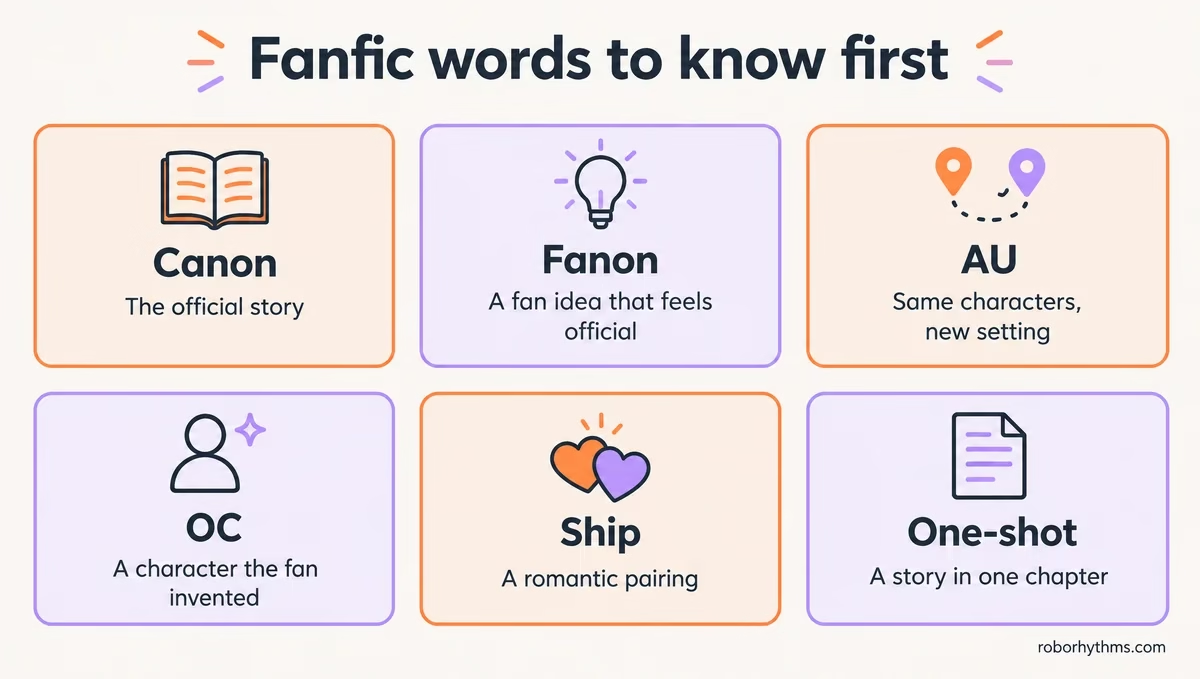
I’d learn canon and fanon before anything else, because every other term sits on top of that split.
| Term | What it means | Example |
|---|---|---|
| Canon | What the original work says happened | The events of the books or episodes |
| Fanon | A fan idea repeated so often it feels official | A habit the books never mention |
| AU | Alternate universe, same characters in a new setting | Coffee shop AU, modern AU |
| OC | Original character, invented by the fan writer | A new student at Hogwarts |
| Ship or OTP | A romantic pairing; your favorite is your one true pairing | Fans “ship” two characters |
| One-shot | A complete story in a single chapter | One scene told start to finish |
OCs split readers more than any other term. In an r/FanFiction thread about OCs, the top answer said many readers have “zero interest in reading OC-centric fanfiction” rather than hating OCs.
Another reply asked writers not to tag “x reader” when the story is about an OC.
That tag means something different. An “x reader” fic casts you, the reader, opposite a canon character, while a self-insert puts a version of the author into the story.
Tropes such as enemies to lovers or slow burn are a separate vocabulary, and the fanfic tropes guide explains the common ones.
A good fanfic premise names the canon moment it changes. A canon divergence follows the original story until one event goes differently.
Vague: “a Sherlock Holmes story”
Specific: “a canon divergence where Holmes tells Watson the truth before Reichenbach, instead of letting him believe Holmes died”
The specific version is what readers scan summaries for, and the fanfic ideas list has dozens of premises built the same way.
Where Do People Read and Post Fanfiction?
Most fanfiction is read and posted on Archive of Our Own, FanFiction.net and Wattpad, with Tumblr and Discord used for sharing and talking about stories.
Each site sets its own rules, and the differences matter more for writers than for readers.
AO3 is the one I’d send a new reader to first, because its tags let you filter by pairing, rating and warning before you open anything.
- Archive of Our Own (AO3): run by the fan-run nonprofit OTW since 2008, with 18.63 million works, 83,110 fandoms and 11.85 million users on its homepage in early October 2026.
- FanFiction.net: online since October 15, 1998, per Fanlore, and its content guidelines accept no MA-rated stories.
- Wattpad: a reading app that mixes original stories with fanfic.
- Tumblr and Discord: places to share links and short pieces, and to talk about what you read.
AO3 has been offline since October 29, 2026, and the OTW has since reported a security incident. Its status page said on November 6 that the original estimate of two to four weeks still holds.
Until it returns, FanFiction.net and Wattpad are the places to start reading.
Is Fanfiction Legal?
Free, non-commercial fanfiction generally falls under fair use in the United States, because it adds something new to the original and is not sold.
Courts decide fair use case by case, so no single story gets a guarantee.
The U.S. Copyright Office’s fair use page says courts are “more likely to find that nonprofit educational and noncommercial uses are fair.” It adds that uses which “add something new, with a further purpose or different character” are more likely to count.
The OTW’s legal FAQ leans on the same idea and cites Campbell v. Acuff-Rose, the 1994 Supreme Court case it says gives uses that rework an original “special consideration.”
My read is that money is the line that matters most, because selling fanfic or charging for access throws away the strongest argument a fan has.
Some authors refuse fanfic of their work, and archives honor that. FanFiction.net’s guidelines name a dozen authors and publishers whose work it will not archive, including Anne Rice, Nora Roberts and Archie Comics.
Is Fanfiction Bad?
Fanfiction is a hobby with every quality level, from rough first drafts to award-winning work.
AO3 won the Hugo Award, one of science fiction’s best-known prizes, for Best Related Work on August 18, 2019, per Fanlore.
Some fanfic has become bestselling fiction. Fifty Shades of Grey began as a Twilight story called Master of the Universe.
The Love Hypothesis began in 2018 as a Star Wars fic called Head Over Feet, and Berkley published it in September 2021.
Where Did Fanfiction Come From?
Modern fanfiction grew out of 1960s Star Trek fan magazines, moved to mailing lists and Usenet in the 1990s, and settled into big web archives from 1998 on.
Spockanalia, which Fanlore calls the first all-Star Trek fanzine, came out in 1967 while the show was still in its first season.
What I find striking is how personal the handoff was. In the r/FanFiction age thread, one reader said a librarian handed them a paper Star Trek fanzine in 1990, and others found stories on AOL and Usenet in the mid-1990s.
FanFiction.net opened on October 15, 1998, and the fan-run AO3 followed in 2008. Since then the archive has grown from 5 million works in July 2019 to 18.63 million in October 2026.
Can AI Write Fanfiction?
AI can draft a fanfic in seconds, but the draft still needs a fan who knows the canon, and AO3 asks writers to tag AI use.
A test draft shows why both parts matter.
Set to Sherlock Holmes, with Holmes and Watson, a Canon divergence trope and a Bittersweet tone, the AI fanfic generator wrote 439 words in about 10 seconds.
Its first line was “Holmes stood at the window of their Baker Street sitting room.”
That opening is a canon slip. In “The Final Problem,” Watson has married and moved into private practice, and Holmes walks into his consulting-room to see him.
That slip is the best argument for knowing canon I can give you, because the draft reached for the shared-flat Holmes most fans picture from the earlier stories, while this one has Watson living elsewhere.
If you post an AI-assisted fic, the AO3 AI policy explains the tags to use, and our fanfiction writing guide covers the edit a draft needs.
Quick Takeaways
- Fanfiction is a story fans write about someone else’s characters and share for free.
- Learn canon, fanon, AU and OC first, since most tags and summaries build on those four words.
- AO3, FanFiction.net and Wattpad hold most fanfic, and AO3 alone listed 18.63 million works in October 2026.
- Free, non-commercial fanfic generally sits under US fair use, and selling it is where the risk starts.
- AI can draft a fic fast, but it still needs a fan to check the canon and an honest tag if you post it.
