
TL;DR: Fanfic tropes are the shared shorthand of fan fiction, like slow burn, fake dating, hurt/comfort and coffee shop AU. In a 7,610-reader survey, friends to lovers ranked first and enemies to lovers only 20th, and seven of the ten most-loved tropes need conflict to work.
Fanfic tropes are the names fans give to story patterns, and every tag on a fic is a promise about one of them.
“Slow burn” promises a long wait for the first kiss, and “there’s only one bed” promises exactly what it says. If you are new to fan fiction, the tags can read like a private language.
In 2016 the fandom podcast Fansplaining asked 7,610 fic readers to vote on 144 tropes and themes. Friends to lovers came first and enemies to lovers came only 20th. Seven of the top ten need conflict to work.
Readers still say the same thing in their own words. Of the 27 answers to an r/FanFiction question in early November 2026 about tropes people only like when done a certain way, 16 named a condition about consequences or about keeping the characters recognisable. Readers want the pressure, and they want it to cost something, which is the rule I hold every trope to.
Below you will find what each common trope means, where several of them started, how readers rank them, and how to use one without it reading as a cliché.
If you want to see a trope play out before you write it, the free AI fanfic generator drafts an opening in about ten seconds.
What Do the Most Common Fanfic Tropes Mean?
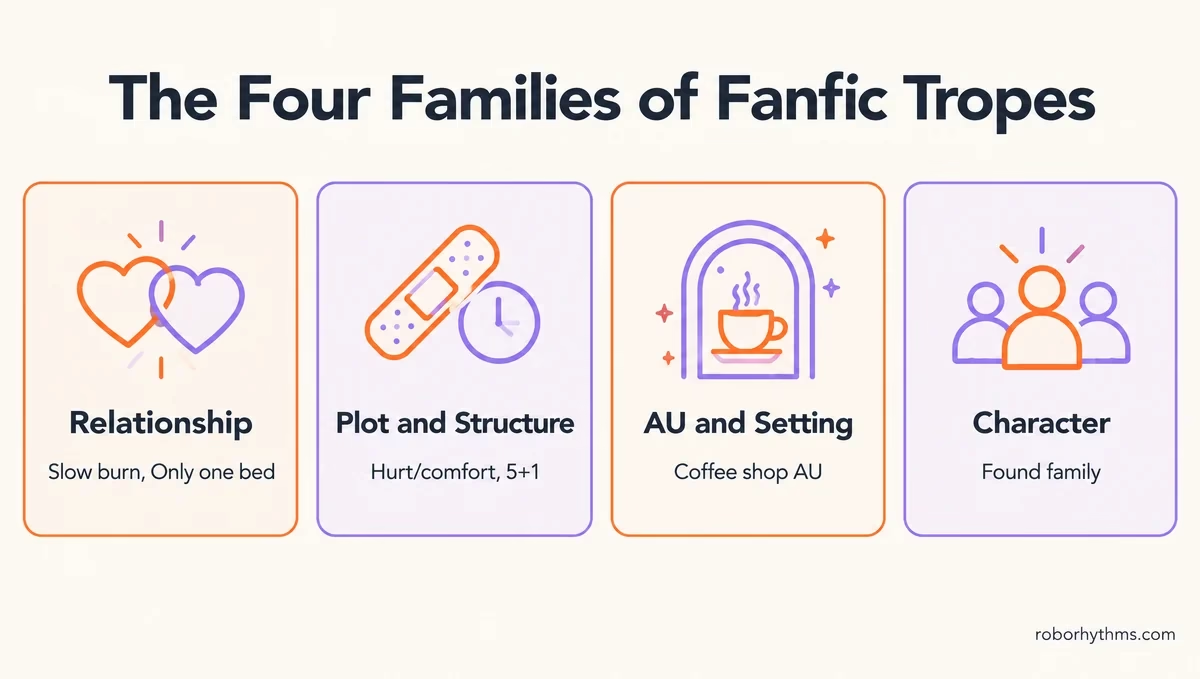
The most common fanfic tropes fall into four families: relationship tropes like slow burn, plot tropes like hurt/comfort and fix-it, AU tropes that move the characters somewhere new, and character tropes like found family.
What is a trope: A story pattern readers recognise on sight, such as a plot setup or a relationship arc. A cliché is a trope used without thought.
Fanlore, the fan-run wiki, says it plainly: “On the whole, tropes are not clichés.” I keep the families separate because the family tells you what the trope needs. A relationship trope needs a reason the pair are not together yet, and a plot trope needs a cost.
What is AO3: Archive of Our Own, a nonprofit, fan-run fan fiction archive where readers find stories by searching and filtering tags.
What Are the Relationship Tropes in Fan Fiction?
Relationship tropes describe how a pairing gets together, and they hold half of the survey’s top ten.
- Friends to lovers: two friends slowly realise they are in love. It ranked first, and readers want the shared history to pay off. It fails when the story never explains why they did not get together sooner.
- Enemies to lovers: two characters who oppose each other end up together. AO3 files “Rivals to Lovers” under the same tag, though some fans treat a rivalry and real hatred as different tropes. It is the one I’d handle most carefully, because it fails when one side does real harm and is forgiven within a chapter.
- Slow burn: the romance takes most of the story to arrive. Fanlore’s slow burn page quotes a fan whose favourite fic had no kiss until about 600,000 words. It ranked third, and it fails when the delay has no obstacle behind it.
- Mutual pining: both characters want each other, and each assumes the feeling is one-sided. It ranked tenth, and it works when every misreading has a believable reason.
- Fake dating: two characters pretend to be a couple for an outside reason, like a wedding, a family dinner or a case. It fails when nothing outside forces the act, because then there is no pressure to break.
- There’s only one bed: circumstance forces two characters to share a bed. The earliest example usually cited is “Bunkies,” a 1979 Star Wars fanzine story where Luke and Han share a bed because no double rooms are left, written as a platonic story. Bed sharing ranked fifth in the survey, and huddling for warmth ranked ninth.
- Soulmate AU: a world where soulmates are marked, with a name on the skin, a countdown timer or the first words they will say. Fanlore links the timer version to the 2009 film TiMER and notes an apparent surge of soulmark stories in 2012 and 2013. The top answer in the r/FanFiction thread asked for soulmates who still get to decide what their relationship looks like.
- Forced proximity and second chance: forced proximity traps two characters together, from a snowed-in cabin to a stuck lift. Isolated or trapped, the survey’s version, ranked 13th. Second chance brings exes or estranged friends back for another try.
What Are the Plot and Structure Tropes in Fan Fiction?
Plot and structure tropes describe what happens or how the story is built, from hurt/comfort to the 5+1 format.
- Hurt/comfort (h/c): one character is hurt or ill, and another takes care of them. It grew out of 1970s Star Trek fanzines, where fans called these “get” stories, as in “get Spock,” and it ranked eighth. Whump is the version that dwells on the hurt and goes light on the comfort.
- Fix-it fic: the writer changes a canon event they hated, often bringing a character back from the dead. It ranked 12th, and readers want the change explained, not just declared.
- Canon divergence: the story splits from canon at one changed moment, like a character who lives instead of dying. It ranked second overall and first among AUs, which makes it the safest AU to start with.
- Missing scene: a scene canon skipped, written out in full. Print zines called these “scenes from the cutting room floor,” and book fandoms often call them gapfillers.
- 5+1 (five things): five times something happened, and one time it went differently. Fanlore dates the format to a 2001 Smallville fic, “Five Things That Aren’t True” by the writer Basingstoke, and counted close to 30,000 AO3 works under the umbrella tag by September 2021.
- Time loop and time travel fix-it: a character relives the same stretch of time, or goes back to stop a disaster. Both suit angst, because the character remembers what everyone else forgets.
- Rescue missions and teamwork: the cast has to save someone or pull off a job together. They ranked fourth and sixth, which says fic readers want plot as much as romance.
What Are the AU and Setting Tropes in Fan Fiction?
An AU, or alternate universe, keeps the characters and moves them into a different world, job or time.
- Coffee shop AU: the cast runs or visits a café. Fanlore’s earliest candidate is “Café de l’Amour,” a popslash (boy band fandom) story from no later than 2001, and by February 2019 the tag covered about 14,800 of the 905,400 AO3 works tagged as AUs. It is the trope outsiders picture first, yet it ranked only 53rd in the survey.
- Modern AU and college AU: characters from a fantasy or historical canon move to the present day or to a university. Present-day AUs ranked second among AUs and college AUs fifth. A modern AU fails when the new setting strips away what made the characters who they are.
- Fairy tale and mythology AU: familiar characters recast as figures from a fairy tale or a myth. This family ranked third among AUs.
- Omegaverse (A/B/O): an AU with secondary genders, alpha, beta and omega, plus rules about instinct. It is usually rated Mature, and the 2016 survey found it one of the most divisive tropes and the second most disliked AU.
What Are the Character Tropes in Fan Fiction?
Character tropes describe who someone is to the rest of the cast, like a found family or a reader written in as “you.”
- Found family: unrelated characters become a family by choice. Fanlore files it under families of choice, and it suits any canon with a team or a crew.
- Reader insert (x Reader): the reader is a character, written as “you” or as Y/N for “your name.” If you take a reader insert into a Character AI bot, why Y/N breaks there explains the placeholder that works instead.
- Ascended extra: a side character gets promoted to the lead. It is a favourite way to write about someone canon barely used.
- Secret identity: someone’s double life gets discovered, a staple of superhero fandoms.
Which Fanfic Tropes Do Readers Love Most?
Friends to lovers is the most-loved fanfic trope in a 2016 survey of 7,610 fic readers, ahead of canon-divergent AUs and slow burn.
Seven of the top ten need conflict to work, and the survey’s authors marked which ones.
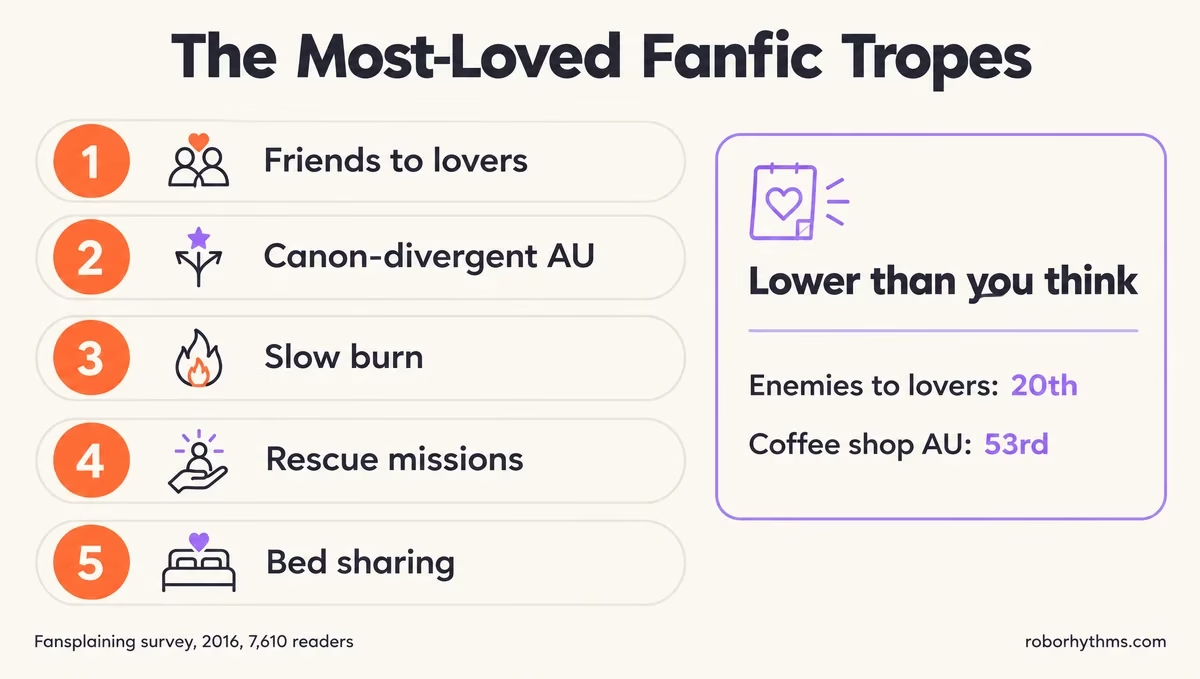
- Friends to lovers (no conflict needed)
- Canon-divergent AU (no conflict needed)
- Slow burn (needs conflict)
- Rescue missions (needs conflict)
- Bed sharing (needs conflict)
- Teamwork (needs conflict)
- Fluff (no conflict needed)
- Hurt/comfort (needs conflict)
- Huddling for warmth (needs conflict)
- Mutual pining (needs conflict)
Source: Fansplaining Fic Preferences Survey, October 2016, 7,610 respondents voting on 144 tropes and themes. The conflict labels follow the survey authors’ own split.
Every respondent had to vote on all 144 items, so the gaps between ranks mean something. Fix-it fic came 12th, isolated or trapped 13th, unresolved sexual tension 16th and enemies to lovers 20th.
Coffee shop AUs, the trope outsiders treat as the face of fan fiction, ranked 53rd, outside the top third. Canon divergence, the quiet what-if, ranked second, and it is the AU I point new writers to first.
Fic readers are generous voters, too. Of the 1,095,188 votes cast, 52% were yay and only 18% nay.
Trope names have also left fandom. The Guardian reported in February 2026 that “there’s only one bed” has spawned “Oh no, now there are two beds” and, in historical romance, “There’s only one horse.”
Why Does Friends to Lovers Rank First?
The survey’s authors call friends to lovers “a trope so common it can hardly even be called a trope.” My read is that it wins because it turns a friendship canon already shows into a ship, the pairing fans root for.
In the same survey, 35% of respondents never read stories without a romantic pairing, and many said they would read any trope at all for their favourite ship.
If that read is right, friends to lovers is the shortest road from a friendship already on screen to that ship, with no villain or contrived obstacle needed.
It is also built around the realisation beat, the moment one friend suddenly sees the other differently. That beat also topped a November 2026 r/FanFiction thread on favourite tropes, covered below.
Which Fanfic Tropes Do Readers Dislike Most?
The most disliked fanfic themes in the survey were built on abuse, eating disorders, bullying and major character death, and the most disliked AU was the zombie AU.
Among all 144 items, the zombie AU was the 14th most disliked and omegaverse the 17th. The most divisive items, loved and hated in near-equal measure, included omegaverse, band AUs, sports AUs, love potions and Cinderella makeover moments.
Darkfic, where nothing redeems the misery, was the least liked tone, while parody and crack, which is deliberately absurd fic, drew the most shrugs. None of this reads to me as a list of tropes to avoid, because a divisive trope still has a loyal half.
What Is the Most Popular Fanfic Trope Right Now?
The 2016 ranking is still the reference point, and recent reader threads still put hurt/comfort and the moment of realisation near the top.
Fansplaining’s own October 2026 follow-up revisits the 2016 results rather than running a new round, and says anyone may run a version under its Creative Commons licence.
The same piece notes that trope labels now appear on bookshop displays and Etsy merchandise, while inside fandom they still work as metadata “meant to help readers find work in a non-algorithmic world.”
The most upvoted answer in a recent r/FanFiction thread on favourite tropes was the “Oh. Oh.” moment, when a character suddenly realises their feelings.
Hurt/comfort came up in three separate answers in that thread, from sick fic to characters getting injured, more than any other single trope.
Trope lists name premises, but what sticks with a reader is usually a single beat like that realisation. A fic that nails the realisation scene can carry an ordinary premise, which is why that scene gets most of my rewrite time.
How Do You Use a Fanfic Trope Without It Becoming a Cliché?
A fanfic trope stays fresh when it costs the characters something and keeps them recognisable.
Of the 27 answers in that r/FanFiction thread on tropes done right, 12 asked for consequences, reasons or real stakes. Four more asked for characters who stay recognisable, and three asked for characters who keep their agency.
| Trope | What readers asked for | What breaks it |
|---|---|---|
| Enemies to lovers | Repercussions and growth | Real harm forgiven within a chapter |
| Fix-it fic | A reason for every change | Characters acting out of character with no cause |
| Miscommunication | A cause behind the misunderstanding | Dragging it out when one talk would fix it |
| Modern AU | Characters who still feel like themselves | A setting that erases who they were |
| Soulmate AU | A pair who choose what the bond means | Fate deciding everything for them |
| Amnesia | Memory loss with honest stakes | Using it to fake a relationship |
The fix is usually one line of consequence. Here is the same enemies-to-lovers beat written both ways.
Before: “Sorry about the warehouse,” Holmes said. Irene smiled, and they were partners again.
After: “Sorry about the warehouse,” Holmes said, and Irene did not smile. “You left me with the police for six hours, so sorry is where you start.”
The second version keeps the trope and adds a cost, and it hands the next scene a job. I still run every trope I plan to write through four questions before I commit a weekend to it:
- What does this trope cost the characters, and when do they pay it?
- Would someone who only knows canon still recognise these characters?
- What outside pressure keeps the trope going, like the case, the family or the snowstorm?
- Which single beat will readers remember, and is it on the page yet?
How Do You Find a Fanfic Trope on AO3?
On AO3, tropes live in the Additional Tags field, and volunteer tag wranglers link different spellings of a trope to one canonical tag, so filtering by that tag catches the variants.
That is why “Rivals to Lovers” turns up under “Enemies to Lovers.” The wrangling team started in February 2009 with 8 volunteers and had about 400 by 2022.
Archive Warnings such as major character death sit in a separate, required field, so they are not trope tags.
When I tag a niche trope, I put the broad tag right beside it, because niche tags scatter. In the favourite-tropes thread, a death game AU fan said those stories are hard to find because writers file them under the fandom tag, a game’s own tag or a spin-off name.
As of November 5, 2026, AO3 itself is offline. It went down on October 29, and on its official status page the nonprofit that runs it reported a security incident, said no works were deleted and estimated two to four weeks to restore service.
If you reused your AO3 password anywhere else, change it there.
How Can You Test a Fanfic Trope Before Writing It?
The fastest test is to run the same characters through two different tropes and compare the openings, which takes about ten seconds per draft in a generator.
Here is one pairing on the free AI fanfic generator: Holmes and Irene Adler from Arthur Conan Doyle’s stories, with the idea that Irene needs Holmes to recover a stolen letter.
On Enemies to lovers, Romance, Suspenseful, third person, General audiences and Short, it returned a 456-word opening called “The Woman Returns.”
Its Holmes gets the line: “Your case, whatever it may be, will be tinged with deception. You cannot help it any more than a scorpion can help its nature.”
Switching the trope to Fake dating, with a Funny tone and an idea about posing as an engaged couple at a society ball, produced “The Engagement of Convenience,” 442 words long. This time Irene gets the best line, calling Holmes “the only man in London I know who won’t interpret a professional arrangement as an opportunity to become genuinely attached.”
The trope changed the stakes, from distrust to a pretence with a deadline, but both drafts opened on the same beat: Irene arrives at Baker Street and Holmes refuses before she finishes asking.
The fake-dating draft also slipped on canon. It seats Irene in Watson’s chair “with the casual confidence of someone who had sat there many times before,” but in Doyle’s stories she never sets foot in those rooms.
What I’d change first is that shared opening, since the trope should shape the first scene too. My habit is to keep the generator’s stakes, then rewrite the opening and check its canon details myself.
For premises to pair with a trope, these 40 fanfic ideas work in any fandom, and these story prompts cover original fiction.
Quick Takeaways
- Friends to lovers ranked first in a 2016 survey of 7,610 fic readers, while enemies to lovers ranked 20th.
- Seven of the ten most-loved tropes need conflict, so give every trope a cost the characters pay.
- Coffee shop AUs ranked 53rd and canon divergence ranked second, so a quiet what-if often beats a novelty setting.
- On AO3, tropes are Additional Tags that volunteer wranglers merge under one canonical name.
- Test a trope pairing in the free AI fanfic generator, then rewrite the opening and check canon yourself.
