
What’s Changed: Razer still has no firm release date for AVA. Its own reservation terms put shipping between July 1 and December 31, 2026, and call even that an estimate. Since its reveal at the CES tech show in January, Razer has also stopped naming Grok as AVA’s AI and replaced most of the launch characters.
The Razer AVA release date is a six-month window with no day attached. Razer expects its hologram companion to launch in the second half of 2026, and its reservation terms spell that out as July 1 through December 31, 2026.
That leaves about eleven weeks as of mid-October, and Razer’s pages still show no date and no price. The product page has changed in other ways since the CES reveal in January, from the AI it names to the characters you can pick.
I care less about the hologram than about the fine print, because that is where buyers get burned.
This guide covers what the $20 deposit commits you to, what AVA needs to run, which AI sits behind it now, and what to use while you wait.
When Is the Razer AVA Release Date?
The Razer AVA release date has not been announced. Razer’s reservation terms say units are expected to ship between July 1 and December 31, 2026, and they describe that window as “an estimate only” that “is subject to change.”
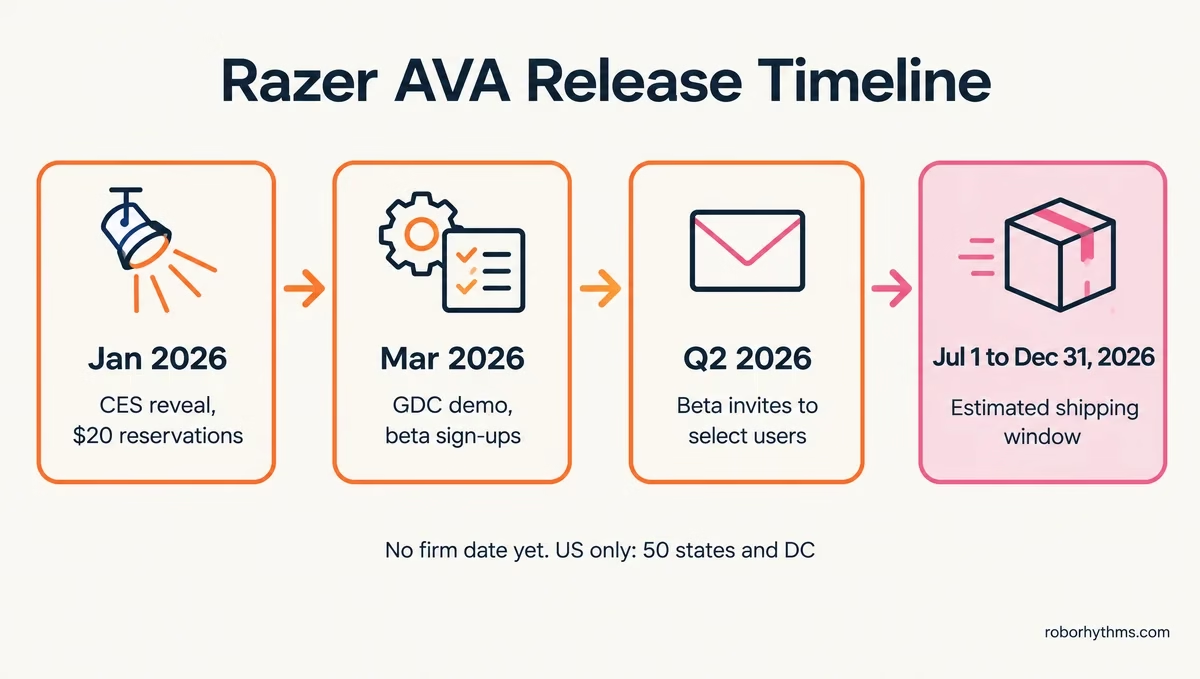
The product page says the same thing in fewer words. Razer AVA “is expected to launch in the second half of 2026,” with no month, no day and no price attached.
Razer will release units for purchase in the order people reserved them. The terms also say final units will only ship to the 50 US states and Washington, DC, so anyone outside the US has no shipping promise at all.
Nothing on Razer’s pages tells me the window has slipped, though an early ship date has no support there either. Until Razer posts a date, a December shipment fits the promise just as well as an October one.
If what you want is a companion that talks back and remembers your day, you do not need to wait for hardware. Candy AI works in a phone or desktop browser today, with nothing to reserve.
What Does the $20 Razer AVA Reservation Commit You To?
The $20 Razer AVA reservation holds your place in line for a unit you still have to buy. It is refundable on request, limited to one per person, and once Razer releases your reservation you get at least 24 hours to complete the purchase.
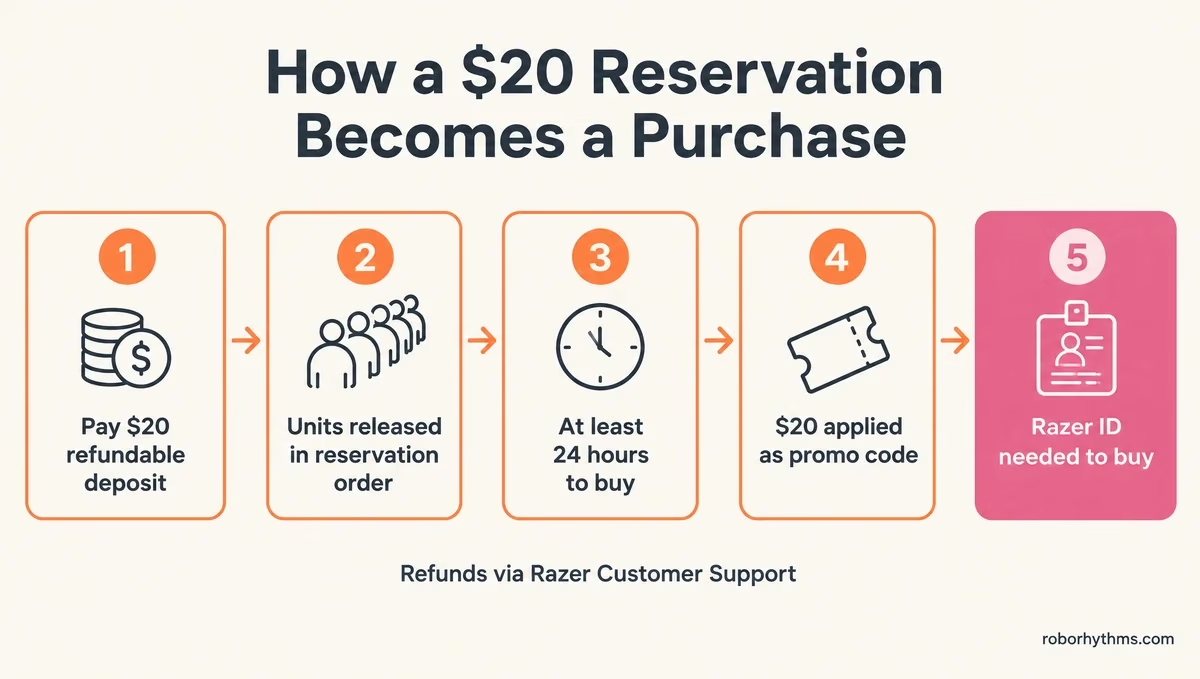
The full terms sit at the bottom of Razer’s reservation page. Here is how a reservation turns into a purchase, step by step:
- You pay a $20 deposit. You must be 18 or older and a legal resident of the 50 US states or DC, and Razer employees cannot reserve.
- Razer releases units for purchase in the order reservations were made.
- When your reservation is released, you have at least 24 hours to complete the purchase.
- The $20 counts toward the price through a promotion code Razer gives you.
- You need a Razer ID account to buy, even though you did not need one to reserve.
The 24-hour window is the term I would put a reminder on. If your reservation is released while you are traveling or asleep, a day is not a lot of slack.
| Reservation term | What it means for you |
|---|---|
| $20 deposit | Credited toward the final price through a Razer promo code |
| Refund | Ask Razer Customer Support, and the money returns to your original payment method |
| Limit | One unit per customer |
| Transfers | Deposits are non-transferable and non-exchangeable |
| Purchase window | At least 24 hours once your reservation is released |
| Who can reserve | US residents aged 18 or older in the 50 states and DC |
Razer itself cannot settle on what to call this. Razer CEO Min-Liang Tan told The Verge in January that “these are reservations. They’re not pre-orders, per se,” as Gizmodo reported.
The banner on Razer’s own reservation page calls it pre-ordering and warns that the product is still under development.
I think of the $20 as a refundable bookmark, though the money only comes back if you ask for it. If you change your mind, put the request in writing and give support everything in one message.
Vague: “I want my AVA money back.”
Specific: “Please cancel my Razer AVA reservation, placed on [date] with [email address], order number [number], and refund the $20 deposit to my original payment method as the reservation terms allow.”
How Much Will Razer AVA Cost?
Razer has not announced a price for AVA. The only official money figure is the $20 deposit, and in January Razer’s CEO said the company had not disclosed the product’s specs or even which AI model it would run.
Price figures circulate on fan sites and retailer blogs, but none of them comes from Razer. I would not budget around any of them until Razer prints a number on its own page.
The bigger unknown is the running cost. Razer’s GDC 2026 announcement, made at the Game Developers Conference in March, says AVA’s new Inference Control Plane “routes requests intelligently between local and cloud models.” Cloud models cost money to run, yet Razer’s AVA pages say nothing about a subscription.
That is the number I want before the hardware price, because a cheap device with a monthly AI fee is not cheap by month three. To Razer’s credit, the deposit terms are written plainly.
What Can Razer AVA Do on Your Desk?
Razer AVA is a 5.5-inch hologram companion that talks with you, reads your PC screen and helps with games, plans and tasks. It is not standalone: it needs a USB-C cable to a Windows PC, and it carries a camera and two far-field microphones.
Razer pitches AVA for life, work and play. Its page lists “planning your day and talking through everyday decisions to brainstorming ideas, translating conversations, and helping you explore games and other interests.”
| Part | What Razer lists | What it means for you |
|---|---|---|
| Display | Swappable 5.5-inch 3D holographic avatars | The character stands on your desk, not inside a window on your monitor |
| Camera | HD camera with ambient light sensor | It can see you and the room around you |
| Microphones | Dual far-field array mics | It can hear you from across the desk |
| Connection | USB Type-C for data and power | One cable carries both, so it stays plugged into your PC |
| Computer | A Windows PC, connected directly | No Mac support is listed, and it does not work on its own |
| PC Vision Mode | Analyzes screen content over the cable | It reads what is on your monitor to comment and help |
The Windows tether is the detail I would check first. Razer lists Windows 10 or 11 (64-bit) for the beta and a direct USB-C link for the device, and it has not published processor or memory requirements.
AVA also does more than chat. Razer showed it at GDC in March planning and running “multi-step tasks autonomously” across connected tools, and using “agent-to-agent communication so AVA companions can coordinate end-to-end tasks across users.”
Which Razer AVA Characters Can You Pick Now?
Razer’s page now lists three companions, AVA, SUMI and NIKO, and says the avatars are “still under development and not final.” At CES the choices included Kira and Zane, and Razer’s March page also listed Faker and SAO.
TechCrunch named “the anime girl Kira or the muscular Zane” among the CES characters. In early March, Razer’s own page offered five companions: AVA, KIRA, ZANE, FAKER and SAO.
Today the carousel shows AVA, SUMI (“A caring friend who listens”) and NIKO (“A quick-witted advisor”). A new avatar customization section promises to keep “the memories, personality, and bond you’ve built” when you change your companion’s look.
Reserving for one particular character is a bet I skip. Razer has already swapped out most of the lineup once, and the fine print says it can change again.
Can You Try Razer AVA Before It Ships?
You can apply for the Razer AVA beta through Razer Cortex on a Windows 10 or 11 PC, but only selected users get in. Testers sign an NDA, and Razer erases all beta data when the program ends.
At GDC in March, Razer said beta sign-ups were open, with “early access invitations” rolling out “to select users starting Q2 2026.”
The beta page lists “personalized assistance, intelligent task automation, persistent memory and contextual recommendations,” and says the beta runs for a limited time.
Testers agree to keep beta details confidential, so do not expect detailed beta reviews before launch. Anything your AVA learns about you in the beta also disappears when the program ends.
I like that Razer states the wipe plainly instead of burying it. Treat the beta as a test drive, because nothing you build there carries over.
Which AI Model Powers Razer AVA?
Razer no longer names the AI model behind AVA. Its FAQ now mentions only unnamed large language models, while the same answer in March said xAI’s Grok powered the experience.
The current Razer AVA page says AVA is built with an open architecture meant to work with other AI platforms, including “a dedicated Razer AI.” In the March 5 version, the answer named “xAI’s Grok engine” and said “Grok powers the current experience.”
That edit does not prove Razer has dropped Grok. In January, Razer CEO Min-Liang Tan said the company had not disclosed “which model it’s gonna be running at this point in time,” per Gizmodo, and the GDC announcement describes requests moving between local and cloud models.
If Grok was part of the appeal for you, judge Grok’s current pricing on its own merits, because Razer’s page no longer promises it.
The question is already live in an r/razer thread asking whether Grok’s changes will touch AVA, and the honest answer for me is that nobody outside Razer knows yet.
Does Razer AVA Watch and Listen to You?
Razer AVA has an HD camera, two far-field microphones and a screen-reading mode, so it can see you, hear you and read your monitor. Razer’s AVA pages carry no statement on what it records, where that data is processed or how long it is kept.
The only privacy line on the product page reads: “All interactions with Razer AVA are protected by your Razer ID, and sensitive information is stored securely.” Since Razer also says requests can go to cloud models, at least some of what AVA handles is processed off your PC.
Privacy was the sharpest complaint when Razer showed AVA at CES. Replies in the r/razer CES thread called a camera-and-microphone device tied to a Windows PC “a privacy nightmare” and said “until they give privacy guarantees, this thing is a big nope.”
The missing camera policy is my biggest objection to AVA right now. Chat apps already raise questions about training on your chats, and a device that can also see your room deserves a written answer before launch.
Is Razer AVA Real or an April Fools Joke?
Razer AVA is real, with a live reservation page and an open beta sign-up. The AVA Mini, a tiny AI pet billed as a companion for your AI companion, was Razer’s April Fools’ gag for 2026.
Razer’s AI team says AVA Mini launched for April Fools’ 2026 as an AI pet for Razer AVA, with a pet-photo tool that ran from March 31 through April 4.
Razer’s April Fools vault now lists AVA Mini as its 2026 entry, next to its older pranks.
AVA itself is a real product, still in development. In January, TechCrunch noted there was “no guarantee it’ll ever become a real product,” and Razer’s reservation banner still says it is under development.
I count AVA as real but unfinished. A live reservation page shows Razer means to sell it, but the ship date is still Razer’s estimate.
What Can You Use Instead While You Wait for Razer AVA?
If you want an AI companion now, a phone or browser app handles the talking and remembering today, with no hardware and no deposit. Candy AI is the one I point people to first.
Candy AI gives you a companion with memory in a browser or on your phone, and you can see what the free tier covers before paying anything. The free tier is a short trial, so expect to pay if you stay.
If voice is the draw, companion apps with voice calls cover the talking part. None of these stands on your desk as a hologram, which is the one thing AVA does that an app cannot.
My advice: book the $20 slot only if the hologram itself is what you want, and use an app for everything else.
Quick Takeaways
- Razer AVA has no firm release date; Razer’s terms promise only July 1 to December 31, 2026, as an estimate.
- The $20 deposit is refundable through Razer Customer Support and limited to one unit per US customer.
- Once your reservation is released, you get at least 24 hours to buy, so set an alert.
- Razer no longer names Grok as AVA’s AI, and the Kira, Zane, Faker and SAO avatars from its March page are gone.
- AVA needs a USB-C cable to a Windows PC, and its product pages carry no camera or microphone data policy.
