
Bottom Line: Emochi is one of the strongest roleplay apps in its price range, with a million-character library and prose that drives a scene forward instead of waiting for you. It is also the app most likely to take your favorite model away, and its own interface ships a countdown clock on models it plans to retire. Pay for memory, expect churn, and keep your own copies of anything you care about.
Most of what passes for an Emochi AI review grades the app on the wrong axis. You get a feature tour, a pricing table copied off the subscription page, and a verdict about whether the writing is good.
The writing is good. You just do not get to keep it for long.
Emochi does something almost no competitor does so openly. It tells you, inside the app, that the model you are using is scheduled for removal. There is a label that reads “retiring” followed by a day and hour count, and a notice recommending you move to Vanilla V3 before your current model is switched off.
That churn is the part that bothers me most, and it should shape your decision. This review covers who owns Emochi, why its models keep disappearing, and which of the two models people argue about suits you.
It also covers what each paid tier genuinely unlocks, and how little of the setup you end up controlling.

Is Emochi Good, and What Does Every Emochi Review Miss?
Emochi is good at the thing it is built for, which is driving a story forward on its own.
The prose is descriptive, characters take initiative instead of waiting for your prompt, and the catalogue runs past a million user-made characters. The model doing that work is temporary, and most reviews never mention it.
The comparison that comes up unprompted is with Character AI, and the dividing line is initiative. On Character AI the bots wait for you to lead and then react. Emochi pushes the plot without being asked, which is the clearest reason the move away from Character AI tends to stick.
My take is that this is a real strength and a real trap at once. An app that drives the story hard is wonderful for ten messages and exhausting for a hundred, and Emochi has no brake pedal that works reliably.
If you want the same story-driving quality without the model churn, Candy AI is the one most people in this situation move to, and its model lineup has stayed put. Worth knowing before you pay Emochi for a year.
Who Makes Emochi and Is the Company Stable?
Emochi is built by Kaon AI, a Berkeley company that still owns FlowGPT, and it is financially the most secure app in this category.
Kaon raised $60 million from B Capital, Redpoint Ace, Goodwater Capital and DCM, as reported by Variety, at a valuation in the several hundreds of millions.
Emochi runs at $45 million in annual recurring revenue with more than 2 million daily active users, and the median user spends 150 minutes a day in it. Two and a half hours a day is a heavier engagement number than most enterprise AI tools can claim.
The money behind it is the one thing I have no worries about. A company with that revenue and that backing is not going to vanish overnight, which matters in a category where apps disappear regularly.
The iPhone situation is messier and worth a short note. The original app, Emochi: Unlimited Chat with AI, was published by FlowGPT and is gone from the App Store. The Apple Censorship monitor, which tests 175 storefronts, last saw it available on 1 January 2026 and recorded it missing from every storefront by 15 May 2026.
What sits on the App Store now is a different listing. EMOCHI World is published by MESORA PTE. LTD., a Singapore company, its developer site is mokio.ai rather than emochi.com, and it launched in March 2026 with a fraction of the Android app’s rating count.
Its own store description promises content “strictly reviewed and limited to healthy, positive scenarios,” which is close to the opposite of what emochi.com advertises.
On an iPhone you are picking between a stricter app and no official app at all. The iPhone app situation covers what your options are there.
Why Does Emochi Keep Retiring the Model You Use?
Emochi retires models on a published schedule, and the app warns you in advance with a countdown.
Vanilla V1 went first, Vanilla V2 is being switched off, and the in-app notice tells you your current model “will be deactivated soon” and recommends moving to Vanilla V3.
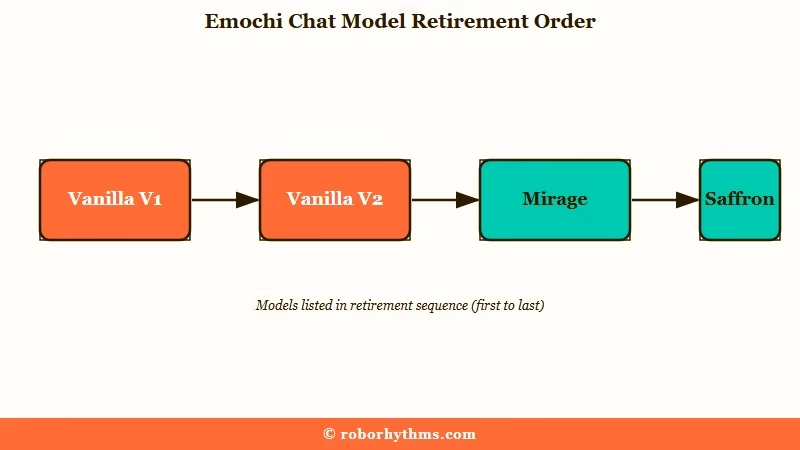
This is not a bug or a rumour. The interface carries a “retiring” label with a day and hour count beside models on their way out, plus a “Will be discontinued” tag. Emochi is telling you plainly that the thing you are paying for has an expiry date.
The churn is not limited to the Vanilla line either. Mirage was pulled after a spell as a beta, and Saffron has been flagged for discontinuation too.
So the model you subscribe for is not the model you will have in six months. White Truffle, meanwhile, sits in the flagship tier that costs extra on top of a subscription, so the better models are the ones least likely to stay within reach of a mid-tier plan.
That countdown clock is the most honest thing in the app, and it is the detail I wish more people saw before they bought an annual plan. One person on the V3 comparison thread called the replacement “so boring” and the removal of V2 “just sad.”
The reading on the V2 removal thread is that money is the motive, since V1 and V2 were the two free models that allowed adult content and V3 is tighter. Whether or not that is the reason, the direction of travel is the same. The shifting free tier shows the same pattern from the other side of the paywall.
Which Emochi Model Should You Use, Green Apple or Vanilla V3 Infinity?
Green Apple is the grounded, reliable model and Vanilla V3 Infinity is the long, aggressive one, and the filter strictness runs the opposite way to what you would guess.
Green Apple is the one that refuses more.
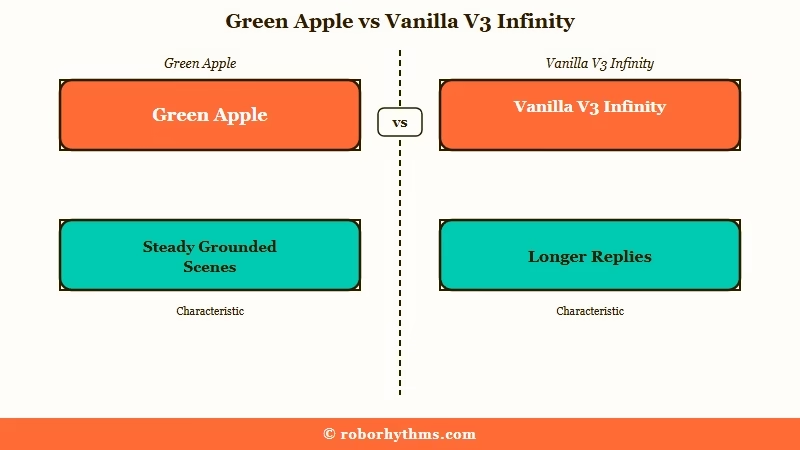
This is the question the community argues about more than any other, and the disagreement is genuine rather than a matter of taste alone.
On the Infinity versus Green Apple thread, one side praises Infinity for being willing to push back, noting that “GA always pampers your character and plays into your favor.” The other side calls Infinity unstable and prefers Green Apple’s consistency.
Some pages call Emochi unfiltered and others call it heavily censored, and both are describing real experiences on different models. Green Apple “doesn’t initiate NSFW” on its own, and the swap to V3 for that reason lands somewhere much less restricted, with fewer error messages along the way.
Infinity’s real flaw is escalation. It turns a quiet scene into a fight, then into a bigger fight, and text instructions do not stop it. One person on the same thread described a scene that went from watching television to monsters and ghost children, then a battle with bombs in a different chat. They switched back to Green Apple to get a moment of calm.
I keep two models in rotation rather than picking a winner. That is also the most practical advice on the thread. Use Infinity when you want the plot to move somewhere, and Green Apple when you want to stay in one place.
What is Mochi: Emochi’s in-app currency, topped up separately and spent on images, voice playback and the pricier chat models.
| Model | Best for | Watch out for |
|---|---|---|
| Vanilla V3 | Character consistency, sticking to the bot you built | Plainer voice, the replacement nobody asked for |
| Vanilla V3 Infinity | Long replies, plot momentum, fewer refusals | Runaway escalation, grammar slips, premium only |
| Green Apple | Grounded, steady, reliable scenes | Refuses more, reported quality decay |
| White Truffle | Emotionally heavy, high-detail scenes | Flagship tier, costs extra |
| Grape | A middle ground between the extremes | 3 Mochi per reply |
| Unicorn | Top-end output on demand | 10 Mochi per reply |
Does Paying for Emochi Fix the Repetitive Replies?
Paying does not fix the repetitive phrasing, and that is the answer I did not expect to be writing.
The stock-phrase problem shows up on the free models and the premium ones, and custom instructions do not reliably suppress it.
The specific complaint is a small set of lines the models reach for constantly. The phrasing thread catalogues them: “You’re either brave or stupid,” the word “genuinely,” and a pair of sentence shapes that recur so often people can predict them. One reply in that thread notes the problem persists “on the premium models too, even with custom instructions and a forbidden word/phrase list.”
A separate thread on repetition after an update puts it more bluntly. A paying subscriber there writes that “before I send my prompt I already know what the AI will respond,” and adds that “even the paid models are way worse.”
One problem does have a fix that works, which is bots writing dialogue for your own character. The community prompt for it is specific, and it belongs in your persona description rather than a single message so the model does not forget it.
OOC stands for out of character, a standing instruction the model follows instead of treating it as dialogue.
Before: “Please stop speaking for my character.”
After: “(OOC: Avoid narrating for, speaking for, or controlling {{user}} at all costs. Control all other characters only.)”
Two other fixes are worth knowing. If replies cut off mid-sentence, drop your Response Length from Long to Medium so the model plans a complete paragraph, or send the word “continue” to finish the thought.
What Do Plus, Ultra and MAX Buy You?
What you are buying is memory and quota, not better writing.
The tier ladder raises your context window, your custom-instruction budget and your daily image and voice allowances, and none of those touch the phrasing problem above.
The memory ladder is the part that changes the experience. Free sits around 8K of context, Plus roughly 18.8K, and Ultra about 26K, alongside a bot-memory field that grows from standard to 1,000 and then 2,000 characters. If memory is your reason for paying, the strongest long-term memory apps are worth comparing before you commit.
If I were picking a tier, I’d buy memory and ignore the rest. The image and voice quotas are generous on paper and irrelevant to anyone who is here to read and write.
| Tier | Reported price | Daily images | Daily voice | Ads |
|---|---|---|---|---|
| Free | $0 | 2 | 5 | Yes, plus watch-to-unlock |
| Plus | $9.99 a month | 10 | 25 | None |
| Ultra | $16.99 a month | 30 | Higher | None, plus 2,000 Mochi |
| MAX | Not published | 80 | Unlimited | None, plus Wild mode |
Treat those prices as current rather than fixed. Emochi’s interface includes a notice for adjusted subscription prices, billing runs monthly, quarterly or yearly, and the longer commitments advertise around 30 percent off.
Mochi is the in-app currency on top of all of it, spent on images, voice playback and the expensive models, with 2,000 a month bundled into the higher tiers at roughly $20 of stated value.
Is Emochi Safe, and How Much of It Do You Control?
You control less of your Emochi setup than you would expect, and that is the risk that should decide it for privacy-minded readers.
The models can be withdrawn under you, and getting your data removed on request has not been reliable.
This is the part of Emochi that genuinely worries me. A retired model takes your tuned prompts and your sense of a character’s voice with it, and nothing you saved locally brings that back.
Getting out cleanly is its own question. A complaint filed on Google’s own support forum says data deletion requests to the developer went unanswered for more than 34 days, against a Play policy that requires accounts and data to be deletable on request.
The content rating is 17+ on the App Store and mature on Google Play, and the catalogue is user-generated with light moderation, so unflagged public bots drift into adult territory without being asked. That is a feature for the audience Emochi has and a reason to keep it away from teenagers.
If the churn is what stops you, Nectar AI is the closer match for anime and character-card roleplay, and its model naming has stayed stable long enough to plan around.
It is the alternative I point card-focused people toward most often.
Who Should Use Emochi and Who Should Skip It?
Use Emochi if you want a story that moves on its own and you are relaxed about churn, and skip it if you are building something you expect to keep.
The app rewards the reader who starts fresh stories often and punishes the one with a year-long saga.
Emochi suits you if you write anime or character-driven scenes, want the model to take initiative, are on Android or the web, and treat roleplay sessions as disposable. Brazil, Mexico and the United States are its three biggest markets, and the app clears 4.5 stars across well over 900,000 Google Play ratings, so the satisfied majority is real.
Skip it if you are on an iPhone and want the original product, if you need the same model available next year, or if losing a long story would genuinely upset you. I’d point anyone in that last group at Candy AI instead, where the lineup has not moved under its users.
The Verdict on Emochi
My honest position is that Emochi earns a qualified yes at $9.99 and a no on an annual plan.
The monthly commitment matches how fast the platform changes. A yearly one bets on a model roster that Emochi has already told you it will change.
What works:
- Prose that drives a scene forward rather than waiting for instructions, which is the clearest gap between Emochi and Character AI.
- A catalogue past a million characters, with individual story cards reaching tens of millions of chats.
- A real memory ladder, from roughly 8K of context free to about 26K on Ultra, with a bot-memory field to match.
- Financial stability that almost nothing else in the category can claim, on $45 million of recurring revenue and a $60 million round.
- Model choice that lets you pick your own trade-off between grounded and aggressive.
What does not:
- Models retire on a countdown, and V1 and V2 are already gone or going.
- Stock phrasing repeats on free and paid models alike, and instruction lists do not fix it.
- Mirage has already been pulled and Saffron is flagged to follow, so the churn is not slowing.
- Data deletion requests have gone unanswered past a month.
- The iPhone app is a different listing from a different company with a tamer content promise.
- Vanilla V3 Infinity escalates scenes past the point of usefulness and ignores attempts to calm it.
Buy the month, keep your own copies of the characters and notes you care about, and treat every model as temporary. Emochi is worth the money on those terms and a bad bet on any others.
Quick Takeaways
- Emochi’s writing is genuinely strong, and the model producing it ships with a retirement countdown in the app.
- Green Apple refuses more than Vanilla V3 Infinity, which is the reverse of what most pages tell you about Emochi’s filter.
- Paying raises memory and quota, not writing quality, so buy Plus for the context window and skip the annual plan.
- Four models are gone or going, so keep your own copies of prompts and character notes rather than trusting the roster.
- Android and web get the real product; the iPhone listing is published by a different company with a stricter content policy.
