
What’s Changed: Emochi AI is still free, with no trial clock and no card required. Two things changed in the same week though. Vanilla V3 Infinity arrived as a paid model, breaking the pattern where every Vanilla before it was free, and the Mirage model was switched off entirely. The $0 plan now runs on two basic chat models, 5 voice messages and 2 images a day, and an ad every several messages.
Emochi AI free accounts have not been cancelled, throttled to uselessness, or moved behind a paywall. You can still open the app, pick from a very large character library, and talk for as long as you like without paying. That part of the promise holds.
What shifted is which models the word “free” covers. In the space of one week the app added a Vanilla model that costs money and removed one that did not, and both changes landed on the free tier rather than the paid ones. The quotas around the edges stayed exactly where they were.
Most of what is written about this repeats Emochi’s own marketing copy or quotes pricing that no longer matches the tier ladder inside the app.
My own answer starts with the quotas nobody lists accurately, and it ends with something about the iPhone version that surprised me more than anything else here.
Is Emochi AI Free or Does It Only Start Free?
Emochi AI is free with no time limit and no payment method required.
The free account includes two basic chat models, unlimited text messages, 5 voice messages a day, 2 image generations a day, and 5 smart replies. Ads pay for it.
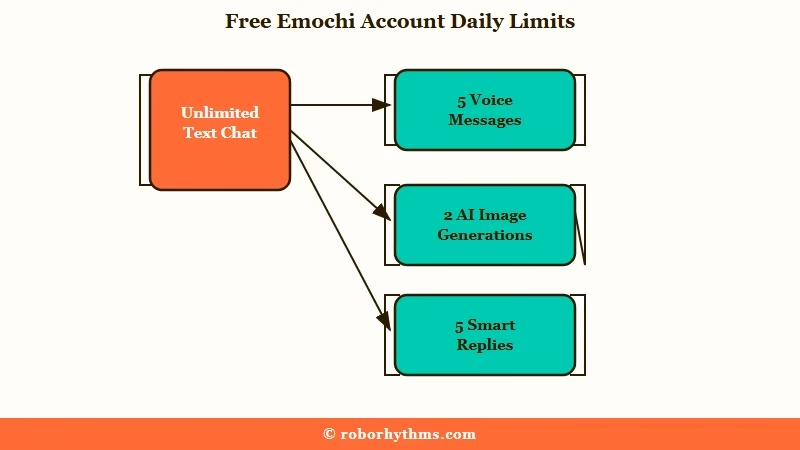
Nothing on the free plan expires after a week. There is a separate 7 day promotion that opens the advanced models temporarily, but the base account keeps working after it ends. You drop back to the standard models and keep your account.
What limits you is a ceiling rather than a clock. Text is genuinely uncapped, and every feature around it is metered: voice, images, smart replies, and the quality tier of the model answering you. I keep having to spell that out, because free and unlimited are doing very different jobs here.
Most people reading this are mid-argument with the app and deciding whether to stay. If that is you, the most common landing spot for people leaving a metered companion app is Candy AI, which runs a single subscription with no second currency stacked on top of it.
What Do You Get on the Emochi Free Tier?
The free tier gives you 5 voice messages, 2 images, and 5 smart replies per day, refreshing daily, against unlimited plain text. Paid tiers mostly multiply those same two numbers.
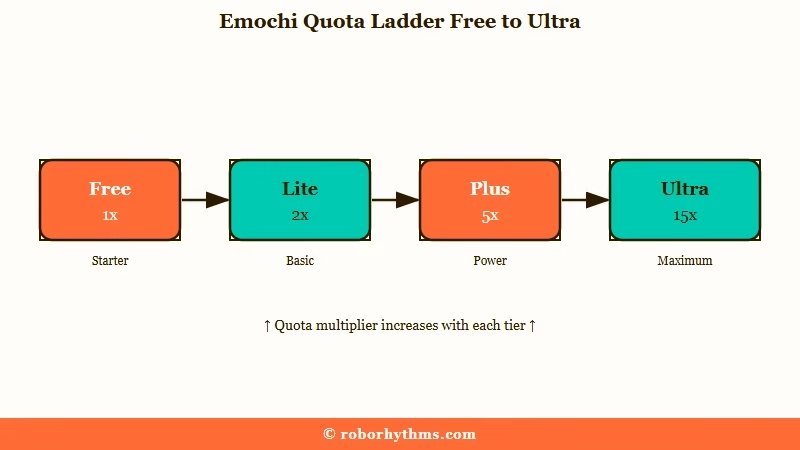
The multipliers are consistent enough to be worth seeing side by side. Emochi describes them in its own interface as 2x, 5x, 15x and 40x the free daily quota, which is the cleanest way to understand what a subscription buys.
| Tier | Voice messages/day | Images/day | Ads |
|---|---|---|---|
| Free | 5 | 2 | Yes |
| Lite | 10 | 4 | No |
| Plus | 25 | 10 | No |
| Ultra | 75 | 30 | No |
| MAX | Highest tier | 80 | No |
Most write-ups describe Emochi as free plus Plus plus Ultra. The app offers Lite underneath and MAX on top as well, each with its own quota row and its own upgrade button, which is the part I see reported wrong most often.
One widely repeated number is worth treating carefully. A lot of pages state Plus at $9.99 and Ultra at $16.99 a month, and those figures come from a two tier description that no longer matches the four paid tiers in the app. Emochi also ships a “Subscription Prices Adjusted” notice and sells monthly, half yearly and annual cycles, so read the price on your own account before deciding.
What is a memory span: the amount of earlier conversation a bot can still see. Once it fills, the oldest details drop out and the character starts forgetting them.
Memory is where the free tier bites hardest. The free span runs at roughly 8K, against about 18.8K on Plus and 26K on Ultra, which works out at around twenty messages before names and plot points start sliding.
Emochi puts it plainly in its own interface: when the memory is full, old memories fade.
Which Emochi Models Are Free and Which Ones Cost Mochi?
Free accounts get two chat models, the standard model and Vanilla Short.
Everything above that runs on Mochi, an in app currency that is spent per message and is separate from any subscription.
Mochi is the part most summaries skip, and skipping it makes the pricing look far simpler than it is. Advanced models are billed per reply: Grape costs 3 Mochi a message and Unicorn costs 10, so a long evening on a flagship model burns through a balance quickly.
Subscriptions hand out 2,000 Mochi a month and leave the meter running. An Ultra subscriber on the Google Play listing sets out the arithmetic in one line, noting that the best models still need currency even on the top plan and that 2,000 does not last. Retries are not charged, and failed generations come back marked free, which softens it a little.
The naming scheme does not help anyone. Emochi’s catalogue runs through Vanilla Short, Vanilla2, Vanilla V3, Blackberry, Strawberry, Sage, Unicorn, Cookie, Green Apple, Juniper, Cardamom and Grape, with no tier or price in any of those names.
My rule is to check the Mochi cost in the picker before starting anything long, since the fruit names tell you nothing about what a reply will cost.
| Symptom | Likely cause | What to do |
|---|---|---|
| Replies suddenly got shorter and blander | You are on a standard free model, not a premium one | Check the model picker in chat, the free default is Vanilla Short |
| “Insufficient free times” on a good model | Daily free quota for that premium model is spent | Wait for the daily reset or switch back to a free model |
| Balance draining after a few replies | You are on a Mochi priced model such as Unicorn at 10 per message | Switch to a cheaper model like Grape at 3, or a free one |
| The model you used is gone | It was deactivated and you were auto switched | Reopen the model picker and reset the conversation after switching |
| Bot forgets your lore | Free memory span is about 8K, roughly twenty messages | Pin key facts with the remember function and keep replies shorter |
What Happened to Emochi and Why Do Free Users Keep Losing Models?
Emochi retires models on a schedule, and the free Vanilla line has been retired repeatedly.
Vanilla V1 was given a June 10 retirement date, Vanilla V2 followed onto the discontinued list, and Mirage was switched off in mid September.
Model deactivation is a scheduled product event with its own interface copy. The app carries a standing “Model Deactivation Notice” and an automatic message telling you the model you were using is no longer available and you have been moved to a different one, with Vanilla V3 named as the recommended destination.
The mid-September wave is what brought people looking for answers. Mirage was pulled, and Vanilla V3 Infinity shipped as a paid model, which broke the run where every Vanilla release had been free. One r/emochiAIapp thread asks the obvious question directly, wanting to know why this Vanilla costs money when every earlier one did not.
The complaints about V3 itself are unusually specific. It speaks for your own character even when told not to, and it leaks its internal planning into the reply.
One longer review of V3 Infinity documents it contradicting itself inside a single sentence, saying it will meet you after school and turning to leave, then turning back in that same sentence to ask whether you are coming.
None of that is fixable from your side of the screen, and I would rather say so than pretend a setting exists. The register shifted too, toward something colder and more assistant-shaped, which is why the phrase doing the rounds is that it sounds like a generic chatbot now.
How Often Do Ads Interrupt Emochi Free Chats?
Ads appear roughly every 7 to 10 messages on the free tier, and removing them is the first thing every paid tier does.
Emochi also uses ads as a currency, offering unlocks in exchange for watching one.
The frequency is survivable but badly placed. An interstitial lands in the middle of a scene rather than between sessions, which is the difference between an ad break and an interruption.
Watching an ad to unlock free usage is a built-in feature with its own button. That cuts both ways. It hands free users a lever that needs no card, and it slows the app down in exactly the moments you care about.
Free replies also slow down when the servers are busy, and that queueing is separate from the ads. My own view is that the slowdown annoys people more than the advertising does, because a delay in the middle of a scene reads as the app being broken rather than as the price of a free plan.
Is Emochi AI Free on iPhone or Is That a Different App?
FlowGPT’s Emochi has no iPhone app at all, and the “Emochi” apps on the App Store are published by other companies.
Almost nothing on page one spells this out, and it changes what you install.
The check is easy to repeat. Emochi’s Android app is com.flow.mobile, published by FlowGPT, and that bundle returns nothing on the App Store in the United States, United Kingdom, Canada, Australia, the Philippines, Brazil, Mexico, India or Indonesia. FlowGPT has no iOS app under any name.
Searching the App Store for Emochi returns two apps from two unrelated developers. One is published by MESORA, a Singapore registered company, and the other comes from an individual developer. Neither is FlowGPT.
Emochi’s own website backs this up by omission. It links to Google Play and nowhere else, and the words “App Store” and “iOS” do not appear on its homepage at all.
Example scenario: You read a guide saying Emochi is free on iOS, install “EMOCHI World” on your iPhone, and start a chat. Your quotas, your Mochi balance and your characters from the Android app are not there, because you are signed into a different company’s product with its own accounts and its own pricing.
Reporting on this is genuinely contradictory, so here is where the line sits. Some coverage says an app called “Emochi: Unlimited Chat with AI” was pulled from the App Store on January 17, 2026 and later reappeared under MESORA, and other pages still list Emochi as available on iOS with a million App Store downloads.
The removal date and the relationship between the two companies are not established by any source I can point you to. What is verifiable today is the present tense: FlowGPT ships nothing on iOS, and the App Store listings belong to someone else.
What Does Paying for Emochi Not Buy You?
A subscription removes ads and raises quotas, and it does not buy unmetered access, permanent models, or safe chat history.
Those three gaps are the same on every paid tier.
Mochi is the first gap and the best documented. Flagship models keep charging per message after you have paid, which is why heavy users end up buying currency on top of a subscription they already hold.
Model permanence is the second. Paying does not exempt you from a deactivation notice, so the model your favourite character was tuned around can be retired while your subscription is live.
The third gap is the one I would want to know before paying anything. When a creator deletes a public character, the chats attached to it can go with it.
In one account of this, an Ultra subscriber who asked for months of history back was refused on the grounds that restoring the character would encourage plagiarism, since the creator owns it outright. Your history lives inside someone else’s character card, which no support ticket can undo.
There is one genuine bright spot worth stating plainly. Mature roleplay does work on the free tier rather than sitting behind the paywall, though Vanilla V3 sanitises detail more than the models it replaced. A softer filter is still a filter.
Should You Stay Free, Pay, or Move Somewhere Else?
Stay free if you mostly type, pay only if voice and images are the point, and move if model stability is what you need.
The free tier is generous on text and thin on everything else.
Here is the order I use when someone asks me which way to jump:
- Count how many voice messages and images you used yesterday. Under 5 and under 2 means a subscription buys you nothing today.
- Check whether your complaint is quota or quality. Quotas are fixable with money, and a model that speaks for your character is not.
- If quality is the problem, open the model picker and reset the conversation after switching, because a mid chat swap carries the old context badly.
- If your favourite model has been deactivated twice, treat that as the pattern rather than bad luck and plan around it.
For anyone in that last group, the useful comparison is not another metered app. Roleplay users who want the model under them to stay put tend to land on Candy AI, and anime and character card players usually prefer Nectar AI, which is built around that style. Both run on a single subscription with no per message currency behind it, so the Mochi problem disappears instead of getting a bigger allowance.
It is worth knowing why the squeeze is happening at all. Companion apps have moved fast from novelty to real revenue, with the category on track for $120 million and spending growing faster than the user base, and free tiers are where that pressure shows up first. Emochi is a recent example of a very ordinary squeeze.
Worth checking the neighbours before committing, since the same squeeze is playing out elsewhere. The Talkie AI free tier and the Candy AI free tier meter their free users in very different ways.
If memory is what keeps breaking your scenes, long term memory varies enormously between these apps. And the Character AI story is the longer version of what Emochi is doing now.
Quick Takeaways
- Emochi AI is free with no trial clock, and the free plan covers two chat models, 5 voice messages, 2 images and 5 smart replies a day against unlimited text.
- Mirage was switched off in mid September and Vanilla V3 Infinity launched as a paid model, so the free tier lost ground twice in one week.
- Mochi is a second currency charged per message, at 3 for Grape and 10 for Unicorn, and a subscription hands you 2,000 a month rather than turning the meter off.
- FlowGPT’s Emochi is Android and web only, so an “Emochi” app on your iPhone belongs to a different company with separate accounts.
- Check yesterday’s voice and image usage before paying, because under 5 voice messages and 2 images a day means a subscription changes nothing for you, and that is the first number I look at.
