
What’s Changed: Grok now asks many users for a live selfie before it will show adult content or answer freely. The check is facial age estimation, it runs against a challenge age well above 18, and it rejects a large share of genuine adults on the first try. Paying for SuperGrok does not skip it.
You open Grok, type something ordinary, and get a wall instead of an answer. Then comes the request for a live selfie, and the camera your desktop does not have.
My first reaction was that something had broken, because nothing about the prompt explains itself.
Nothing broke. Grok age verification is a deliberate gate that X has been tightening all year, and it is now reaching people who sailed through for months.
The frustrating part is that clearing it is not the same as passing it, and failing it does more than hide one image.
This piece covers what the check is, why it rejects adults who are visibly adults, what it blocks when you refuse, what happens to the photo, and the sequence that gets most people through.
There is no workaround here, and further down I explain why I will not publish one.
What Is Grok Age Verification and Why Did It Appear?
Grok age verification is X’s age assurance system, and it estimates your age from a live selfie when it cannot work you out from account signals it already holds.
It is not a Grok feature so much as an X account check that gates the chatbot.
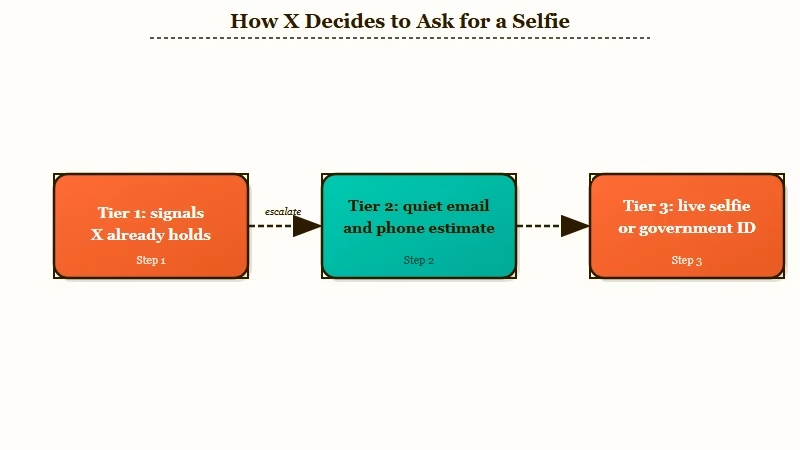
X runs three tiers before it ever asks you for anything. The first tier uses what it calls highly reliable signals: a previously self-attested age, a completed ID verification, legacy verified status, a grey or gold badge, or an account created in 2012 or earlier.
The second tier estimates your age quietly from your email address and phone number.
Only when both tiers fail does the third tier appear, and that is where the selfie lives. X offers two options at that point: facial age estimation from a live selfie, or a government-issued ID.
| Tier | What X checks | Do you do anything? |
|---|---|---|
| 1. Highly reliable signals | Self-attested age, prior ID verification, legacy verified status, grey or gold badge, account created 2012 or earlier | No, it resolves silently |
| 2. Quiet estimation | Your email address and your phone number | No, also silent |
| 3. User involved | A live selfie scored by facial age estimation, or a government-issued ID | Yes, this is the prompt you are stuck on |
Note what is missing from all three tiers. There is no payment signal anywhere, and that absence is the single most useful thing I can point you at on this page, because it comes up again below.
The timing is not random. Ofcom opened a formal investigation into X on 12 January 2026 under the Online Safety Act, following the spread of sexualised images of real people, including children, generated through Grok. That investigation expressly examines whether X used highly effective age assurance to protect children from sexually explicit content.
The Information Commissioner’s Office opened its own investigation into xAI on 3 February 2026 over how Grok processes personal data. Both remain open. Expect the gate to keep tightening while they are.
X names four laws behind the system: the UK’s Online Safety Act, the Irish Online Safety Code, the EU Digital Services Act, and Australia’s Online Safety Act. India and individual US states are not on that list, whatever your local prompt implies.
Why Does Grok Age Verification Reject Real Adults?
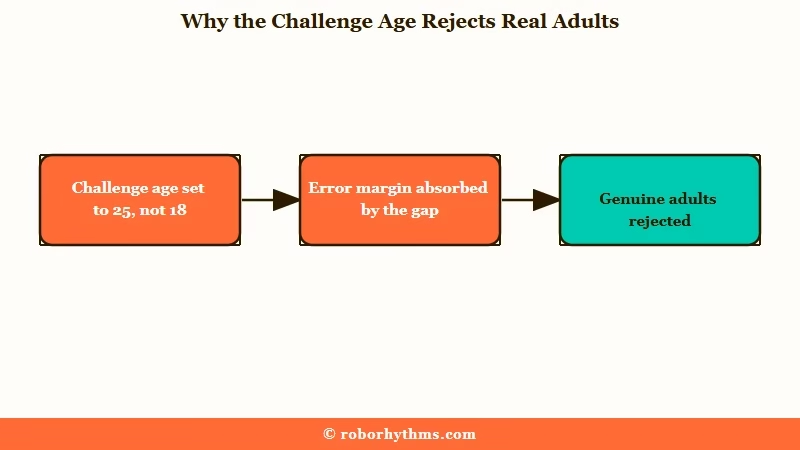
The system is not checking whether you are 18. It is checking whether you look at least 25, because platforms set the challenge age far above the legal age to cover the error margin.
That single design choice explains most rejections.
Testing under the US National Institute of Standards and Technology puts a number on it. For a 20-year-old, raising the challenge threshold from 25 to 28 cuts one leading algorithm’s false-positive rate from 12.0 percent to 3.1 percent. Two others fall from 14.0 to 3.6 percent and from 16.4 to 3.7 percent.
What a false positive means here: someone below the challenge age being waved through. Cutting that rate is the platform’s goal, and rejecting more real adults is how it gets there.
Read that in reverse and you have your answer. Platforms buy protection against minors by rejecting more real adults, and the tighter they set the dial, the more twenty-somethings get bounced.
The demographic spread is worse than most people assume. At age 24 with a challenge threshold of 25, average acceptance across tested algorithms runs from about 51 percent for Eastern European women up to 70 percent for Eastern African men. On a second image set the range stretches wider still, 47 percent at the bottom against 80 percent at the top.
Close to half of genuine 24-year-olds in the worst-served group are not waved through. That is the measured version of every complaint that starts “it will not recognise my face” and ends with someone wondering whether their ethnicity is the problem.
NIST’s own evaluation is blunt about the gender half of this. Error rates were almost always higher for female faces than for male faces, it was equally true in the 2014 round, and the underlying reasons are unknown.
Accuracy has improved, to be fair to the technology. Mean absolute error on a common photo set dropped from 4.3 years to 3.1 years across a decade of submissions. A three-year error bar is still a three-year error bar when the cutoff is a single birthday.
Ofcom, for its part, set no numerical accuracy threshold such as 99 percent. Its four criteria, quoted exactly, are that a check be “technically accurate, robust, reliable and fair”, with fairness defined around not being less accurate for particular ethnicities. No number attaches to any of them.
What Happens if You Refuse the Grok Age Check?
Refusing does not just hide one image. It leaves your account in an unverified state, which restricts sensitive media across X and gates Grok itself.
The block is quiet, and that is the part that misleads people.
X’s own wording is narrow: until it can determine you are 18 or over, you may not be able to access sensitive media. The lived version is broader, because Grok sits behind the same gate, so an unverified account runs into refusals on plain text prompts that have nothing to do with images.
There is a real gap between the documented scope and the experienced one. Ofcom’s legal target is pornographic and harmful content. X’s implementation reaches further, covering 18+ timeline content and the chatbot as a whole, which is why the app feels globally clamped rather than selectively filtered.
One detail deserves a warning, because it changes whether the effort is worth it. Passing the check restores access to age-gated content, and it does not loosen Grok’s content moderation, which is a separate system with separate rules.
That distinction is the one I most want people to take away from this section. Verify for access, never for fewer refusals.
If you want the moderation side of that story rather than the age side, Grok’s spicy mode restrictions cover what the filter does independently of your verified status.
The other string you may hit reads: “Due to local laws, we are temporarily restricting access to this content until X estimates your age.” That is the same gate wearing a different label.
Does Paying for SuperGrok Skip the Age Check?
No. A paid subscription is not an age signal at X, and a payment card appears nowhere among the eight signals X lists.
Subscribers hit the selfie prompt exactly like everyone else.
I do not buy the common explanation for this one. The assumption is that regulators banned card-based age checks, and that is backwards.
Ofcom, the UK communications regulator enforcing all of this, explicitly lists credit card checks among the methods capable of being highly effective. The rest of its list runs to open banking, photo ID matching, facial age estimation, mobile network operator checks, digital identity services and email-based estimation.
What Ofcom rules out is self-declaration and online payments that do not require the payer to be 18. A credit card check would qualify. X simply chose not to build one.
So the complaint that a card is no longer good enough is aimed at the wrong party. Nobody took the option away. X never offered it, and the money you hand xAI every month tells its own system nothing about your age.
There is a second sting for subscribers. X’s ID verification policy states that ID verification is available globally for X Premium and says nothing about non-subscribers, so on the documentation the manual route reads as a paid feature while the restriction it lifts applies to everyone.
If you are weighing whether the subscription earns its keep at all, whether SuperGrok is worth it goes through what the tier does and does not buy.
Why Does Grok Say No Face Detected?
Because facial age estimation is unstable frame to frame, and small physical changes move the result by years.
The rejection is usually about capture conditions, not your face.
The NIST evaluation demonstrated this on one of its own staff members. When the subject changed facial expression, or put glasses on and took them off, all six algorithms tested returned age estimates that moved around the true value. Across frames pulled from a single phone video of a 58-year-old, the estimates drifted by a few years from frame to frame.
Same person, same minute, different answers. That is why retrying with a different setup is a real fix rather than superstition, and it is why the fifth attempt sometimes works when the first four did not.
I treat the first rejection as a lighting problem before anything else, because that is what it usually turns out to be.
The exact error most people see reads: “We could not detect a clearly visible face. Make sure your face is well lit and unobstructed, then try again.” It is a capture failure message, so treat it as one.
Here is the difference between a capture that fails and one that passes:
Before: laptop webcam, back to a bright window, overhead room light only, glasses on, half-smiling, phone held at chest height so the camera points up your chin.
After: face the brightest light source in the room so it falls on your face rather than behind you, glasses off, neutral expression with your mouth closed, camera at eye level, plain wall behind you, nothing across your forehead or jaw.
The pattern below covers what goes wrong most often.
| Symptom | Likely cause | Fix |
|---|---|---|
| “No face detected” on every attempt | Backlighting, so the camera sees a silhouette | Turn to face the window or lamp, never sit in front of it |
| Prompt never opens in the app | No camera available or camera permission denied | Complete the check on a device with a working front camera and grant permission |
| Estimated under 18 despite being an adult | Challenge age set above 18, plus a genuine error margin | Retake with a neutral expression and no glasses, then appeal if it repeats |
| Everything moderated, even plain text | Account sitting in an unverified state | Complete the check, or accept restricted access |
| Passed the check, output still refused | Content moderation, a separate system from age status | Nothing to fix here, the age gate was never the cause |
What Happens to Your Selfie After Grok Scans It?
X names a vendor and a 30-day deletion window for its ID verification flow, and states neither for the facial age estimation flow.
These are two separate policy pages, and only one of them makes a promise.
The ID verification policy is specific. X uses Persona and Stripe, collects an image of the ID and the selfie including face data, and says Persona delete images of the IDs, selfies and extracted data after 30 days, expressly so there is time to appeal. For creators, Stripe retains the data as long as the person remains a creator.
The age assurance page, which is the one covering the standalone selfie, names no vendor and states no retention period. It says only that third party providers will be bound by strict data protection standards.
My honest position is that this is the weakest part of the whole system, and it is a documentation problem X could fix in an afternoon. Two flows, two selfies, one retention commitment between them.
There is an unresolved question sitting underneath it. Reporting on the rollout described X building a native process in which its own systems estimate age from the selfie, rather than outsourcing it the way some rivals did, while X’s age assurance page refers to third party providers. The documentation does not settle which applies to the age selfie.
One more thing worth knowing before you decide: X previously listed Au10tix alongside Persona and Stripe. Only Persona and Stripe appear on the current policy, and nothing on the page addresses what happened to data the dropped vendor already held.
Anyone who has been through this on another companion app will recognise the shape. The same face-scan pattern arrived at Character AI’s age verification and at CrushOn AI’s paid age gate before it reached Grok.
Does a VPN Get You Around Grok Age Verification?
A VPN alone changes nothing, because X reads an in-app location setting rather than only your IP address.
That is the mechanical reason the prompt follows an account across countries.
I am telling you the mechanism so you stop burning an evening on it, and stopping there is deliberate. This is a legal age check under active regulatory investigation, and Ofcom’s guidance states that services should not host or permit content that directs or encourages users to attempt to circumvent an age assurance process. That applies to us as much as to X.
The UK also moved the legal line in a way most people covering this have missed. Since 6 February 2026, Section 138 of the Data (Use and Access) Act 2025 has made it an offence to ask an AI tool to create non-consensual intimate images. Some of the output this gate exists to stop is now unlawful to even request.
If you do not want to complete the check, the honest options are to accept the restricted experience or to use something else. Those are the two, and I would rather say so plainly than pretend there is a clever third.
What to Do When Grok Age Verification Keeps Failing
Work through capture conditions first, then the account signals, then the appeal.
Most people who get stuck are repeating attempt one in identical conditions.
I use the same order every time, and it resolves the majority of cases before the appeal step:
- Move to a device with a working front-facing camera. The check needs one, and a desktop without a webcam has no path forward.
- Face your light source. Backlighting is the single most common cause of a face going undetected.
- Take off glasses, drop the expression to neutral, and put the camera at eye level rather than below your chin.
- Clear anything crossing your face: hair across the forehead, a mask, a hood, a hat brim.
- Retry a few times rather than once. The estimate genuinely varies between attempts, so a second or third capture is not wishful thinking.
- Check your account information for a date of birth that is missing or wrong, since a stored under-18 self-attestation is a first-tier signal that overrides everything else.
- Appeal if it still fails. X’s stated route is to contact X Support through the app or website to challenge an incorrect age estimate, and the 30-day retention window on the ID flow exists precisely so there is material to review.
Step seven is the one people skip, and it is the only step that reaches a human.
What to Use Instead if You Will Not Send a Face Scan
If the dealbreaker is handing a face scan to the same company that runs the chatbot, moving to a platform where adult content is the expected product is a more honest fix than fighting the gate.
Grok was never built as a companion app, and it shows.
Let me be straight about what switching does and does not solve. It does not put you beyond age verification: regulation is arriving across this category, and any platform serving adult content in the UK, EU or Australia faces the same duties X does. Anyone promising you a permanent no-checks option is selling something.
What switching does solve is the second problem in this article, the one verification does not touch. On Grok you can clear the age gate and still watch the model refuse, because moderation sits separately from age status. On a platform built for adult conversation, that refusal is not part of the design.
Candy AI is where I point most people leaving Grok, mainly because its memory holds across sessions in a way Grok’s chat does not, and because you are not negotiating with a general-purpose assistant about whether your prompt is allowed.
Nectar AI is the one I suggest for anime and illustrated styles, which is the taste Grok’s image side never served well.
Both still ask you to confirm your age. The difference is that neither one is a search-and-news product with a companion mode bolted on, so the gate is the only hurdle rather than the first of two.
Frequently Asked Questions
Why is Grok asking for my age all of a sudden?
Your account failed X’s automatic signals. X checks self-attested age, prior ID verification, badges, and whether the account was created in 2012 or earlier, then estimates from your email and phone. The selfie appears only when all of those come up short.
Does Grok age verification store my selfie?
X’s age assurance page states no retention period and names no vendor for the facial estimation selfie. Its separate ID verification policy says Persona deletes ID images and selfies after 30 days. The two flows are documented differently.
Why does Grok say no face detected when my face is on camera?
It is almost always lighting or framing. Backlighting turns your face into a silhouette, and glasses, expression changes and low camera angles all shift the result. Face your light source, remove glasses, and retry.
Can I use Grok without verifying my age?
Yes, with restrictions. An unverified account cannot reach sensitive media, and Grok itself becomes heavily limited. Nothing is deleted, and you can complete the check later.
Does an X Premium subscription verify my age?
No. Payment is not among the age signals X lists, and subscribers hit the same selfie prompt. Ofcom does permit credit card checks as a method, but X has not built one.
What if the check keeps deciding I am under 18?
Retry with a neutral expression, no glasses and even lighting, since estimates vary between captures. If it repeats, contact X Support through the app or website to challenge the decision, which is X’s stated appeal route.
Quick Takeaways
- The check estimates whether you look about 25, not whether you are 18, which is why real adults in their twenties get rejected.
- Failing or refusing it restricts sensitive media across X and clamps Grok itself, so the effect feels far wider than one blocked image.
- Passing it does not loosen Grok’s content moderation, which is a separate system, so verify for access and not for fewer refusals.
- A paid subscription proves nothing about your age, and the missing card option is X’s choice rather than a regulator’s ban.
- Fix capture conditions before anything else: face your light source, glasses off, neutral expression, camera at eye level, then appeal through X Support if it still fails.
