
What’s Changed: Swiping no longer produces a different scene on Character AI’s newer chat styles. The model rewords the same outcome instead of choosing a new one, so twenty swipes land on one story beat with different adjectives. Swiping harder makes it worse, and the fixes that work involve changing the input rather than rerolling the output.
There is a specific kind of frustration that hits when Character AI keeps giving the same response every swipe. Not a repeated phrase. The whole reply, same beat, same emotional turn, same ending, with maybe four words swapped out.
This is different from the older repetition complaints, and treating it the same way is why most fixes fail. A bot leaning on stock vocabulary is one problem. A bot that has decided how this exchange ends and will not be argued out of it is another, and the swipe button is the wrong tool for the second one.
The first thing I check now is whether the reply is genuinely varying or just re-dressing. If three swipes produce the same outcome with different adjectives, more swipes will not help, and there is a decent chance they are making it worse.
Below is what is driving it, what Character AI’s own documentation says about the fix (which contradicts the advice circulating in the community), and the sequence that shifts a stuck chat.
Why Does Character AI Give the Same Response on Every Swipe?
Character AI gives the same response on every swipe because each swipe regenerates from the identical context. Nothing about your input changed, so the model re-runs the same probability distribution and lands on the same outcome, varying only the surface wording.
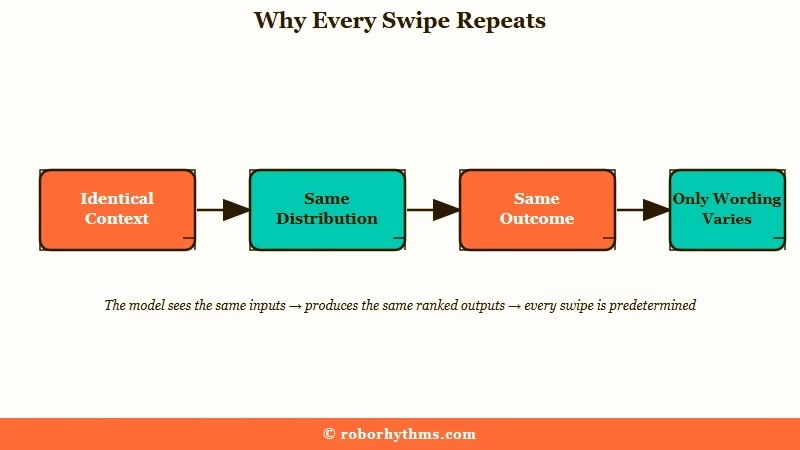
A swipe does not ask the model for a new idea. It asks the same question again. The prompt, the chat history, the persona, and the pinned memories are byte-for-byte identical on swipe twelve and swipe one.
What surprised me is how visible the ceiling is once you look for it. When the context strongly implies one continuation, the model’s top candidates are all versions of that continuation, and rerolling just samples among near-identical options.
The academic work on this explains the direction of travel. Tatsuya Hiraoka and Kentaro Inui, in their paper on repetition neurons, identify neurons they describe as “skill neurons” responsible for repetition, and find they “tend to become progressively more strongly activated as the repetition sequence continues.”
That finding is about language models in general, not Character AI specifically. It matters here because it establishes that repetition is self-reinforcing at the mechanism level: the more a pattern is present, the more strongly the machinery that continues it fires.
What Changed With LongSqueak and the Newer Chat Styles?
LongSqueak is built around a much larger memory window than the styles it replaced, which is genuinely useful for continuity and is also what makes its swipes so rigid. More context pulled into every generation means a more constrained answer, not a freer one.
Larger memory sounds like it should produce richer variation. It produces the opposite, because a heavily specified context leaves the model less room to branch.
The trade is real in both directions. The continuity is better than anything the platform shipped before, and the cost is that the story feels decided. A fuller breakdown of what LongSqueak is covers the access and Style Control side.
I still keep one long-running chat on DeepSqueak for exactly this reason, and move it over only when I want the memory depth more than the unpredictability.
Separate this from the stock-phrase problem, which is a different failure with different fixes. If the complaint is recurring vocabulary rather than a locked outcome, the guide to Character AI’s overused phrases is the more useful page.
What is a chat style: Character AI’s name for the underlying model serving your conversation. Different styles have different memory sizes, response lengths, and writing tendencies.
Does Swiping More Make Repetition Worse?
This is where the platform’s documentation and its experienced users flatly disagree. Character AI’s help centre presents swiping as the primary fix. Long-time roleplayers treat heavy swiping as something that degrades a chat.
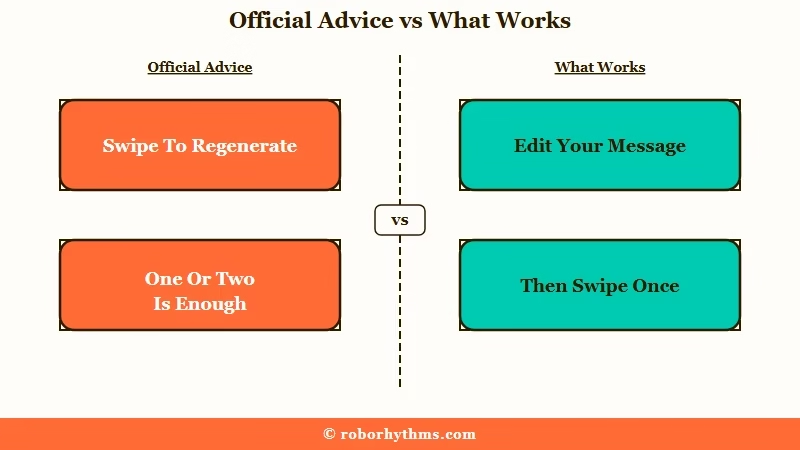
Character AI’s troubleshooting guide is unambiguous about the intended behaviour. It tells users “Swiping to regenerate is the fastest fix”, and frames a good result within a swipe or two as evidence the problem was never structural.
The counter-position is that hammering the swipe button on one message, especially a character’s opening greeting, destabilises the thing the rest of the conversation is built on. The greeting is the foundation every later turn refers back to.
I don’t buy the strong version of this, where swiping actively trains the bot to be worse. Nothing in the chat history records the swipes you rejected, so there is no obvious channel for that to happen.
The weak version holds up fine, and it is the useful one. Swiping is capped, it is the least effective tool for a locked outcome, and burning thirty attempts on rewordings leaves you nothing when you reach a message that genuinely would have varied.
The caps matter here. Character AI’s February 2025 community update set c.ai+ members to “Swipe up to 100 times on all messages” while confirming that free users “will still have the ability to swipe 30 times per message”. The same update raised Muted Words to 20 for paying members, which quietly makes the community’s favourite anti-repetition tool a paid, capped feature.
That update also carried one more claim: “Thanks to your feedback we reduced repetitiveness by 30%.” That is the platform’s own number from its own announcement, and the distance between it and the current experience is the whole story here.
Why Did Character AI Retire Roar and the Old Chat Styles?
The stated reason is architectural. A community moderator explained that Lorebook and the improved memory features only run on the newest architecture, so the older styles could not be carried forward while the new generation was being built.
The exact wording from a distinguished CAI Community Moderator on r/CharacterAI: “We couldn’t keep advancing the old styles and building the next generation at the same time. New features like Lorebook and the improved memory features only work on our latest architecture, and unfortunately we had to retire the older chat styles.”
Be precise about what that is. It is a community moderator with platform knowledge, not a company press statement, and no official blog post frames the retirement in those terms.
My read is that this explanation is probably true and also incomplete. Consolidating onto one architecture is a real engineering constraint, and it is also the version of the story that costs the least to tell.
The practical upshot for anyone waiting: Roar is not coming back in its original form. The nostalgia is well founded, because a model with a looser grip on its own conclusions is exactly what produces varied swipes, but it is nostalgia for a trade-off the platform has decided against.
How Do I Get Different Responses Out of a Stuck Chat?
Every fix that works changes the input. Nothing that only re-rolls the output will move a locked outcome, which is why swiping, waiting, and asking the bot to stop repeating all fail.
Here is the sequence I run when a chat locks, in order of how little damage it does:
- Edit your own last message before swiping again. Add a concrete detail, a physical action, or an interruption. This changes the context, which is the only thing a swipe cannot do.
- Edit the bot’s reply directly using the pencil icon. Cut it to the last good sentence and let it continue from there. You are steering rather than rerolling.
- Send an out-of-character correction, then swipe until the bot answers in that register, then recap the scene.
- Switch that specific chat to a different style. DeepSqueak is the usual destination when LongSqueak goes flat, and the change is per-chat, so nothing else is affected.
- Trim your pinned memories. Long, dense pins crowd the context window and narrow what the model will consider.
- Add the offending words to Muted Words if you are on c.ai+, remembering the 20-word ceiling.
The out-of-character step is the one people execute badly, so here is the difference:
Before: “stop repeating yourself”
After: “(OOC: pausing the scene. You’ve ended the last four replies with him pulling away and apologising. For the next reply, he stays and escalates the argument instead. Keep his speech clipped and stop using the word ‘ozone’.)”
The first version asks for a behaviour change with no new information, and the bot will apologise and then do it again. The second one puts a new constraint into the context, names the pattern, and specifies the alternative.
| Symptom | Likely cause | Fix |
|---|---|---|
| Every swipe ends the same way, different words | Context strongly implies one continuation | Edit your own message to add a new detail |
| Same stock words across many replies | Vocabulary repetition, not outcome lock | Muted Words, or an out-of-character naming of the phrase |
| Bot narrates your character’s actions | Weak persona boundary in the definition | Edit the reply to cut the intrusion, restate the boundary |
| Replies fine at first, gibberish partway | Generation or serving issue on that message | Swipe once, then report it if it repeats |
| Quality drops after a long session | Context window saturated with pins and history | Trim pins, or start a fresh chat with a copied recap |
| Formatting turns into bullet points | Style mismatch for roleplay | Switch chat style for that chat |
One thing the platform is right about, and it is in their troubleshooting doc: “Vague or repetitive Definitions produce vague or repetitive Characters.” A bot with a thin definition gives the model very little to branch on, and that shows up as identical swipes long before it shows up as anything else.
If your chats are also ending early rather than repeating, that is a separate constraint covered in the breakdown of the Character AI swipe limit.
What If Nothing Works and You Want Somewhere Else to Go?
If you have edited the context, trimmed the pins, switched styles, and the chat is still delivering one outcome six ways, the honest answer is that the model is doing what it was tuned to do. At that point the choice is to accept it or use something built on a looser leash.
Two options fit anyone in that position, and both are doing something Character AI has moved away from rather than toward.
Candy AI is the one I hand people first when the complaint is that scenes feel decided before they start. It holds character consistency without steering every exchange to the same resolution, and the memory carries across sessions rather than resetting.
Nectar AI is the better fit if the thing you miss is visual and narrative range in the same chat, particularly for anime-styled characters where Character AI’s newer styles flatten the tone hardest.
Neither is a drop-in replacement for a long chat history you have built up, and moving means starting the relationship over. That cost is real, and it is why I would exhaust the editing fixes above before treating a switch as the answer.
Frequently Asked Questions
Why does Character AI keep giving the same answer when I swipe?
Each swipe regenerates from identical context, so the model re-runs the same probability distribution. When the conversation strongly implies one continuation, every candidate reply is a version of that continuation. Changing your own message is the only reliable way to change the result.
How many times can I swipe on Character AI?
Free users get 30 swipes per message. Paying c.ai+ members get 100, per Character AI’s February 2025 community update. Neither cap resets by waiting on a single message.
Does swiping too much damage my chat?
Rejected swipes are not stored in your chat history, so there is no direct mechanism for it to train the bot. The practical harm is that swipes are capped and ineffective against a locked outcome, so heavy swiping wastes a limited resource.
Is LongSqueak more repetitive than DeepSqueak?
LongSqueak carries a much larger memory window, which improves continuity and constrains variation at the same time. Switching a specific chat to DeepSqueak is a per-chat change and is the standard move when a scene goes flat.
Will Roar and the old chat styles come back?
No. A CAI community moderator stated the older styles were retired because Lorebook and the improved memory features only run on the newest architecture, and that the team could not advance both at once.
What is the fastest way to unstick a repeating chat?
Edit your own last message to add a concrete new detail, then swipe once. That changes the context rather than rerolling the same one, which is what a swipe on its own cannot do.
Quick Takeaways
- Swiping cannot fix a locked outcome, because every swipe regenerates from the exact same context you already had.
- Editing your own message is the highest-leverage fix, and it costs nothing from your swipe cap.
- Free users get 30 swipes per message and c.ai+ users get 100, so burning them on rewordings has a real price.
- Switching a single chat to DeepSqueak is a per-chat change and the standard move when LongSqueak flattens a scene.
- Character AI claimed a 30% reduction in repetitiveness in its own February 2025 update, a number that sits awkwardly beside what the newer styles deliver today.
