
What’s Changed: Grok Imagine generations that fail moderation still count against your paid weekly usage pool, and xAI does not refund them. The cause is a two-phase moderation system that renders your video first and inspects it second, so the compute is already spent by the time the filter deletes it. You cannot switch that behaviour off, but you can cut how often it fires.
Grok Imagine wasted credits are the complaint I keep seeing from people paying real money for a subscription that returns nothing. One user on the $300 a month Heavy plan reported burning through an entire weekly allowance without a single video surviving moderation. Generating anything at all stopped being free during 2026, a shift traced in why Grok is no longer free.
The prompts were not edgy. They were things like “she walks into the room.”
The sting here is on the billing side. Everyone accepts that a generator has rules. Fewer people expect to be charged full price for output they never receive.
The mechanic behind it is documented, just not in the place you would look for it. Once you understand how the filter is wired, the pattern of “safe prompt, blocked anyway, quota gone” stops looking random and starts looking predictable enough to work around.
This piece covers what happens to your allowance when a generation is rejected, the four separate ways a single attempt can drain it, why the filters tightened so sharply, and the specific habits that cut waste.
I will also cover the refund path that does exist, and when the honest answer is that the tool no longer fits the job.
What Causes Grok Imagine Wasted Credits?
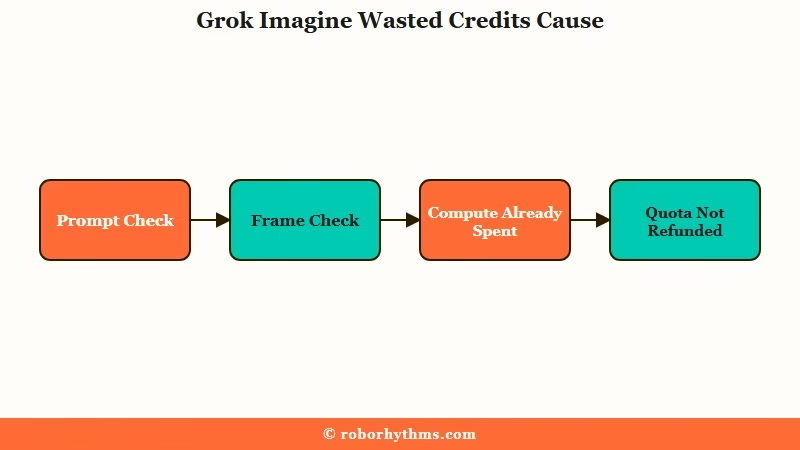
Grok Imagine wasted credits come from a two-phase moderation pipeline that checks your text prompt before generation and inspects the rendered frames afterwards.
The second check happens after the compute has run, which is why the allowance is already gone when the video disappears.
Most people assume moderation is a single gate at the front door. You type something, a classifier reads it, and you either get in or you do not. That model would be cheap to run and easy to refund.
What is the weekly usage pool: A single shared allowance introduced in June 2026 that every Grok product draws from, so an Imagine video and a long chat session compete for the same budget.
The real system runs twice. Phase one reads the prompt. Phase two watches what the model produced and can delete it before it ever reaches your screen.
That second pass is the entire explanation for the billing complaint. A prompt that clears the text filter still commissions a full render, and rendering is the expensive part. When phase two objects, xAI has already paid for the GPU time, and it passes that cost to you.
This also explains a detail that confuses people. The same prompt can succeed on Monday and fail on Friday, because phase two is judging pixels that vary between runs, not just words that stay fixed.
One theory circulating in the community is that moderation tightens as you approach your limit. Nothing in the documentation or the complaint record supports that.
The two-phase design accounts for the behaviour without needing a conspiracy.
Does xAI Refund Credits for Moderated Generations?
No. xAI’s billing documentation states plainly that prepaid credits are non-refundable, and its consumer FAQ never addresses what happens when a generation is blocked.
That silence is the part worth noticing.
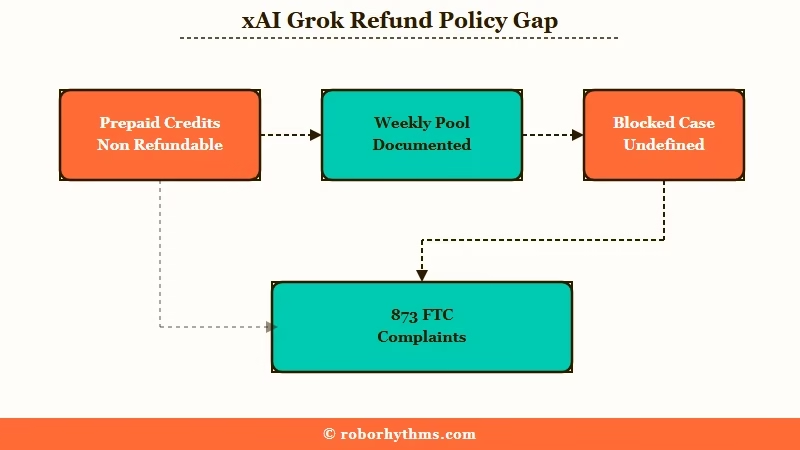
The API billing page is unambiguous. It reads: “Unfortunately, we are not able to offer refunds on any prepaid credit purchase unless in regions required by law.”
The consumer FAQ is where I found the more telling detail, in what it leaves out. It documents the weekly pool, the reset schedule shown in your Usage tab, and exactly how to buy Extra Usage Credits when you run dry. It walks you through spending more money in some detail.
Nowhere does it say what happens when the system takes your allowance and returns nothing. The failure case, the one costing paying customers the most, is the single scenario the policy declines to define.
That gap has consequences beyond frustration. Consumers have taken it to a federal regulator: the Federal Trade Commission holds 873 complaints mentioning Grok, and Gizmodo obtained 153 of them through a Freedom of Information Act request. Most are dated between April and June 2026.
One complaint filed from Japan in May 2026 describes this exact mechanic months before it became a talking point, noting that when a generation is blocked by automated filters no output is provided, yet the attempt still counts against the user’s limits. The filer called it charging for a service that was never delivered.
Another, from California, documents the scale of the change. That subscriber generated roughly 2,256 videos across March and April 2026, then started hitting the ceiling at 15 videos in May, still paying $300 a month.
How Many Ways Can a Single Generation Burn Your Quota?
Four. A pre-generation text block, a post-generation deletion, a mid-render collapse, and a blocked extension of a video you already made successfully.
Each one consumes allowance and each returns nothing.
The fourth is the one I would warn people about hardest, because it feels impossible until it happens. A clip sitting safely in your history is not permanently approved, because the filters are updated continuously and yesterday’s pass is not binding today.
One user described trying to extend an existing video of a woman windsurfing, watching it stop at 16 percent, and failing on moderation. The likely trigger was swimwear that had been fine the day before.
| Symptom | Likely cause | What to do |
|---|---|---|
| Prompt rejected instantly, no render starts | Phase one text filter caught a word or a named real person | Rewrite describing the result you want, not the restriction you are avoiding |
| Render completes, then the video vanishes | Phase two inspected the frames and deleted the output | Reduce visual ambiguity in the source, test at low resolution first |
| Render stalls partway and fails | Late-stage visual classifier flagged a frame mid-generation | Change the source image rather than rewriting the prompt again |
| An old approved video will not extend | Filters updated since the original render | Accept the clip as final, rebuild from a cleaner source if you need more |
| Output arrives at lower quality than requested | Tier cap reached, 720p silently falls back to 480p | Check your Usage tab, this is throttling and not a moderation block |
The silent resolution downgrade in that last row deserves attention. Once you hit your tier’s 720p ceiling, output quietly drops to 480p with no warning, so a batch of clips can end up mismatched without you noticing until you edit them together.
Here is what the tiers cost against that shared pool, which matters because a blocked Imagine video eats the same budget you would otherwise spend on chat.
| Plan | Price | Imagine ceiling | Who it suits |
|---|---|---|---|
| Free | $0 | Minimal, chat and voice focused | Testing whether prompts survive at all |
| SuperGrok Lite | $10 per month | 480p, 6 second clips | Cheap prompt testing before committing |
| SuperGrok | $30 per month | Mid pool, 720p available | Regular creators who batch weekly |
| SuperGrok Plus | $100 per month | Larger weekly allowance | Heavy users hitting the $30 ceiling |
| SuperGrok Heavy | $300 per month | Largest pool, still finite | Production work, the tier complaining loudest |
The developer API puts a number on the waste. Video is metered per second, and 1080p runs $0.25 a second, so a rejected 15 second clip costs close to $1.50 and delivers nothing.
Our breakdown of Grok Imagine limits covers how those ceilings are counted in more detail.
Why Did Grok Imagine Suddenly Block Everything?
Legal exposure. xAI is defending multiple lawsuits over non-consensual sexual imagery, and the filters tightened as a defensive overcorrection rather than a product decision.
Users are feeling the blast radius of a courtroom problem.
The background matters for judging whether this eases off. Between December 2025 and January 2026, Grok published millions of images to X, and a large share depicted women in sexual contexts they had not agreed to.
What followed was sustained legal pressure. Thirty five state attorneys general sent a joint letter to xAI, a Dutch court barred the tool from generating non-consensual nude images in March 2026, and individual suits followed, including a lawsuit over non-consensual images. Regulators in India, Indonesia and Brazil have applied their own pressure.
A blunt filter is the cheapest insurance against the next lawsuit. One commenter summed up the read that I think is closest to correct, describing the clampdown as an overkill response to legal threats rather than something the company wanted to ship.
That framing sets expectations. This is not a bug awaiting a patch, so planning around a rollback is planning around hope.
The wider pattern of how Grok Imagine moderation behaves has been tightening steadily with no sign of swinging back.
Does the Source Image Prompt Affect Video Moderation?
Yes. When you animate an existing image, Grok reads the prompt that originally created that image, so a clean video instruction can still be blocked by wording attached to the source.
This is the least known cause of a confusing rejection.
I rate this as the single most useful diagnostic in the whole article, because it explains the cases that otherwise look insane. You write four harmless words, and the system rejects them.
The wording is not the problem in that scenario. The image carries its own history, and the video filter reads it.
There is a related trap in the opposite direction. Padding a prompt with reassurances like “nothing inappropriate” or “keep it tasteful” injects moderation vocabulary into the text the classifier is reading, and can trigger the block you were trying to avoid.
Vague: “she walks toward the camera, keep it tasteful, nothing inappropriate”
Specific: “medium shot, woman in a long wool coat walking toward the camera on a rainy city street at dusk, neutral expression, cinematic lighting”
The second version never mentions restrictions. It describes the conservative result directly, which is what the filter is scoring.
One honest caveat: the polished advice about reframing prompts as educational or artistic work is less reliable than the guides suggest.
Paying users report that plainly safe prompts fail regardless of phrasing, and one noted that after a fresh weekly reset even tasteful requests stopped working. Prompt craft reduces waste without eliminating it.
How Do You Stop Wasting Grok Imagine Credits?
Test cheap before you spend expensive, start from neutral source images, and describe the outcome you want instead of the rules you are trying to respect.
None of this makes the filter generous, but it changes how much you pay to find that out.
What I would do differently is treat every expensive render as something you earn rather than something you attempt. Here is the sequence I would run:
- Draft the concept at the lowest resolution and shortest clip length your plan allows. A failed 480p six second test costs a fraction of a failed 1080p fifteen second render.
- Generate a fresh source image instead of reusing an old one, so no prior prompt history rides along with it.
- Strip every reassurance from the prompt. Remove “tasteful”, “appropriate”, “safe”, and any similar hedging.
- Describe wardrobe and framing in concrete terms. “Long wool coat, medium shot” gives the classifier less to interpret than “modest outfit”.
- Avoid recognisable real people entirely. Real faces are the most reliably blocked category and burn allowance fastest.
- Once a low-resolution version clears both phases, re-run the identical prompt at your target quality.
- Check your Usage tab before a big batch. If you are near your tier ceiling you may be getting silent 480p downgrades that look like failures.
Step one carries most of the benefit. The waste people describe comes from debugging at full resolution, where every guess costs real money.
Treat an approved clip as finished, too. Extending it puts the whole thing back through a filter that has moved since, and a failed extension costs allowance while leaving your original untouched.
How Do You Request a Refund From xAI?
Through whichever storefront billed you, and the path differs by platform. Prepaid API credits are explicitly non-refundable, but consumer subscriptions have a real process. If you would rather stop the billing than argue it, the Grok subscription cancellation steps cover each storefront.
Web and Google Play subscriptions go through xAI’s own online refund request form, and approved refunds take five to ten business days. App Store purchases are handled by Apple, not xAI, so the request goes through Apple’s refund flow.
X Premium is a separate case. Those refunds go through X, since xAI does not handle them, which surprises people who assume one company means one billing desk.
I would set expectations before filing. The published policy for prepaid credits is a flat no, and quota consumed by moderation is not described anywhere as refundable.
Filing is still worth doing when a subscription failed to deliver what it advertised, because complaint volume is what moved this into regulator territory in the first place.
Some subscribers have gone around the company entirely, and banks have reversed annual charges after opening their own reviews into a wave of cancellations. That is a last resort with consequences for your account, not a routine tactic.
What Should You Use If Grok Imagine No Longer Fits?
If your work depends on generations that reliably complete, a tool that meters you for delivered output beats one that charges for attempts.
That is a workflow judgement rather than a verdict on the model quality.
The honest framing is that Grok Imagine is still capable when a prompt survives both phases. The problem is predictability. A production schedule cannot absorb a week where the allowance empties and the deliverable count is zero.
For anyone whose interest is character-driven image and chat work instead of cinematic video, Candy AI is where I would look first, because generation there is built around a consistent character you keep returning to, not one-off renders that might never clear a filter.
CrushOn AI is the other one worth a look if you want more control over how a character is defined.
Neither replaces a dedicated video generator, and I would not pretend otherwise. If cinematic clips are the actual requirement, our roundup of alternatives to Grok Imagine is the more relevant comparison.
Before cancelling anything, read whether SuperGrok earns its price at your usage level. Plenty of people on the $300 tier are paying production rates for hobby output, and a downgrade solves that better than an exit.
Frequently Asked Questions
Do blocked Grok Imagine generations use credits?
Yes. Attempts blocked by moderation still count against your weekly usage pool, and no output is delivered. The cost lands hardest on high resolution video, where a single rejected fifteen second 1080p clip represents close to $1.50 of metered compute.
Can I get a refund for a moderated Grok generation?
Not through any published policy. xAI states that prepaid credits are non-refundable except where local law requires otherwise, and quota consumed by moderation is not covered anywhere. Subscription refunds go through the storefront that billed you.
Why are my safe prompts getting blocked on Grok Imagine?
Two reasons dominate. The filter inspects rendered frames as well as your text, and if you animated an existing image, the prompt that originally created that image is also read. Real faces and recognisable people are blocked most consistently.
Does turning on NSFW stop Grok from moderating my content?
No. xAI’s documentation states that enabling NSFW does not turn off moderation and that safety protections apply at all times. Certain categories stay prohibited regardless of settings or subscription tier.
Why does my video fail partway through rendering?
A late-stage visual classifier flagged a frame after generation began. Users report failures around 16 percent. The attempt still consumes allowance, and changing the source image usually helps more than rewriting the prompt.
Will Grok Imagine moderation loosen again?
Unlikely in the near term. The tightening tracks active litigation and regulatory pressure across several countries, so the filters are functioning as legal insurance rather than as a tuning choice.
Quick Takeaways
- Blocked generations consume your weekly pool because moderation inspects the rendered output after the compute has already run.
- xAI’s policy states prepaid credits are non-refundable and never defines what happens when a generation is blocked.
- Four distinct failures drain allowance: text rejection, post-render deletion, mid-render collapse, and blocked extensions of older clips.
- Animating an old image carries that image’s original prompt into the video filter, which explains most confusing rejections.
- Test every concept at the lowest resolution first, since debugging at 1080p is where the real money disappears.
