
What’s Changed: Janitor AI lorebook token usage is widely misunderstood. A big lorebook does not cost big tokens on every reply, because keyed entries only inject when their trigger words appear. The real token sink is the Constant toggle, which costs the same as pasting the text into the bot definition and can quietly drain a paid proxy balance.
There is a fear that spreads through the community every few months: that a big lorebook is silently eating your tokens on every single message.
If you run a paid proxy, it comes with a real bill attached, and Janitor AI lorebook token usage turns into a money question on top of a memory one.
The truth is more reassuring and more useful than the panic. A 30,000-token lorebook with 150 entries almost never adds 30,000 tokens to a reply, because most of those entries are asleep until something wakes them up.
What does cost you is a small number of settings almost nobody checks. So I want to break down where the tokens really go, how a single bad lorebook can burn through a proxy balance, and the exact checklist I use to keep a lorebook rich but light.
Why Janitor AI Lorebook Token Usage Is Not What You Think
Janitor AI lorebook token usage is driven by which entries trigger on a given reply, far more than by the lorebook’s total size.
Keyed entries are temporary. They inject into the prompt only when their trigger word shows up in recent messages, then drop back out and free the space.
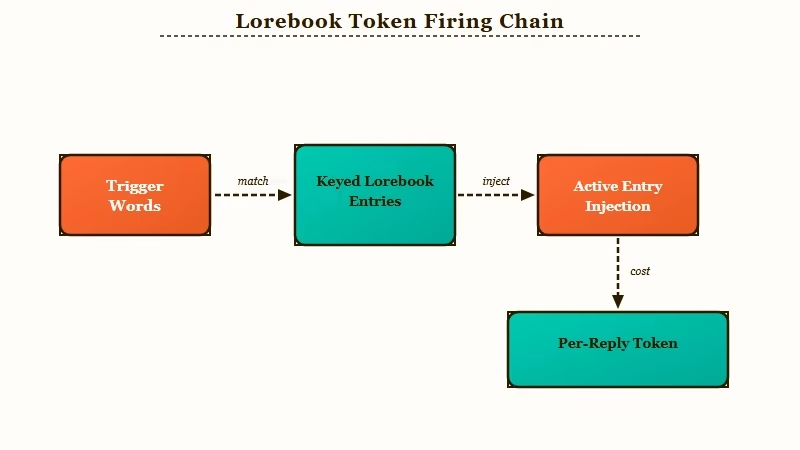
What is a lorebook entry: A block of lore tied to trigger keywords. When a keyword appears in chat, that entry’s text is injected into the prompt as temporary tokens, then removed once the keyword falls out of range.
This is why the community request for a lorebook “token counter” misses the point, and the more experienced users keep pushing back on it.
A total token count is close to meaningless, because the whole book never fires at once. One creator runs lorebooks with 150-plus entries and nearly 30,000 tokens total, yet any given reply only pulls the handful of entries whose keys matched.
The metric that predicts cost is a different one. It is how many entries fire on a typical turn and how big each of those entries is, which is why a lean 40-token entry beats a bloated 1,000-token one every time.
Used right, a lorebook is the opposite of a token drain. Moving side characters and world lore out of the always-sent personality field and into keyed entries means that information costs you tokens only when it is relevant, which frees up room for actual chat memory.
How the Constant Toggle Quietly Burns Your Tokens
The Constant or Always On toggle is the single biggest cause of lorebook token waste.
A constant entry ignores keywords and injects into every message, so it stops being a temporary cost and becomes a permanent one.
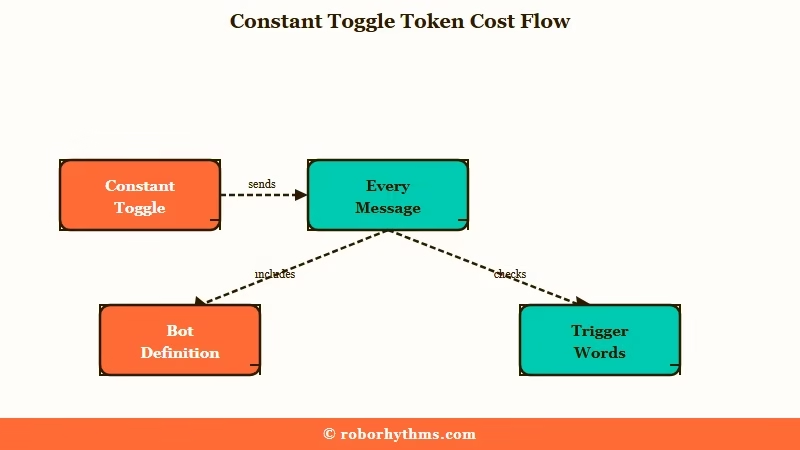
What is the Constant toggle: A per-entry setting that forces the entry into the prompt on every message regardless of trigger words, exactly like text pasted into the bot’s personality.
Here is the part that changes how you build. A constant entry saves you nothing compared to just writing that text into the bot definition, because both get sent on every turn.
People flip entries to Constant thinking they are guaranteeing the AI remembers something, and instead they are quietly moving that text into the permanent budget forever.
My rule is blunt. If a fact is not relevant to most scenes, it should not be constant, and if it is genuinely always relevant, it belongs in the bot definition where you can at least see it.
I reserve Constant for one or two true world rules and let everything else ride on keywords, the same discipline that keeps Janitor AI memory working instead of overflowing.
How a Lorebook Drains Your DeepSeek or OpenRouter Balance
A bloated or always-triggering lorebook drains a proxy balance because the whole active context is re-sent and re-charged on every message.
On a paid proxy you pay per token, so a fat prompt on every turn adds up fast.
The numbers make it concrete. Through OpenRouter, DeepSeek V3 0324 runs about $0.24 per million input tokens and $0.90 per million output (OpenRouter’s pricing page lists the current rates), and a $5 balance that should last thousands of messages can vanish when a misconfigured setup wastes up to 200,000 tokens on a single reply.
The extreme cases are almost funny until they happen to you. A 300,000-token lorebook is non-functional and throws an instant max tokens error, and even a 100,000-token one made DeepSeek stop responding after a few messages.
Most people never go that far, but a favorite bot with one weird always-active lorebook is enough to burn through a balance like a hot knife through butter.
| Symptom | Likely cause | Fix |
|---|---|---|
| Proxy balance draining unusually fast | Constant entries or huge context re-sent every turn | Un-toggle Constant, cap context size |
| Replies getting dumber over a long chat | Lorebook crowding out chat memory | Shrink entries, move always-on lore to the bot def |
| Instant max tokens error on send | A single oversized lorebook or entry | Split the entry, keep each under 100 tokens |
| Multiple entries firing at once | Overlapping common trigger words | Use Inclusion Groups so one entry wins |
How Do I Make a Token Light Lorebook
You make a token light lorebook by keeping entries tiny, keywords specific, and almost nothing set to Constant.
Small keyed entries give you deep lore that only costs tokens when the scene calls for it.
The sizing targets I stick to are simple. Keep each entry under 100 tokens, roughly one to three sentences, with core identity entries at 80 to 120 tokens and lighter details like emotional states or relationships at 40 to 80. If an idea is bigger than that, split it into several small entries rather than one wall of text.
The habit that saves the most grief is a setting called Message Depth, more than entry size. Here is the sequence I would set up before writing a single entry:
- Set Message Depth to 1 so only your latest message can trigger entries, which stops the bot from waking its own lorebooks in a loop.
- Give each entry specific, uncommon trigger words so it fires only when genuinely relevant, not half the book at once.
- Keep every entry under 100 tokens and one concept per entry.
- Group overlapping entries into an Inclusion Group so a single winner speaks instead of five entries stacking.
- Leave Constant off unless a fact is truly relevant to every scene.
What is Message Depth: The setting that controls how many recent messages Janitor scans for trigger keywords. Depth 1 scans only your latest message, which prevents the bot from triggering its own entries.
For the grouping step, Inclusion Groups act like traffic control. Set the entries to 100 percent probability, then let Group Weight, a lottery where higher numbers get drawn more often, or the Use Insertion Order toggle where the highest priority number wins, pick one entry instead of injecting all of them.
| Entry type | Token target | Trigger setup |
|---|---|---|
| Core identity | 80 to 120 tokens | Keyed to the character name, not Constant |
| Emotion or relationship | 40 to 80 tokens | Keyed to specific, uncommon words |
| World rule everyone needs | Keep it in the bot definition | Only make it Constant if truly always on |
| Overlapping variants | Under 100 tokens each | Bundle into one Inclusion Group |
Before: One entry set to Constant, 1,000 tokens of full backstory, injected on every single message.
After: Five keyed entries of 60 to 90 tokens each, triggered by name and topic, so only the relevant one or two fire per reply.
How Do I Cap the Cost With Context Size
You cap the cost by capping Context Size around 16,384 tokens, which limits how much is ever sent per message.
Lorebooks do not override the context ceiling, so a hard cap is your safety net even when an entry misbehaves.
Bigger is not better here, which surprises people who paid for a 65,000-token proxy. Large language models have a U-shaped memory, meaning they hold onto the start and end of a prompt but let the middle blur, so stuffing 60,000 tokens in makes the bot slower and more forgetful, not sharper.
Capping around 16k gives the best balance of memory and cost, and it is the same ceiling that keeps a Janitor proxy setup running smoothly.
If you want to remove the money risk entirely, the free tier does it for you. Running the free DeepSeek model on OpenRouter gives you daily messages that never touch your paid balance, so an occasional lorebook mistake costs you nothing but a retry.
That is a gentler landing than the surprise bills people describe after a proxy price change catches them off guard.
This is also where I separate cost from triggering problems. If your entries are lean but still not firing when they should, that is a keyword issue covered in the guide on Janitor AI lorebooks not working, a different fix from the token math here.
When the Token Math Is Not Worth the Effort
If you would rather not audit token budgets to keep a character consistent, a hosted companion handles memory for you.
Some people enjoy tuning entries and depth settings, and some just want the character to remember without the spreadsheet.
For the second group, Candy AI has no token meter or proxy balance to babysit, because the memory lives server-side and the cost is a flat subscription rather than a per-message tally.
You give up Janitor’s deep lorebook control and its huge community library, so I treat it as a different trade rather than a strict upgrade.
If long-term continuity is the real goal, Nectar AI keeps memory across sessions without any manual token budgeting on your end.
I still keep Janitor for its free model and the power a well-built lorebook gives you, and once you tame the tokens with the checklist above, that power stops costing you anything you did not choose to spend.
Janitor sits among the most-trafficked apps in the a16z Top 100 AI apps ranking, so these lorebook habits pay off for a very large number of people.
Frequently Asked Questions
Does a big Janitor AI lorebook use all its tokens on every message?
No. Keyed lorebook entries only inject when their trigger words appear in recent messages, then drop out. A 30,000-token lorebook usually adds only a few hundred tokens to any single reply, not its full size.
Does the Constant toggle waste tokens?
Yes, if overused. A Constant entry injects on every message and costs exactly the same as pasting that text into the bot definition. Reserve it for one or two genuinely always-relevant world rules and keep everything else keyed.
Can a lorebook drain my DeepSeek or OpenRouter balance?
Yes. Paid proxies charge per token and re-send the whole context every message, so a bloated or always-triggering lorebook can waste up to 200,000 tokens on one reply and burn through a $5 balance quickly.
How big should a lorebook entry be?
Keep each entry under 100 tokens, about one to three sentences. Core identity entries can reach 80 to 120 tokens, while emotional or relationship details should stay around 40 to 80. Split large ideas into several small entries.
What does Message Depth do for token usage?
Message Depth sets how many recent messages Janitor scans for trigger words. Setting it to 1 means only your latest message triggers entries, which stops the bot from waking its own lorebooks in an endless, token-hungry loop.
Quick Takeaways
- Total lorebook size barely matters, only the entries that trigger on a given reply cost you tokens.
- The Constant toggle is the real token sink, it equals pasting text into the bot definition on every message.
- On a paid proxy, a bad lorebook can waste 200,000 tokens in one reply and drain a $5 balance fast.
- Keep entries under 100 tokens, set Message Depth to 1, and use Inclusion Groups so one entry wins.
- Cap Context Size near 16,384 tokens, or run the free proxy tier to remove the money risk entirely.
