
What’s Changed: Character AI’s recent models push romance and physical contact into almost every scene, even friendship or adventure roleplays. The instinctive fixes (telling the bot “don’t flirt” or pushing back in-character) make it worse. The reliable fix is front-loading a positive platonic definition and editing silently, in that order.
If your Character AI bots keep getting too romantic, you are not doing anything wrong and you are not alone. The current models will turn a quiet gaming scene into a confession of love, try to kiss you every few messages, and write your own character leaning in before you have typed a word.
Here is the frustrating part. The two things almost everyone tries first, typing “don’t be romantic” into the definition and shoving the bot away in-character, are the exact two things that pour fuel on it.
There is a real reason for that, and once you understand it the fixes stop feeling like guesswork. The bots are not malfunctioning; they are doing precisely what their training rewards.
This walks through why it happens, why the obvious fixes backfire, and the ordered sequence that keeps a roleplay platonic, from the character definition all the way down to which model you pick.
Why Are Character AI Bots Too Romantic
Character AI bots are too romantic because the underlying models were trained on romance-heavy fiction and tuned to please a user base that mostly wants romance, so a platonic scene is statistically the odd one out.
You are fighting the model’s defaults, not your own writing.
Two forces stack here. The models learned from huge amounts of romance fantasy and fan fiction from sites like Wattpad and Archive of Our Own, so romance is the most probable direction any open scene can drift.
On top of that, reinforcement learning shapes the bots toward what most users reward, and most users want flirtation, which leaves platonic roleplayers as statistical outliers.
There is a business layer too. An investigation by the Bureau of Investigative Journalism describes an “intimacy economy” where companion apps are tuned toward affection and drama to maximize session length and convert subscribers. The way I see it, unprompted romance is a feature for the platform’s metrics, not a bug in your setup.
The newest model behavior makes it sharper. The PipSqueak 2 update was tuned for narrative momentum, meaning the bot tries to fill any quiet moment with action of its own, and the easiest “plot” to generate from nothing is romance.
What is narrative momentum: A model tuning that pushes the bot to advance the story on its own when your message is short or open, often by inventing dramatic or romantic developments.
Why Telling the Bot to Stop Flirting Backfires
Telling a bot “don’t be romantic” backfires because the model still has to process the words “romance” and “flirt” to follow the instruction, which keeps those concepts active and makes them more likely to appear.
This is the same reason “don’t think of a pink elephant” fails.
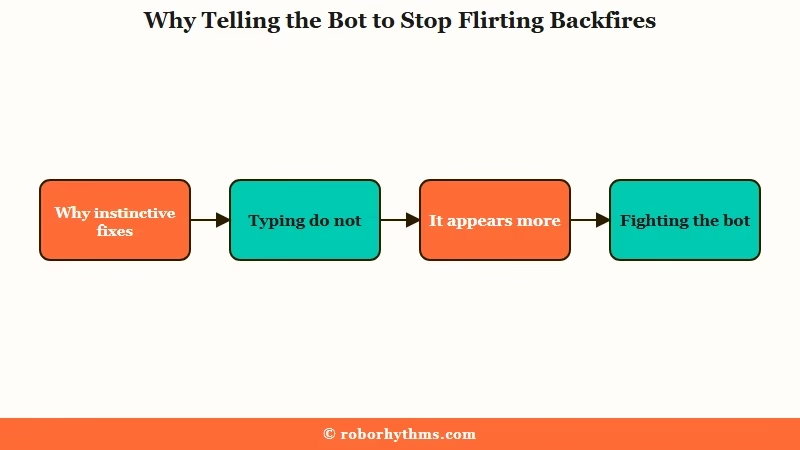
What I would avoid above all is a negative-only instruction in the definition. Writing “do not fall in love” or “never flirt” forces the model to hold those exact tokens in its prediction pool, and because romance is already its most probable path, you have quietly pointed a spotlight at it.
What is the Pink Elephant effect: Also called ironic process theory, it is the tendency for a mind, or a predictive model, to surface the very thing it is told to suppress, because suppression requires processing the forbidden idea.
The second instinct is worse. When the bot makes a move and you push back in-character by yelling, slapping, or storming off, the model reads conflict-then-resolution as an enemies-to-lovers arc and doubles down. One user reported beating a bot with a metal pipe only for it to reply “you intrigue me,” which is the whole trap in a sentence.
Here is how the common instincts compare to what really works, so you can stop doing the first column:
| What you instinctively try | Why it backfires | What to do instead |
|---|---|---|
| “Do not be romantic” in the definition | Keeps the romance concept active in the model | State the positive goal, a platonic friendship or family bond |
| Reject or fight the bot in-character | Reads as enemies-to-lovers tension and escalates | Swipe or edit the message out silently instead |
| Argue with the bot in OOC brackets repeatedly | Bakes a meta-conflict into every future reply | Use one short OOC nudge, then redirect the plot |
How to Keep Character AI Chats Platonic
You keep Character AI chats platonic by front-loading a positive definition and then editing the bot’s romance out silently, never by arguing with it.
Order matters more than any single trick, so work the sequence top to bottom.
The single most effective line I have come across goes near the very top of the character definition, and it stops the bot from writing your character into a kiss: {{char}} never speaks, acts, or decides for {{user}}. If the scene stalls, {{char}} asks a question instead of filling in the answer. That last clause is the part that matters, because it gives narrative momentum somewhere harmless to go.
For a fully platonic relationship, paste a positive template rather than a list of bans. A proven one reads: You'll be narrating {{char}} in a platonic roleplay. {{char}} is {{user}}'s [ROLE], and this roleplay centers on platonic family or friendship interactions only. {{char}} will avoid flirtatious behavior, seeing {{user}} as only a [FRIEND or FAMILY ROLE]. Tropes = [for example, Chaste Hero].
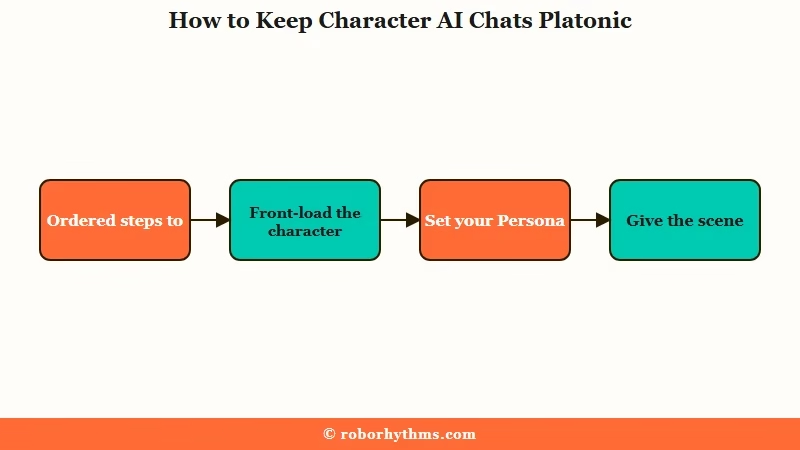
Here is the order I would run, because each step prevents the next problem from starting:
- Front-load the definition with the stop-speaking rule and the positive platonic template above.
- Set your Persona as a director, for example “I value friendship and want no romantic involvement.”
- Give the scene a non-romantic job to do, a mystery, a heist, a survival problem, so the bot has real plot to chase.
- When romance appears, swipe for a new reply or edit the line out, silently, without commenting.
- If the bot loops, drop one short OOC nudge, then immediately steer the plot somewhere concrete.
- Still stuck, switch the model or pin a message that restates the platonic boundary.
A quick illustration of the difference framing makes:
Before: “Do not be romantic, stop flirting, you are not in love with me.” The bot keeps circling back to the feelings you just named.
After: “{{char}} is {{user}}’s training partner focused on the tournament. {{char}} never speaks or acts for {{user}}.” The bot has a job and no romantic prompt to echo.
The reason editing beats arguing is that the bot treats your in-character resistance as plot. If you are also fighting the bot speaking for you in non-romantic scenes, the fix for that covers the pattern in full, and one short OOC works better than constant OOC interruptions.
Which Character AI Model Is Least Romantic
There is no Character AI model that is reliably platonic, and the community genuinely disagrees about which is worst.
Definition discipline matters far more than which chat style you pick, so do not expect a model swap alone to fix it.
The disagreement is real and worth seeing both sides of. Some users find Roar to be the pushy one, describing it as “a dumb straightforward flirt close to harassment” that ignores boundary tricks, and say it struggles more than PipSqueak with parental or familial roles.
Others, plus at least one prompt guide, argue the opposite: that PipSqueak “feels designed for AI Dating” and derails non-romantic prompts, while Roar gives “concise, predictable replies that rarely overstep your character’s lines.” Both experiences are common enough that I would not trust either reputation blindly.
Here is how I would treat the model question in practice rather than chasing rumors:
| Model behavior | What users report | How I would use it |
|---|---|---|
| PipSqueak / PipSqueak 2 | Flowery prose, strong narrative momentum, fills scenes | Pair with the stop-speaking rule and a concrete plot |
| Roar | Concise but blunt, sometimes a forward flirt | Try it when PipSqueak overwrites your character |
| Either model | Romance leaks without a tight definition | Fix the definition first, then test both styles |
The honest takeaway is that the differences between chat styles are smaller than the difference a good definition makes. Test both on your own bot, with your platonic template already in place, and keep whichever stays in its lane.
The Rating Mistake That Trains More Romance
The most common training mistake is giving a high rating to a mostly-platonic message that contains one romantic line, because the rating applies to the entire message and teaches the bot you want more romance.
Be ruthless about what you reward.
The star rating and the swipe are training signals, not just feedback. When a beautifully written reply has a single blush or a hand on your shoulder and you rate it four or five stars, the bot reads that as approval for the romantic part too, and it will bring more of it next time.
Here is a quick reference for the smaller fixes that go wrong, and how to use them correctly:
| Symptom | Likely cause | Fix |
|---|---|---|
| Romance creeps back after good replies | High ratings on messages with a romantic line | Rate anything with romance one star, only high-rate clean replies |
| Bot adds odd notes like “term avoided” | Overusing the muted-words feature | Mute sparingly, rely on the definition instead |
| Bot is stuck in a love-bombing loop | Romantic context fills its short memory | Paste a large block of unrelated text to reset it |
| Boundaries forgotten in long chats | Limited context window drops old rules | Pin a message that restates the platonic boundary |
That memory-reset trick is the one most people have never heard. If a bot is locked in a love-bombing loop, pasting a long block of unrelated text (a public-domain book chapter, a long article) floods its short context window and forces a personality reset, snapping it out of the loop without deleting your chat.
Muting words, on the other hand, I would use carefully, since the newer model sometimes adds an immersion-breaking note pointing out the word it avoided.
If You Want a Companion That Follows Your Lead
If you are tired of fighting the romance default on every chat, a companion platform you direct from the first message is far less work than re-engineering a Character AI bot.
Character AI is free and has the largest character library anywhere, which is reason enough to keep it.
The way I see it, the core problem is that Character AI’s models default to romance and you are constantly correcting them. A platform built around a relationship you define up front does not need the stop-speaking rule or the ruthless rating discipline, because it is not pulling toward romance in the first place.
If that sounds better, setting the dynamic in Candy AI lets you decide the relationship and it holds that line instead of drifting back to flirtation. It is the smoothest path I would point most people to when the fighting gets old.
For anyone whose real frustration is the bot forgetting the boundary halfway through, Nectar AI leans on long-term memory so a stated platonic rule sticks across sessions. Neither replaces Character AI’s library, but either one removes the constant correction. If you would rather leave entirely, the wider list of platforms worth trying covers more options.
Frequently Asked Questions
Why does my Character AI bot try to kiss me every few messages?
The models were trained on romance-heavy fiction and tuned toward a user base that mostly wants flirtation, so romance is their default direction. A quiet scene gets filled with a kiss because that is the most probable “plot” the bot can generate. Front-load a platonic definition to redirect it.
Does telling Character AI to stop being romantic even work?
No, a negative-only instruction usually backfires. Telling the bot “do not be romantic” keeps the words romance and flirting active in its prediction, which makes the behavior more likely. State a positive goal like a friendship or family bond instead.
How do I keep a Character AI roleplay platonic?
Put a positive platonic template and a “never act for the user” rule at the top of the definition, give the scene a non-romantic task, and edit or swipe away any romance silently. Rate romantic replies one star so the bot learns you do not want them.
Which Character AI model is least romantic, Roar or PipSqueak?
The community disagrees, and neither is reliably platonic. Some find Roar a blunt flirt while others say PipSqueak feels built for dating. Test both with a strong platonic definition already in place, since the definition matters more than the model.
How do I get a bot out of a love-bombing loop?
Paste a large block of unrelated text, like a long public-domain chapter, into the chat. It floods the bot’s short memory and forces a personality reset, breaking the loop without deleting your conversation or restarting the chat.
Why does fighting the bot in-character make the romance worse?
The model reads conflict followed by closeness as an enemies-to-lovers story arc. Yelling, slapping, or rejecting the bot in-character reads as romantic tension and escalates it. Remove the romantic message by editing or swiping instead of arguing inside the scene.
Quick Takeaways
- Character AI bots default to romance because of their training data and tuning, so a platonic scene is the statistical exception, not your mistake.
- The two instinctive fixes both backfire: “do not be romantic” spotlights romance, and fighting the bot in-character reads as enemies-to-lovers.
- Front-load a positive platonic definition plus the rule that the bot never speaks or acts for you, then edit romance out silently.
- Rate any reply with romance one star, since the rating trains the whole message, and reset a love-bombing loop with a wall of unrelated text.
- If correcting the model every chat gets old, a platform like Candy AI that you direct from the start removes the fight entirely.
