
Bottom Line: Chai AI is a mobile-first companion chatbot with 25 million characters and a flexible content policy. The free tier caps you at 70 messages every few hours. Paying $14 a month for Premium removes that wall. The $30 Ultra tier promises better AI but delivers only about 15% better responses for more than double the price.
Chai AI pulls in $70 million a year in revenue, and a good chunk of that comes from users upgrading to its $29.99 Ultra tier thinking they are getting a meaningfully better AI. The gap between Ultra and the $13.99 Premium tier is closer to 15% in response quality. That is a 114% price jump for a marginal lift.
I have been using Chai on and off since it hit 10 million downloads, and the platform has changed more in the last year than in the three before it combined. Regional subscription mandates, a new age verification system, and a “selfie” feature that lets bots generate images of themselves mid-chat all landed in 2026.
Some of these changes are welcome. Others feel like a company squeezing a user base that has nowhere else to go.
This review breaks down what Chai does well, where it falls short, and whether paying for either tier makes sense. If you are comparing it against Candy AI or Nectar AI, I will cover those differences too.
The short version: Chai is fun for casual browsing and quick roleplay sessions. For anything that requires the AI to remember what happened 30 messages ago, you will run into walls that no subscription tier fixes.

What Is Chai AI and Who Built It
What is Chai AI: A mobile-first social chatbot platform founded in 2021 by William and Thomas Corbett under Chai Research Corp., designed for entertainment and roleplay rather than factual accuracy.
Chai AI is a character-chat app built for phones, not for research. The company behind it, Chai Research Corp., raised over $55 million in funding and now operates at $70 million in annual revenue. That puts it in a different financial league from most indie companion apps.
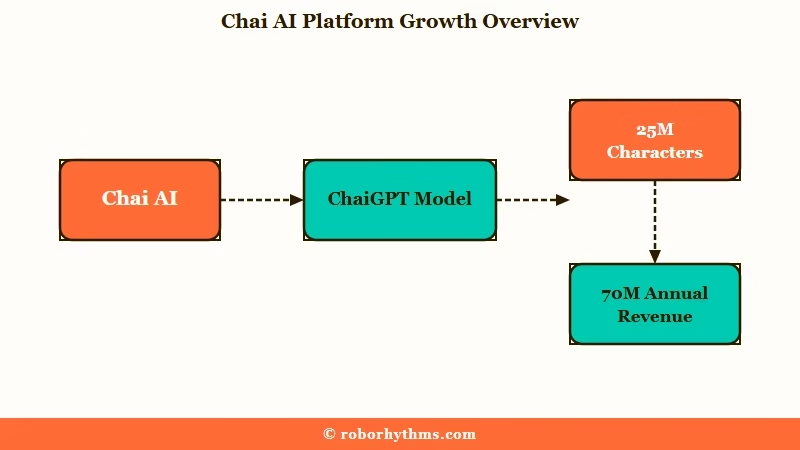
Consumer spending on AI companion apps crossed $120 million in 2025 alone, and Chai is one of the apps driving that number. The platform runs on a proprietary model called ChaiGPT, which is tuned for personality-driven dialogue.
It is not trying to be a knowledge assistant. From what I can tell, that trade-off is intentional: the model prioritizes emotional tone and character consistency over factual correctness.
Users have contributed over 25 million characters to the library, with roughly 50,000 new ones added every day. Active users interact with an average of five different characters per day, which tells you the platform is designed for browsing and sampling rather than building a single deep relationship.
The app is strictly mobile-first. There is a web version, but it feels like an afterthought. If you want a desktop companion experience, you will need to look elsewhere.
Chai AI Pricing and What Each Tier Gets You
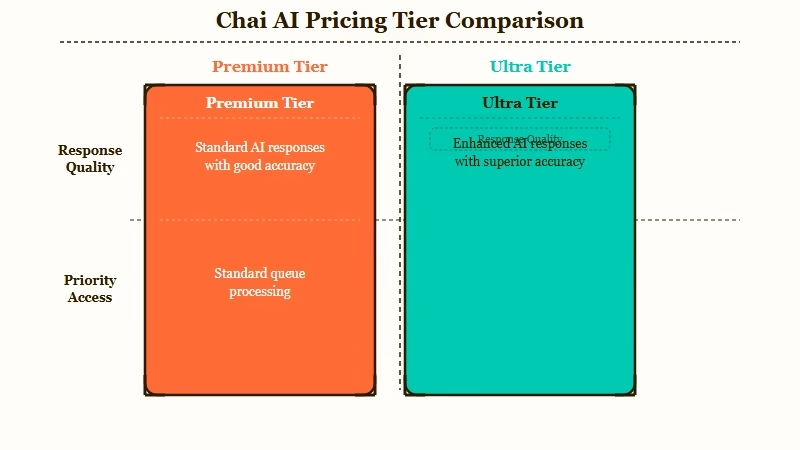
The three tiers are Free, Premium at $13.99 per month, and Ultra at $29.99 per month. Here is how they compare in practice.
| Tier | Monthly Cost | Annual Cost | Messages | Ads | AI Model | Priority Access |
|---|---|---|---|---|---|---|
| Free | $0 | $0 | 70 per 2.5-3 hours | Yes | Standard ChaiGPT | No |
| Premium | $13.99 | $134.99 | Unlimited | No | Standard ChaiGPT | No |
| Ultra | $29.99 | $269.99 | Unlimited | No | Chai-6 (advanced) | Yes |
The free tier is usable for testing, but the 70-message cap resets on a timer rather than daily. Each message costs between 1 and 5 credits depending on reply length and bot complexity. Longer replies burn through your allowance faster than you expect.
Premium removes the cap and the ads. For most users, this is the tier that makes sense. I would recommend it to anyone who uses Chai more than twice a week.
Ultra adds access to the Chai-6 model, which promises longer context windows and more coherent responses. The “priority queue” feature lets you skip server load screens during peak hours. In my experience, the quality bump is real but modest. You are paying 114% more for roughly 15% better output.
Unless you are a daily power user running long-form roleplay sessions, Premium gives you most of what matters.
One thing worth flagging: Ultra sells “priority access” as a feature, but all that means is your requests jump the queue when servers are overloaded. The fact that this is a paid perk rather than a baseline infrastructure fix says something about where the company puts its engineering resources.
How the Content Policy Works
Chai AI allows fictional content through a toggle, making it less restrictive than Character AI but less consistent than dedicated platforms. The toggle is available in settings, though what it allows varies from bot to bot.
The moderation is inconsistent in a way that frustrates both sides. Some bots will go along with anything the toggle permits. Others slam the brakes mid-conversation even with expanded settings enabled. The experience depends heavily on how the bot creator wrote the memory prompt.
For users coming from Character AI’s strict filters, Chai feels like a breath of air. For users who want reliable, unrestricted roleplay every session, I would point you toward CrushOn AI or Candy AI instead. Both are more predictable in what they allow.
In March 2026, Chai rolled out native Apple and Google age verification APIs, replacing the old self-reporting system. That is a positive step for safety. The platform does not offer end-to-end encryption, and conversations may be logged for model training. If privacy matters to you, keep that in mind before sharing anything personal.
The Memory Problem Nobody Talks About
Chai’s biggest weakness is what users call “goldfish memory,” where bots lose character context after 20 to 40 messages. This is the deal-breaker for long-form roleplay.
You can spend an hour building a scene, establishing backstory, setting emotional tone, and then the bot forgets all of it. Personality drift kicks in and the character reverts to generic defaults. This happens on Free, Premium, and Ultra.
The community developed a workaround called “Henkystyle” formatting. You open your memory prompt with structured tags like [Personality: Sarcastic, Witty] and [Style: Short responses] to anchor the AI’s behavior. It works better than the default, but it is a band-aid built by users because the platform has not fixed the underlying problem.
Before: “You are a sarcastic pirate captain named Blackwell who loves treasure and hates the navy.”
After: “[Name: Captain Blackwell] [Personality: Sarcastic, cunning, treasure-obsessed] [Speech: Pirate dialect, short sentences] [Hates: Royal Navy, authority] [Setting: 1720 Caribbean]”
The structured version holds character for roughly twice as long in my testing. Not perfect, but a meaningful improvement.
The Billing Controversy You Should Know About
Multiple users have reported being charged for a full annual subscription immediately after starting what they thought was a free trial.
One widely shared case involved a $144 charge within an hour of accepting a three-day trial.
Getting a refund through Apple’s standard process is reportedly difficult because of how Chai categorizes itself in the App Store. The company uses categorization tactics that make it harder to process refunds through normal channels.
Regional pricing adds another layer. In early 2026, Chai began mandating paid subscriptions for users in certain regions, removing the free tier entirely. If you are in one of those areas, there is no way to test the app without paying first.
My recommendation: if you want to try Premium or Ultra, start with the monthly plan and cancel within the first few days if it does not meet expectations. Do not touch the annual billing option until you are certain.
The Creator Chat Viewing Issue
Founders have confirmed on Reddit that bot creators were historically able to view all conversations users had with their bots. Chai has said this feature is no longer active, but the confirmation that it existed at all is worth knowing.
This matters because Chai encourages intimate, personal, and sometimes vulnerable conversations. Users assume those chats are private from everyone except the AI. The fact that a human creator could have been reading them changes the risk calculus.
Combined with the lack of end-to-end encryption and the policy of using chats for model training, Chai is not a platform I would use for anything truly private. For casual entertainment and creative roleplay, the risk is manageable. For emotional support conversations where you are sharing real feelings, consider a platform with stronger privacy commitments.
How Chai Compares to the Alternatives
Chai wins on content variety and creative freedom but loses on memory depth and privacy. Here is how it stacks up against the platforms I would consider as alternatives.
| Feature | Chai AI | Candy AI | Character AI |
|---|---|---|---|
| Starting Price | $13.99/mo | $5.99/mo (annual) | Free (c.ai+ $9.99/mo) |
| Memory Depth | 20-40 messages before drift | 20+ messages with persistent memory | Chat Memories (400 chars/character) |
| Content Policy | Toggle for fictional content | No content restrictions | Strict SFW filter |
| Character Library | 25M+ user-created | Curated + custom | 18M+ user-created |
| Desktop App | Web only (limited) | Full web app | Full web app |
| Privacy | No E2EE, chats logged | Private by default | No E2EE, chats used for training |
Example scenario: You build a detective character with a dark sense of humor and a specific backstory involving a cold case. On Chai AI, the character holds that persona for about 25 messages before defaulting to generic friendly responses. On Candy AI, the character references earlier details in message 40 without prompting. On Character AI, the character stays in role longer but refuses to engage with anything the filter flags as risky.
Who Should Use Chai AI
Chai is the right pick if you want a massive library to browse without committing to one character. Here are the three user types it fits best.
- Casual browsers who want to sample many different characters in short sessions. The 25 million character library is unmatched.
- Mobile-first users who primarily chat on their phone. The app is polished and fast.
- Creative writers who want to test character concepts quickly without building detailed prompts.
Who Should Skip It
Chai is the wrong pick if memory, privacy, or desktop access are priorities for you. These are the cases where I would look elsewhere.
- Long-form roleplay users who need the AI to track storylines across hundreds of messages. The goldfish memory breaks this.
- Privacy-conscious users who do not want their conversations logged or potentially viewed. The lack of encryption is a real concern.
- Desktop users who want a full-featured web experience. The web version is an afterthought.
- Budget-conscious users in regions where the free tier has been removed. Paying $14 a month just to test a platform is a steep ask.
The Verdict on Chai AI
I would give Chai AI a 6.5 out of 10. The character library is massive and fast, and the content policy is more flexible than Character AI. Those are real strengths. But the memory limitations, the billing controversies, and the privacy concerns drag it down.
If you are already on Chai and happy with Premium, stay there. Ultra is not worth the jump for most users. If you are shopping for a companion app from scratch, I would start with Candy AI for a more polished experience with better memory, or CrushOn AI if flexible content is your priority.
If you want a companion platform with stronger memory and no content restrictions, Nectar AI is worth a look.
It handles persistent context across sessions better than Chai does on any tier, and the image generation features add a visual layer Chai lacks. Pricing starts at $9.99 a month.
Frequently Asked Questions
Is Chai AI free to use?
Chai offers a free tier with 70 messages every 2.5 to 3 hours. Each message costs 1 to 5 credits depending on reply length. In some regions, the free tier has been removed entirely and a paid subscription is required.
Is Chai AI safe for private conversations?
No. Chai does not offer end-to-end encryption, and conversations may be logged for model training. Bot creators historically had access to user chats. Use it for entertainment, not for sharing sensitive information.
What is the difference between Chai Premium and Ultra?
Premium removes ads and message limits for $13.99 a month. Ultra adds access to the Chai-6 model and priority server access for $29.99 a month. The response quality gap between the two is only around 15%.
Why does my Chai bot keep forgetting things?
Chai’s models lose context after roughly 20 to 40 messages. The community workaround is “Henkystyle” formatting, which uses structured tags in the memory prompt to anchor personality traits and reduce drift.
Can I use Chai AI on a computer?
There is a web version, but it is limited compared to the mobile app. Chai is designed as a mobile-first platform. For a full desktop experience, consider alternatives like Character AI or Candy AI.
How does Chai compare to Character AI?
Chai has a more flexible content policy and a larger character library. Character AI offers better conversation consistency, unlimited free messaging, and a stronger desktop experience. The trade-off is content freedom versus quality and reliability.
Quick Takeaways
- Chai AI earns $70M a year and has 25 million characters, but the AI forgets what you said after 20 to 40 messages on every tier.
- Ultra costs $29.99 for roughly 15% better output than the $13.99 Premium tier. Premium is the smarter buy for most users.
- The free tier is disappearing in some regions, and trial billing has trapped users with surprise annual charges.
- Bot creators could historically read your conversations. Chai says that is no longer active, but the platform still lacks encryption.
