
What Happened: Anthropic released Claude Opus 4.8 on May 28, 2026, and the real story is not the benchmark bump. It is a new Claude Code feature called dynamic workflows that already ported a 750,000-line codebase in 11 days, plus a fast mode that now costs a third of what it used to. Standard pricing did not change.
The Claude Opus 4.8 release is barely a day old, and it is already splitting opinion on whether it is a real jump or a quiet tune-up. Here is why it is worth a look either way.
Anthropic shipped Claude Opus 4.8 on May 28, 2026, and the headline most outlets ran with, a few points of benchmark gain, buries the part that matters most to anyone who lives in Claude Code. The model came out alongside a feature called dynamic workflows that lets Claude write its own orchestration script and run up to 1,000 subagents in the background.
What caught my eye first was not a score. It was a migration. Anthropic used dynamic workflows to port the Bun project from Zig to Rust, producing roughly 750,000 lines of code in 11 days with a 99.8% pass rate on the existing test suite, per TechCrunch’s launch coverage. That is the kind of job that used to be a quarter of engineering time, and it reframes what “agentic coding” even means.
By the end of this you will know exactly what changed, what the new effort and fast-mode controls cost, and whether any of it is worth changing your setup over.
What Actually Happened With Claude Opus 4.8
Claude Opus 4.8 is an incremental model update paired with two bigger Claude Code changes: dynamic workflows and an effort control.
Anthropic released it on May 28, 2026, just 41 days after Opus 4.7, a far faster turnaround than its usual three-to-seven-month cadence.
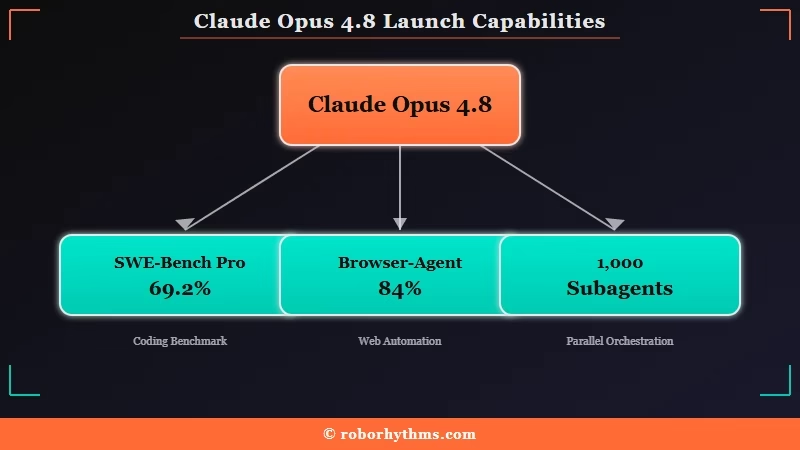
The model itself moved the numbers in the direction you would expect. Agentic coding on SWE-Bench Pro rose from 64.3% to 69.2%, multidisciplinary reasoning with tools went from 54.7% to 57.9%, and it scored 84% on Online-Mind2Web, the benchmark that tests whether a model can act as a browser agent. From what I have seen, the browser-agent number is the one to watch, because that is where the real-world “do my task” use cases live.
The piece I keep coming back to is the dynamic workflows architecture, because it breaks a rule most language models follow. Instead of keeping the plan inside its context window, Claude writes a JavaScript script that orchestrates subagents, stores intermediate results in script variables, and returns only the final answer to your session. The thinking never clutters your context, which is a genuinely different way to run a long job.
There is one more thing Anthropic is teasing rather than shipping. A restricted model called Claude Mythos Preview is already in use by a small number of organizations for cybersecurity work under a program called Project Glasswing, including finding critical vulnerabilities in operating systems like macOS, and it is expected to reach a wider audience in the coming weeks.
Why This Is a Bigger Deal Than the Benchmarks Suggest
The reliability and cost changes matter more than the raw scores because they change how much you can trust and afford to run.
Anthropic claims Opus 4.8 is four times less likely than Opus 4.7 to let a flaw in its own code pass unremarked, and it is more willing to push back when a plan is not sound.
That “honesty” framing sounds soft until you have had an agent confidently ship a broken migration. Scott Wu, the CEO of Cognition and the team behind Devin, specifically noted that Opus 4.8 fixes the comment-verbosity and tool-calling issues that dogged 4.7, per Anthropic’s announcement. When the people building production coding agents call out specific fixes, that tells me more than a leaderboard does.
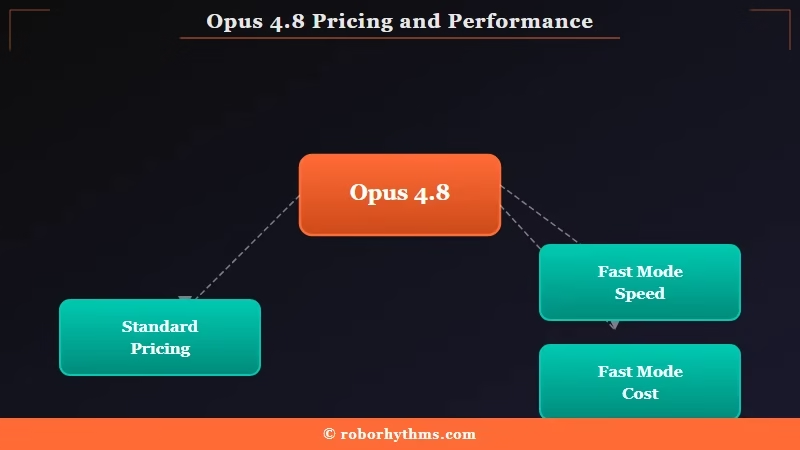
The cost side is where it gets interesting for everyday users. Standard pricing is unchanged at $5 per million input tokens and $25 per million output tokens, but fast mode is now 2.5x faster and three times cheaper than it was on previous models. The way I read it, Anthropic is trying to make speed a default habit rather than a luxury you ration.
Here is the part that surprised me. Fast mode is not a smaller, distilled version of the model the way Haiku or a “Flash” tier would be. It is the full Opus 4.8 running in a high-speed configuration with identical intelligence, which means you are not trading quality for speed the way you usually do.
What This Means for You and Your Claude Code Setup
For most people the practical wins are the effort slider and cheaper fast mode, not the 1,000-agent workflows.
Dynamic workflows require Claude Code version 2.1.154 or later and are limited to Enterprise, Team, and Max plans, so a lot of solo users will not see them yet.
The new effort control sits next to the model selector and lets you dial how hard Claude thinks. It defaults to “high,” and Anthropic says that default spends a similar number of tokens as the Opus 4.7 default while performing better, so you are not automatically paying more. For the heavier “extra” (xhigh) and “max” settings, Anthropic raised rate limits to account for the higher token use, which tells me they expect power users to lean on them.
If you are wondering when to reach for these settings, here is the rough decision table I would start from.
| Setting | Best for | Watch out for |
|---|---|---|
| High (default) | Day-to-day coding and writing | Already strong, no reason to drop lower |
| Extra (xhigh) | Multi-step debugging, tricky refactors | Higher token spend, slower responses |
| Max | One-shot hard problems where being right matters most | Reserve it, do not run it on everything |
| Fast mode | Live iteration, bulk generation, quick edits | Uses credits, so batch your work to get value |
A concrete way to think about effort versus fast mode in practice:
Before: You leave Claude on max effort for an afternoon of routine edits and burn through credits and rate limits on work that did not need deep reasoning.
After: You keep high effort as your default, switch to fast mode for the dozen small iterative edits, and save max for the one gnarly bug that genuinely needs it.
If you only do three things after the update, I would do these in order:
- Update Claude Code to version 2.1.154 or later so the new controls and workflows even show up.
- Leave the effort slider on “high” and spend a day noticing whether you ever miss the deeper setting.
- Move your small, repetitive edits to fast mode and watch your credit burn rather than your wall-clock time.
One caution worth flagging. GPT-5.5 still leads Opus 4.8 on at least one terminal-coding benchmark, per MacRumors, so this is not a clean sweep. If your workflow is heavy on raw terminal coding, test before you assume 4.8 is automatically better for your specific tasks.
What Comes Next
Expect the dynamic workflows preview to widen and the Mythos model to surface for more users.
The feature is labeled a research preview, which usually means the plan limits and the 16-concurrent-agent cap loosen over time.
I would not over-read the size of this release. Techzine pointed out that Opus 4.6 was a larger capability leap over its predecessor than 4.8 is over 4.7, which lines up with how this feels like a usability and reliability refinement, not an architecture revolution.
If you have been on the fence about agentic coding because reliability scared you off, this is the update that closes part of that gap. If you want the broader context on getting agents to run without torching your token budget, our guide to making an AI agent reliable without token burn covers the habits that matter most.
For anyone weighing Claude against the field, the GPT-5.5 versus Claude Sonnet 4.6 breakdown is a good companion read, and if you are wiring Claude into automations, the walkthrough on building n8n workflows from Claude shows where the agentic gains pay off.
The short version of today is simple. The model got a little smarter, a lot more honest about its own mistakes, and meaningfully cheaper to run fast.
Quick Takeaways
- Claude Opus 4.8 launched May 28, 2026, 41 days after 4.7, with SWE-Bench Pro up to 69.2% and an 84% browser-agent score.
- Dynamic workflows let Claude orchestrate up to 1,000 subagents via a JavaScript script that keeps planning out of your context window; it already ported 750,000 lines of Bun code in 11 days.
- Fast mode is the full model at 2.5x speed and three times cheaper than before, not a distilled “lite” version.
- Keep the effort slider on its “high” default, use fast mode for iterative work, and reserve “max” for genuinely hard problems.
- Dynamic workflows need Claude Code 2.1.154+ on Enterprise, Team, or Max plans, so solo users may not see them yet.
