
The Verdict: The best AI animated video generator depends on whether you want full-length narrative video (LongStories AI, LTX Studio, Kaiber) or short cinematic clips you assemble yourself (Pika, Runway, Kling, PixVerse). Most shoppers want the first and end up paying for the second.
The search term “ai animated video generator” lands you on listicles that mix two completely different products and pretend they compete. They do not. One category renders a full animated video in a single pass; the other generates a clip and asks you to stitch it.
I have seen the same buyer story play out three times in the last month: someone signs up for a $58 Pika Pro plan, expects a five-minute animated short, and discovers each clip caps at fifteen seconds. They cancel within a week. The category they wanted was somewhere else on the same page, buried in position seven.
This guide separates the two cleanly. Integrated narrative tools first, clip-based generators second, with a “who should choose what” decision frame before the FAQ. The honest take: most readers searching this term are looking for the first category and being sold the second.
Why AI Animated Video Generator Hides Two Product Categories
An AI animated video generator is one of two structurally different tools: integrated narrative engines that render a full-length animated video from a script (LongStories AI, LTX Studio, Kaiber), or clip-based generators that produce 5 to 60-second cinematic shots you assemble manually (Pika, Runway, Kling, PixVerse V6, Sora).
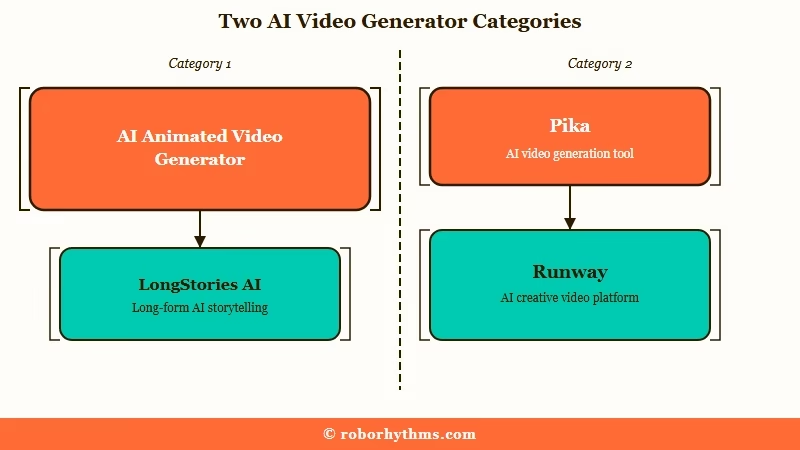
The way I see it, the search results confusion comes from vendor positioning. Every clip-based tool calls itself an “animated video generator” because the term has search volume, even when the longest clip it produces is fifteen seconds. The buyer reads “video” and assumes “video they can watch end to end,” then learns the truth at the timeline editor.
What is integrated narrative video: An AI workflow that takes a script or storyboard and renders a single full-length animated video, with characters consistent across every scene.
What is clip-based generation: An AI model that produces one cinematic shot at a time, typically 5 to 60 seconds, with character identity that drifts between clips.
The structural difference matters because price-per-minute math is wildly different between the two. A clip-based tool at $58 monthly produces maybe two hundred 10-second shots, which becomes about thirty-three minutes of raw clip output before any stitching, retake, or character continuity work. An integrated tool at $9 monthly renders a 10-minute animated video as one piece, with the characters already locked.
Best AI Animated Video Generator for Full-Length Narrative
The best AI animated video generator for full-length narrative is LongStories AI, because it renders up to 10-minute animated videos as a single pass with the Universe system handling character consistency across every scene.
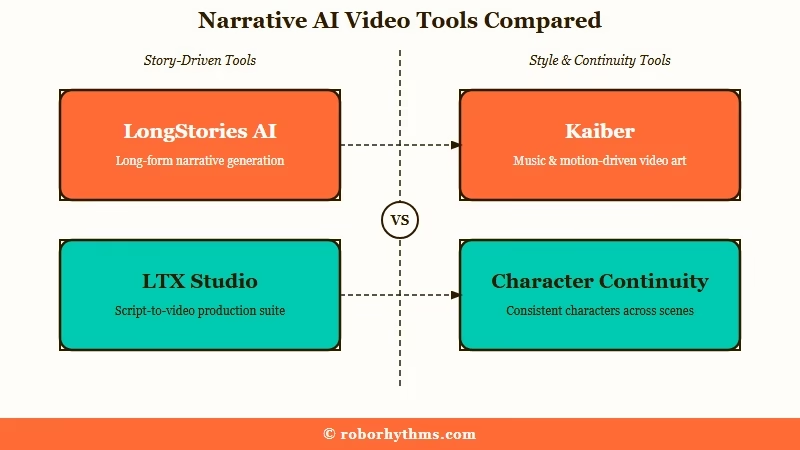
From my testing, this is the category most YouTube and faceless-channel creators are shopping for without realizing it. Three tools live here and they are all structurally different from the clip-based pack.
LongStories AI
The most direct fit for the search term, and the only sub-$10 option in this category. Pricing starts at $9 monthly and supports videos up to 10 minutes.
The Universe feature is the real differentiator. Define a character and visual style once, reuse both across every video on the account. The full LongStories AI review breaks down the Universe workflow with example outputs.
What I would recommend most: pair LongStories with a tight script and a defined Universe before generating. The output quality scales with how tightly you have specified the character upfront. You can get started at LongStories AI.
LTX Studio
A heavier-weight option from Lightricks, the Facetune company. Free tier offers 800 one-time computing seconds for personal use, with a Standard plan supporting eight trained actors per month. The Timeline Editor combines 3 to 20-second shots into longer sequences, which is closer to integrated than clip-based but still requires shot-by-shot work.
From what I have seen, LTX Studio is the right pick for creators who want studio-grade output and are willing to invest hours per project. Their reported numbers are 200% faster iterations and 3x faster collaboration versus traditional workflows, which only matters if a team is involved.
Kaiber
Storyboard-to-video focused, with a workflow built around defining the sequence visually before rendering. Kaiber is the best fit if you think in storyboards and want to specify shot composition before generation. It is the smallest of the three but the workflow appeals to filmmakers and music video creators.
I would suggest Kaiber over LongStories only if storyboarding is part of how you think. If you want to write a script and get a video, LongStories is the cleaner fit. For music-specific work, the music video generator breakdown covers the dedicated tools.
Best AI Animated Video Generator for Cinematic Clips
The best AI animated video generator for cinematic clips is Runway Gen-4, because it produces the highest-quality 60-second shots in the category and supports 4K output on the Unlimited plan, with Pika and Kling competing on price.
These are the tools that win head-to-head comparisons on output quality but never produce a full video. Buyers who want a 5-minute animated short will end up assembling 30+ clips and managing character drift across every one.
Runway Gen-4 / Gen-4.5
The output-quality leader. Per the Runway Gen-4 guide, Gen-4 natively supports up to 60-second clips, with chained sequences possible but consistency degrading after 2 to 3 minutes. The Standard plan runs $15 monthly for 625 credits; the Unlimited plan jumps to $95 monthly for 4K output.
The catch nobody surfaces: character identity drifts after 30 seconds, documented in the official guide. For anything longer than that, the same character will look subtly different between clips.
Runway Gen-4.5 scored 1,247 Elo on the Artificial Analysis Text-to-Video benchmark, surpassing Google Veo 3, so the clip quality genuinely is best-in-class. The character drift is the structural ceiling.
Pika
The accessible mid-tier option. Free tier offers 30 daily credits with a Pika watermark and no commercial rights.
Basic at $10 monthly ($8 annual) unlocks 1080p and commercial use. Pro at $58 monthly ($46 annual) provides roughly 2,000 generations and 10 concurrent jobs.
What surprised me about Pika is the concurrent generation limit. Free is 1, Basic is 3, Pro is 10. For storyboard iteration that 10x difference matters more than the credit count.
Kling AI
The longest individual clips in the clip-based category at 2 minutes via the extend feature, with five pricing tiers spanning Free, $6.99 Standard, $25.99 Pro, $64.99 Premier, and $127.99 to $180 Ultra. Caps at 1080p across every tier with no 4K option, per the Kling 2026 pricing breakdown.
Two quirks worth knowing. First, subscription credits expire monthly while separately purchased top-up packs remain valid for 2 years, which inverts the usual buying logic for heavy users. Second, audio generation uses roughly 5x the credits of silent video, which caps the Standard tier ($6.99 monthly, 660 credits) at roughly one narrated 10-second clip per month.
Sora and PixVerse V6
The high-cost and stylized options. Sora by OpenAI caps Pro users at 16 to 20-second clips for $200 monthly, the highest cost-to-length ratio in the entire category. PixVerse V6 occupies the stylized-content niche with character locks but smaller output volume than the leaders.
I would skip Sora unless an OpenAI ecosystem subscription already exists. The 16 to 20-second cap at $200 monthly does not pencil out for any narrative project I have run.
How AI Animated Video Generators Compare on Price and Output
The cheapest full-length AI animated video generator is LongStories AI at $9 monthly with 10-minute videos, while the highest-quality clip generator is Runway Gen-4 at $15 monthly for 1080p or $95 for 4K.
The pricing comparison below sorts the field by what you really get per dollar spent.
| Tool | Starting price | Max clip / video | Character consistency |
|---|---|---|---|
| LongStories AI | $9/month | 10 minutes (full render) | Universe system (high) |
| LTX Studio | Free / paid tiers | Stitched timeline (multi-minute) | Elements system (medium-high) |
| Runway Gen-4 | $15/month | 60-second clips (chainable) | 70% in testing, drifts after 30s |
| Kling AI | $6.99/month | 2 minutes via extend | Temporal coherence (medium) |
| Pika | $10/month | Short clips (under 15 seconds) | Low across clips |
| Sora (OpenAI) | $200/month | 16 to 20-second clips | Frame-level consistency only |
The global AI video market sat at $1.8 billion in 2024 and is projected past $25 billion by 2025 per Grand View Research. The category is moving fast enough that pricing will shift within a quarter, but the structural split between integrated narrative and clip-based generation will not.
If you only remember one decision frame from this guide, use the one below.
| Your goal | Pick this category | Top tool |
|---|---|---|
| Full-length animated video in one render | Integrated narrative | LongStories AI |
| Studio-grade timeline with trained actors | Integrated narrative | LTX Studio |
| Single cinematic clip at 4K | Clip-based | Runway Gen-4 Unlimited |
| Long single clips on a tight budget | Clip-based | Kling AI Pro |
| Short social clips, fast iteration | Clip-based | Pika Pro |
| Storyboard-first workflow | Integrated narrative | Kaiber |
Who Should Choose Integrated Narrative Tools
Choose an integrated narrative tool if you need a single full-length animated video without manual stitching, want consistent characters across every scene, and would rather spend time on script than on a timeline editor.
From my testing, three buyer profiles map cleanly to this category:
- Faceless YouTube creators producing 5 to 10-minute animated explainers or narrative content. The Universe system on LongStories AI handles the character continuity that clip-based tools cannot.
- Solo creators with a script but no editor skills. Integrated tools render the full video in one pass. You revise the script, regenerate, ship.
- Anyone allergic to credit-counting. LongStories at $9 monthly is flat-rate output for a 10-minute video. Kling at $25.99 Pro tier with 3,000 credits caps at roughly 37 ten-second clips a month, and that math changes with every generation.
Example scenario: You want a 5-minute animated YouTube explainer about ancient Egyptian mythology. On LongStories AI, you write the script, define a Universe with a recurring narrator character and consistent visual style, and generate. The output is one 5-minute video with the same character across every scene. On Runway Gen-4, the same project requires 5 to 10 clips at 30 to 60 seconds each, manual character consistency tuning between each clip, and a video editor to stitch the sequence with transitions.
The cluster of story-focused AI tools sits in the same category, and the structural pattern is the same: integrated workflow beats stitched clips for narrative output.
Who Should Choose Clip-Based Generators
Choose a clip-based generator if you produce short-form social content, need cinematic quality for individual hero shots, or work in a professional video editor and want AI as one source among many.
From my testing, the clip-based category is genuinely best-in-class for output quality on individual shots. Three buyer profiles fit here:
- Short-form social creators producing TikToks, Reels, or YouTube Shorts under 30 seconds. Runway, Pika, and Kling all produce excellent single-clip output for this length.
- Marketing teams producing hero shots for campaigns, where the output is one or two cinematic clips embedded in a larger video. Runway Gen-4.5 at 1,247 Elo on the Artificial Analysis benchmark is the quality leader here.
- Filmmakers and motion designers with a professional editor (Premiere, DaVinci, After Effects) who want AI clips as raw material alongside footage. The stitching workload is already part of their pipeline.
If output is going into a longer narrative video, expect significant manual character continuity work. Runway’s documented 30-second character drift threshold means any character appearing in clips longer than that will look subtly different scene to scene.
What Character Consistency Really Means in Practice
Character consistency in AI animated video is the difference between a defined character that looks the same across every scene (Universe systems) and a character description that gets re-interpreted by the model each generation (reference image systems).
From my testing, the three mechanisms below feel very different in production, and the labels vendors use do not always map to what the tool can do.
Universe / Element systems (LongStories AI Universes, LTX Studio Elements): define a character once as a persistent asset. Every generation referencing that asset produces the same character. This is the only mechanism that holds across full-length output.
Reference image systems (OpenArt AI, Higgsfield AI Popcorn engine): upload one or more reference photos and the model interprets them per generation. Effectiveness scales with reference quality and “creativity” settings. Works well for stills and short clips, breaks down past 30 seconds of continuous video.
Temporal coherence (Runway Gen-4 Temporal Attention Layers, Kling frame-by-frame continuity): keeps character identity stable within a single clip. Does not transfer between clips. Hit a 70% character consistency rate in Runway testing, which is best-in-class for clip-based but still means 30% of characters drift visibly.
For full-length narrative video, only the first mechanism delivers. For short cinematic clips, the third is sufficient.
The second is a bridge solution that handles stills and very short clips reasonably and breaks down past that. The broader animation generator category breakdown covers the template versus generative split that intersects this.
Frequently Asked Questions
What is the best AI animated video generator overall?
The best overall depends on output length. For full-length animated videos up to 10 minutes, LongStories AI at $9 monthly with the Universe system. For cinematic individual clips up to 60 seconds, Runway Gen-4 at $15 monthly with the highest output quality in the clip-based category.
Can AI generate a full 5-minute animated video from a single prompt?
Only integrated narrative tools can generate full-length animated video in a single pass. LongStories AI supports up to 10 minutes, LTX Studio combines multi-shot timelines, and Kaiber handles storyboard-to-video sequences. Clip-based tools (Pika, Runway, Kling) require manual stitching for anything longer than 60 seconds.
Why does Runway cost more than LongStories but produce shorter videos?
Runway is built for cinematic clip quality and 4K output at the professional tier; LongStories is built for narrative length and character consistency. They serve different jobs. A 10-minute Runway video would require chaining 10+ clips with significant character drift after 30 seconds per the official guide.
How much does an AI animated video cost to make?
A 5-minute animated video costs roughly $9 for one month of LongStories AI as a single render, versus $15 to $95 monthly on Runway plus an editor’s time to stitch 5 to 10 clips. Sora’s $200 monthly tier with 16 to 20-second clips makes it the highest cost-per-minute option in the category.
Can AI animated video tools keep characters consistent across scenes?
Only Universe / Element systems (LongStories AI, LTX Studio) reliably maintain character consistency across multiple scenes. Reference image systems (OpenArt, Higgsfield) handle stills and short clips but break down past 30 seconds. Temporal coherence (Runway, Kling) holds within a single clip but does not transfer between clips.
What is the cheapest AI animated video generator?
LongStories AI at $9 monthly is the cheapest full-length option. Kling AI at $6.99 monthly is the cheapest clip-based option but caps the Standard tier at roughly 9 professional-mode 10-second videos per month, with audio generation using 5x the credits.
Quick Takeaways
- The AI animated video generator category is two products in one search term: full-length narrative tools (LongStories AI, LTX Studio, Kaiber) and clip-based generators (Pika, Runway, Kling, Sora, PixVerse).
- For full-length animated video up to 10 minutes, LongStories AI at $9 monthly with the Universe system is the only sub-$10 option that handles character consistency across the whole render.
- Runway Gen-4 leads the clip-based category on output quality at $15 monthly, but character identity drifts after 30 seconds per the official guide.
- Sora’s $200 monthly tier capped at 16 to 20-second clips is the highest cost-to-length ratio in the field; skip unless you are already in the OpenAI ecosystem.
- If you searched “ai animated video generator” looking for a full video, start with LongStories AI before paying for a clip-based tool you will outgrow in a week.
