
The Verdict: The best AI music video generator depends on which job you need done. For story-driven music videos with consistent characters across the whole song, LongStories AI is the strongest pick. For lip-synced indie releases, Freebeat leads. For cinematic clips you sync to your own audio, Runway Gen-4 wins. The phrase “AI music video generator” hides three completely different tool categories, and most listicles mix them up.
When someone searches for an AI music video generator, they almost always get sent to a list that lumps three completely different tool types together. Suno appears next to Runway, Runway appears next to Kaiber, and Kaiber appears next to Stable Audio. The article never explains that these tools do fundamentally different jobs.
That confusion is the reason buyers pick the wrong one and then complain that AI music video tools are not yet ready. The way I see it, the tools are ready. The category labels are broken.
This guide splits the AI music video generator category into the three jobs it really contains: audio-only AI music tools that make the song, video-only AI tools you sync manually, and integrated tools that handle song and visuals together. Each section names the best pick and the honest tradeoffs. The verdict at the end routes you to the right tool by use case.

Why AI Music Video Generator Means Three Different Things
An AI music video generator is either an audio tool that makes the song, a video tool that makes clips you sync manually, or an integrated tool that handles both.
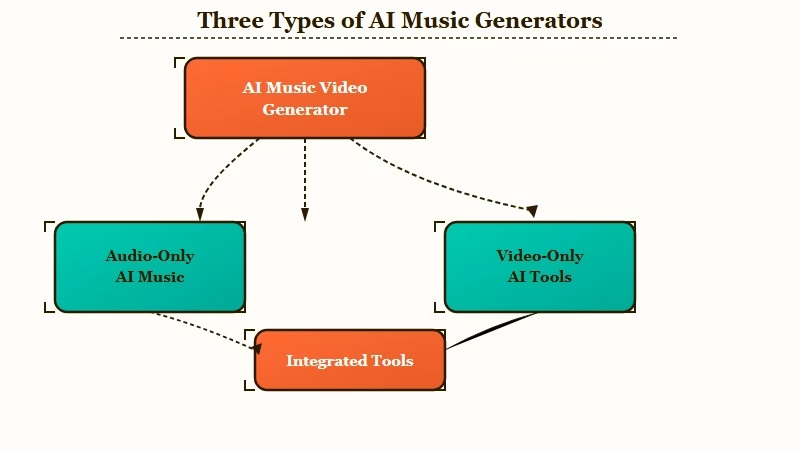
The phrase covers three different jobs. The first job is generating the song itself with AI vocals, instruments, and structure.
The second job is generating short video clips that you assemble in DaVinci or Premiere and sync to a song you already have. The third job is producing a finished music video where the AI handles the visual story and timing in a single tool.
In my experience, creators get this decision wrong because the listicles never call out the split. Someone reads a “best AI music video generator” article that puts Suno at #1, thinks Suno makes music videos, signs up, and discovers Suno only generates audio. The video part is on you.
For the integrated category specifically, only a small set of tools genuinely deliver song-and-visual together. Freebeat, Kaiber, Neural Frames, and LongStories AI all sit in this lane with different strengths. Everything else in the typical listicle belongs in one of the other two categories.
Best AI Music Video Generator for Song and Video Together
LongStories AI is the strongest pick for narrative music videos with character consistency across 10 to 15 minutes, with Freebeat as the runner-up for lip-synced indie releases and Kaiber for short Spotify Canvas loops.
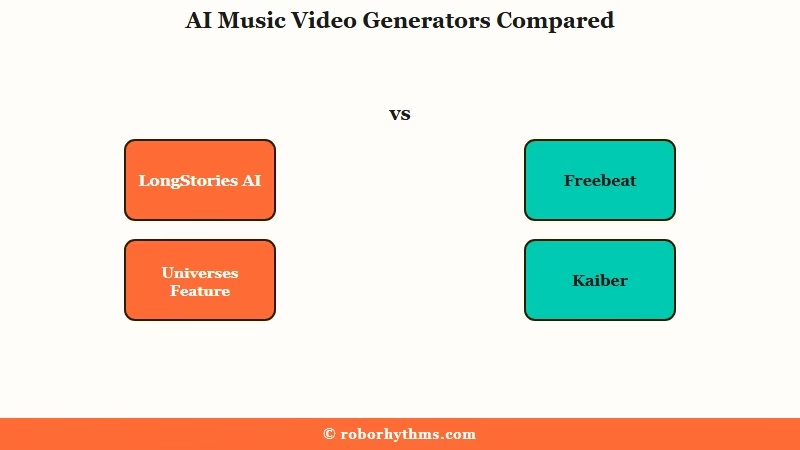
LongStories AI leads the integrated category for one specific reason. Its Universes feature defines characters, visual style, voice, and world once, then references that frozen definition across every scene.
That means a 4-minute music video with a recurring lead character keeps the same face, the same outfit, and the same backdrop logic from intro to outro. My LongStories AI review walks through the Universes architecture in detail.
The Music for Spiritual Education channel on YouTube uses LongStories for scene-by-scene children’s music videos and has 50,000 subscribers as the in-the-wild proof point.
Pricing on LongStories runs Free ($0, 30-second demo, 1 video lifetime), Pro ($59/mo, 10-min cap), Creator ($99/mo, API access), Creator Max ($199/mo, full 15-min cap), Studio ($299/mo, team workloads). For most music video creators, Pro at $59/mo covers a single 3-to-4-minute song with room for iteration. You can get started at LongStories AI.
Freebeat is the integrated alternative if your priority is lip-sync. From what I have seen, Freebeat hits more than 90% lip-sync precision (per the Renownedforsound 2026 indie-artist roundup) and handles full song architecture in one workflow. The tradeoff is the visual style is less narrative and more performance-focused, which fits singer-songwriter releases more than story-driven music videos.
Kaiber rounds out the integrated picks for short Spotify Canvas loops. Its energy-based audio reactivity creates pulsing visuals synced to the beat, which works well for the 8-second Canvas format.
The known limitation is that Kaiber subjects “constantly morph and melt”, preventing the visual continuity needed for longer videos. For full-length AI movie alternatives, the AI movie generator breakdown covers the streaming-tier and pipeline-tier tools designed for narrative video past a few minutes. Neural Frames is the IDM (intelligent dance music) and electronic specialist with stem-level audio analysis but no lip-sync and no narrative structure.
Best AI Tools for the Audio Side of a Music Video
Suno v5 is the strongest pick for full-song audio generation with 4-minute outputs and 9/10 vocal clarity, Udio is the safer legal choice after the Universal Music Group settlement, and Stable Audio is the instrumental-only budget option.
From my testing, Suno v5 delivers the longest tracks in the audio-only category at up to 4 minutes per generation. Vocal clarity scores 9 out of 10 on community benchmarks and the model supports 20+ languages. Direct Suno subscriptions cost over $100 for 100 songs, but third-party API resellers offer significantly cheaper rates if you generate at scale.
Udio is the cleaner legal pick after the October 2025 settlement with Universal Music Group. The Q2 2026 relaunch uses licensed training data sourced directly from Universal’s catalog, which removes the copyright cloud hanging over the older Udio model. Pricing runs $0 free (10 generations per month), $15/mo Standard (100 credits, HD export, remix tools), $29/mo Pro (unlimited generations, commercial rights), and custom Enterprise.
One Udio limitation creators should know about is the “walled garden” download model that restricts full track downloads to within the Udio ecosystem only. Tracks are playable and shareable but harder to pull out for use elsewhere. Maximum track length sits at 2 minutes, which is shorter than Suno.
Stable Audio is the budget instrumental-only pick at around $0.50 per song with up to 3 minutes of output. The catch is in the name: it generates instrumental tracks only, no vocals.
If your music video concept needs vocals, Stable Audio is the wrong tool. The Music Business Worldwide AI copyright analysis covers the broader legal context for all three audio tools as the industry navigates licensing settlements.
Best AI Tools for the Visual Side of a Music Video
Runway Gen-4 is the strongest pick for cinematic music video clips at 10 seconds per generation with native audio synthesis, and Pika Labs is the budget social-first alternative.
Runway Gen-4 sits at the top of the cinematic-clip category for music videos. Output scores 9.5 out of 10 on community benchmarks, clips run 10 seconds natively (extensible to 16 to 30 seconds with their extend feature), and the editor now includes audio synthesis with sound effects, ambience, and lip-sync TTS (text-to-speech) built in.
That last point is the 2026 update most reviewers still miss: Runway Gen-4 is no longer video-only.
Runway pricing runs Standard $12/mo, Pro $28/mo, Unlimited $76/mo. For pro music video work where you assemble 10-to-30 clips into a final 3-minute video, the Pro tier is the realistic starting point. The clips genuinely match what advertising production buys, but you handle the final assembly and audio sync in your own editor.
Pika Labs is the alternative for fast social-first content. Pricing runs Standard $10/mo, Pro $35/mo, Fancy $95/mo.
Output scores around 9.0 out of 10, with more artifacts on faces and complex motion than Runway. Pika added Sound Effects and Lip Sync mode in 2024 to 2025 but remains “more limited” on both fronts than Runway.
The way I see it, Pika fits the TikTok and Reels music-video format, while Runway fits the YouTube and label-release format.
Stable Video Diffusion 2.0 is the self-hosted option if you want to run a music-video pipeline locally rather than pay subscriptions. The 2026 hardware requirements are nontrivial (a 16GB or higher VRAM GPU is the realistic minimum), so this is a power-user path rather than a beginner choice. Output quality lags Runway and Pika but the marginal cost per clip is effectively zero after the hardware investment.
How Much These Tools Cost
The cheapest AI music video setup pairs Stable Audio for the song with Pika Labs for the clips, while LongStories AI is the cheapest end-to-end integrated option for full-length narrative videos.
In my experience, monthly subscription math hides the true cost of a finished music video. A $59/mo LongStories AI Pro subscription that produces one 3-to-4-minute music video per month costs much less than chaining Suno ($100+ for 100 songs) with Runway Gen-4 ($28/mo Pro) plus DaVinci editing time.
Pairing Stable Audio ($0.50/song) with Pika Labs ($10/mo) is the cheapest serviceable setup if you do not need vocals.
Here is the side-by-side breakdown across all three categories:
| Tool | Category | Entry tier | Premium tier | Key limit |
|---|---|---|---|---|
| LongStories AI | Integrated (song + video) | Pro $59/mo | Creator Max $199/mo | 15-min cap requires Creator Max |
| Freebeat | Integrated (song + video) | Tier pricing varies | Pro tier | Performance-focused, less narrative |
| Kaiber | Integrated (short loops) | Tier pricing varies | Premium tier | Subjects morph and melt past 30 seconds |
| Suno | Audio only | Free tier | $100+ per 100 songs (direct) | Suno v5 4-min cap |
| Udio | Audio only | Standard $15/mo | Pro $29/mo | Walled-garden download restriction |
| Stable Audio | Audio only | $0.50/song | Self-hosted | Instrumental only, no vocals |
| Runway Gen-4 | Video only | Standard $12/mo | Unlimited $76/mo | 10s clip cap, manual audio sync |
| Pika Labs | Video only | Standard $10/mo | Fancy $95/mo | More artifacts on faces |
The way I would think about it is per-finished-music-video cost rather than per month. For a single 3-minute narrative music video with consistent characters, LongStories AI Pro at $59/mo gets the job done in one tool.
For the same video stitched from separate audio and video tools, you are looking at $30 to $50 in subscription cost plus several hours of manual editing time per finished song.
How to Pick the Right Tool for Your Music Video
Pick the AI music video generator by matching your output type first: integrated for full songs with consistent visuals, audio-only for the song component, video-only for cinematic clips you assemble.
What I would recommend doing is naming the output type honestly before you compare features. Here is the decision framework I use:
- Are you making a full song-and-video together as one workflow? If yes, you want the integrated category. LongStories AI for narrative consistency, Freebeat for lip-sync precision, Kaiber for short Spotify Canvas loops.
- Do you already have the song (or a different AI tool generating it)? If yes, you want the video-only category. Runway Gen-4 for cinematic clips with native audio synthesis, Pika Labs for fast social-first content.
- Do you need only the audio side? If yes, Suno v5 for the longest tracks, Udio for the cleaner legal posture, Stable Audio for instrumental budget plays.
- What is your finished video length? Under 30 seconds: Kaiber or Pika clips work well. 3 to 5 minutes: LongStories AI, or Suno+Runway assembled. 10 to 15 minutes: only LongStories AI handles this as a single-tool render.
Example scenario: You want to publish a 4-minute story-driven music video on YouTube with two recurring characters. On Suno+Runway, you would generate the song separately, then create 24 separate 10-second clips, then manually assemble and lip-sync in DaVinci, with no character consistency between clips. On Kaiber, you would get 30-second loops that morph between clips, losing both characters. On LongStories AI Creator Max, you define the Universe once and render the entire 4-minute video in one workflow with both characters intact from intro to outro.
That scenario is the kind of decision the category misframes. The right tool depends on whether you are making a music video as a connected story or as a collection of cinematic clips.
Honest Limitations No One Lists
Every AI music video generator has a real limitation that most reviews skip over, and the right pick depends on which limitation you can tolerate.
The five real limitations I would call out before subscribing:
- LongStories AI free tier is a 30-second one-video lifetime demo with a watermark, not a real trial. The full music video workflow needs at least one month of Pro at $59 to evaluate properly.
- Suno copyright status remains unsettled in 2026 while Udio’s October 2025 UMG settlement puts Udio on cleaner legal ground. If commercial release matters, Udio is the safer pick.
- Runway Gen-4 10-second clip cap means a 3-minute music video needs roughly 18 separate generations plus manual assembly. The output quality is high but the assembly workflow is real labor.
- Kaiber’s morph-and-melt problem breaks character continuity past about 30 seconds. Kaiber is a great Spotify Canvas tool and a bad full-music-video tool.
- Udio’s walled-garden download restriction limits how you can use the audio outside the Udio ecosystem. For YouTube uploads this is workable; for stem-level editing it is friction.
The way I see it, every tool in this category has a real constraint. The right pick depends on which constraint you can live with.
The Verdict on the Best AI Music Video Generator
The best AI music video generator is LongStories AI for integrated narrative music videos, Suno paired with Runway Gen-4 for cinematic-clip workflows, and Stable Audio paired with Pika Labs for budget instrumental projects.
What I would recommend depends entirely on the job. If you are making story-driven music videos with recurring characters, LongStories AI Pro at $59/mo handles the entire pipeline in one tool with the Universes feature solving the consistency problem that defeats every other AI video tool past 60 seconds.
If you already have your song (or are using Suno to generate it) and you want pro cinematic clips for the visual side, Runway Gen-4 Pro at $28/mo delivers shots usable in real music video production. The catch is the 10-second clip cap and the manual assembly in DaVinci. The best AI video generator guide covers the broader video-generation category if you want to compare Runway and Pika against tools optimized for other formats.
For budget projects without vocals, Stable Audio at $0.50/song paired with Pika Labs at $10/mo gets you a serviceable instrumental music video for under $15. The best AI story maker pillar covers the broader story-video category if your project is more narrative than music-driven.
Frequently Asked Questions
What is the best AI music video generator overall?
The best pick depends on the job. For integrated song-and-video workflows with character consistency, LongStories AI wins, while Freebeat leads on lip-sync precision for indie releases. For cinematic clips synced manually, Runway Gen-4 is the top choice.
Do AI music video tools also generate the music?
Some do, some don’t. Suno, Udio, and Stable Audio generate audio only, while Runway, Pika, Kaiber, and Luma generate video only. LongStories AI and Freebeat are the integrated tools that handle both song and visuals together in one workflow.
How much does the cheapest AI music video generator cost?
The cheapest serviceable setup is Stable Audio at $0.50 per song paired with Pika Labs Standard at $10/mo for the video. Under $15 per finished instrumental music video. For integrated end-to-end tools, LongStories AI Pro at $59/mo and Kaiber tier pricing are the entry points.
Is Suno safe to use for commercial music video releases?
Suno’s legal status remains unsettled in 2026. Udio’s October 2025 settlement with Universal Music Group and the Q2 2026 licensed relaunch puts Udio on cleaner legal ground for commercial use. If commercial release matters, choose Udio over Suno.
How long can AI music videos be?
Most generative video tools cap at 5 to 10 seconds per generation, requiring you to assemble dozens of clips for a full song. LongStories AI is the outlier with 10 to 15 minutes per single-render video. Kaiber works for short Spotify Canvas loops in the 8-to-30-second range.
Can Runway Gen-4 generate audio for music videos?
Yes, as of 2026 Runway Gen-4 includes native audio synthesis directly in the editor, covering sound effects, ambience, and lip-sync TTS. Most reviews still describe Runway as video-only, but the editor now handles audio synthesis natively for clip-level integration.
Quick Takeaways
The best AI music video generator depends on whether you need audio, video, or both in one tool.
- LongStories AI is the strongest pick for integrated narrative music videos with character consistency across 10 to 15 minutes
- Suno v5 leads audio-only generation with 4-minute outputs and 9/10 vocal clarity, but Udio is the safer legal choice after the October 2025 UMG settlement
- Runway Gen-4 leads cinematic video clips with native audio synthesis added in 2026
- Most listicles in this category confuse three different tool jobs; pick by output type first, not by feature list
- Pair Stable Audio with Pika Labs for under $15 per finished instrumental music video
