
The Verdict: The best AI story maker depends entirely on the output you want. For animated story videos up to 15 minutes, LongStories AI is the strongest pick. For written fiction, NovelAI Opus wins on worldbuilding depth and Sudowrite wins on prose polish. The phrase “AI story maker” hides two completely different jobs, and most listicles ignore the split.
The phrase “AI story maker” is one of the most confused commercial keywords in the AI tool category. Two buyers can type the same query and want completely different things.
One person wants to write a novel; the other wants to make a 10-minute animated story video for YouTube. The tools that serve each of those jobs barely overlap.
I have spent enough time across both categories to call the split confidently. Animated narrative video is the LongStories AI lane, and written prose is the NovelAI and Sudowrite lane.
Mixing them in a single “best of” listicle without acknowledging the split is the most common mistake I see in this category, and it leaves buyers picking the wrong tool.
This guide breaks the AI story maker category into the two jobs it really contains, names the best pick for each, gives the honest tradeoffs, and routes you to the right tool based on what you are making rather than what looks shiny. Pricing is real 2026 numbers, not guesses. The verdict at the end names a winner per use case.
Why AI Story Maker Means Two Different Things
An AI story maker is either a written-fiction prose tool or a visual story video generator, with almost no real overlap between the two categories.
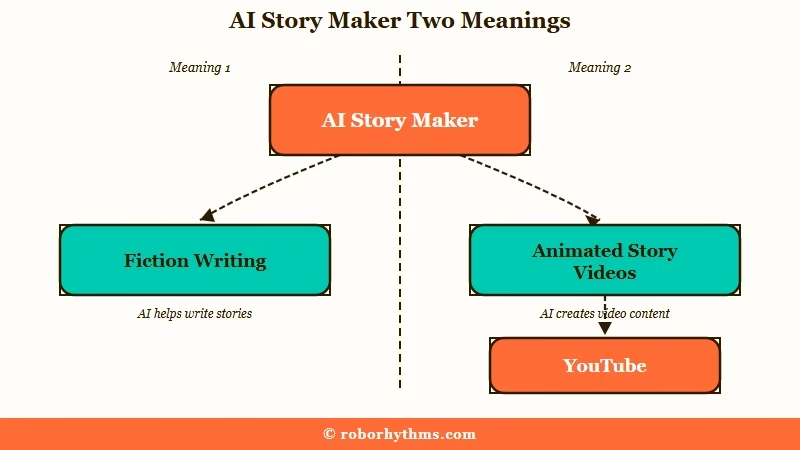
When people search “ai story maker”, they are looking for one of two things. The first group wants help writing a story in text, like a chapter of a novel or a short fiction piece. The second group wants help producing a finished animated video that tells a story.
In my experience, the second group is bigger and growing faster, driven by faceless YouTube channels publishing animated story content. The first group is older and dominated by long-running tools like NovelAI and Sudowrite that have been refined for years. The two groups rarely cross over because the workflows are completely different.
The category mismatch shows up in every “best AI story maker” article I see. They list NovelAI right next to Plotagon (a visual animation tool), as if a writer would treat them as interchangeable. They are not.
The first chapter of a novel and a 10-minute animated YouTube short share only the word “story” in the brief. Everything else, including the tool that produces the best output, is different.
This guide treats the two categories as separate decisions. If you want the best AI video generator guide in the talking-head style, that is a third category covered elsewhere. The visual-story tools below are specifically for animated narrative.
Best AI Story Maker for Visual Story Videos
LongStories AI is the strongest pick for animated narrative videos up to 15 minutes, with Steve AI as the budget-friendly runner-up for shorter pieces.
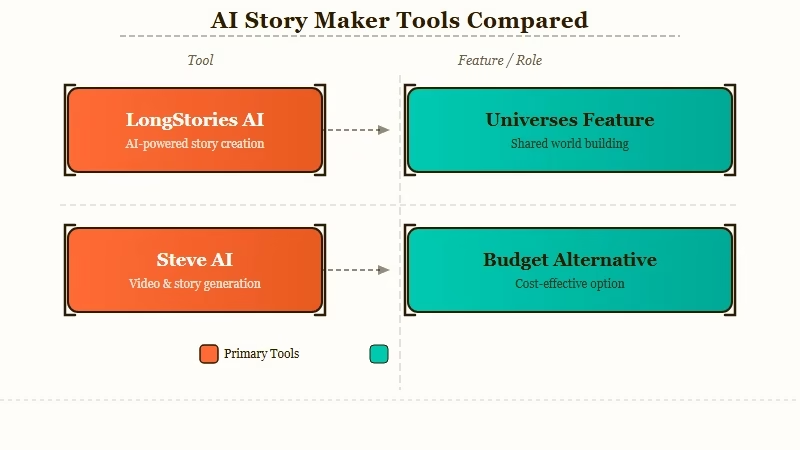
LongStories AI sits at #1 in this category because of one feature called Universes. The way I see it, Universes is the only architectural answer to the consistency-drift problem that defeats Runway, Pika, and most other generative video tools when you push past 60 seconds.
You define your characters, visual style, voice, and world once, and every subsequent video in that Universe references the frozen definition. Character faces stay recognizable across scenes, voice tone stays consistent, the world stays coherent.
Pricing runs Free ($0, 30-second demo, 1 video lifetime), Pro ($59/mo, 10-min cap), Creator ($99/mo, API access), Creator Max ($199/mo, full 15-min cap), Studio ($299/mo, team workloads). The 15-minute video length is the strategic feature for YouTube creators because it crosses the watch-time threshold for Partner Program qualification, and the faceless YouTube channel workflow puts LongStories at the core of that production stack. My LongStories AI review walks through the Universes feature, the pricing math, and where the tool falls short in detail.
Steve AI is the alternative I would point you to if LongStories’ $59 entry tier is still too much, and the broader animated video generator comparison covers the clip-based options that compete on individual shot quality. Steve AI’s G2 listing shows the 2026 tiers at $29/mo (Starter), $59/mo (Pro), $129/mo (Generative AI), and custom Enterprise.
The catch is the Starter tier caps at 720p output, which is below the recommended upload resolution for YouTube. If you can swing the $129/mo Generative AI tier, you get text-to-video at proper resolution, but at that price LongStories’ richer feature set wins on cost per finished minute.
LTX Studio is a third option with 135,000+ users and a library of 52 distinct visual styles, useful if you need stylistic variety more than narrative continuity. Domo AI is the volume play with 3 million users and over a billion projects, but the focus is short clips rather than full episodes. Neither is the best primary pick for narrative video, but both are worth knowing about; the animation generator category breakdown covers the template-versus-generative split they fit into.
If LongStories AI fits your workflow, you can get started at LongStories AI.
Best AI Story Maker for Written Stories
NovelAI Opus is the strongest pick for deep worldbuilding fiction, Sudowrite is the strongest pick for prose polish, and Inkfluence AI is the strongest pick for full-novel pipelines on a tight budget.
From my testing, the right pick depends on what stage of the writing process needs the most help. NovelAI is built for fantasy and sci-fi writers who need persistent character memory and detailed worldbuilding across long series.
The Opus tier at $25/mo gives 8,192 tokens of memory and 10,000 monthly Anlas credits (NovelAI’s internal currency for generation), with the Kayra model handling generation. The Lorebook feature lets you define characters, places, and lore that the AI references in every generation.
The January 23, 2026 update introduced what the company called the Six-Character Limit Breakthrough. The feature lets up to six unique anime characters appear in a single interactive scene, which had been a long-standing constraint.
Sudowrite is what I would recommend if you already have a draft and need help polishing prose. Users report 25 to 30% gains in tone consistency when using the Describe and Tone Shift controls, plus a 30% lift in creative flow.
The credit-based pricing (around $20 for 225,000 credits) is the only real drawback, with intensive drafting sessions sometimes triggering what users on Reddit call credit evaporation. Sudowrite also exports only to DOCX, which is a real limitation if you need EPUB or PDF for self-publishing.
Squibler serves a different niche. With over 20,000 writers on the platform, it focuses on organization through visual corkboards and hierarchical outlines that reportedly reduce planning time by 20 to 30%.
The May 14, 2026 update added the Dangerous Writing App productivity mode, which literally deletes your work if you stop typing for too long. The way I see it, that feature is brilliant for breaking writer’s block and terrifying for anyone who steps away to think.
Inkfluence AI is the contrarian pick for full-novel pipelines on a budget. A complete 60,000-word novel including cover, audiobook, and EPUB export costs $9.99, versus $144 to $371 for separate tool stacks.
The free tier gives 5 chapters initially plus 5 more per month with full commercial rights, which is the most generous tier in the category. The pricing is so far below the competition I would flag it as worth verifying directly before committing to a long project, but the math is compelling if it holds up.
StravoAI rounds out the written-story picks for a different use case: more than 4,500 startups use it for end-to-end writing plus research and marketing workflows. If your story project is also tied to business content, StravoAI is the all-in-one play.
My NovelAI alternatives guide covers more options in this category if none of these five fit your specific workflow, and the autoblogging AI writing tool review walks through a different AI writing approach for content creators.
How Much These Tools Cost
The cheapest AI story maker depends on whether you measure by monthly subscription or by cost per finished output.
From my testing, monthly subscription math hides the real cost. A $25/mo NovelAI Opus subscription that lets you finish one novel per quarter costs more per finished book than Inkfluence AI’s $9.99 per novel pricing. A $59/mo LongStories AI Pro subscription that produces 8 to 9 minutes of Pro Animation costs more per finished minute than expected if you compare against traditional studio rates.
Here is the side-by-side breakdown for the seven picks across both categories:
| Tool | Category | Entry tier | Premium tier | Key limit |
|---|---|---|---|---|
| LongStories AI | Visual story video | Pro $59/mo | Creator Max $199/mo | 15-min cap requires Creator Max |
| Steve AI | Visual story video | Starter $29/mo | Generative AI $129/mo | Starter caps at 720p |
| NovelAI | Written fiction | Tablet $10/mo | Opus $25/mo | 8,192-token Opus memory ceiling |
| Sudowrite | Written fiction | About $20 per 225k credits | Pay as you go | DOCX-only export |
| Squibler | Written fiction | Standard tier | Premium tier | Dangerous Writing mode deletes work |
| Inkfluence AI | Written fiction | Free 5+5 chapters | $9.99 per 60k-word novel | Pricing low enough to verify quality |
| StravoAI | Written fiction | Startup tier | Enterprise | Workflow-first, not novel-first |
The way I would think about cost is per finished output rather than per month. For an animated story video at 15 minutes finished length on LongStories AI Creator Max, you are looking at roughly $6.25 per finished minute compared to traditional studio production averaging around $4,500 per minute, a 99% cost reduction that holds even after the subscription overhead.
For a 60,000-word novel on Inkfluence AI, the $9.99 per-book pricing beats every subscription stack if you only need one finished book.
Honest Limitations No One Lists
Every AI story maker has a real limitation that most reviews skip over, and those limitations should drive your pick more than the headline features do.
The five real limitations I would call out before you subscribe to anything:
- LongStories AI free tier is a 30-second one-video lifetime demo with a watermark, not a real trial. To meaningfully test the workflow you need at least one month of Pro at $59.
- NovelAI Opus 8,192-token memory ceiling becomes a real constraint on book-length projects past chapter 8 or 9. The Lorebook helps but cannot fully compensate for the limit.
- Sudowrite credit evaporation during intensive drafting sessions makes budget planning hard. Pay-as-you-go pricing scales linearly with how much you generate, not how many words land in your final draft.
- Squibler Dangerous Writing mode is brilliant or catastrophic depending on your writing style. If you draft in bursts with thinking time between, it will delete what you wrote during the thinking.
- Steve AI Starter at 720p produces below-recommended YouTube upload resolution. The tier saving versus moving up to Generative AI is real but the output quality difference is also real.
The way I see it, the right tool depends more on which of these limitations you can tolerate than on which has the prettiest demo reel.
How to Pick the Right Tool for Your Story
Pick the AI story maker by matching your output type and budget ceiling first, then narrow by genre and workflow style.
In my experience, creators get this decision wrong because they start with feature lists rather than output type. Start with what you are making, then narrow by budget, then by genre fit. Here is the decision framework I use:
- What is the final output? Animated video, written prose, or both? If video, go LongStories AI for narrative depth or Steve AI for budget. If prose, go NovelAI for worldbuilding depth, Sudowrite for prose polish, or Inkfluence AI for full-pipeline value.
- What is your monthly budget? Under $25 puts you in NovelAI Tablet or Inkfluence AI free tier territory. $50 to $100 opens NovelAI Opus, Sudowrite, or LongStories AI Pro. $200+ unlocks LongStories AI Creator Max with the full 15-minute video length.
- What genre fit are you optimizing for? Anime and fantasy lean toward NovelAI (Kayra model, Six-Character Limit). Literary fiction leans toward Sudowrite (Tone Shift). Kids’ stories and music videos lean toward LongStories AI. Branching interactive narratives lean toward Talefy at $9/mo.
- How important is multi-scene consistency? If you are making episode 5 of a series with recurring characters, only LongStories AI’s Universes architecture genuinely solves the consistency-drift problem.
Example scenario: You want to publish a 12-episode animated story series on YouTube with recurring characters. On NovelAI, you would generate the prose script but need a separate tool to animate it, with no character consistency guarantee across episodes. On Runway or Pika, you would get high-fidelity 5-second clips but lose character continuity by episode 3. On LongStories AI Creator Max, you define the Universe once and every episode references the same characters and visual style automatically.
That scenario is the kind of decision the category misframes. The right answer is rarely the most popular tool overall, it is the one architected for your specific job.
The Verdict on the Best AI Story Maker
The best AI story maker is LongStories AI for visual story videos and NovelAI Opus for written fiction, with Inkfluence AI as the budget-friendly full-pipeline alternative.
What I would recommend doing first is naming the output type honestly. If you are publishing animated story content on YouTube, LongStories AI is the right pick and the price (between $59 and $199/mo depending on tier) earns itself back within the first two or three episodes you ship through Universes.
The talking-head video category is a different decision entirely, covered in the guide linked earlier, and the AI movie generator breakdown covers the streaming-tier and clip-tier alternatives if your project is closer to film than narrative episodes.
If you are writing fiction, NovelAI Opus at $25/mo is the strongest pick for deep worldbuilding and series consistency. Sudowrite is the right add-on or alternative if your draft already exists and you need prose polish. Inkfluence AI deserves the contrarian pick because the $9.99-per-novel pricing makes the cost-per-book math impossible to beat if the quality holds up.
If your project crosses categories, run two separate tools rather than expecting one to handle both. The category split exists for a reason, and the tools optimized for each side reflect different architectures, different training data, and different workflows. The music video generator breakdown covers the third structural variant where audio and visual workflows have to integrate. Trying to force one tool to do both jobs is how creators end up disappointed with every AI story maker they try.
Frequently Asked Questions
What is the best AI story maker overall?
The best AI story maker depends on the output type. For animated video, LongStories AI wins on multi-scene character consistency, and for written fiction NovelAI Opus wins on worldbuilding depth. For full-novel pipelines on a tight budget, Inkfluence AI’s $9.99 per novel beats every subscription stack.
Can the same AI story maker do both writing and video?
No, almost no tool does both well because the architectures differ. Written-fiction tools like NovelAI optimize for long-context language generation, while visual-story tools like LongStories AI optimize for cross-scene visual consistency. Use two separate tools for two-format projects.
How much does the cheapest AI story maker cost?
Inkfluence AI at $9.99 per finished 60,000-word novel beats every subscription. For ongoing subscriptions, NovelAI Tablet at $10/mo is the cheapest entry, but limits memory and credits. Free tiers exist on Inkfluence AI, NovelAI, and LongStories AI but with significant feature gates.
Is there a free AI story maker worth using?
Inkfluence AI’s free tier is the most generous, giving 5 chapters initially plus 5 more per month with full commercial rights. LongStories AI offers 400 free credits but only one 30-second video for lifetime. NovelAI does not offer a true free tier for fiction generation.
How does LongStories AI compare to Runway or Pika?
These are different jobs. Runway and Pika produce high-fidelity 5-second clips, while LongStories AI produces multi-scene narrative videos up to 15 minutes with character and style consistency. Use Runway or Pika for viral clips and LongStories AI for story-driven content.
Which AI story maker is best for fantasy or sci-fi?
NovelAI Opus is the strongest pick for fantasy and sci-fi because the Lorebook lets you define detailed worldbuilding rules the AI references in every generation. The Kayra model handles genre conventions well. Sudowrite is the secondary pick if your fantasy draft needs prose polish.
Quick Takeaways
The best AI story maker depends on your output type, your budget ceiling, and your genre, in that order.
- LongStories AI is the strongest pick for animated story videos up to 15 minutes, with Universes solving the consistency-drift problem that defeats other video tools
- NovelAI Opus at $25/mo is the strongest written-fiction pick for deep worldbuilding and series consistency
- Inkfluence AI at $9.99 per novel is the contrarian budget pick if the full-pipeline quality holds up
- The category hides two completely different jobs; pick by output type first, not by feature list
- For multi-format projects, run two separate tools rather than expecting one to handle both prose and video
