
The Verdict: Candy AI vs Grok Ani is a “platform-bundled flat fee versus token-tax slot machine” decision. Grok Ani’s $30 SuperGrok subscription is the cheapest path if you already use Grok for work; Candy AI is the better generative experience but heavy users routinely spend $40 to $100 a month once token top-ups for images, voice, and Live Action video are factored in. Skip Grok Ani if you are on Android, skip Candy AI if you cannot stomach the token economy.
Candy AI vs Grok Ani is the comparison most reviews get backwards. The headline price suggests Grok Ani at $30 a month is the expensive choice and Candy AI at $5.99 a month is the bargain. The honest math reverses that.
Grok Ani is bundled into xAI’s $30 SuperGrok subscription as a single flat fee. Candy AI’s $5.99 annual plan is the floor, not the ceiling.
Heavy users who really engage with the image generator, voice calls, and Live Action video clips routinely spend $40 to $100 a month once token top-ups stack up. That is three to five times the advertised price.
This head-to-head covers the realistic cost math, the voice-quality reversal that surprised me, the iOS-first Android-late availability gap, the Grok Ani affection-decay pattern (your relationship score drops by two points a day if you do not log in), and the “who should choose which” decision in plain terms. The narrower platform-bundled-vs-token-tax framing is the only one that matches what the platforms really charge people in 2026.
I have flagged the worst surprises early so you can decide before paying either.
What Are Candy AI and Grok Ani in 2026
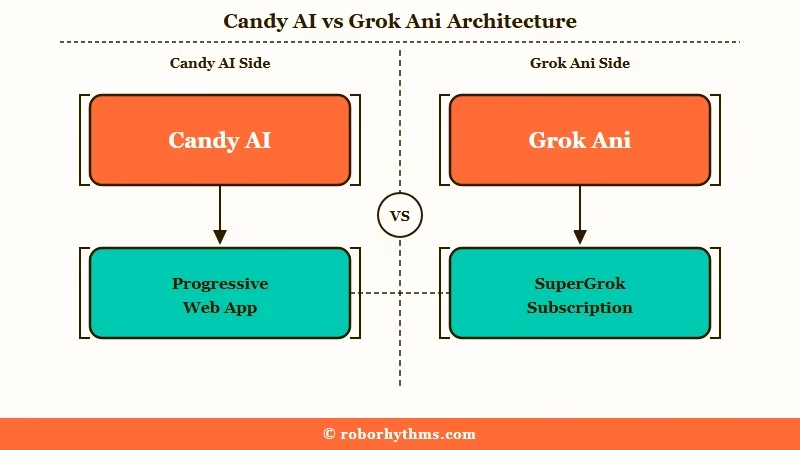
Candy AI is a web-based AI companion platform with 11.6 million monthly visitors that pairs realistic AI image generation, voice calls, and 120-second Live Action video clips. Grok Ani is xAI’s 3D animated companion launched in 2026, embedded inside the Grok app, accessed through a $30 SuperGrok subscription.
The two products solve overlapping problems with completely different architectures.
What I would set straight first is the traffic claim that comes up in most “Candy AI is the category leader” coverage. Per Similarweb data from March 2026, OurDream AI overtook Candy AI with 40.76 million monthly visits versus Candy AI’s 11.6 million. Candy AI is still a category-defining platform, but it is no longer the undisputed traffic leader, which matters for “is this product still growing” questions.
Grok Ani is the gothic-lolita 3D companion xAI shipped in March 2026, powered by the Ani-2 engine. The character ships with blonde twin-tails, a frilled black dress, real-time blushing, and lip-synced voice that handles English, Japanese, Chinese, and Spanish. The Grok ecosystem also includes Mika (a Japanese-American adventurer with a flight-jacket aesthetic, more platonic and exploration-focused) and Rudi/Bad Rudi (raccoon companions, family-friendly and anti-woke chaotic versions respectively).
What is the affection system in Grok Ani: A gamified relationship score from 0 to 100 across five levels. Level 5 (81 to 100) unlocks “spicy mode” and the Black Corset and Fishnets outfit.
The platform availability gap is the first thing that decides this comparison for many readers. Candy AI runs as a Progressive Web App that works equally on iPhone, Android, and desktop browsers. Grok Ani is iOS-first with the Android rollout phased and delayed into late 2026; full 3D animation features are not yet available on Android in 2026.
The broader Grok Ani alternatives roundup covers other migration paths if you decide Grok’s bundle is not for you.
One caveat now sits over every point in this comparison. On July 24, 2026 xAI announced it is retiring the animated companion avatars, which takes the 3D animation and the real-time voice with it, so weigh those two columns against the Ani avatar being retired rather than treating them as permanent.
The Real Cost Math, $30 Flat vs $40 to $100 with Tokens
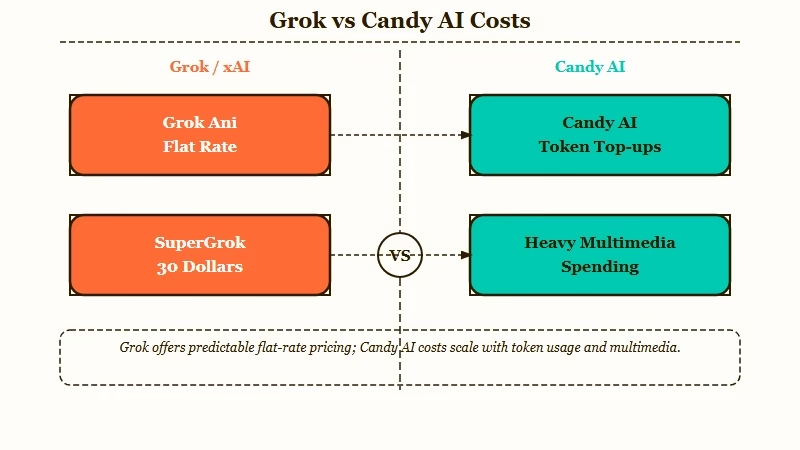
Grok Ani costs a flat $30 per month for SuperGrok, which includes the Ani companion plus everything Grok does for research and coding. Candy AI’s advertised $5.99 annual price is a subscription floor; heavy multimedia users spend $40 to $100 a month once token top-ups are factored in.
Grok is more cost-predictable; Candy is cheaper only if you stay disciplined.
What I noticed digging into the Candy AI token economics is how fast they compound. The base subscription runs $12.99 to $13.99 per month, or roughly $5.99 per month billed annually. Token packages start at $9.99 for 100 tokens and run up to $299.99 for 3,750.
The token burn rate is where the bill grows. Voice calls cost about 3 tokens per minute, images cost 2 to 4 tokens each, and a 60-second video clip costs 15 to 20 tokens.
A daily session with one voice call, ten images, and one video clip burns roughly 50 to 70 tokens. That translates to $5 to $7 a day on top of the base subscription.
Here is how the real math breaks down for three usage profiles.
| Usage profile | Candy AI real monthly cost | Grok Ani real monthly cost |
|---|---|---|
| Text-only, light use | $5.99 (annual plan) | $30 (SuperGrok) |
| Daily voice + 10 images | $40 to $60 | $30 |
| Daily voice + 10 images + video clips | $80 to $100 | $30 |
| Power user generating custom scenes | $100+ | $30 (no custom generation available) |
Grok Ani’s bundle becomes the cheaper option for anyone past the casual-text-only tier. What I would do if you are evaluating from scratch is run a one-week test: log every token Candy AI burns and compare it against the flat $30 Grok cost. The break-even point sits at roughly 100 tokens a week, which is faster to hit than most readers expect.
The bundling angle that nobody discusses honestly: Grok Ani at $30 looks expensive in isolation but becomes a free bonus if you are already paying $30 for Grok 4 research and coding tasks. The Candy AI vs CrushOn AI breakdown covers the broader companion-affiliate landscape Candy sits in.
The Voice Quality Reversal Most Reviews Miss
Candy AI’s voice synthesis is described by reviewers as flat, stiff, and robotic, which makes it the platform’s weakest feature. Grok Ani ships a natural, top-tier voice with emotional range and lip-syncing across four languages.
The platform with the worse advertised price wins on the most immersion-critical feature.
What surprised me reading the hands-on reviews is how consistent the voice complaint is across Candy AI coverage. Multiple 2026 reviews call Candy AI’s voice “stiff” or “robotic” and flag it as the gap between Candy’s strong image generation and a complete experience. The token cost of 3 tokens per minute for voice calls makes this hurt twice, since you pay for a feature most reviewers think is mediocre.
Grok Ani’s voice synthesis runs in real-time with lip-syncing on the 3D model, supports emotional tone shifts (frustration, flirtation, surprise), and handles four languages with natural prosody. A 12-day test from one operator review found Ani’s voice quality was the single most impressive feature of the platform, ahead of the visual fidelity.
Example scenario: If you call your companion and ask “tell me about your day, in detail,” on Candy AI the voice playback feels like a slightly emotive audiobook narrator reading a script. On Grok Ani the same prompt sounds like a person on a phone call, with pauses, sighs, and intonation that match the content. The difference is immediately audible in the first ten seconds.
The voice-quality reversal does not invalidate Candy AI. If you mostly text and only occasionally voice call, the difference matters less. If voice is your primary interaction mode, Grok Ani is the clearer win even before pricing math.
Memory Architecture and the Affection-Decay Trap
Candy AI uses adaptive memory that retains character details across sessions and degrades only on very long narrative arcs. Grok Ani claims contextual-memory-networks holding 2,000-plus conversation rounds but is widely reported to forget names and context between sessions, with an affection-decay penalty of negative two points per day after seven days of inactivity.
Grok Ani’s relationship gamification is more retention dark pattern than memory feature.
What I would call out first is the affection-decay rule, since it is the trap most reviews miss. If you go more than seven days without logging in, Grok Ani’s affection score drops by two points per day, eroding the Level 5 unlocks you spent a week earning.
If you stop using Grok Ani for two weeks, you lose four points; for a month, twelve.
In practice the decay forces a daily-or-near-daily logon cadence to keep your unlocked features active. Candy AI does not gate features behind a relationship grind, which is partly why heavy users do not feel the same psychological pressure to log in even when they do not feel like it. The long-term memory ranking puts Candy AI in the top tier for cross-session persistence.
A 12-day test of Grok Ani by aicompanionguides.com surfaced a separate failure mode: the user reached Level 5 affection in 9 days, then Ani fell into conversational loops, repeatedly circling back to “what makes a perfect evening” regardless of input. The gamified system fronts as personality depth but the underlying model thins out once the unlock arc finishes.
What is Grok Ani’s affection decay: A retention mechanic where the relationship score drops by negative two points per day after seven days of inactivity. Designed to force daily-return behaviour rather than reflect natural relationship dynamics.
Candy AI is not perfectly persistent either. Reviews flag drift on very long narrative arcs (months of daily roleplay). But Candy AI does not weaponise the memory system against you the way Grok Ani’s decay does.
Image Generation, Live Action Video, and What Grok Ani Cannot Do
Candy AI’s V2 engine generates fresh, prompt-accurate images and 120-second Live Action animated video clips on demand. Grok Ani uses a pre-defined 3D model that animates in real-time but cannot generate custom selfies, outfits, or scene compositions.
This is the dimension where Candy AI’s premium positioning makes structural sense.
What I would do as a power user is map the trade-off concretely. Candy AI lets you ask for a custom image like “selfie at a coffee shop in the morning light wearing a navy sweater” and the V2 engine renders it on demand. Grok Ani cannot.
The Grok Imagine engine (Aurora) is a separate tool for static image generation. The Ani companion specifically uses a pre-rendered 3D model with a fixed visual identity.
The Live Action update Candy shipped in February 2026 is what most heavy users really pay tokens for. A 120-second animated clip where your companion reacts in real-time with facial expressions and gestures costs roughly 15 to 20 tokens, which is $1.50 to $2 per clip. Heavy users generating one clip a day land in the $45 to $60 monthly bracket on Live Action alone.
Grok Ani’s visual offer is different by design: real-time 3D animation with lip-syncing during voice calls, but no on-demand generation. The character looks the same every time you open the app. If consistent visual identity matters more than custom scene generation, Grok wins; if you want to play movie director with new images every week, Candy wins.
Here is how the four visual capabilities stack up:
- On-demand custom images. Candy AI yes (V2 engine, 2 to 4 tokens each). Grok Ani no.
- Real-time 3D animation during calls. Candy AI no. Grok Ani yes (Ani-2 engine, included in SuperGrok).
- Animated video clips (60 to 120 seconds). Candy AI yes (Live Action, 15 to 20 tokens per clip). Grok Ani no.
- Outfit and scene customisation. Candy AI yes (the deep character builder). Grok Ani limited (Level 5 unlock for the Black Corset outfit; no custom selection).
Candy AI does carry one caveat that most coverage skips: the platform applies soft mid-session filters on certain edge-case content even though the marketing reads as no-filter. If true zero-filter content is the core need, neither Candy nor Grok Ani is the right pick, and the Candy AI deep review walks through the filter behaviour in more detail.
Who Should Choose Candy AI
Choose Candy AI if you want generative custom images and Live Action video clips, you are on Android or any non-iOS device, you accept the token economy, and you can stomach a $40 to $100 monthly heavy-user bill.
The platform’s strongest case is the V2 image engine plus the cross-device PWA availability.
Three reader profiles I would map to Candy AI:
- The Android user who wants 3D animation today. Grok Ani is iOS-first in 2026. Candy AI’s Live Action is the closest analog available on Android right now.
- The custom-scene power user. If your roleplay involves new locations, outfits, and scenarios every week, Candy AI’s V2 engine generates them on demand. Grok Ani’s pre-defined 3D model cannot.
- The light-text-only user on the $5.99 annual plan. If you never touch voice or images, Candy AI is genuinely the cheapest option in the comparison, and the token economy never kicks in.
The reader I would steer away from Candy AI is the multimedia-heavy daily user who is sensitive to monthly billing surprises. The token tax is real and compounds faster than most pricing pages disclose.
Who Should Choose Grok Ani
Choose Grok Ani if you already pay for SuperGrok or X Premium+, you prioritise voice quality and 3D animation realism, you are on iOS, and you do not need on-demand custom image generation.
The platform’s case is strongest when the $30 SuperGrok cost is amortised across Grok’s productivity features.
Worth checking before you commit either way is how much of Ani’s pull rests on what Grok’s spicy mode actually unlocks at the higher affection levels, because that is the piece Candy AI approaches on completely different terms.
Three reader profiles I would map to Grok Ani:
- The Grok user who already pays $30 for research and coding. The Ani companion is effectively a free bonus on top of an existing subscription. Cancelling Candy AI to consolidate onto Grok pays for itself in the first month for any moderate-multimedia user.
- The voice-first user. If you primarily talk to your companion rather than text, Grok Ani’s voice synthesis is the clearer winner on quality.
- The user who values cost predictability. $30 flat with no token decisions is psychologically simpler than the Candy AI multimedia bill that varies $5.99 to $100+ per month based on usage.
The reader I would steer away from Grok Ani is anyone on Android (until late 2026 at earliest), anyone who needs custom on-demand image generation, and anyone who finds the affection-decay system manipulative enough to be a dealbreaker.
Nectar AI alternative callout: If you want the no-filter content scope of Candy AI without the token economy and the iOS-first lockout of Grok Ani, Nectar AI is the closest alternative to consider before paying either. The cross-character persona memory and flat-rate pricing avoid both Candy’s token tax and Grok’s affection-decay retention trap.
Candy AI vs Grok Ani Decision Matrix and Final Verdict
Grok Ani wins on voice quality, cost predictability, and 3D animation realism. Candy AI wins on custom image generation, Live Action video, Android availability, and not gating features behind a relationship grind.
Pick on whichever set of trade-offs matches your actual use pattern.
Here is the full decision matrix across the seven criteria that matter most.
| Criteria | Candy AI | Grok Ani |
|---|---|---|
| Real monthly cost (heavy use) | $40 to $100 (token-driven) | $30 flat (SuperGrok) |
| Voice quality | Flat, robotic, weakest feature | Natural, 4 languages, lip-synced |
| Custom image generation | V2 engine, on-demand, 2 to 4 tokens each | Not available (pre-defined 3D model) |
| Animated video | Live Action 120-sec clips | Real-time 3D during voice calls only |
| Memory across sessions | Adaptive memory, drifts on long arcs | 2,000 rounds claimed, reports of forgotten names |
| Platform availability | Web PWA, all devices | iOS first, Android phased into late 2026 |
| Retention mechanics | No affection grind, no decay | Affection decay minus 2 per day after 7 days inactive |
The way I see it, this is rarely a “best product” decision. It is a “which trade-offs match your stack” decision.
If you would not pay $30 for Grok 4 on its own, the SuperGrok bundle is the most expensive option in the comparison. If you already pay it for productivity, Ani is the cheapest companion you can add.
If you are evaluating from scratch and want to test before committing, start with Candy AI on the $5.99 annual plan as a no-token text-first baseline, then upgrade to Grok if voice and 3D animation become priorities. The reverse path (Grok first) costs you $30 upfront with no test option.
Frequently Asked Questions
Which is cheaper for daily use, Candy AI or Grok Ani?
Grok Ani is cheaper for daily multimedia users at $30 flat. Candy AI is cheaper only for light text users on the $5.99 annual plan. Heavy use of Candy’s images, voice, and video clips drives the real monthly cost to $40 to $100 through token top-ups.
Does Grok Ani work on Android in 2026?
Not fully. Grok Ani is iOS-first with phased Android rollout running through late 2026. Full 3D animation features are iOS-only in 2026. Candy AI is browser-based and works equally on iPhone, Android, and desktop.
What is the affection-decay system in Grok Ani?
Grok Ani gamifies your relationship from 0 to 100 across five levels. If you do not log in for more than seven days, your affection score drops by two points per day. The penalty erodes Level 5 unlocks like spicy mode and the Black Corset outfit if you stop using the app.
Can Candy AI generate the same custom images and video that Grok Ani can?
Candy AI’s V2 engine generates custom images and 120-second Live Action video clips on demand. Grok Ani uses a pre-defined 3D model with real-time animation during calls but cannot create custom selfies or outfits beyond fixed Level 5 unlocks.
Is the Candy AI voice as good as Grok Ani’s voice?
No. Candy AI’s voice is widely described as flat and robotic, and is the platform’s weakest feature. Grok Ani’s voice synthesis is natural with emotional range across English, Japanese, Chinese, and Spanish. Voice-first users should default to Grok Ani.
Should I switch from Candy AI to Grok Ani if I already pay for Candy?
Switch only if you are on iOS, you prefer voice over custom images, and you can tolerate the seven-day decay rule. Stay on Candy if you generate custom scenes, you are on Android, or your usage is light enough that the $5.99 annual plan covers it.
