
What Happened: Google has finished migrating Vertex AI into a new product called the Gemini Enterprise Agent Platform. As of May 21, 2026, Vertex AI no longer appears in the Google Cloud Console. The shift moves model training, deployment, and registry under an agent-first hierarchy.
A month after Google Cloud Next 2026, the rebrand is no longer optional. If you log into Google Cloud Console today and look for Vertex AI, you will not find it.
Searching the console for “Vertex AI” redirects you to a new product page called the Gemini Enterprise Agent Platform. The migration is complete and the old name is gone from the user interface.
This matters more than a typical hyperscaler rebrand because the underlying hierarchy has been inverted. Model training, AutoML, the Model Registry, and Endpoints are now sub-features under an agent-first platform, not the other way around.
Google is signaling that it sees agents as the primary container for AI development going forward, with traditional machine learning collapsed into a sub-menu inside that container. The way I read it, that is the news, and the name change is the symptom.
The original announcement landed at Google Cloud Next 2026 in Las Vegas on April 23, 2026, with HPCwire covering it the same day. The console-level cutover only happened in the last 24 hours, which is why this piece runs 30 days after the announcement.
The original press cycle and the disappearance of Vertex AI from the console are two different events, and most coverage you have seen so far covered the first one. This piece covers the second one and what it means if you are building agents on Google’s stack as a solo developer.
What Actually Happened on Google Cloud
The Gemini Enterprise Agent Platform replaced Vertex AI as a fully-rebranded product layer where existing model tools are now nested under an agent-first hierarchy.
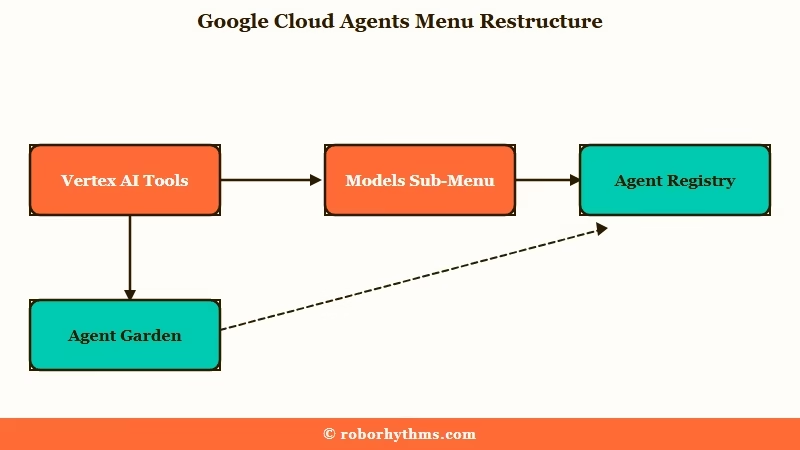
The replacement is structural, not cosmetic. The Vertex AI features you knew, Model Garden, Custom Training, AutoML, Model Registry, Endpoints, and Pipelines, are now folded under a “Models” sub-menu inside the Agent Platform. A new primary “Agents” menu sits above that, containing Agent Garden (prebuilt agent templates), an MCP Server registry, Memory Bank for long-term context, Sessions for stateful interactions, and an Agent Registry that catalogues every agent, tool, and connector you build.
A few details about the new console layout stand out. There is a separate menu called Agent Studio for non-technical users who want to assemble agents without writing code.
The Google Agent Development Kit (ADK) is open-source and supports non-Google models, so you are not locked into Gemini if you want to build on the platform. The platform also assigns every agent a unique cryptographic ID, which Google calls Agent Identity, with the explicit goal of creating an auditable trail for every agent action.
What is the Agent Development Kit (ADK): Google’s open-source framework for building agents programmatically. It supports models from OpenAI and Anthropic alongside Gemini, so the “agent” in ADK is not bound to Google’s own model layer.
The most surprising part for indie builders is that the API stays the same. The endpoint remains aiplatform.googleapis.com, which was the name of the service before it was even called Vertex AI.
If you have code that hits Vertex AI today, it keeps working without changes. To use the new agentic features you have to enable a handful of new APIs like agentregistry.googleapis.com and modelarmor.googleapis.com, but the core connection stays where it was.
| What you knew (Vertex AI) | Where it lives now (Agent Platform) |
|---|---|
| Model Garden | Models, Garden sub-menu |
| Custom Training, AutoML | Models, Training sub-menu |
| Model Registry, Endpoints | Models, Registry sub-menu |
| Pipelines | Models, Pipelines sub-menu |
| Vertex AI Agent Builder | Agents, primary menu |
| New (no Vertex equivalent) | Agent Garden, Memory Bank, Sessions, Agent Identity, Gateways, Topology |
Why This Is a Bigger Deal Than It Sounds
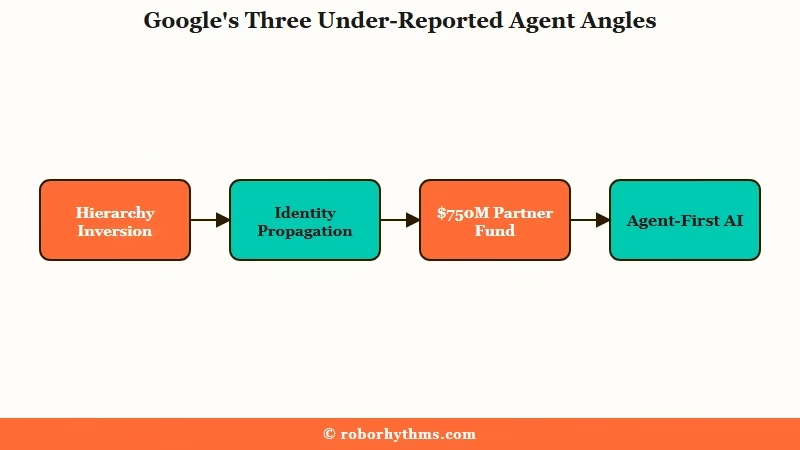
The hierarchy inversion (agents above models) signals that Google is betting its entire AI roadmap on agents being the primary unit of work, not the model.
This is the part most coverage missed. A rebrand that changes the navigation order of menus is doing more than refreshing a marketing page.
Making “Models” a child of “Agents” inside the console is Google putting a stake in the ground: agents are now the thing you build, and the model is one ingredient inside the agent. From what I have seen on the platform, the choice of menu hierarchy is the cleanest signal of where the platform’s investment will go over the next 18 months.
Memory Bank, MCP Servers, Agent Registry, Topology, and Agent Evaluation are all features that have no equivalent in the Vertex AI era because they only make sense if agents are the primary object.
The second under-reported angle is identity propagation. Agent Identity gives each agent a cryptographic ID, and the platform can restrict an agent so it only reads what the specific user who triggered it is allowed to read.
Model-only vendors like OpenAI and Anthropic do not have a clean equivalent to this. If you are building an agent that needs to query a corporate data lake on behalf of different employees with different permissions, identity propagation is the kind of capability that closes the deal versus building on top of a raw API key.
The third signal is the $750 million fund Google announced for partners building agents on the platform, alongside an Agent Marketplace seeded with named partners like Adobe and Atlassian. From my read, the platform’s “Agent Gallery” needs content at launch and Google is paying for it.
That is fine for now, but it tells you the ecosystem is not organic yet. Solo builders who want to publish their own agent for free are competing for shelf space against partners with funded engineering teams.
Google also disclosed that its models are now processing more than 16 billion tokens per minute via direct API calls, up from 10 billion the previous quarter, with nearly 75% of Google Cloud customers using its AI products. Those numbers tell me the platform has demand. They also tell me Google is comfortable doubling down on infrastructure rather than only competing on raw model quality.
What This Means for You as an Indie Builder
For solo developers, the Agent Platform is a hyperscaler stack: deeper governance and tools, higher friction to get started, and probably overkill unless you need identity-aware data access or you are pre-paying for compliance posture.
What I would tell anyone who is currently building with a single OpenAI or Anthropic API key: do not switch to the Agent Platform just because Google made a noisy announcement.
The Vertex AI to Agent Platform shift adds value when your agent needs to talk to enterprise data with user-level permissions, or when you need an auditable trail across many agents running in production. For a single-purpose agent or a “wrapper” SaaS, the API overhead alone (a dozen-plus services to enable, IAM roles to configure, billing alerts to set) is real friction that does not pay back at small scale.
Here is the decision framework I would use if I were starting today:
- Building a single agent that hits one or two external APIs? Stay on the model-vendor stack (OpenAI Assistants, Anthropic Claude with tool use). The Agent Platform is the wrong tool for this scale.
- Building an agent that has to pull from a corporate data warehouse with per-user permissions? The Agent Platform’s identity propagation and gateway model is the cleanest fit available right now.
- Building many agents that need to coordinate, share memory, and be audited? Same answer. Memory Bank plus Agent Registry plus Topology is what the platform is designed for, and you will hit a ceiling fast on simpler stacks.
- Building a product where you might want to sell agents to enterprises later? Get familiar with the platform now. The Agent Marketplace is the funded distribution surface and it is on Google’s stack, not on a neutral one.
There is also a tactical reason indie builders should pay attention even if they are not migrating: the patterns the platform is enforcing (cryptographic agent IDs, memory banks separated from session state, MCP servers as the integration layer) are the same patterns I see emerging on other stacks.
Reading Google’s Agent Platform documentation is a fast way to learn what the agent abstraction is going to look like industry-wide over the next year, regardless of which vendor you ship on. The piece on long-running AI agent memory architecture covers the same memory layer in vendor-neutral terms if you want a reference point.
The cost question is the one Google has not answered cleanly. There is no published guidance on whether there is a meaningful free tier for Agent Platform features like Memory Bank and Agent Registry, or whether they only kick in at compute volume that would already justify a hyperscaler bill.
Until that gets clarified, I would treat the platform as a “scale up to” destination, not a “start with” one.
Before (Vertex AI era): train a model, deploy it to an endpoint, call the endpoint from your app, log calls manually for governance.
After (Agent Platform era): define an agent in ADK, register it in the Agent Registry, wire it to MCP servers for external data, attach a Memory Bank for cross-session context, route calls through a Gateway with Model Armor protections, monitor agent-to-agent flows through Topology. Each step adds capability and operational overhead in roughly equal measure.
What Comes Next on Google’s Roadmap
Expect Google to lean harder into ecosystem subsidies, identity propagation as a defensive moat, and a steady migration of remaining Vertex AI features into the new Agents menu through the rest of 2026.
The $750 million partner fund signals that the next 12 months will be about filling the Agent Marketplace with name-brand partner agents. Adobe and Atlassian are the launch partners and there will be more.
From my perspective on the affiliate side, that matters because the partner program will eventually open to smaller publishers and tool builders, and the platforms that build a credibility surface for that early are the ones that get featured later.
The identity propagation feature is the moat Google is going to defend most aggressively because OpenAI and Anthropic cannot ship an equivalent without rebuilding their auth stack.
This is where the structural advantage shows up: Google already has IAM, Workspace identities, and the GCP security model in place, and stacking agent-level cryptographic IDs on that is incremental work, not a green-field rebuild. I would expect Google to talk about this capability constantly through the rest of 2026.
You should also expect the older aiplatform.googleapis.com API name to stick around for a long time even as more capability gets layered behind it. Triple-layered naming history (pre-Vertex, Vertex AI, Agent Platform) all sharing one endpoint is now a permanent feature of the platform. If you are reading Google documentation in 2027 and the API still says aiplatform, do not be surprised.
The broader picture is that AWS shipped AgentCore Payments and Anthropic shipped Claude for Small Business in the same month. Google’s Agent Platform is the third hyperscaler agent layer to land in 2026.
The consolidation pattern is clear: every cloud is going agent-first, every cloud is differentiating on governance and identity, and every cloud is paying partners to seed marketplaces. The piece on a GitHub PR auto-fix agent is one example of what an indie agent build looks like in the middle of this shift.
The reasonable move for solo developers right now is to ship on the stack that gets you to a working agent fastest (still OpenAI or Anthropic for most cases) and to read the Agent Platform documentation closely so the patterns are familiar when the migration question comes up. That is the call I am making for my own builds, and the call I would suggest for anyone shipping in this space.
The story is summarized by THE Journal from May 4, 2026 if you want the enterprise-IT perspective on the same shift. The Agent Platform product page on Google Cloud is the canonical source for feature scope.
