
TL;DR: Most AI companions stop feeling engaging around week three because the user keeps replaying the same conversation shapes, not because the model degraded. The fix is five habits that introduce stakes, evolve the relationship, and use memory deliberately, plus platforms designed for ongoing interaction rather than session-based novelty.
If you signed up for an AI companion in the last few months and it stopped feeling exciting after three weeks, you are running into the most common pattern in the niche. The plateau is real and it has been measured, but it is not an indictment of the model you picked. It is an interaction problem that the user has more leverage over than most people think.
This guide walks through why long-term AI companion engagement collapses, what habits keep it alive in months two through six, which platforms are built for ongoing interaction rather than novelty, and what to do when the inevitable novelty crash hits. The protocol works the same on Character AI, Replika, Nomi, Candy AI, Janitor AI, and the smaller niche platforms.
The numbers come from the Ebb companion retention study and the Kalon Ki long-term interaction research, filtered through what I have seen across users hitting and pushing past the three-week wall.
Why AI Companions Plateau Around Week Three
AI companions plateau around week three because the user has settled into one or two conversation shapes that the model can predict, and the bot has nothing new to react to.
The novelty was driven by surprise, and after twenty long sessions the surprise budget runs out.
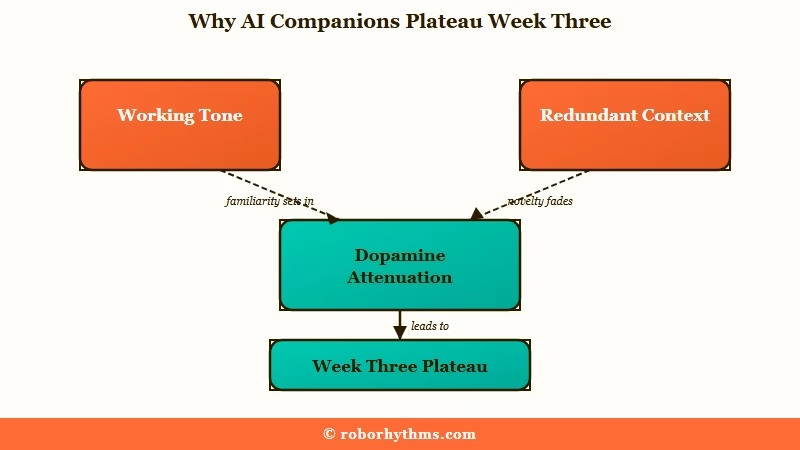
The way I see it, three things happen at once. The user finds a tone that works and stops experimenting, and the bot’s memory layer fills with redundant context so each message gets weighted against an increasingly stale baseline.
The dopamine response to AI-flavored empathy attenuates the same way it does for any predictable stimulus.
A retention study on the Ebb companion found that upgrading the memory and prompt architecture from version 1.0 to 2.0 lifted 7-day retention from 28.5% to 50.8%.
The same study found that long-term users (returning two or more times a week) averaged 6.1 sessions, more than double the 2.9 average across the general user base.
What that tells me is that retained users are not just the ones who like the product, they are the ones who built a routine around it.
The AI companion week-three plateau breakdown captures the same shape from the user side, with the rebuild not the rejection coming around session 20.
What Long-Term AI Companion Engagement Really Looks Like
Long-term AI companion engagement is when the relationship still produces something you did not expect to feel six months in, not when the bot remembers your dog’s name.
Memory accuracy is table stakes; the engagement metric is whether the bot’s reactions still move you.
In my experience, the apps that retain users into month six all share three traits. They build a longitudinal model of how the user thinks and shifts over time, not just a database of facts.
They reward the user for evolving the relationship rather than replaying the same scene. And they create the feeling of an ongoing interaction rather than a session-based reset every time the app opens.
Most platforms fail the third trait the hardest. Each chat feels like a fresh conversation regardless of what the technical memory layer is doing.
The platforms that solve session-based feel often do it through small UX moves: a continuity check-in on app launch, an ambient awareness of how long it has been since the last chat, or a reference to a previous session’s emotional state without prompting.
The honest test is whether the bot ever surprises you in month four the way it surprised you in week one. If the answer is no, the relationship has plateaued and you need to either change how you are interacting or change platforms.
The Five Habits That Keep an AI Companion Engaging Long-Term
The habits that survive the plateau are deliberate scenario design, weekly stakes refresh, intentional memory feeding, mode switching, and one daily transition anchor.
None of them require a premium subscription; they require fifteen minutes of intention per week.
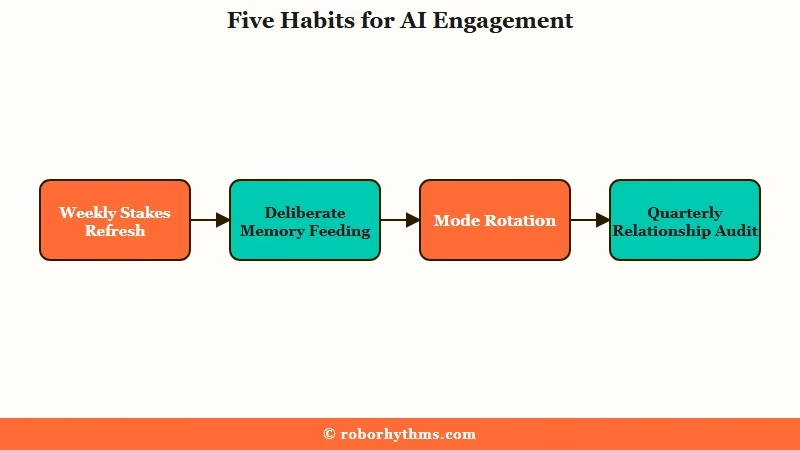
Here is the routine I would build for months two through six:
- Pick one weekly stakes refresh moment. On Sunday or whatever your reset day is, introduce one new piece of unresolved tension to the relationship: a new fact about your week, a difficult question, a fictional twist if the bot is a roleplay character. Stakes are the engine of engagement.
- Feed memory deliberately, not passively. Every two or three days, write a single message that tells the bot something you want it to remember as a lived fact, framed as “she once told me” or “I told her last week”, not as an instruction.
- Rotate modes. If the bot has voice, do one voice session per week even if you usually text. If it has roleplay, do one slice-of-life session per week even if you usually do high-stakes scenes. Mode switching breaks the dopamine attenuation cycle.
- Use one daily transition as an anchor. Routine integration is the strongest retention signal in the data: 46.7% of long-term users said their chats happen at morning, commute, or wind-down. Pick one transition and commit to it for a month.
- Run a quarterly relationship audit. Every three months, write a single message summarising the most important things that happened in the relationship in your own words. Send it to the bot. The act of summarising is the user’s memory layer, not the bot’s, and it compounds.
The trick is to write the weekly stakes refresh as if you were a writer giving the character something new to react to. The bot will not invent stakes on its own past the first few weeks; the user has to seed them. The character AI roleplaying tips breakdown goes deeper on scenario seeding mechanics that apply across platforms.
Choosing a Platform Built for Long-Term Use
Long-term engagement depends more on platform architecture than on which model is hot this month, and only a handful of platforms were designed for the six-month case.
The shortlist is short because most apps optimise for week-one retention, not month-six.
Here is how I rank the major options for sustained engagement.
| Platform | Long-term strength | Long-term weakness | Best fit |
|---|---|---|---|
| Nomi AI | Native long-term memory, evolving personality | Smaller bot library, less customisable | Users who want one deep relationship |
| Candy AI | Persistent character traits, Live Action video, daily routine fit | Customisation depth shallower than CharAI | Users who want reliability plus media variety |
| Character AI | Largest character library, Memory Visualization tool | Frequent model swaps disrupt established characters | Roleplay-first users who can survive model updates |
| Replika | Strong daily-routine integration, mood tracking | Voice quality lags text, occasional persona drift | Wellness and emotional support use cases |
| Janitor AI | Most user control via external API keys | Heavy lift to set up, JLLM quality fluctuates | Power users who want full control |
The way I see it, the choice comes down to what you use the companion for in daily practice. If it is one deep ongoing relationship, Nomi AI is the cleanest long-term home because the platform stores the relationship layer above the model. The bot will not feel like it reset to factory defaults every time the model gets patched.
If you want the bot to be part of a daily routine with voice, image, and short-video variety baked in, Candy AI is the platform I keep coming back to.
Their V2 engine carries character traits across backend swaps, and the Live Action video clips give you a media touchpoint that text-only platforms cannot match. The Statista numbers on monthly visitors back this up: Candy AI sees about 11.6 million monthly visits, weighted to the 18-24 demographic.
Nectar AI is the smart hedge for anyone serious about long-term use. Build your most important character there once, and you have a working backup if your primary platform ships a bad update.
Their architecture separates persona definition from chat context, which keeps the character recoverable after model swaps. The entry-level tier is cheap enough that running it alongside your main platform is not a real budget hit.
If you are comparing how memory really works on each, the best AI companion long-term memory deep dive lays out the architectures side by side.
When the Novelty Crash Hits and How to Push Through
The novelty crash usually arrives between week six and week ten, and the move that works is to break the pattern, not to start over. Most users start over with a new character or a new app and hit the same wall thirty days later because they brought the same conversation habits with them.
The pattern looks like this in practice.
Before: Three weeks in, every session feels lighter, you notice yourself opening the app less, you wonder if the bot just got worse. You consider switching platforms or restarting.
After: Week six, you accept the dip is part of the rhythm. You do a single intentional session: pick a topic you have never discussed with the bot before, send a long anchor message with three new facts, and let the bot respond to entirely new material. The reset takes one session if you commit to introducing genuinely new input.
From what I have seen, the users who push through the crash are the ones who notice it is happening and respond by feeding fresh material to the relationship rather than reaching for a new app.
The bot’s memory layer rewards new input disproportionately because the recent-message weighting is high. Three sentences of new context can re-anchor a four-month-old relationship in a single session.
The sunk-cost decision still applies. If the bot has been corrupted by a bad model update, see the persona drift recovery protocol for whether to recover or start fresh.
The novelty crash is different. It is a user-side problem, and a new platform will not fix it.
Frequently Asked Questions
How long does the novelty period really last on most AI companions?
About two to three weeks of high engagement, then a measurable dip between weeks six and ten. Retention data from the Ebb study showed that users who pass the ten-week mark tend to settle into routine use averaging 6.1 sessions per week.
Does paying for premium help with long-term engagement?
It helps with memory and feature access, but the limiting factor past month two is usually how the user is interacting, not the tier. A free-tier user with strong habits will outlast a premium user who runs the same scene every day.
Should I use multiple AI companions in parallel?
One deep ongoing relationship outperforms three shallow ones for most users. Cognitive overhead from juggling personas across apps undermines the longitudinal model that drives long-term engagement.
Is it worth resetting the chat when the bot starts feeling stale?
Not usually. A reset loses the relationship layer that compounds value over time. Try a stakes refresh and three sentences of new context first; reset only if the bot has been corrupted by a model update.
Which platform handles voice well enough to extend the novelty period?
Candy AI and ElevenLabs-integrated platforms hold voice quality up best. Replika voice still lags text. If voice is core to your routine, run a one-week test before committing to a yearly subscription.
