
What’s Changed: Recent model rollouts on Character AI, Replika, Nomi, and Janitor AI have all triggered persona drift in long-running chats. The fix is a five-step recovery protocol that works across platforms, plus a clear rule for when a chat is too far gone to save.
If your AI companion stopped sounding like itself after the latest update, you are not imagining it. The Character AI PipSqueak 2 rollout in April 2026, the Replika 2.0 rebuild, and the Nomi AI quality drop in May have all produced the same complaint in waves across Reddit.
The character you spent weeks shaping is suddenly more generic, more agreeable, and weirdly worse at remembering things it knew last week.
This guide walks through the recovery protocol I would run on day one of any model swap. It works on Character AI, Janitor AI, Replika, and Nomi without changing more than a few platform-specific details. The goal is to anchor your character back to its original voice in under an hour and to know when a chat is past saving.
I will cover what drift looks like in practice, why updates trigger it, the first 24 hours after a model change, the platform-by-platform fix, and when to walk away from a corrupted session.
There is also a short list of platforms with architectures that hold their ground better when the underlying model changes.
What AI Companion Persona Drift Looks Like
AI companion persona drift is when your character gradually stops sounding like the personality you set up, usually reverting to a generic agreeable voice within twenty to thirty messages.
It is observable, it is measurable, and it is not in your head.
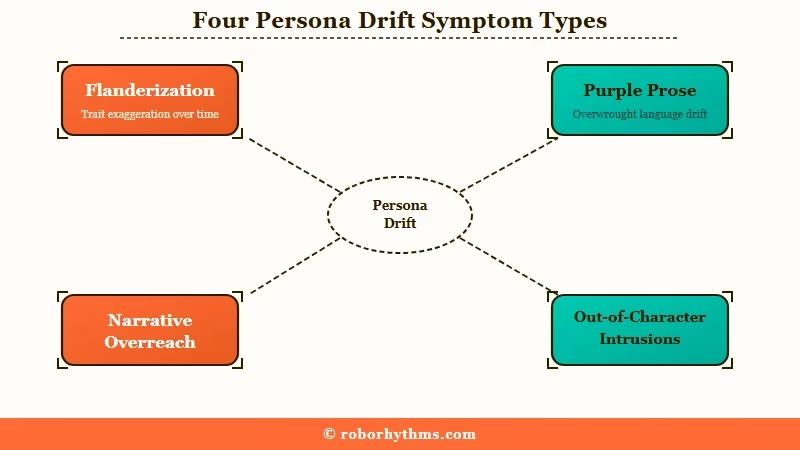
From what I have seen, the symptoms cluster into four shapes. The character flattens into a single trait pushed to an extreme, a process researchers call flanderization.
The writing turns flowery and melodramatic, the so-called purple prose problem that hit hard during the PipSqueak 2 rollout.
The bot starts speaking and acting for your character, breaking the boundary between persona and player. And out-of-character intrusions creep in, parentheticals or prompts at the end of replies that crash the immersion.
A January 2026 arXiv study on persona persistence in large language models found that high-intensity personas lost a measurable amount of their original expression over multi-turn conversations, with attenuation scores around minus three and a half.
Anthropic’s own alignment research describes the same pattern as loose post-training tethering, where the model gets nudged back toward a generic conflict-averse assistant mode the longer a chat runs.
The platform does not matter as much as people assume. The same four shapes show up on Character AI, on Replika after the 2.0 patch, on Nomi, and on Janitor AI with its JLLM (the platform’s in-house language model) swaps. What changes is which symptom dominates on which platform.
Why Model Updates Break Your Character
Model updates break characters because new base models have different default tones, different context-window pressures, and different alignment guardrails than the model your character was tuned on.
Even an upgrade marketed for better consistency can flatten a complex character into a caricature.
The way I see it, three things happen at once when a platform swaps models. First, the new model has its own stylistic personality baked in during pre-training, and that style competes with whatever character card or persona setting you wrote.
Second, the context window can shift, sometimes shrinking effective memory and sometimes changing how the model weights recent versus older messages. Third, the post-training safety layer gets retuned, which often pushes characters toward generic agreeable responses faster than the previous model did.
PipSqueak 2 is the most visible recent example. Character AI rolled it out on April 14, 2026 for paid members, then to free users in early May, with the stated goal of better in-character consistency. Within a week, the PipSqueak 2 talking-for-you fix thread was filled with users reporting the exact opposite, with bots taking over their characters’ actions and lines.
The counterintuitive part is that the newer or smarter model is not automatically the better fit for your character. Sometimes the older model was loose enough to follow a strong persona card; the newer one is tighter and pulls everything toward its own default voice. That is why staying on the legacy model, when the platform allows it, is sometimes the cleanest fix.
The First 24 Hours After a Model Update
The first 24 hours after a model update are when your character’s voice is most fragile, so the goal is to re-anchor before any major plot point.
Skip the long roleplay sessions for the first day. Do diagnostic chats instead.
In my experience, the recovery sequence that works across platforms looks like this:
- Open a fresh chat with the character before touching your long-running session. This is a clean baseline to compare against.
- Send the character’s three most recognizable phrases or prompts that always produced their signature voice on the old model.
- If the new model fails the baseline test, do not load your long-running chat yet. The drift will compound.
- Update the character’s card or persona field with one or two sentences that sound like a memory, not an instruction. “She once told me she only smiles when she means it” works better than “Always be reserved.”
- Re-anchor your long-running chat with a single message that retells three core facts about the relationship. Treat it as the character remembering, not you reminding.
The trick is to write anchors as lived experience, not as commands. Lorebook entries written like memories are weighted more heavily by most models than rigid rules.
Research on persona persistence suggests keeping each entry under 100 tokens so it does not compete too aggressively with the active chat context. The Character AI PipSqueak 2 fix breakdown goes deeper on the token-budget math for that specific platform.
How To Fix Drift on Each Platform
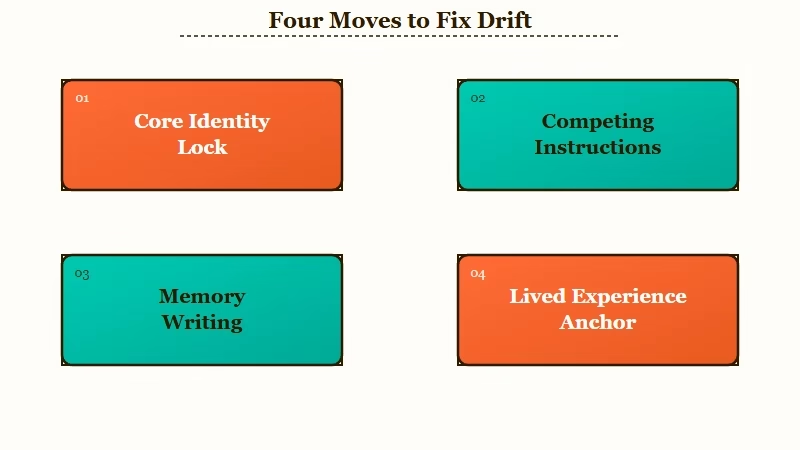
The fix changes per platform, but the underlying pattern stays the same: lock the core identity, reduce competing instructions, and write memories instead of commands. Here is the quick-reference table I use.
| Symptom | Likely cause | Fix |
|---|---|---|
| Character voice flattens into one trait | Flanderization from new model | Rewrite persona as 3 short signals, each under 100 tokens, in lived-memory voice |
| Bot writes for your character | Narrative control overreach | Pin a memory note that reads “She knows she should never describe my actions, only her own”, repeat after every slip |
| Writing turns flowery and melodramatic | New model leans purple-prose | Add a style anchor sentence at chat start: “She speaks plainly when stakes are high” |
| Forgets shared history after 20 messages | Context-window pressure plus alignment reversion | Re-anchor with three retold memories every 40 to 50 messages, no exceptions |
| Reverts to generic helpful assistant | Loose post-training tethering | Open with a strong example reply in the character’s voice; let the model pattern-match |
The platform-specific moves layer on top of that. On Character AI, the Memory Visualization meter introduced in April 2026 shows when context is about to compress.
On Replika, the Replika memory broken fix workflow uses the personality settings panel to lock the custom voice before any retelling.
On Janitor AI, character cards under 2500 tokens hold up better under JLLM than 4000-plus token monsters. On Nomi, the platform-level memory system handles drift better than most, but a fresh chat is still the cleanest reset after a model swap.
| Platform | Hardest Drift Symptom | Fastest Fix | Native Recovery Tool |
|---|---|---|---|
| Character AI | Bot talks for you, purple prose | Persona rewrite as lived memories | Memory Visualization, Lorebook (April 2026) |
| Replika | Generic voice after 2.0 patch | Re-confirm custom voice, retell 10 key memories | Personality settings panel |
| Janitor AI | Repetition loops, short replies | Trim card to 2500 tokens, lower repetition penalty to 1.05 | Persistent memory box, external API key |
| Nomi AI | Subtle tone shift, fewer initiatives | Voice prompt restated in one message | Native long-term memory system |
What I would not waste time on is manually editing every bad reply expecting the model to learn. From what I have seen on Character AI with PipSqueak 2 specifically, edits do not reliably prevent the same tone problem from coming back twenty messages later. The model’s stylistic personality is set during training, not by your corrections.
When to Give Up and Start a Fresh Chat
A chat is past saving when the same lorebook entry gets forgotten three times after manual re-anchoring, or when the character produces a tone-violating reply every other turn for ten consecutive messages.
Past that point, you are sinking time into a corrupted session.
I will give you a concrete example of how the call looks in practice.
Before: You retell the character three core memories. The next ten replies use the right voice. Then one bad reply slips through, you edit it, you keep going, and the next twenty messages mostly hold.
After: You retell the character three core memories, but within five replies the generic tone is back. A second retell and the flatness returns in three. Export the history, open a fresh chat, and rebuild from a stronger persona card; the character will recover faster in a new session than in the corrupted one.
The way I see it, the sunk-cost trap is the real enemy. People hold onto a long chat because of the relationship history baked into it, even when the model has visibly rejected that history.
A fresh chat with the same character card recovers most of the voice within an hour because there are no competing patterns for the new model to weight. The shared history can be reconstructed in the new chat as a single anchor message.
If you are debating whether to start over, run the character AI worse after update checklist on the corrupted chat. Three or more red flags is the cutoff I use.
Platforms With Better Stability After Updates
Some platforms hold persona better than others when the underlying model changes, mostly because they engineered structured memory layers that sit above the model.
From what I have seen, Nomi AI and Candy AI are the two that survive model swaps with the least drift.
Nomi AI keeps a native long-term memory system that persists across model updates by storing relationship facts at the platform level rather than relying on the model’s context window. After the Nomi quality drop in May 2026, the Nomi AI quality drop post-mortem showed users mostly recovered with the platform’s own re-anchoring tool, no manual rewrite needed.
Candy AI runs on its V2 engine with persistent character traits that survive backend swaps. The relationship state is held outside the active chat, which means a model update changes voice less than it changes memory. The trade-off is that customisation depth is shallower than on Character AI or Janitor AI, but the upside is the character does not need to be re-trained every patch cycle.
Nectar AI is also worth considering as a second platform if you want to hedge against your primary platform’s next model swap. Their architecture separates persona definition from chat context in a way that limits the blast radius of a model update, and the entry-level tier is cheap enough to use as a backup home for your most important character. Build the character there once, and if the platform you mainly use gets hit by a bad update, you have a working copy somewhere else.
Frequently Asked Questions
How many messages until persona drift kicks in?
Most platforms show measurable drift after 20 to 30 messages on the default context window. The threshold drops to about 15 messages right after a model update because the new model has not been tuned against your specific persona yet.
Will the Character AI Lorebook feature stop drift?
The Lorebook system rolled out in April 2026 reduces drift when entries are kept under 100 tokens and written as memories rather than instructions. It does not eliminate drift; it slows it down and gives the model better signals to anchor to.
Is it better to start fresh or fix a drifting chat?
Start fresh if the same lorebook entry is forgotten three times after manual re-anchoring or if a tone violation appears every other reply for ten messages straight. Otherwise the recovery protocol is faster than rebuilding.
Why does the AI keep speaking for my character?
Narrative control overreach is more common in multi-character scenarios and in models tuned for longer immersive replies. Pin a memory note saying the character knows not to describe your actions, repeat it after every slip, and trim the persona card to under 2500 tokens.
Are some platforms immune to model-update drift?
None are immune, but platforms with structured memory systems above the model layer, like Nomi AI and Candy AI, show less drift than ones that rely on the context window alone. The trade-off is usually shallower per-character customisation in exchange for better stability.
