
TL;DR: Long running AI agents need seven memory layers, not one vector store. The breakthrough that holds the stack together is temporal edges, storing every fact with avalidatandinvalidattimestamp instead of overwriting. Wire it up with a tri-store of vector plus episodic plus graph, route queries through a classifier, and you can run thousands of agents for months without state drift.
If you have ever shipped an AI agent that worked great for a week and then started lying about what users told it, you already know the headline problem. Standard memory patterns are built around short chat sessions.
The agent answers the question, you reset the context, the user goes home. None of that survives in production once the same agent is supposed to remember a customer for six months across thirty separate conversations.
The way I see it, retrieval is the bottleneck in 2026, not generation. Most failures that look like hallucinations are retrieval misses. The agent has the fact somewhere in its store; it just cannot pull the right one at the right time, especially when the user changed their email provider last Tuesday and the old one is still ranked first by cosine similarity.
This is the operator-grade playbook I would put on the wall before writing a single line of memory code. It is grounded in a 2026 production deployment running roughly 1,000 long-running agents over two months, plus the public research from the Mem0, Zep, and Letta teams.
The framework is the same whether you are building a single SaaS agent for a thousand users or a single power-user agent that has to remember you for a year.

Why Standard Memory Patterns Break After Day Seven
Standard agent memory patterns break in production because they treat memory as a single vector store, when long running agents need at least four distinct memory types and explicit time-awareness on the fact graph.
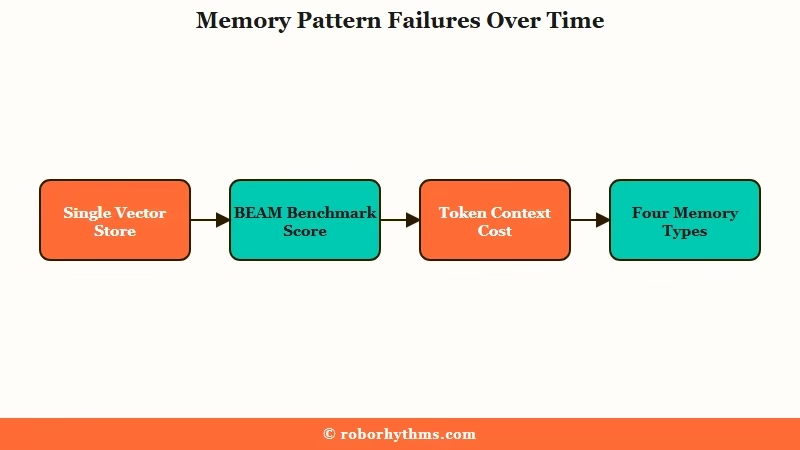
The most published benchmark on this gap is BEAM, which scales context evaluation from 1 million to 10 million tokens. Performance drops from a score of 64.1 at 1M to 48.6 at 10M, roughly a 25 percent loss in temporal abstraction the bigger the context gets.
That is the empirical version of what every builder learns the painful way: large context windows do not replace memory architecture. They scale costs linearly, suffer “lost in the middle” attention failures, and have no concept of selective forgetting.
The economic math is uglier than the benchmark. From Mem0’s state-of-memory research, processing a 10 million token context at typical 2026 prices costs about $5 per inference call, and a single multi-turn session can reach $100. An agent running ten conversations a day per user on a thousand users is a five-figure monthly bill before you have shipped a feature.
From what I have seen in production stacks, the symptoms of a one-store memory system are predictable. The agent forgets a preference the user set three sessions ago. It cites a contradicted fact (current email is Gmail, agent insists it is Outlook).
It repeats work it already did last week. It loses procedural context after every restart. Each of these is a different memory failure mode that lives in a different layer, and a single vector index cannot fix any of them properly.
The same retrieval pathology that RAG chunking quietly destroys agents is what wrecks naive memory: one store, one similarity metric, no awareness of what kind of memory the query needs.
The mental model that fixes this is to stop thinking of memory as “the vector database” and start thinking of it as a small operating system with several stores running in parallel, plus a router that picks the right one per query.
The Seven Memory Layers You Actually Need
The 2026 production pattern for long running agents is a seven layer stack: Working, Conversation, Episodic, Semantic, Knowledge Graph, Procedural, and Checkpoints, each backed by a store optimized for its query shape.
Here is the layer-by-layer breakdown, with what each one stores, the store type that fits, and the failure it prevents:
| Layer | What it stores | Backing store | Failure it prevents |
|---|---|---|---|
| 1. Working | Per-turn scratchpad, intermediate reasoning, tool outputs | In-memory dict or Redis | Leaking transient tokens into long-term storage |
| 2. Conversation | Active thread history, dynamic summary | Append log + summarizer middleware | Burning token budget on raw chat replay |
| 3. Episodic | Time-indexed log of past runs, especially failed ones | Append-only event store (Postgres or DynamoDB) | Repeating past mistakes across sessions |
| 4. Semantic | Slow-changing facts, user preferences, configurations | Markdown notebook + LLM-extracted facts | Forgetting durable facts the user set once |
| 5. Knowledge Graph | Entities and relationships, multi-hop edges | Graph DB (Neo4j, Apache AGE, Kuzu) | Missing the answer to “who knows whom” queries |
| 6. Procedural | Tool-use skills, workflow patterns, “how we do this” | Workflow registry or relational table | Re-deriving the same playbook every run |
| 7. Checkpoints | State snapshots between long-running steps | Object store with versioned keys | Restarting a 40-minute task from minute zero |
Two layers deserve a callout because they are where most indie builders are weakest. Procedural memory is the layer that turns one successful agent run into a reusable habit. If your agent figured out how to coordinate Slack to Jira to GitHub in twelve steps yesterday, procedural memory is what stops it from re-deriving that path tomorrow.
Episodic memory is the layer that lets the agent learn from its own failures. Every aborted run, every tool call that returned an error, every recovery sequence goes here, indexed by timestamp.
A semantic-memory split worth stealing: store explicit user-edited facts in a human-readable markdown notebook, and store LLM-extracted facts in a graph layer alongside. When they disagree, the human notebook wins, no contest. That single rule kills an entire class of “the agent overruled what I told it” complaints in support tickets.
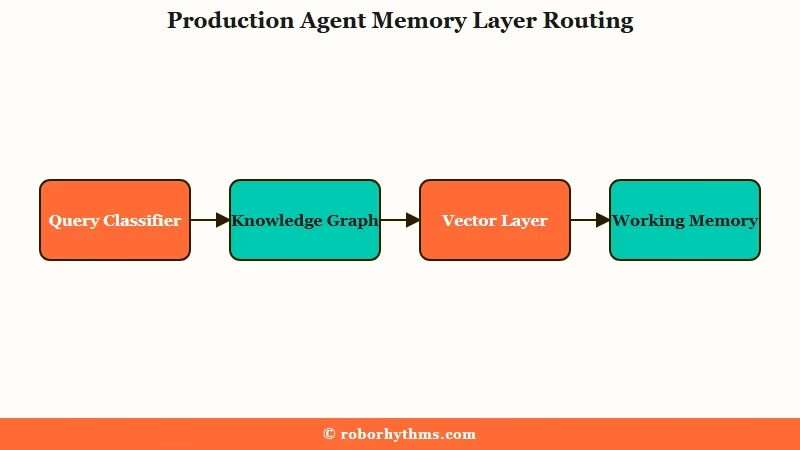
From my reading of the production stacks running in 2026, the right way to wire this is one classifier on the read path. Given an incoming query, route it by intent.
Factual question about a person goes to graph. A vague callback about something the user said goes to vector. A workflow trigger goes to the procedural store. Recent conversation context comes from working memory plus the running summary.
The router itself can be a small model; the cost savings against running every query through every store are large.
Temporal Edges and How to Stop Overwriting Facts
Temporal edges are the production memory pattern that stops your agent from lying about stale facts: every memory record carries validat and invalidat timestamps so the agent can reason about when something was true instead of treating contradiction as a delete.
The single most expensive mistake in long-running memory is overwriting. The user says they switched from Gmail to Outlook. You update the “email_provider” field from “Gmail” to “Outlook”.
The agent now believes the user has always used Outlook, which is wrong. That mistake surfaces three weeks later when the user asks “did you send that to my old Gmail address?” and the agent has no memory of Gmail ever existing.
The fix is to never delete and never overwrite. Every fact in the semantic and graph layers gets two timestamps: when it became true (validat) and when it was superseded (invalidat, null while still current).
When today’s session contradicts yesterday’s state, you mark the old edge invalid_at = now() and insert a new edge for the new fact. The query layer filters on validity windows by default and only retrieves edges that were valid at the relevant point in time.
Before: a single-row update destroys history.
db.execute("UPDATE user_facts SET value = 'Outlook' WHERE user_id = ? AND key = 'email_provider'", (user_id,))After: invalidate the old edge, insert the new one, keep both.
now = datetime.utcnow()
db.execute(
    "UPDATE user_facts SET invalid_at = ? WHERE user_id = ? AND key = 'email_provider' AND invalid_at IS NULL",
    (now, user_id),
)
db.execute(
    "INSERT INTO user_facts (user_id, key, value, valid_at, invalid_at) VALUES (?, ?, 'Outlook', ?, NULL)",
    (user_id, 'email_provider', now),
)
What I would not skip is the index. Once you have temporal edges, queries always carry a “valid at this time” filter, and that filter has to be cheap. Zep’s production implementation indexes temporal edges with interval trees; you can get most of the benefit on Postgres with a composite index on (userid, key, validat, invalidat) plus a partial index on invalidat IS NULL for the hot “current state” path.
Two checks belong in the write path before any new fact enters the semantic or graph layers:
- Contradiction detection. Run a cheap LLM check: “does this new fact contradict any current edge with the same key for this user?” If yes, the writer is responsible for invalidating the old edge, not overwriting it.
- Trust score. Tag every fact with a source confidence: direct user statement = high, third-party document = medium, agent inference = low. Low-trust writes should not invalidate high-trust facts without an explicit verification step. This is the same pattern that prevents adversarial memory poisoning when an attacker tries to slip a fake “user said X” into the store through an indirect channel.
How to Wire This Up Without Three Cloud Bills
Indie operators do not need three separate managed cloud services to run this stack; a single Postgres database with pgvector and Apache AGE plus a small object store will cover vector, graph, episodic, and checkpoint layers on a $20 per month VPS for years.
Most public 2026 memory tutorials assume you are paying a managed Pinecone bill, a Neo4j Aura bill, and a Redis cloud bill in parallel. That stack works at enterprise scale; it is overkill at indie scale and the schema-migration story across three vendors is a real maintenance tax.
From my reading of the operator stacks shipped this year, the leanest production pattern that still hits the 2026 quality bar uses one Postgres instance with the right extensions plus a thin orchestration layer.
Here is the layer-to-store mapping I would actually run on a single VPS:
- Working memory lives in process memory or a single Redis instance you already run for caching.
- Conversation memory sits in a Postgres table with a summary column and a token-budget trigger that condenses old turns when the thread crosses 8K tokens.
- Episodic memory is another Postgres table, append-only, partitioned by month, with a JSONB column for the event payload.
- Semantic memory splits across two stores: a markdown file per user for explicit configs (committed to S3 or a versioned blob store) and a
pgvectorcolumn for LLM-extracted facts with their embeddings. - Knowledge graph runs on Apache AGE inside the same Postgres database, which gives you Cypher-style queries without a second engine.
- Procedural memory is a third Postgres table holding workflow definitions as structured JSON, looked up by trigger condition.
- Checkpoints go to S3 or any object store with versioned keys, one snapshot per step boundary.
The orchestration glue between these layers, the part where you decide when to write to which store and when to retrieve from where, is exactly the kind of branching, retry-aware workflow that automation platforms like Make.com handle well if you do not want to maintain the routing code yourself.
You build the memory adapters as functions; the platform handles the “when this happens, write here, then call this” plumbing without you owning the queue. Whether you self-host or use a platform depends on volume, but the architectural shape is the same as the production infrastructure patterns you would use for any 2026 agent stack.
The hidden cost of cloud-managed memory stacks is integration time. The same research that benchmarks Mem0 at 93.4 on LongMemEval notes that vector store integrations average one to two weeks, while graph store integrations run four to eight weeks.
On a single Postgres stack with AGE, both layers come up in roughly a day each because the schema, transactions, and backup story are already solved.
What to Test Before You Ship a Memory Change
Before any production memory change ships, run a 50-question targeted regression that covers temporal queries, multi-hop reasoning, contradiction handling, and procedural recall, against a fixed snapshot of your real memory store.
Public benchmarks like LoCoMo (1,540 questions) and LongMemEval (500 questions) are too large for a hobby project and too generic for a specific agent. What I would do, and what catches the most real regressions, is build a 50-question internal test set seeded from your own production memory dumps.
Each question maps to a layer you care about. The 2026 multi-signal retrieval gains on temporal queries (+29.6 points) and multi-hop reasoning (+23.1 points) are exactly where naive vector-only setups quietly lose; a targeted test surfaces those losses before users notice.
A practical split for the 50 questions:
- 20 temporal queries. “What was the user’s email provider before March 2026?” and similar. Pass if the agent retrieves the correct historical fact and explicitly cites the time window. Fail if the agent returns the current value as if it were always true.
- 10 multi-hop queries. “Which of the user’s colleagues was at the Acme meeting last week?” Pass if the agent traverses two or more edges in the graph layer. Fail if it returns a list of all colleagues without filtering.
- 10 contradiction queries. Plant a contradiction in the semantic store and ask the agent to resolve it. Pass if it surfaces the contradiction and applies the trust-score rule. Fail if it picks one silently.
- 5 procedural queries. “When the user asks to schedule a meeting, what is your sequence?” Pass if the agent retrieves a stored procedure. Fail if it re-derives one from scratch.
- 5 forgetting queries. Ask the agent for a fact that should have aged out per your retention policy. Pass if it correctly refuses or surfaces a stub. Fail if it hallucinates a value.
Run this test set on a fixed-cost cheap model, not your production model. The whole sweep should cost roughly $2 per run; that is the price of a unit test that catches a class of regressions which would otherwise reach users. The same logic that applies to coordinating agents in a distributed multi-agent system applies here: cheap, fast, repeatable feedback loops on the layer most likely to break.
My read is that long-running agent memory is the part of the agent stack where 2026 separates serious operators from hobbyists. The model is not the differentiator anymore.
An agent with a frontier-class model and no persistent memory is a genius with amnesia; an agent with the right seven-layer stack and a midweight model can run a customer relationship for a year. Pick the stack, test the stack, and stop overwriting facts. The rest is implementation detail.
Frequently Asked Questions
What is the difference between long-term agent memory and a large context window?
A large context window holds tokens for one inference call. Long-term agent memory persists facts, events, and procedures across sessions, weeks, and model swaps. Context windows scale linearly in cost and degrade on retrieval; memory architecture keeps state cheap and selectively forgets.
Do I need a graph database for AI agent memory or is vector search enough?
Vector search alone handles fuzzy recall well but fails on multi-hop reasoning, entity resolution, and strict temporal constraints. Add a graph layer when your agent has to answer “who knows whom” or “what was true in March” questions. For most production agents, the tri-store pattern (vector plus graph plus episodic) is the safe baseline.
How do I handle conflicting facts in a long running agent?
Never overwrite. Tag every fact with validat and invalidat timestamps, plus a trust score based on source.
When a new fact contradicts an existing high-trust edge, invalidate the old one and write the new one; never delete. This preserves an audit trail and prevents silent regressions.
What is procedural memory and why does my agent need it?
Procedural memory stores reusable workflows the agent has executed successfully, indexed by trigger condition. Without it, the agent re-derives the same sequence of tool calls every time a similar request comes in, which wastes tokens and produces inconsistent execution. Episodic memory says “this happened”; procedural memory says “this is how we always do it”.
Can I run all seven memory layers on a single Postgres database?
Yes. Postgres with the pgvector and Apache AGE extensions covers vector, graph, episodic, and relational needs in one instance.
Pair it with a single object store for checkpoints. This stack scales comfortably to tens of thousands of users on a small VPS, with one schema, one backup strategy, and no cross-vendor integration tax.
How often should I re-embed my vector store?
Only when you change the embedding model. When you do, batch the migration in chunks (1,000 records at a time), keep the old vectors readable until the new index passes a regression test, and then atomically swap. Never re-embed in place; always write to a parallel column or table and cut over once verified.
