My Take: The 71 percent versus 40 percent AI productivity gap that Stanford documented in March 2026 has nothing to do with which model companies are using and everything to do with whether leadership had the courage to remove humans from the approval loop. The 20 percent who hit 71 percent treat AI like a hire. The 80 percent who stalled at 40 percent treat it like a tool that needs supervision on every decision.
The Stanford Digital Economy Lab paper by Pereira, Graylin, and Brynjolfsson studied 51 real AI deployments and found two production patterns sitting on the exact same technology with nearly double the output gap between them.
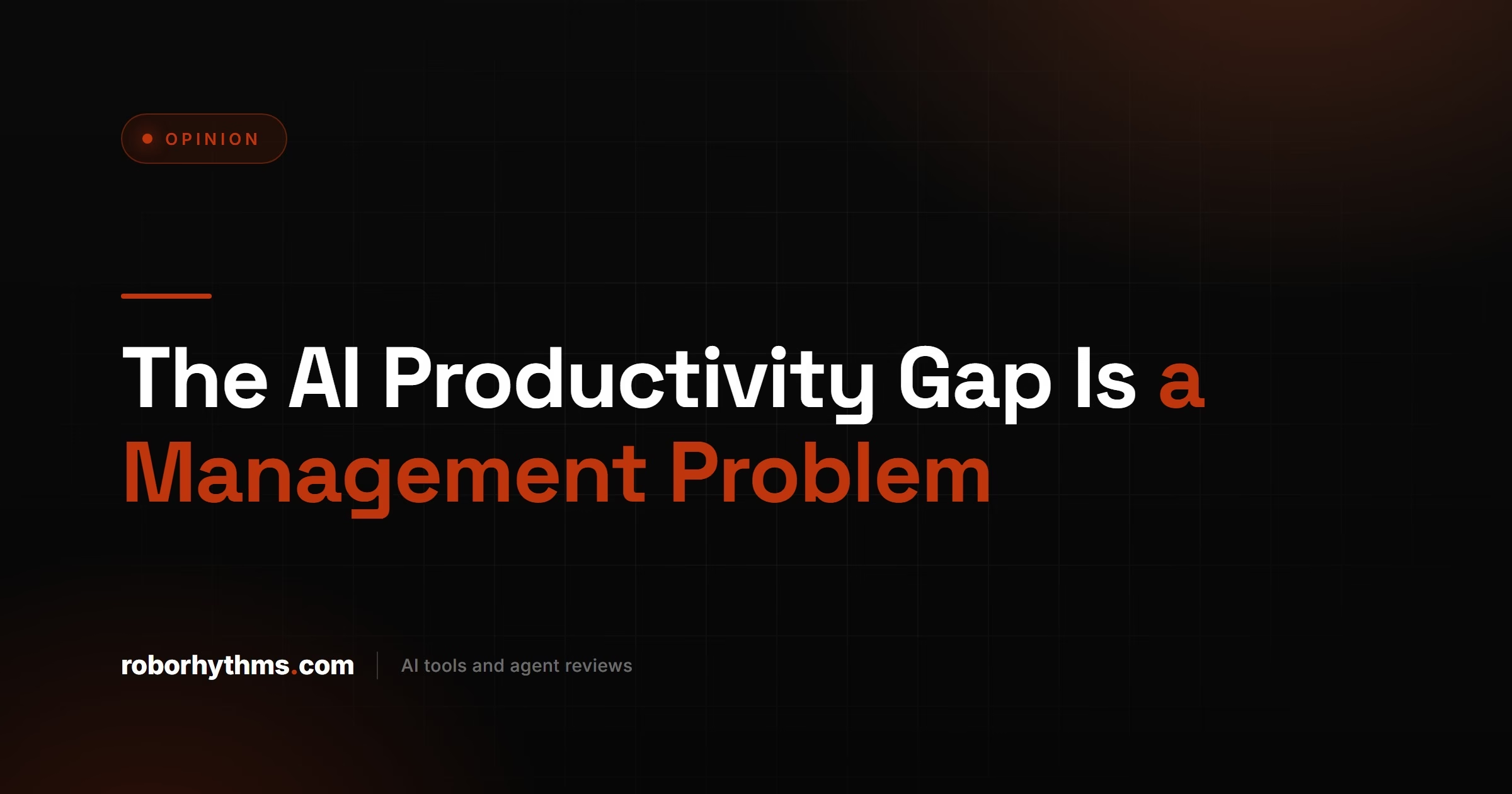
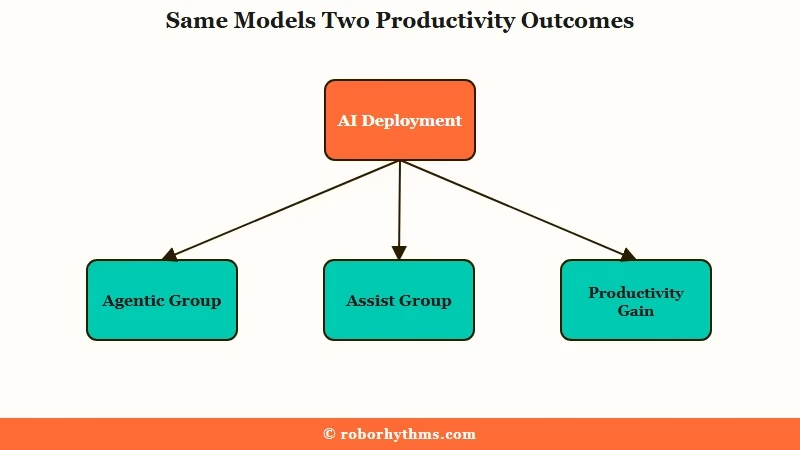
The “agentic” group, where the AI owns the task end-to-end with no human approval gate, hit 71 percent median productivity gains. The “assist” group, where humans approve every meaningful action, hit 40 percent.
The Reddit thread on r/artificial that broke the study to the broader audience this week is full of takes blaming “AI hype,” “model capability limits,” and “marketing language.” None of those are the real story. The real story is that 80 percent of companies running AI in production refused to let it really run anything.
This piece is the contrarian read on why the productivity gap exists, what the 71 percent group did differently, and what the rest of the industry is going to have to admit before they catch up.
What the Hype Cycle Says About the Productivity Gap
The mainstream view is that the AI productivity gap reflects uneven model quality, prompt engineering skill, or technical integration depth, and the fix is better tools, more training, and more iteration. That diagnosis is wrong because all 51 companies in the Stanford study had access to the same models.
The dominant framing in the AI press right now is that companies seeing weak productivity gains are using AI wrong in some technical sense. Pick any of the major AI vendor blogs and you will find variations of “your prompts need work,” “you need fine-tuning,” or “your data pipeline is not ready.” The implied fix is always more product, more services, more consulting.
The Stanford study breaks that framing. All 51 companies they studied had production access to current-frontier models.
The 71 percent group did not have GPT-6 while the 40 percent group ran Llama 2. Same technology, same vintage, near-double output gap.
I have read the same hype cycle for two years now. Every quarter, a new “best practices” document tells enterprises that the next round of prompt engineering, agent frameworks, or retrieval-augmented generation will close the gap.
The Stanford data says these are not the variables that matter. The variable that matters is whether the AI gets to do the thing or whether a human gets to second-guess it first.
The piece on why AI agent demos fail makes a related argument from a different angle. The gap there is between demo and production.
The gap here is between production-with-humans-in-the-loop and production-with-AI-in-charge. Same root cause, different surface.
What Is Really Going On Inside the Productivity Gap
The real driver of the gap is who holds final approval. The 71 percent group removed the human approval gate on tasks that met three Stanford-defined conditions. The 40 percent group kept the approval gate on the same tasks because the cost of being wrong felt too high to a leadership team that does not have to live inside the workflow.
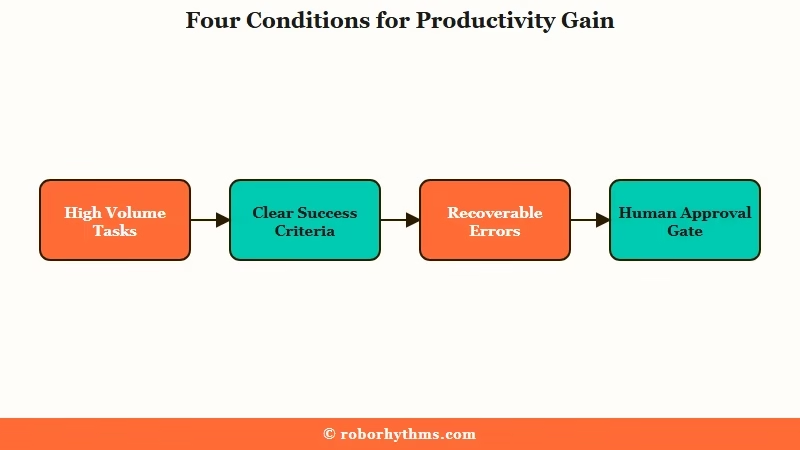
The Stanford paper names three conditions that have to be true before the agentic model produces the 71 percent gain. The tasks must be high-volume.
The success criteria must be clear and measurable, and the errors must be recoverable. When all three are true, removing the human approval gate roughly doubles output without proportional quality loss.
Most companies have plenty of tasks that meet all three conditions. Supplier reorder decisions in retail, tier-1 ticket categorization in support, alert triage in security operations, lead qualification in sales.
None of these are mysterious. The 20 percent who hit 71 percent productivity did not find some secret category of work.
They authorized the AI to act on the workflows their teams already knew met the three criteria. The GitHub PR auto-fix agent build walks through what that authorization looks like in a real developer workflow.
From my own observation, the 40 percent group is overwhelmingly companies where a leadership team is one bad headline away from a board call. Those leaders cannot tolerate the failure mode where the AI processes 10,000 alerts and gets 50 of them wrong, even if the human team was previously processing 1,500 alerts and getting 100 of them wrong.
The math says the AI is better. The optics say the human is safer. Optics win.
The Stanford case studies make this concrete. A supermarket replaced its entire buying process with AI, and waste dropped 40 percent, stockouts dropped 80 percent, and profit margin doubled.
A security team went from processing 1,500 alerts per month to 40,000 with the same headcount. Both moves required the same thing, a leader who signed off on the AI making the call without a human pre-approval.
The way I see it, no amount of model improvement closes this gap. Model improvement keeps shifting the optimal frontier outward, but if a company keeps the human approval gate on the same workflows, that company stays at 40 percent forever no matter how good the underlying AI gets.
The Part Nobody at the C-Suite Will Admit
The uncomfortable implication is that the AI productivity gap is a measure of leadership courage, not engineering competence, and most enterprises are going to fall further behind every quarter because no consulting engagement or platform upgrade can manufacture the willingness to fire the approval gate.
What I find telling is which voices are missing from the productivity-gap discussion. You can find a hundred AI vendor briefings on “best practices for enterprise deployment.” You will not find a single one titled “your CEO is the constraint.” That topic does not generate consulting hours.
The Pereira-Graylin-Brynjolfsson paper from the Stanford Digital Economy Lab frames the constraint as organizational, not technological.
The companies in the 71 percent group are not running better infrastructure. They are running the same infrastructure under a leadership team that accepted the autonomous failure mode as a price of the autonomous gain. The 40 percent group rejected that trade and got the gain that comes with rejecting it.
The reason this stays uncomfortable is that it implies a specific failure mode that boards do not want to name. The CEO who keeps humans in the loop is not being cautious; the CEO is being career-protective.
A 40 percent gain in a category competitor doing 71 percent is a 30-point quarterly lag that compounds. According to the Stanford AI Index 2026, the productivity gap between top-quartile and bottom-quartile AI deployers has widened to roughly four times its initial size as the best adopters compound their advantage and the weakest ones stall.
That math does not let the cautious CEO catch up later by being slightly less cautious.
The piece on why free AI models lose addresses the cost side of this same pattern from a different angle. The cheap-feeling option is the one where the buyer pays in friction instead of dollars.
The productivity-gap version is similar. The cautious-feeling deployment is the one where the company pays in compounding lag instead of risk.
Before: “We need to evaluate AI agent platforms and roll out a phased pilot with human-in-the-loop validation for the first six months.” After: “We are removing the approval gate on tier-1 alert triage on June 1. Quality bar is fewer than 0.5 percent material misses, measured weekly. If we miss the bar twice in a row, we add the gate back.”
The “before” version is the 40 percent posture, and the “after” version is the 71 percent posture. The difference is not a tool.
It is a written commitment to the autonomous failure mode with a measurable kill switch.
Hot Take
The AI productivity gap is a measure of how many leaders are willing to put the autonomous failure mode in writing. The 20 percent who did got 71 percent. The 80 percent who did not got 40 percent.
Better models will not close the gap because better models keep moving the optimal frontier outward without changing the approval loop. The next round of AI rankings, benchmarks, and platform launches will not move the gap either.
The only thing that closes it is a CEO who signs the kill-switch criteria in writing and ships the AI past the approval gate the same week. There is no version of this story where the 80 percent catch up by hiring a better consultant.
