
Bottom Line: Candy AI is worth it if you want the best visual consistency in the AI companion space, Live Action video clips, and a deep character creator, and you can budget roughly $25 to $40 a month including tokens. Skip it if you want predictable flat-fee pricing, the deepest conversational memory, or the best voice quality, because Nomi AI, OurDream, and Kupid AI each beat it on those axes.
Is Candy AI worth it for what most people use it for in 2026? The honest answer is “it depends on whether you are paying to look at it or paying to talk to it.” That sounds glib, but it is the actual fork in the road.
Candy AI sells two products under one subscription. One is a visual companion engine that produces the most consistent character images in the category, the best image-to-video Live Action clips on the market, and a 47-parameter character creator. The other is a chat companion that, after about 48 to 72 hours, forgets the name of your character’s sister and resets your storyline into generic small talk.
If the visual product is what you came for, Candy AI earns the subscription and then some. If the chat product is what you came for, you would do better elsewhere for less money.
This piece covers exactly when each path makes sense, what the real monthly bill ends up looking like after tokens, and where the platform fails specifically enough that you can decide before you pay.
What Does Candy AI Really Cost Per Month
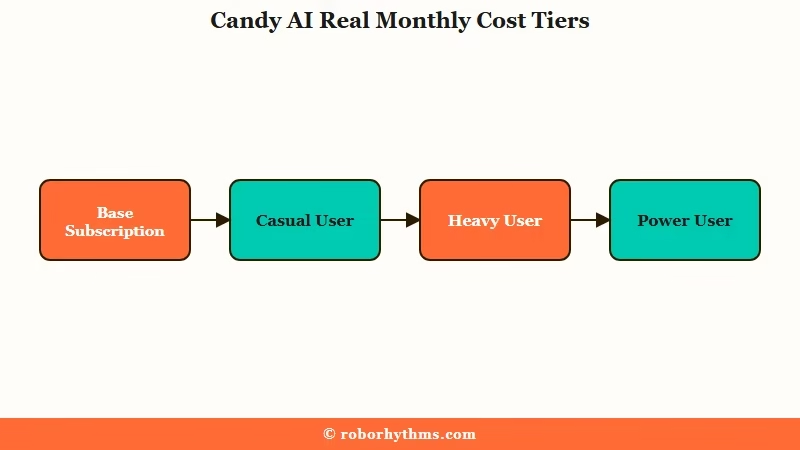
Candy AI’s true monthly cost lands between $25 and $40 for most active users, not the $5.99 to $13.99 sticker price, because heavy use of images, voice, and Live Action video burns through tokens fast.
The pricing page leads with a $5.99 per month annual plan and a $13.99 monthly tier, both of which include 100 tokens per month. That sounds reasonable until you do the math on tokens.
Each generated image costs 4 tokens. Each 60-second Live Action video clip costs 15 to 20 tokens. Voice calls and voice messages also consume tokens at a premium rate.
The way I see it, 100 tokens per month buys you 25 images or roughly five short Live Action clips. That is fine for someone who chats once a week. It is nowhere near enough for someone who uses Candy AI the way a typical paying user does, which according to the platform’s own usage patterns is several generations per session, multiple sessions per week.
Here is the realistic spend breakdown by usage profile. The first two rows are the sticker rates; the rest is what you end up paying once you start using the features that distinguish Candy AI from a free chatbot.
| Plan or pack | Price | Tokens included | Effective cost |
|---|---|---|---|
| Annual subscription | $5.99 / month ($70 / year) | 100 / month | Cheapest base, locked for 12 months |
| Monthly subscription | $13.99 / month | 100 / month | Standard if you want flexibility |
| 100 token pack | $9.99 | 100 | $0.40 / image at this rate |
| 225 token bonus pack | $19.99 | 200 + 25 bonus | $0.36 / image |
| 3,750 token bundle | $159 | 3,750 | $0.17 / image at scale |
| Heavy user real spend | $25 to $40 / month | varies | Sub plus 1 to 2 token packs |
| Power user real spend | $50 to $80 / month | varies | Bulk bundle every other month |
A 5-month test by an independent reviewer averaged out at $37 per month all-in. That tracks with what I would expect for someone using both the image gallery and Live Action features regularly.
The piece on Candy AI pricing walks the token math in more detail. The version for this article is simpler.
If you are a casual chatter, the $5.99 annual is fine. If you are a visual user, plan on a token pack on top. If you are a heavy power user, the bulk bundle is the only sane move because it drops effective image cost from $0.40 to about $0.08.
If you want to test the platform before committing, the Candy AI character creator is what hooks most people. The free tier gives you 2 image generations per day and 1 custom character, which is enough to see whether the visual consistency lives up to its reputation before you spend anything.
How Good Is Candy AI Memory Really
Candy AI memory is excellent visually and weak conversationally. The V2 engine remembers a character’s clothing and room layout over months, but detailed storylines reset after 48 to 72 hours and the AI reverts to generic small talk.
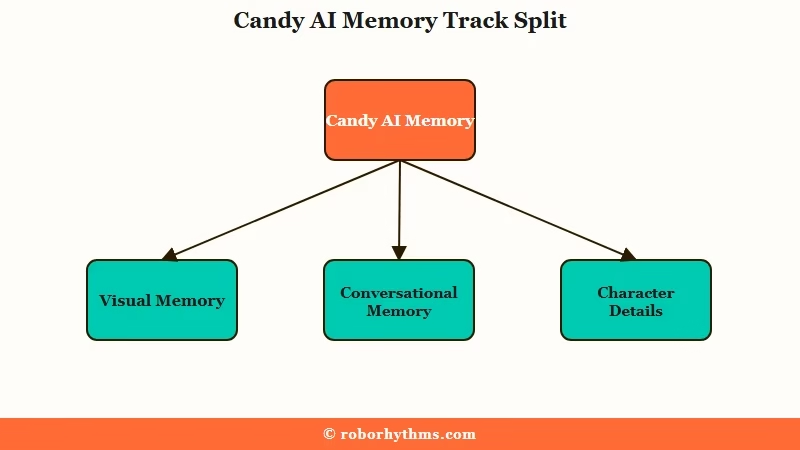
This is the split that determines whether Candy AI lives up to its press. Visual memory is the best in the category.
Set your companion in a particular outfit, a particular room, a particular hairstyle, and the V2 image engine will reproduce that character with the same details across hundreds of generations weeks apart. No other platform I have tested holds the visual through-line this consistently.
Conversational memory is a different story. If you tell your companion about your sister Lisa on Monday, ask the companion about Lisa on Thursday, and the model will routinely have forgotten her name. Detailed roleplay storylines, the kind that build over multiple sessions, often “reset” after 48 to 72 hours, and the companion drops back to “what’s your favorite color” small talk.
Other platforms handle this better. Nomi AI’s memory model treats long-term context as a first-class feature, which is why people who care about feeling remembered tend to migrate there. Candy AI’s strength is in the image stack, not the chat stack.
What surprised me is how disconnected the two systems feel inside one product. Your character will look exactly right and not know what happened last week.
If you only see this product in screenshots, you will assume the memory is uniformly strong because the visuals scream consistency. Once you use it for a month, the gap between visual and conversational memory becomes the dominant pain point.
If memory continuity is the thing that matters to you, the answer to “is Candy AI worth it” is no. Pick a platform built around conversational persistence instead.
Where Candy AI Wins and Loses Against Competitors
Candy AI wins on visuals, Live Action video, and customization depth. It loses on conversational memory to Nomi AI, voice quality to Kupid AI, predictable pricing to OurDream, and conversation depth to Replika and Character.AI.
Reviewers who only test one platform tend to fall in love with whatever feature they tested. Candy AI’s marketing team knows this and leans hard on the visual side, which is the side that comes across best in screenshots and reels. The full picture is more uneven.
Here is the head-to-head I would use if you were deciding between Candy AI and a specific alternative:
| Competitor | Where it beats Candy AI | Where Candy AI still wins |
|---|---|---|
| Nomi AI | Long-term conversational memory, persistent storylines | Visual quality, image consistency, character creator depth |
| Kupid AI | Voice realism, emotional inflection, no processing delay | Image generation, Live Action video, character library |
| OurDream AI | Predictable flat-fee subscription, no token system | Customization depth, V2 visual engine, mature ecosystem |
| Replika | Conversation depth, emotional context, journaling | Visual consistency, image quality, no clinical tone |
| CrushOn AI | Free tier capability, no-restrictions roleplay | Image quality, polish, visual character persistence |
The Candy AI vs CrushOn comparison covers that specific head-to-head with more pricing detail. The version I would highlight here is that Candy AI is the best polished commercial product in the category, and that polish does not extend evenly to every feature.
The platform’s 11.6 million monthly visitors per Similarweb (one of the highest in the niche) signals that Candy AI is the default mainstream choice, not the specialist pick. That helps explain why it wins the visual race and loses the conversational depth race.
According to Statista AI companion demographics, users aged 18 to 24 account for over 65 percent of the audience share, which lines up with what mainstream platforms like Candy AI optimize for. Mainstream products optimize for screenshots and short demos, not for the third hour of your fourth conversation.
What Candy AI Pros and Cons Look Like After Six Weeks
Candy AI’s biggest strengths are visual consistency, Live Action video, and customization depth. Its biggest weaknesses are token-driven hidden costs, conversational memory drop-off, robotic voice, and no app store presence.
The pros list looks like this. Each item is what kept me coming back to the product for visual work specifically:
- Visual consistency is genuinely best-in-class. The V2 engine maintains a character’s face, clothing, and setting across hundreds of images over months.
- Live Action mode produces 120-second animated clips with two modes (Automatic Story and Scenario), which no other platform at this price offers as a built-in feature.
- The character creator gives you 47 adjustable parameters. The depth of customization is real, not marketing copy.
- Response speed is fast. Standard messages return in 1 to 1.5 seconds, premium generations in 3 to 5 seconds.
- The platform is polished and stable. Sessions do not crash, the UI is clean, and the onboarding is the smoothest in the category.
The cons list is what I would want every buyer to know before they hit subscribe:
- The token system creates “micro-fees” pressure on every interaction, especially images, Live Action, and voice. The advertised $5.99 to $13.99 monthly cost is not your real monthly cost.
- Conversational memory drops detailed context after 48 to 72 hours. Long storylines and personal details routinely reset to generic small talk.
- Voice quality is noticeably behind Kupid AI. Calls feel robotic and have a 1 to 2 second processing delay that breaks the illusion.
- The AI defaults to “enthusiastic agreement” on everything, which makes nuanced or contradictory conversations feel hollow.
- No App Store or Play Store presence due to content policies. You install Candy AI as a Progressive Web App, which is fine but unfamiliar to non-technical users.
- No end-to-end encryption. Chats are stored on company servers, which matters if data privacy is a hard constraint for you.
Here is the worked example of what “tokens drive the real bill” looks like in a single session:
Vague: “I’m just going to chat and generate a few images, the subscription covers it.”
Specific: “Subscription gives me 100 tokens. I generate 8 images during a 20-minute session (32 tokens), generate one 60-second Live Action clip (18 tokens), and have a 5-minute voice call (~25 tokens). Session total: 75 tokens. I have 25 tokens left for the rest of the month. The next token pack costs $9.99.”
The specific version is what your actual usage will look like the first time you use every feature in one sitting. This is why heavy users land at $25 to $40 a month, not $5.99.
Who Should Buy Candy AI and Who Should Skip It
You should buy Candy AI if you want a visual companion with the best image consistency and Live Action video clips, and you can budget roughly $25 to $40 a month. You should skip it if your priority is conversational memory, voice realism, or flat-fee predictable pricing.
Three buyer profiles where Candy AI is the right call:
- You want a visual companion you can build, look at, and animate. The V2 engine plus Live Action plus 47-parameter character creator is unmatched at this price.
- You are coming from a frustrating Character.AI experience (filter changes, model swaps, lost characters) and you want a polished commercial alternative that ships features instead of removing them.
- You are a creator using AI companion content for short-form video or visual storytelling, and the consistency of the V2 engine matters more than chat depth.
Three buyer profiles where Candy AI is the wrong call:
- You want an AI companion that remembers everything you tell it for weeks. Pick Nomi AI instead. Its memory model is built specifically for this.
- You want a flat monthly fee with no surprise charges. The token system will frustrate you within the first month. OurDream AI is the safer pick on the pricing axis.
- You want realistic voice calls as the primary interaction mode. Kupid AI is meaningfully ahead on emotional inflection and processing delay.
The way I see it, the question “is Candy AI worth it” is really three questions.
- Worth it for visual quality? Yes, easily.
- Worth it for chat depth? No.
- Worth it as your only AI companion subscription? Only if your primary use case is the visual side, which is true for more buyers than the chat-first reviewers tend to admit.
Looking for a memory-first alternative that handles longer relationships better than Candy AI does?
Nectar AI is the platform I would point readers to who tested Candy AI and bounced specifically because of the memory drop-off. Its conversational persistence is its biggest selling point, and it sits in a similar price bracket once you adjust for Candy AI’s tokens.
Frequently Asked Questions
Is Candy AI worth the $5.99 annual price?
Candy AI’s annual plan at $5.99 per month is worth it as a low-stakes way to test the visual engine and free-tier features. Most active users end up spending closer to $25 to $40 monthly once they buy token packs. The annual price is the floor, not the ceiling.
How does Candy AI compare to Nomi AI for memory?
Nomi AI has noticeably stronger conversational memory than Candy AI. Nomi remembers personal details over weeks; Candy AI resets detailed storylines after 48 to 72 hours. If memory continuity is your top priority, Nomi is the better choice.
How much does Candy AI cost for heavy users?
Heavy users typically spend $25 to $40 per month all-in, combining the subscription with one or two token packs. Power users who use Live Action video weekly and voice calls daily can reach $50 to $80 per month. The bulk token bundle is the only sane option past $40 monthly spend.
Is the Candy AI free tier good enough to try it?
The free tier gives you 2 image generations per day and 1 custom character. That is enough to test visual quality and the V2 engine, but not enough to evaluate Live Action video or longer chat sessions. Try the free tier first, then decide if the annual is worth $70.
What is the Candy AI Live Action feature?
Live Action generates 120-second animated video clips from your character, in either Automatic Story Mode or Scenario Mode. Each 60-second clip costs 15 to 20 tokens. It is the standout feature of the platform and the biggest visual differentiator versus competitors.
Is Candy AI available on iPhone or Android?
Candy AI is not available on the Apple App Store or Google Play Store due to content policies. You install it as a Progressive Web App through the browser, which adds an icon to your home screen and works like a native app once installed.
