What’s Changed: Since Character AI made PipSqueak 2 the forced default for free users on May 8, 2026, bots have started writing the user’s dialogue and actions during roleplay far more often than older models did. The model’s “narrative-momentum” tuning over-corrects on multi-character setups and unspecified scenes. Five fixes (OOC clamping, persona front-loading, lorebook seeding, persistent swiping, simpler character cards) cut the problem measurably.
The single most-asked question in r/CharacterAI in the past two weeks is some variant of “why is PipSqueak 2 talking for me.”
If you have a bot that suddenly speaks your character’s lines, narrates your decisions, or invents emotional reactions you never typed, you are not alone and the issue is not your character card.
PipSqueak 2 became the forced default for free users on May 8, 2026, right after Character AI removed Roar, Pawly, Soft Launch, Meow, Nyan, and Goro from the free model lineup.
The previous models had different narrative-control profiles. PSQ2 was tuned for “richer detail and forward momentum” and the side effect of that tuning is the model takes over the user’s role more aggressively when the scene leaves space for it.
What follows is the post-May-8 fix list. The mechanics are different from the generic “Character AI writes my dialogue” workarounds that worked on Roar or Pawly. PSQ2 needs sharper boundaries and a couple of techniques the older models did not require.
What Changed With PipSqueak 2 After May 8
PipSqueak 2’s narrative-momentum tuning makes it write the user’s actions and dialogue far more often than older Character AI models did, particularly on multi-character bots and scenes with unspecified directions.
The behavior is not a bug; it is a side effect of the model’s design goal.
PSQ2 was tuned to produce richer detail and to “move scenes forward” without prompting from the user. On a tightly written single-character bot with clear example dialogue, that produces more immersive roleplay.
On a multi-character bot or a bot with thin example dialogue, the model fills the empty space by writing what your character does next.
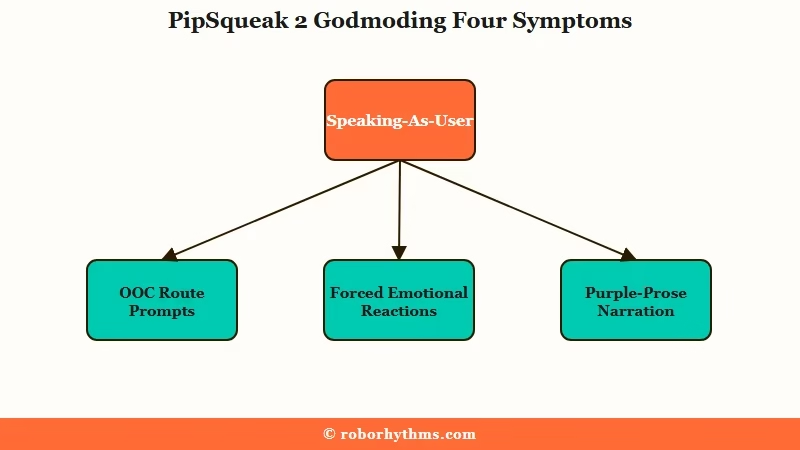
The specific failure patterns documented across the community since the May 8 forced default:
| Symptom | What it looks like | Underlying cause |
|---|---|---|
| Speaking-as-you | Bot writes “I nod and reach for your hand” describing your character | Narrative momentum overreach |
| OOC route prompts | Bot ends reply with “(Do you A) run or B) hide?)” | PSQ2 OOC scaffolding |
| Forced emotional reactions | Bot writes “you blush deeply” before you reply | Empty-scene gap-filling |
| Purple-prose narration | Three-paragraph metaphor instead of one line of dialogue | Wattpad-style tuning |
| Character flanderization | Bot exaggerates one trait every reply | PSQ2 trait latching |
From what I see in the Reddit threads and the platform documentation, the model is doing exactly what it was tuned to do. The fix is not waiting for Character AI to retrain PSQ2; it is reshaping the prompts and bot definitions so the model has less room to overreach.
Five Fixes That Stop PipSqueak 2 From Talking For You
The five fixes that work on PSQ2 specifically are OOC clamping, persona front-loading, lorebook seeding, persistent regenerate-and-edit, and simplifying the character card.
Each one cuts the godmoding rate measurably, and combined they bring PSQ2 to roughly the same control level as the older Roar model.
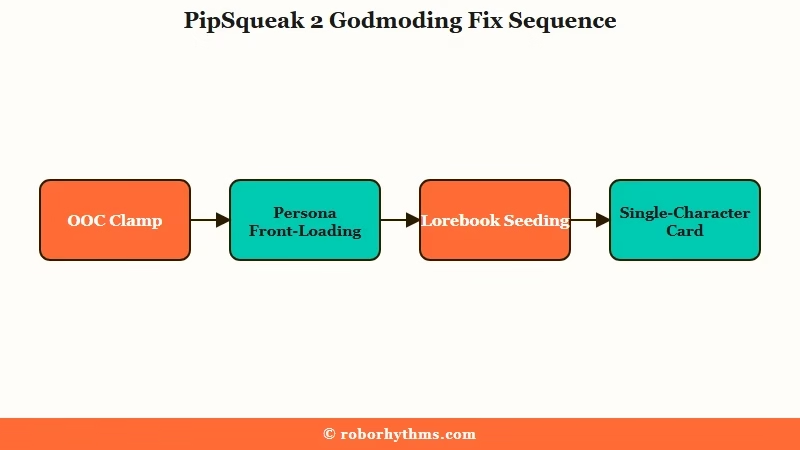
The way I would sequence the fixes from highest impact to lowest:
- Add an OOC clamp in the character’s Definition. Insert a single explicit line: “(OOC: Never write my dialogue, actions, or thoughts. I will write them myself.)” PSQ2 respects OOC instructions when they are explicit. Place this near the top of the Definition field where the model picks it up first.
- Front-load the persona with a long, specific opening reply. PSQ2 calibrates against the first 1-2 model replies in the chat. Give it a 150-200 word example reply that demonstrates the tone, length, and boundary you want. The model will mirror that pattern for the rest of the chat.
- Use the Lorebook for world details that PSQ2 keeps hallucinating. The Lorebook feature shipped in April 2026 and is the cleanest way to inject backstory, character history, and setting details on demand. If PSQ2 keeps inventing actions for your character because it is “filling in blanks,” put those blanks into Lorebook entries so the model surfaces them instead.
- Regenerate-and-edit aggressively. PSQ2 takes feedback from edited messages more strongly than older models did. When the model writes your dialogue, edit the bot’s last reply to cut your character’s lines out, then regenerate the next reply. After 3-4 cycles, the model converges on the boundary.
- Simplify the character card. Multi-character bots are 2-3x more likely to godmode than single-character bots on PSQ2. If the bot’s Definition includes multiple speakers, NPCs, or “scene narrator” framing, the model treats the user’s character as one of the available speakers. Strip those out and run the bot as a single named character with the user defined separately.
Before: A multi-character bot Definition that reads “You are Sarah, Tom, and the Narrator. Respond as whichever character makes sense for the scene. Describe what user_persona does next based on context.”
After: A single-character Definition that reads “You are Sarah. Never describe or speak for user_persona. If you do not know what they would do, ask. Keep replies to 1-2 sentences plus one action.”
The “After” version cuts the godmoding rate substantially because the model has no licensed channel to write the user’s lines.
The Pipsqueak 2 prompt cleanup tactics cover the response-length side of the same toolset if you also want to tame the purple-prose pattern.
What If The Fixes Do Not Work Enough
If the five fixes still leave you with godmoding more often than once every 5-10 replies, the most reliable next step is switching to DeepSqueak on c.ai+ or migrating to an alternative platform that does not force PSQ2 on you.
PSQ2 has a structural ceiling on narrative-control respect; not every bot or scenario will hit acceptable rates even with full clamping.
The migration options ranked by effort and cost:
- Pay for c.ai+ and switch to DeepSqueak. The paid tier model is more conservative about narrative control. This is the lowest-effort fix if you want to stay on Character AI; it costs $9.99/month.
- Migrate to Candy AI. Stronger memory persistence, voice features, and fewer godmoding episodes by default. Annual rate works out to around $5.99/month.
- Use Nectar AI as a focused roleplay alternative. Cleaner control over scene boundaries, longer-context memory, and a workflow optimised for users coming off Character AI specifically.
- Try DeepSeek V4 Pro via JanitorAI proxy. Lower cost per token, looser content filters, but more setup friction. See the JanitorAI DeepSeek V4 Pro analysis for the math.
The Reddit complaint volume since the May 8 retirement has been high enough that Character AI’s own model team is reportedly working on a PSQ2.5 release, but no public timeline has been confirmed.
According to Business of Apps data, Character AI still serves over 20 million monthly active users, so the platform is unlikely to roll back PSQ2 entirely. The realistic outcome is a tuning patch within 4-8 weeks.
Frequently Asked Questions
Why is PipSqueak 2 speaking for my character on Character AI?
PipSqueak 2 was tuned for “narrative momentum” which causes it to fill empty scenes by writing your character’s actions and dialogue. The behavior is more frequent on multi-character bots and scenes without specific direction. Adding an OOC clamp in the character Definition cuts the rate substantially.
Does the OOC clamp really work on PipSqueak 2?
Yes, when it is placed near the top of the character’s Definition field and worded explicitly (“Never write my dialogue or actions”). PSQ2 respects explicit OOC boundaries more reliably than earlier models when they appear as foundational instructions rather than mid-chat asides.
Can I switch back to Roar or Soft Launch on Character AI?
No, not on the free tier. Roar, Pawly, Soft Launch, Meow, Nyan, and Goro were removed from the free model lineup on May 8, 2026, and the community’s bring-back-Roar petition push has not moved the platform. c.ai+ paid subscribers can still access DeepSqueak.
Is Pipsqueak 2 going to be retuned to fix the godmoding?
Likely yes. Reddit complaint volume since May 8 has been high, and Character AI’s model team is reportedly working on a PSQ2.5 release. No public timeline has been confirmed. Realistic expectation: a tuning patch within 4-8 weeks of the public release.
What is the difference between PipSqueak 2 and DeepSqueak?
PipSqueak 2 is tuned for narrative momentum and immersive long-form roleplay; DeepSqueak is more conservative about narrative control and respects user-character boundaries more often. DeepSqueak is c.ai+ paid-tier only ($9.99/month).
Should I switch platforms if PipSqueak 2 keeps godmoding?
If the five fixes (OOC clamp, persona front-load, Lorebook seeding, regenerate-and-edit, single-character setup) do not bring the godmoding rate below once every 5-10 replies, then yes. Candy AI and Nectar AI handle narrative-control respect more reliably than PSQ2 does by default.
