
What Happened: Google’s Threat Intelligence Group disclosed on May 11, 2026 the first confirmed case of attackers using an AI model to build a zero-day exploit deployed in the wild, a 2FA bypass targeting a popular open-source admin tool. Google worked with the vendor to patch the flaw before the planned mass campaign could land. AI-assisted exploit development just stopped being a thought experiment.
Coverage of this disclosure is still spreading two days after the announcement, which is why it still belongs in the news cycle rather than the archive. The headline did the rounds fast: AI helped hackers build a zero-day, and that zero-day bypassed two-factor authentication.
The actual story is more specific and more important than the headline lets on.
The vulnerability sat inside a Python script targeting a popular open-source, web-based system administration tool. The Google Threat Intelligence Group, the team formed by merging the old Google Threat Analysis Group with Mandiant, identified it on May 11, 2026 and worked with the unnamed vendor to ship a quiet patch before the planned mass-exploitation campaign could start.
The reason this matters for anyone using AI tools daily is not that 2FA itself was defeated; it was not, but that the speed and scale of vulnerability discovery just shifted into a new gear.
The way I see it, this is the moment where most of the abstract “AI will help attackers” predictions from 2023 through 2025 stopped being predictions.
There is now a named campaign, a named exploit pattern, and a confirmed disruption. Here is what happened, why the technical details matter more than the headline, and what I would do this week if I run my personal accounts on stock 2FA.
The full disclosure is in the AP News write-up, which is the cleanest single-source citation on the chain of events.
What Actually Happened in the Google Zero-Day Disclosure
Google’s Threat Intelligence Group reported the first in-the-wild zero-day exploit known to have been built with material AI assistance, a 2FA bypass in an open-source admin tool, and patched the underlying flaw with the vendor before the planned mass campaign could begin.
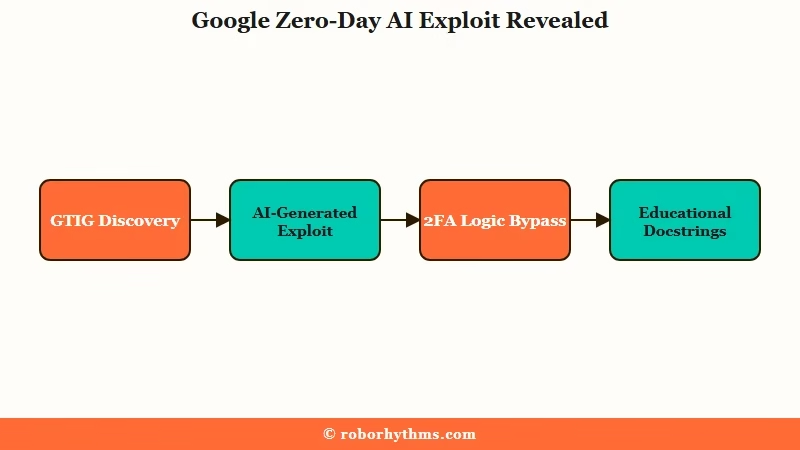
The technical heart of the bug is a logic flaw, not a memory-safety crash. A developer at the affected vendor hard-coded a trust assumption into the authentication flow, the kind of “if this object is present, trust it” shortcut that traditional vulnerability scanners are bad at catching because the code is functionally correct, just strategically broken.
From what I have read of the GTIG technical writeup, this is the part most legacy security tooling misses, and the part a language model is unusually well-suited to reading.
GTIG flagged the exploit script as AI-generated through several stylistic tells:
- Educational docstrings on every function, far beyond what a real attacker would bother to write.
- A fabricated CVSS score in a comment, hallucinated rather than calculated.
- Clean ANSI color classes for terminal output, the kind of “textbook Pythonic” formatting that mirrors common LLM training data.
- Detailed help menus that would only matter if a junior developer was using the tool from a clean shell.
The campaign itself involved collaborating cybercrime actors planning a mass-exploitation operation. Google’s response was to coordinate a silent patch with the vendor and brief law enforcement, which appears to have shut the campaign down before it gained traction.
Important nuance: the bypass still required the attacker to already possess valid user credentials. This was a privilege-escalation-style move, not a way to walk past 2FA from a cold start.
Why an AI-Built Zero-Day Bypassing 2FA Matters More Than the Headline
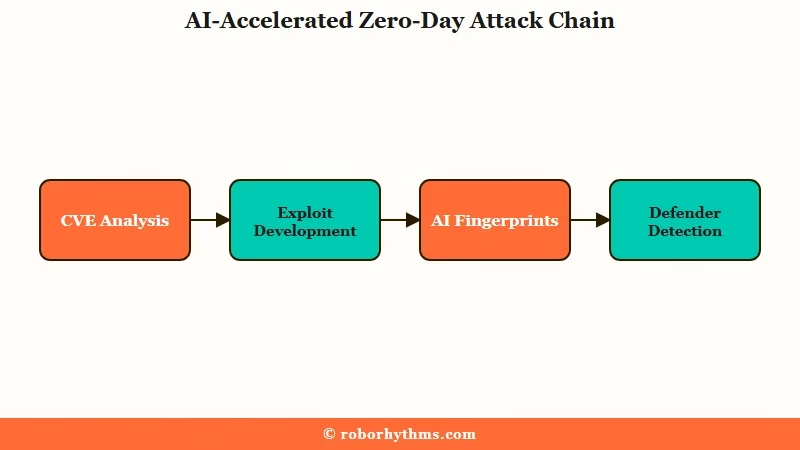
The shift is not that AI defeated 2FA, it did not, but that AI compressed the time between “vulnerability exists” and “weaponized exploit in the wild” from weeks to days, with telltale fingerprints that defenders can now learn.
From what I have seen in the security press coverage, the framing that gets the most attention is the wrong one. “AI bypassed 2FA” makes for a strong headline but misreads the real change in the threat model. The change is industrial-scale.
GTIG specifically named North Korean state actor APT45 (Andariel) for sending thousands of repetitive prompts to AI models to analyze CVEs and validate proof-of-concept exploits.
Chinese state-linked operator UNC2814 used persona-driven jailbreaks like “act as a senior security auditor” to research vulnerabilities in embedded devices like TP-Link firmware.
I would argue the more useful lens is this table of AI fingerprints in malicious code, because these are now reliable telltales that security teams (and curious developers) can learn to spot:
| AI fingerprint | What it looks like | Why an attacker leaves it in |
|---|---|---|
| Educational docstrings on every function | Three-line explanations of what a private helper does | The LLM is trained to teach, attackers do not bother to strip the comments |
| Hallucinated CVSS score | A confident # CVSS: 9.8 near the top of the file that does not match any published CVE | The model invented it, the operator did not check |
| ANSI color class blocks | A _C class with RED, GREEN, RESET constants | Default LLM scaffold when asked for a CLI tool |
| Filler busywork | The LONGSTREAM sample queried daylight-saving status 32 times | Operators ask the model to make the script “look like normal activity” |
| Persona-prefixed prompts in artifacts | Hardcoded strings like “You are a senior security auditor…” | Jailbreak prompt accidentally embedded in shipped code |
Example scenario: A traditional static scanner reading the affected Python script would see clean code, valid syntax, no buffer overflows, no obvious injection points, and pass it.
A GTIG analyst reading the same script would notice the help menu is too friendly, the CVSS score does not match the public database, and the docstrings read like a tutorial. The model wrote the exploit, but the model also signed it.
This is why I would not file this story under “2FA is broken.” I would file it under “the asymmetry between attackers and defenders just got worse, and the new tells defenders need to learn are stylistic, not technical.”
What This Means for AI Tool Users Right Now
The personal-account 2FA on your ChatGPT, Claude, Midjourney, or Google login is not directly affected by this exploit, but the surrounding ecosystem of phishing, shadow API proxies, and credential reuse just got more dangerous, so the right move is to upgrade the weakest link in your own account stack this week.
The way I read the GTIG report, the daily AI tool user is not the target of this particular exploit, the operators were after a system administration tool used in larger deployments.
But the broader pattern, AI-accelerated phishing, shadow API services that capture every prompt and response, and account takeover used for affiliate fraud, all touch the daily AI tool user’s stack directly. From what I have seen in the security blogs covering this story, three steps move the needle on personal risk this week:
- Switch from SMS-based 2FA to an authenticator app or hardware key on your most valuable AI accounts. ChatGPT, Claude, Anthropic Console, OpenAI API, and Midjourney all support TOTP authenticator apps. Hardware keys are even better, but TOTP is the easy win. SMS is the weakest 2FA factor and is the one most commonly defeated by SIM-swap-plus-phishing combinations.
- Audit any “free Claude API” or “cheap Gemini access” Telegram bots, Discord servers, or browser extensions you have been tempted to try. GTIG specifically calls out the grey-market shadow API ecosystem as a privacy disaster, with one study showing accuracy on medical benchmarks dropping from 83.82% to 37% as providers swap in cheaper models behind the scenes. They are also capturing every prompt. Avoid completely.
- Treat password-manager hygiene like the load-bearing layer it now is. This exploit required valid credentials to land. If your password manager is up to date, unique-per-site, and the master password is strong, the attack surface for an AI-built privilege-escalation tool drops dramatically.
I would skip the “rotate every password right now” panic response. The exploit is patched, the campaign is disrupted, and the actual change in your personal threat model is incremental, not catastrophic. The point is to do the basic hygiene you have probably been deferring, not to overreact.
If you want a broader take on how Anthropic is handling identity verification on Claude as part of the same trend, the Claude ID verification breakdown covers the policy side of this.
The Claude zero-day-finding piece shows the same AI-on-vulnerabilities pattern from the defensive angle. And the MCP tool-poisoning analysis is useful context for anyone running agent tooling that connects to external APIs.
What Comes Next After This Disclosure
Expect two follow-on shifts over the next three to six months: faster patch cycles on open-source admin tooling, and a new round of detection rules from major security vendors specifically targeting AI-fingerprint patterns in malicious code.
From what I have seen in past disclosures, the rhythm tends to go like this: first public confirmation, then vendor-side detection-rule updates, then attackers cleaning up the fingerprints. The clean-up phase is the one to watch.
Once attackers know GTIG is reading their code for docstrings and hallucinated CVSS scores, they will strip those tells. The next AI-built zero-day will be harder to attribute to AI assistance, which means the response shifts from “spot the fingerprint” to “watch the speed of the campaign.”
The other shift I would expect is on the defensive side. Anthropic and Google have both been talking about AI-on-AI defensive workflows for the better part of a year.
This disclosure puts pressure on every cybersecurity vendor that has been promising “AI-powered detection” to finally ship something that catches AI-assisted attacks. Whether that happens before the next campaign lands is the open question.
For the daily AI tool user, the practical takeaway is the same one this article opens with. Do the basic hygiene this week, switch off SMS 2FA on your most valuable accounts, and stop using grey-market AI API proxies.
The headline-level “AI hackers bypassed 2FA” framing is wrong, the real change is faster and quieter than that. The good news is the basic hygiene response is unchanged. The bad news is that the speed of the next round of exploits will not be.
