
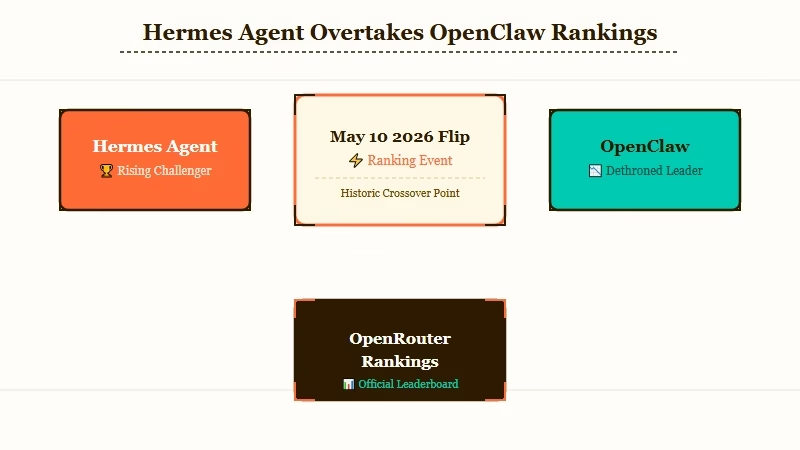
What Happened: Nous Research’s Hermes Agent crossed OpenClaw on OpenRouter’s global daily token rankings on May 10, 2026, hitting 224 billion daily tokens against OpenClaw’s 186 billion. OpenClaw still leads the all-time chart at 9.17 trillion, but for the first time the daily winner is a self-improving open-source agent, not a session-native one.
Hermes Agent, the self-improving open-source runtime from Nous Research, is now the most-used agent on OpenRouter’s global daily rankings. The flip happened on May 10, 2026, and it is the first time since OpenClaw’s late-2025 rise that a Claude Code-style session tool isn’t sitting at #1.
The headline number is the daily token count, where Hermes is now running 224 billion tokens a day on OpenRouter versus OpenClaw’s 186 billion. That gap opened up in about a week of v0.13.0 releases, not over months.
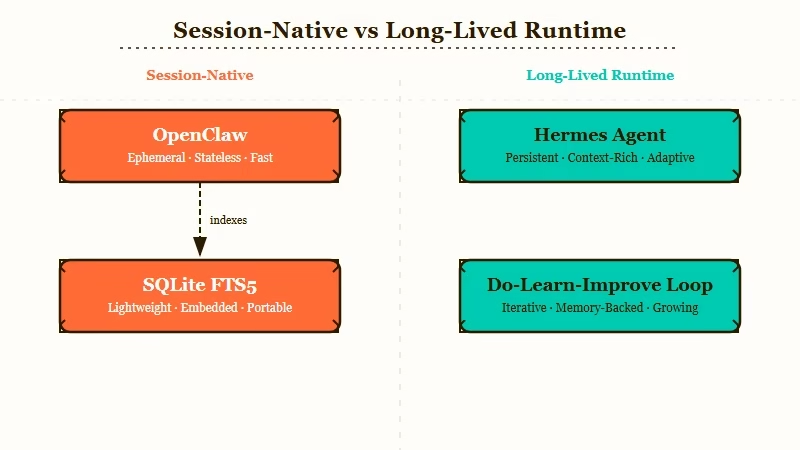
What makes this news instead of a routine leaderboard wobble is the architecture difference. OpenClaw is a session-native agent that loses memory across runs unless you wire it up yourself.
Hermes is a long-lived runtime that builds skills from experience and resumes the same brain across sessions. That is the gap the daily-volume chart is now rewarding.
If you run agent stacks for tooling, automation, or research, this is the headline you want to read for ten minutes and then decide whether to move part of your workload across.
What Happened on OpenRouter
Hermes Agent’s rise on OpenRouter is a daily-volume flip, not yet an all-time one.
As of May 10, 2026, Hermes is processing 224 billion daily tokens on OpenRouter, compared to OpenClaw’s 186 billion, and that is the metric that drives the global app and agent rankings.
The cumulative chart still belongs to OpenClaw, which has logged 9.17 trillion all-time tokens since launch versus Hermes’s 6.35 trillion. OpenClaw also holds the GitHub lead at 370,000+ stars, with Hermes catching up fast at 114,000+ since its February 2026 launch. So this is a momentum story, not a coronation.
The flip lines up with the May 7, 2026 release of Hermes v0.13.0 “Tenacity”, which shipped 864 commits, 588 merged pull requests, and 295 contributors. That release added a Kanban-style durable multi-agent task board with heartbeat monitoring, zombie detection, and hallucination recovery, plus Google Chat as the 20th supported messaging platform.
Nous Research announced the ranking on May 10 with a short post on X thanking contributors, and MarkTechPost’s same-day breakdown is the deepest external analysis so far.
The live ranking sits on OpenRouter’s app rankings page for anyone who wants to watch it shift in real time.
Why This Flip Is a Bigger Deal Than It Sounds
The OpenRouter daily ranking is rewarding agent depth, not platform breadth, for the first time.
OpenClaw still wins on platform integrations with 50+ messaging channels and a 44,000-skill ClawHub library, but the chart now belongs to the agent that prioritises persistent memory and self-generated procedural skills.
That is a real strategic reversal. For most of 2025 and early 2026, the conventional wisdom was that “reach” mattered most, that whoever connected to the most apps and exposed the most third-party skills would own the agent runtime category.
Hermes is winning the daily chart with roughly 40% of OpenClaw’s reach, which suggests developers are voting with their tokens for an agent that learns from the work it has already done.
The way I see it, this is the first concrete market signal that “session-native” is a ceiling. Claude Code, Cursor, and OpenClaw all reset (or near-reset) between runs, and the workaround is fragile context-stuffing.
Hermes treats the agent as a long-lived runtime with a three-layer memory system: a persistent identity snapshot, a SQLite FTS5 full-text database of every past session, and procedural skill files the agent writes for itself.
Security pressure is the other half of the story. OpenClaw had nine CVEs disclosed in four days in March 2026, one with a 9.9 CVSS score, and Koi Security found 341 malicious entries in ClawHub later that quarter.
Hermes shipped its v0.13.0 release with eight P0 security fixes including TOCTOU patches and data redaction enabled by default. That is the kind of background pressure that flips the OpenRouter chart in a single release cycle.
What This Means for You
If you run any agent stack with cross-session continuity, Hermes Agent is a credible Claude Code and OpenClaw alternative as of this week.
The MIT license is real, the migration tool is real, and the cost floor is unusually low.
Here is the practical version, in the order I would walk through it:
- Audit what you run today. If your agent loses context between sessions and you are paying tokens to feed it back in each time, you are exactly the workload Hermes is built for. Make a list of the three workflows that pay the highest “context-stuffing tax” before you switch anything.
- Try the migration tool first. Hermes ships with
hermes claw migrate, which auto-detects~/.openclawand imports your settings, memories, API keys, and skills. Running it does not delete anything from OpenClaw, so you can run both in parallel for a week and compare. - Start small on cheap infrastructure. Hermes is documented to run on a $5 VPS with near-zero idle cost. That is enough headroom for solo dev workloads and easily worth a weekend of testing before you commit production traffic.
- Watch the token bill, not just the leaderboard. A self-improving agent reflects and re-reads its own logs between turns, which costs tokens even when you are not actively prompting it. Set a daily budget cap on your OpenRouter key for the first week so the “learning” loop does not surprise you.
For deeper context on running production agent stacks, the agent production infrastructure patterns piece covers idempotency keys, postgres-backed state, and validation gates that pair well with Hermes’s procedural skill files.
The multi-agent distributed pattern walkthrough is the right next read for orchestration. And if you are coming from n8n, the n8n AI agent tutorial explains how to wire an external runtime into a flow-based pipeline.
The catch, and there is one, is that Hermes does not have OpenClaw’s third-party skill marketplace. If your current setup depends on dozens of community-built ClawHub skills, you are going to do more of that work yourself for a few months until the Hermes ecosystem catches up.
How Hermes Agent and OpenClaw Compare Right Now
The depth-versus-breadth split decides the pick: Hermes wins on memory and self-improving skills, OpenClaw wins on platform reach and marketplace skills.
Either tool is fine for a one-off task; the difference shows up the third or fourth time you run the same workflow.
A concrete worked example on the same recurring research task:
Before (OpenClaw, session-native): You ask the agent to summarise this week’s AI research papers. Next Monday you ask again. It re-reads your past summaries from scratch, redoes the same filtering work, and bills you for the context window every single time.
After (Hermes Agent, persistent memory): You ask the same agent to summarise this week’s papers. It writes a
weekly-research-summaryprocedural skill the first time. Next Monday it runs the skill in roughly a quarter of the tokens, references last week’s summary in its three-layer memory, and skips the papers you already saw.
Here is the side-by-side worth keeping open in a tab while evaluating whether to move.
| Dimension | Hermes Agent | OpenClaw |
|---|---|---|
| OpenRouter daily tokens (May 10) | 224 billion | 186 billion |
| All-time tokens on OpenRouter | 6.35 trillion | 9.17 trillion |
| GitHub stars | 114,000+ | 370,000+ |
| Memory model | Three-layer persistent memory with SQLite FTS5 search of all sessions | Session-native, memory wired externally |
| Messaging integrations | 20 (Google Chat added in v0.13.0) | 50+ |
| Third-party skill ecosystem | Skills auto-generated by the agent, no public marketplace yet | ClawHub with 44,000+ community skills |
| Minimum infrastructure | $5 VPS, near-zero idle cost | Heavier baseline, gateway always on |
| Recent security profile | 8 P0 fixes in v0.13.0, default redaction on | 9 CVEs in 4 days (March 2026), 341 malicious entries in ClawHub |
| License | MIT | MIT |
The OpenClaw all-time advantage is not nothing. If you are starting from scratch and you want the largest possible skill marketplace on day one, OpenClaw is still the safer pick.
If you are starting from scratch and you want an agent that gets better at your specific work over time without you hand-curating a skill library, Hermes is the call this week.
| Use case | Better pick today | Why |
|---|---|---|
| Recurring maintenance scripts | Hermes | Skills compound across runs |
| Multi-channel inbound (50+ messaging apps) | OpenClaw | Reach is still the moat |
| Long-horizon research project | Hermes | SQLite FTS5 over past sessions |
| Want a marketplace of pre-built skills | OpenClaw | ClawHub has the volume |
| Solo dev on a $5 VPS | Hermes | Near-zero idle cost |
| Security-sensitive workload | Hermes | Cleaner Q2 2026 track record |
A concrete example: I would not move a multi-channel customer-support bot off OpenClaw this week. I would absolutely test a “weekly newsletter research agent” on Hermes, because that is the exact shape of workload where compounding skill files pay back.
What Comes Next
The next inflection point is whether Hermes can hold the daily lead through OpenClaw’s reaction.
OpenClaw has the larger contributor base, the cash, and the existing channel reach, so a memory-architecture release on their side is the obvious counter.
The way I read the trajectory, Hermes spent February through April quietly fixing security issues and shipping the v0.11.0 “Interface” rewrite (1,556 commits, full React/Ink TUI). The v0.13.0 “Tenacity” release on May 7 was the visible payoff, and the May 10 ranking flip happened three days later. That is not a slow build; it is a release-cadence moment, and OpenClaw is going to respond.
What I would watch for in the next 30 days: an OpenClaw release that explicitly addresses persistent memory and procedural skills, plus whether the OpenRouter all-time chart starts narrowing. If Hermes is still posting 200B+ daily tokens in mid-June while OpenClaw ships a memory release that lands flat, that is when this becomes the new default, not just the new headline.
For the broader agent ecosystem, the most interesting downstream effect is on the closed runtimes. Claude Code and Cursor sit in the same session-native bucket as OpenClaw. If “depth over breadth” keeps winning on the daily chart, the pressure to add real persistent memory to closed tools goes from “interesting roadmap item” to “category-defining feature you cannot ship without.”
